Share this link via:

The global gastrointestinal stromal tumors (GIST) market was valued at USD 2.4 billion in 2025 and is estimated to reach USD 2.6 billion in 2026, expanding to approximately USD 4.8 billion by 2034, registering a compound annual growth rate of around 8.0% during the forecast period (2026-2034).
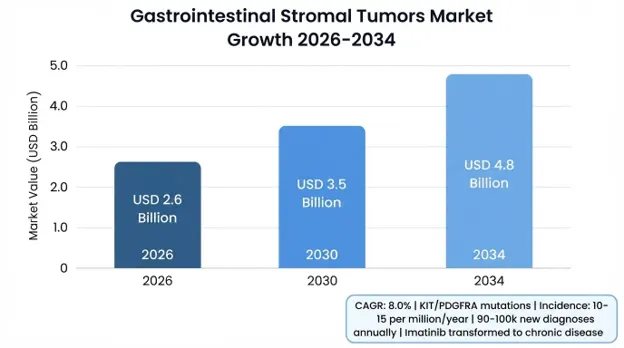
The GISTs are the most common mesenchymal neoplasms of the digestive tract and are derived from interstitial cells of Cajal or their precursor cells and, in almost all cases, are caused by gain-of-function mutations of receptor tyrosine kinase genes. Approximately 75-80% of tumors have activating mutations in the proto-oncogene KIT, 5-10% have activating mutations in the platelet-derived growth factor receptor alpha (PDGFRA) gene, and 10-15% are molecularly heterogeneous wild-type tumors, defined by succinate dehydrogenase (SDH) complex deficiency or mutations in the neurofibromatosis type 1 (NF1) gene or mutations in BRAF or other rare oncogenic drivers. They can occur along the entire gastrointestinal tract, with the stomach being the site of 60-70% of the primary lesions, the small intestine 20-30%, and the rectum, esophagus, and colon the remaining 10-20%. They range from small, incidental, indolent lesions to large, aggressive, metastatic tumors with a historically poor prognosis.
After the discovery that the KIT and PDGFRA are responsible for the constitutive activation in GIST, the therapeutic landscape of GIST changed dramatically in the early 2000s with the introduction of imatinib as the first molecularly targeted therapy for advanced GIST. In the metastatic setting, this one approval changed a malignancy with median survival of ~18-20 months to a medically manageable chronic disease, with median overall survival now being over 5 years for many patients receiving sequential targeted therapy. The structured, mutation-informed multi-line treatment algorithm for the last decade has been built on the back of subsequent approvals of sunitinib as a second-line therapy after imatinib resistance or intolerance, regorafenib as a third-line therapy and ripretinib as a broad-spectrum switch-control inhibitor for heavily pretreated disease, plus the recent approval of avapritinib as a mutation-selective agent for PDGFRA D842V-mutant tumors, with both remaining to continue to prolong patient survival and cumulative treatment durations.
The commercialization of GIST architecture is far beyond just the drug and includes a growing number of disease-specific diagnostic platforms, such as next-generation sequencing panels for primary and secondary mutations, emerging liquid biopsy technologies for non-invasive resistance monitoring, and immunohistochemical confirmation of disease with CD117 (KIT) and DOG1 markers. The global incidence of GIST is estimated to be 10-15 cases per million people per year, which equates to 90,000-100,000 new diagnoses of GIST worldwide each year, with a median age at diagnosis of 60-65 years. The increasing use of adjuvants with respected high-risk localized disease and its chronic, multi-line nature is still increasing the number of patients being treated and maintaining long-term therapeutic demand.
| Report Coverage | Details |
|---|---|
| Base Year | 2025 |
| Base Year Value | USD 2.4 billion |
| Forecast Value | USD 4.8 Billion |
| CAGR | 8.0% |
| Forecast Period | 2025-2034 |
| Historical Data | 2022-2025 |
| Largest Market | North America |
| Fastest Growing Market | Asia Pacific |
| Segments Covered | By Treatment Type, Line of Therapy, Mutation Type, Route of Administration, End-User, Region |
| Region Covered | North America, Europe, Asia Pacific, Middle East & Africa, Latin America |
| Countries Covered | US, Canada, Mexico, UK, Germany, France, Italy, Spain, China, Japan, India, Australia, South Korea, Brazil, Saudi Arabia, South Africa |
| Key Market Playes | Novartis AG, Pfizer Inc., Bayer AG, Blueprint Medicines, Deciphera Pharmaceuticals, Cogent Biosciences, Sun Pharmaceutical Industries |
Get more details on this report - Request Free Sample
The major growth factor for GISTs will be the increasing number of diagnosed patients through greater application of immunohistochemical and molecular diagnostic techniques. In the past, GISTs have often been incorrectly diagnosed as leiomyosarcomas or other spindle cell neoplasms owing to the lack of availability of CD117 and DOG1 stains, thus resulting in patients being treated using ineffective chemotherapy and not being considered candidates for targeted therapy. With the greater application of these diagnostic markers and reflex mutation tests in KIT exons 9, 11, 13, and 17 as well as PDGFRA exons 12, 14, and 18, there has been increased diagnostic accuracy and thus an increase in the number of patients that can be subjected to targeted therapy. The increasing numbers of elderly people worldwide further support this trend as GISTs occur in a median age range of 60-65 years.
The development of sequential GIST therapy from monotherapy to an algorithm involving at least four lines of drugs has significantly increased pharmaceutical expenses during the patient’s lifetime. Post-imatinib first line, the development of resistance through secondary mutations in the KIT and PDGFRA genes leads to the necessity to use sunitinib and regorafenib and then ripretinib as therapy for a more specific group of patients. The avapritinib that treats PDGFRA D842V mutant type of GIST, which is not responsive to imatinib, illustrates the fact that drug development based on mutations increases the number of patients who can be treated with the drug. Three years’ post-surgical adjuvant therapy with imatinib has become the standard of care in most guidelines-based healthcare systems for patients with high-risk GISTs.
The next-generation treatments, including regorafenib, ripretinib, and avapritinib, still maintain their high price, causing accessibility problems and reimbursement issues, although generic imatinib reduced costs in first-line therapy significantly in most regions after expiration of patent rights. In countries with a high level of income, the annual costs of next-line GIST treatments usually exceed $100,000. Health technology assessment agencies in many countries have put off or restricted reimbursement of new drugs until more reliable real-world data are acquired, particularly when the benefit in progression-free survival is counted in months rather than in years.
The effectiveness of avapritinib in PDGFRA D842V mutant GIST confirms the potential for achieving excellent clinical results and earning premium pricing for treatment that targets a specific mutation within a smaller subset of patients. This supports the research efforts toward the development of drugs for other resistant and hard-to-treat molecular subtypes of cancer, such as SDH-deficient GIST, which usually occurs in young people with multifocal stomach tumors who do not respond to the traditional treatments targeting KIT.
Platforms for liquid biopsies that allow for the detection of circulating tumor DNA are increasingly being used to non-invasively detect new resistance mutations in KIT and PDGFRA, providing insights into the tumor evolution process without having to undergo repeated biopsies. This method allows early detection of molecular changes prior to imaging changes and will help in the implementation of earlier treatment changes and is increasingly employed alongside imaging surveillance at specialized sarcoma centers.
Imatinib treatment before surgery is increasingly being used as a means of downstaging large and anatomically difficult to resect GISTs, especially in the stomach, rectum, and esophagus, thus allowing a less invasive approach during surgery. Increasing data from prospective studies and multidisciplinary tumor boards, this preoperative approach is expected to become increasingly common, increasing the duration and scope of TKIs in early-stage GISTs.
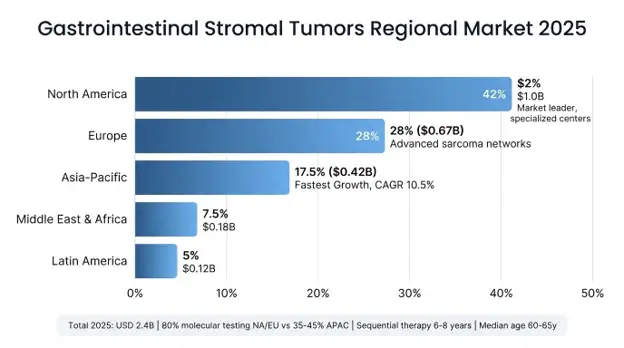
North America emerged as the biggest regional market, worth an estimated USD 1.0 billion in 2025, which is expected to maintain its position in the forecast period of 2025-2034 at a CAGR of 7.8%. Regional dominance is attributed to the availability of highly specialized sarcoma and oncology centers, high rates of molecular diagnosis, and insurance/Medicare coverage allowing access to all available therapeutic regimens due to premium pricing of new drugs. A large percentage of the regional revenue comes from the United States due to advanced clinical trial setup and orphan drug programs facilitating the development of novel therapies for GIST patients.
The Asia Pacific region is expected to witness the highest growth rate with revenues of about USD 420 million in 2025, with growth at a CAGR of nearly 10.5% during 2026–2034. The growth can be attributed to increasing capacity in molecular pathology tests in China, Japan, South Korea, and India, increasing investments in cancer care infrastructure, and the development of government initiatives to enhance access to targeted drugs. China contributes significantly to the value of the region with extensive availability of generics of imatinib and progressive approvals of later lines of agents; meanwhile, Japan has demonstrated advanced management of GISTs, based on guidelines and with extensive testing and insurance coverage.
Europe, Latin America, and the Middle East & Africa together constitute the remaining part of the market with advanced research of sarcomas in Western Europe and improved diagnostics and therapies in emerging nations.
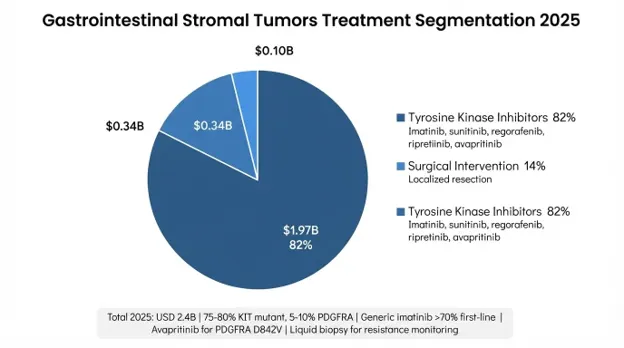
Treatment Type Insights: Tyrosine Kinase Inhibitors lead the market, capturing most of the revenue based on the near-ubiquitous reliance of GIST tumorigenesis on abnormal signaling through KIT and PDGFRA. Surgery is the definitive treatment for localized cancer but does not provide repeat revenue through medicines. Chemotherapy and radiotherapy have very little role to play, as the tumor shows resistance to these treatments.
Line of Therapy Insights: First-line therapy is the biggest market in terms of share, driven by the large patient pool that begins imatinib therapy, whereas third line and beyond is the fastest-growing segment due to better survival rates.
Mutation Type Insights: KIT-mutated GIST constitutes the largest group; however, the high positioning of avapritinib results in PDGFRA-mutated GIST earning significantly more money on a per-patient basis. The smallest types of GIST, wild-type and SDH-deficient, have shown the fastest growth due to the advancements in diagnosis.
End-User Insights: Hospital and comprehensive cancer center segments emerge as the major end-user segments due to the presence of complex decision-making regarding diagnosis and treatment, while specialty oncology clinic segments are the fast-growing ones due to TKI management in such settings.
The global GIST market is moderately to highly concentrated, with a small number of pharmaceutical companies controlling the majority of revenue through established and next-generation targeted therapies. Competitive differentiation centers on breadth of mutation coverage, depth of long-term survival and safety data, guideline positioning, and relationships with specialized sarcoma treatment centers. Specialized oncology companies such as Blueprint Medicines and Deciphera Pharmaceuticals compete effectively against larger diversified pharmaceutical companies through focused molecular expertise and agile clinical development, while generic manufacturers play an increasingly important role in expanding first-line access in price-sensitive markets.
March 2026: Blueprint Medicines completed Phase III trials in the adjuvant setting for highly regarded PDGFRA D842V-mutant GIST, where top-line results are expected by 2027.
February 2026: Deciphera Pharmaceuticals showed extended real-world data in favor of ripretinib in fourth line and beyond metastatic GIST, thereby solidifying its position as the gold standard switch-control inhibitor for pretreated GIST patients.
January 2026: Cogent Biosciences disclosed new Phase II results from its ongoing trial for bezuclastinib in PDGFRA D842V-mutant GIST, exhibiting durable responses and good tolerability, making bezuclastinib a prospective competitor for avapritinib in the future.
December 2025: Bayer AG moved a new generation KIT/PDGFRA inhibitor towards clinical trials, focusing on the activity against secondary mutations in exons 17 and 18 after imatinib and sunitinib treatment.
You'll get the sample you asked for by email. Remember to check your spam folder as well. If you have any further questions or require additional assistance, feel free to let us know via-
+1 724 648 0810 +91 976 407 9503 sales@intellectualmarketinsights.com
22 Aug 2026
Intellectual Market Insights Research © 2026. All rights reserved.