Share this link via:

The global Gaucher disease market size was valued at USD 1.9 billion in 2025 and is projected to reach USD 2.05 billion in 2026, expanding to USD 3.4 billion by 2034, growing at a CAGR of 6.5% during the forecast period (2026-2034).
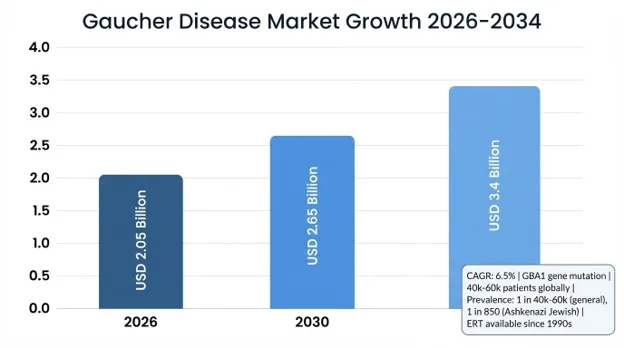
Gaucher disease is a rare autosomal recessive lysosomal storage disease due to biallelic mutations in the gene GBA1, which encodes the enzyme glucocerebrosidase (acid beta-glucosidase). The resulting enzymatic defect results in progressive storage of the glycolipid glucosylceramide in the lysosomes of cells of macrophage lineage and the accumulation of “Gaucher cells” in the spleen, liver, bone marrow, and, in the neuronopathic forms, CNS. Clinical symptoms typically include hepatosplenomegaly, anemia, thrombocytopenia, chronic bone pain, osteopenia, avascular necrosis, pathological fractures, and growth retardation in children who are affected, with severe phenotypes characterized by progressive neurological deterioration. The disease is divided into 3 major subcategories: Type 1, the non-neuronopathic form (about 90-95% of the diagnosed cases); Type 2, the acute neuronopathic form (diagnosed in infancy, rapid neurodegeneration); and Type 3, the chronic neuronopathic form (slow, progressive neurological disease, plus visceral disease).
Since the early 1990s, the therapeutic landscape has changed with the introduction of enzyme replacement therapy (ERT) using imiglucerase, a recombinant enzyme, which replaces the placental-derived enzyme alglucerase and has replaced intravenous infusion every week in the treatment of Type 1 disease and systemic disease in Type 3 disease. ERT gives very good results in terms of organomegaly, hematologic abnormalities, and skeletal outcomes, but the large recombinant protein fails to cross the blood-brain barrier, and neurological symptoms in patients with neuronopathic conditions are not well addressed. The next step was approval of oral substrate reduction therapy (SRT) consisting of the two drugs miglustat and eliglustat, which are both inhibitors of glucosylceramide synthase (GALCST). For adult patients who can use the drugs, an alternative to lifelong infusion, this proved to be a more convenient option.
Beyond the small, diagnosed population of 40,000–60,000 patients worldwide, high per-patient treatment costs and the lifelong treatment needs create a high-value concentrated orphan drug market. The wider context includes specialized lysosomal storage disorder centers; genetic counseling and genetic screening; biomarker monitoring platforms, including chitotriosidase and glucosylsphingosine (lyso-Gb1); and the International Collaborative Gaucher Group Registry, which has been monitoring thousands of patients in dozens of countries for more than 30 years. In Ashkenazi Jews, the incidence of the disease is approximately 1 per 850 to 1,000 live births in the population, whereas the general population prevalence is 1 per 40,000 to 60,000. A higher prevalence of the disease than in the general population is seen, with the Ashkenazi Jewish population having a carrier frequency of 1 in 15 and a disease incidence of approximately 1 in 850 to 1,000 live births. The scientific interest of the GBA1 pathway has increased steadily over the years, with solid evidence showing that heterozygous mutations of GBA1 increase the risk of developing Parkinson's disease, leading to increased investment in glucocerebrosidase-targeted therapeutics across the neuroscience community that could have an impact on the Gaucher disease pipeline. In the future, gene therapy and chaperone and CNS-penetrant substrate reduction agents will drive the treatment paradigm, especially within the group of neuronopathic patients for whom effective disease-modifying therapy is not currently available.
| Report Coverage | Details |
|---|---|
| Base Year | 2025 |
| Base Year Value | USD 1.9 Billion |
| Forecast Value | USD 3.4 billion |
| CAGR | 6.5% |
| Forecast Period | 2025-2034 |
| Historical Data | 2022-2025 |
| Largest Market | North America |
| Fastest Growing Market | Asia Pacific |
| Segments Covered | By Disease Type, Treatment Type, Route of Administration, End-User |
| Region Covered | North America, Europe, Asia Pacific, Middle East & Africa, Latin America |
| Countries Covered | US, Canada, Germany, UK, France, Italy, Spain, Israel, Japan, China, India, South Korea, Brazil, UAE, Saudi Arabia |
| Key Market Playes | Sanofi, Takeda, Pfizer, Protalix BioTherapeutics, Johnson & Johnson (Actelion), and Prevail Therapeutics (Eli Lilly) |
Get more details on this report - Request Free Sample
Gaucher disease has been significantly under-diagnosed in the past owing to its heterogeneity in clinical presentation. Patients were usually initially assessed by hematologists, orthopedists, or hepatologists based on individual symptoms, such as splenomegaly, thrombocytopenia, or pain in the bones. In many cases, diagnosis was delayed for several years to more than a decade in locations where there is no system in place for referral for rare diseases. With the increased use of dried blood spot enzyme assays to measure the glucocerebrosidase levels, as well as GBA1 mutation testing, the time taken to diagnose the condition has been greatly reduced. Programs for newborn screening, which include Gaucher disease together with other lysosomal storage disorders, have already been launched or trialed in various US states, Taiwan, and Israel, while carrier screening in populations at risk has identified affected individuals before the onset of symptoms.
Gaucher disease still stands out as one of the prototypical examples of an orphan indication that has greatly benefited from regulatory mechanisms that have been put in place to foster the development of drugs for rare diseases, such as the extended market exclusivity of seven years in the US and ten years in the EU, among others like reduced fees for development and tax credits that cover the huge expenses associated with manufacturing and post-market surveillance. National rare disease funds, high-cost drug budgets, and compassionate use programs in North America, Western Europe, and Israel still facilitate coverage of both ERTs and SRTs.
High cost of lifelong treatment represents the biggest hurdle in Gaucher disease market growth, as annual expenditure on enzyme replacement therapy treatment per patient in the adult category typically amounts to USD 150,000-300,000 depending on body weight and dosage, while overall lifetime cost of treatment in case of starting from childhood could be measured in millions of dollars. Such cost is a heavy burden for healthcare budgets in even developed nations and frequently goes beyond the sustainable level of financing by health insurance schemes in medium- and low-income territories, resulting in denial of treatment to many people diagnosed with this disorder in Eastern Europe, Latin America, and certain Asian and African countries. Several European health markets have recently become stricter in relation to the cost-effectiveness of therapies and now require confidential price reductions or managed entry agreements prior to reimbursement decision-making.
Most revolutionary in the Gaucher market would be gene therapy techniques that offer a possibility of long-term, possibly even permanent, correction of the glucocerebrosidase deficiency via a one-off treatment, thus challenging the existing model of the chronic therapy, which generates recurring enzyme replacement and substrate reduction therapy revenue streams. Ex vivo strategies include obtaining the patient’s hematopoietic stem cells, transducing them with the functional GBA1 gene via lentivirus, and re-injecting them after the conditioning procedure is completed. In addition, in vivo adeno-associated virus vector-based therapy is under research for treatment of neuronopathic type 2-type 3 Gaucher disease when there is no neurological improvement from enzyme replacement therapy. High pricing potential of a one-time therapy in combination with a relatively large market size justifies the high potential of such drugs.
Gaucher disease management is currently evolving towards the use of home infusion for patients on stable enzyme replacement therapy. This development is especially prevalent in North America and Western Europe, as specialized pharmacy companies and home infusion companies have been able to provide for the administration of biologics beyond hospital settings. Treatment choices are also being personalized with considerations made for the genotype, metabolizing status of cytochrome P450 2D6, level of severity, and patient’s lifestyle choices, thanks to the existing real-world data from patient registries that have existed internationally for many years.
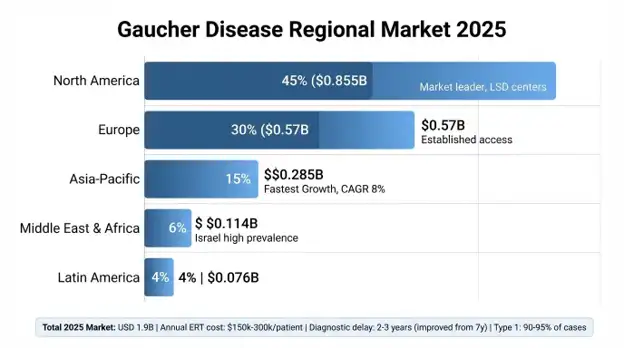
North America is the largest regional market with a market valuation of around USD 855 million in 2025, expected to rise to a CAGR of around 6.3% up to 2034. This market leadership will be based on focused expertise available at specialized lysosomal storage disorder centers in leading academic medical institutions, insurance coverage via Medicare and other insurance providers, and the availability of the largest Ashkenazi Jewish community, apart from Israel. The United States is the primary contributor to the regional market revenue, aided by the availability of incentives for orphan drugs, including market exclusivity and newborn screening programs.
Europe is the second largest market, worth an estimated USD 570 million in 2025, where western European nations such as Germany, France, the United Kingdom, Italy, and the Netherlands have well-organized centers of expertise and reimbursement for enzyme replacement and substrate reduction therapy. The European Reference Networks (ERNs) for rare metabolic disorders enable information exchange across borders, although differences still exist between the Western and Eastern member states. The per capita prevalence rate of Gaucher’s disease is the highest in Israel, along with complete national health insurance coverage.
The Asia Pacific market, estimated at around USD 285 million in 2025, is expected to register the highest regional CAGR of 8% between 2026 and 2034 on account of increasing diagnosis infrastructure for rare diseases, gradual incorporation of expensive orphan drugs into national insurance programs of countries like China, Japan, and South Korea, and increased awareness among doctors regarding lysosomal storage disorders. Japan possesses relatively advanced insurance coverage and diagnostic systems, whereas China can offer significant growth potential in the future owing to its large population size despite being an underdiagnosed market.
The markets in the Middle East, Africa, and Latin America, together, comprise the balance of world revenues, with access to therapy being limited to certain urban tertiary centers due to the involvement of both government health services and private insurance and manufacturers' patient assistance programs. Slow but steady progress in developing laboratory facilities for diagnosis and policies related to rare diseases is expected to fuel modest growth in diagnosed and treated patients during the forecast period.
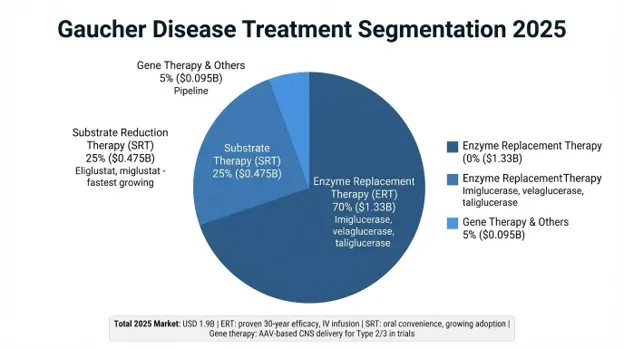
Enzyme replacement therapy is the leading type of therapy, capturing more than 70% of the market share, worth approximately USD 1.33 billion in 2025, owing to its proven success for three decades in terms of safety and effectiveness via the use of international registries. The therapy involves three kinds of approved therapies that include imiglucerase, velaglucerase alfa, and taliglucerase alfa, which differ in terms of the platform and glycosylation of the product. The substrate reduction therapy, worth USD 475 million, or 25% of the market value, is the fastest-growing market segment as patients prefer the oral delivery method.
The market value of type 1 Gaucher disease treatment comprises the vast majority, more than 90% of total revenue, due to the greater frequency of the disease and the presence of an effective treatment for its mostly visceral and hematology-related symptoms. Type 3 disease is a smaller yet significant part, where the symptoms of the system are treatable via enzyme replacement, while there is little done for the progressing neurology-related symptoms. Type 2 Gaucher disease has almost no significance in the pharmaceutical market value.
The dominance of the intravenous mode of administration comes from its approximately 72% share of market revenue because of the proven efficacy of ERT, whereas the oral mode of administration captures the remaining percentage of the market using substrate reduction therapy and constitutes the fastest-growing one owing to the growing popularity of eliglustat. Hospitals and specialized clinics continue to be the most common end users owing to the need for an intravenous mode of administration and the presence of diagnostic and multidisciplinary facilities at the specialized LSD centers, whereas home healthcare constitutes the fastest-growing end user owing to the increasing number of stable patients receiving home infusion.
The global Gaucher disease market is still relatively concentrated, with a few leading pharma players capturing a large market share due to their franchise of enzyme replacement therapy products and close ties with the worldwide lysosomal storage disorder expert community. Sanofi continues to hold the leadership position within the Gaucher market segment via the Genzyme franchise, including both imiglucerase and eliglustat, as well as through the large number of patients involved within the International Collaborative Gaucher Group Registry. Takeda and Pfizer also occupy important market positions via their own velaglucerase alfa and taliglucerase alfa, respectively; each player has its own manufacturing platform and infrastructure of patient support services.
You'll get the sample you asked for by email. Remember to check your spam folder as well. If you have any further questions or require additional assistance, feel free to let us know via-
+1 724 648 0810 +91 976 407 9503 sales@intellectualmarketinsights.com
22 Aug 2026
Intellectual Market Insights Research © 2026. All rights reserved.