Share this link via:

Valued at USD 44.8 million in 2025 and expected to grow to USD 48.6 million in 2026, the global Gerstmann-Strussler-Scheinker (GSS) syndrome market is projected to expand to approximately USD 98.3 million by 2034, growing at a CAGR of 9.2% during the forecast period (2026-2034). One of the rarest inherited neurodegenerative disorders ever described in scientific literature, GSS is relatively unique in the space of ultra-rare and orphan diseases where market value generation derives more from the provision of care services as opposed to volumes of drugs supplied, as well as a rising number of investigative, disease-altering drugs whose value proposition transcends those that might currently use them. Overview of Gerstmann-Strussler-Scheinker syndrome (GSS).
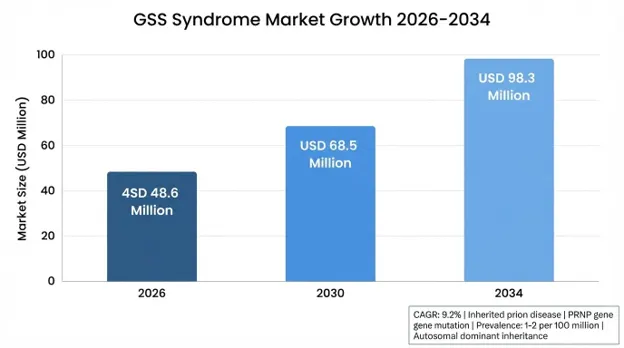
A GSS syndrome is an inherited, typically fatal, prion disease that begins with one patient and is passed from generation to generation by autosomal dominant inheritance.
A hallmark mutation in this disorder is one involving a change in a gene that provides instructions to make a protein called "PRNP." It was first identified in 1936 by Josef Gerstmann, Ernst Strüßler, and Ilya Scheinker in an Austrian kindred. Other transmissible spongiform encephalopathies like CJD (Creutzfeldt-Jakob disease), FFI (fatal familial insomnia), and Kuru all create similar clinical diseases but often present more rapidly than those experienced by patients suffering with GSS, where the disease duration generally runs two years to ten years with cerebellar ataxia, dysarthria, and ambulatory difficulty presenting with diverse symptom onset from the start and late-onset (relative to disease onset) memory and cognition impairment present at some time during the GSS illness. Among the more than thirty different PRNP genetic mutations that will manifest as GSS, the most prevalent found around the world is P102L, with patients' particular mutations presenting in different-to-highly-different ways and with varied durations.
When this occurs, disease often spreads across the cell to neighbor brain cells; the result is cell destruction in many regions of the brain, ultimately leading to brain death.
At a very approximate rate of incidence on Earth, some 1 per several hundred people at the same time develop GSS; other thousands of individuals test positively for these mutations, even if the person is never diagnosed symptomatically for the disorder, as these positive genetic results cascade and alert loved ones or clinicians to the diagnosis and to genetically relevant blood tests or saliva tests to inform family members. No approved therapy to treat GSS exists. Antispasm drugs that offer a solution to brain hypertonicity; antiseizure medicine such as anticonvulsants for individuals showing their characteristic movements; mood stabilizers to address behavioral issues; and a regimen of comprehensive physical, occupational, and speech therapy are the only treatments available today to enhance function for years in an individual with GSS syndrome.
State-of-the-art imaging of the brain, analysis of the cerebrospinal fluid (CSF), and gene sequencing are, therefore, increasingly becoming valuable to physician teams caring for persons affected with the brain disorder known as GSS syndrome due to growing awareness and use of next-generation sequencing. The value of the market for this indication extends far beyond the patients. GSS is extremely rare, an inherited disease that causes brain death in approximately 1/10,000,000 people annually, so overall globally there are a few hundred individuals affected with the GSS disorder simultaneously in any 12-month period. Another thousand-plus people may test positively for an established GSS mutation via the familial screening cascade in response to another individual in the family who manifests GSS or a spouse/parent with a history of this uncommon neurological disorder to know that individual is at risk.
Even for very small patient numbers, orphan drug status has proved attractive in many markets: the EU has a lengthy list of special designations and incentives (as per the orphan drug directives) and long periods of ultra-rare orphan drug patent protection that effectively incentivize companies for their investments.
That is often sufficient, along with any unique opportunity that a rare neurological disease presents to market itself as having significant strategic importance for certain indications, as seen where a GSS indication, the common neuro-inflammatory pathology (a protein misfolding or templating of folded protein misfolding is observed for other diseases, as seen in the shingles virus-associated PD and others with dementia), will generate a new class of drugs that would have broad potential appeal and future indications for other neurological diseases, as is observed in some patients diagnosed with PD, some individuals affected with dementia, some patients with PD, and in other neurodegenerative diseases, and with these newer developments, some companies will seek to establish a niche in the market through which other opportunities may follow to gain the future.
| Report Coverage | Details |
|---|---|
| Base Year | 2025 |
| Base Year Value | USD 44.8 Million |
| Forecast Value | USD 98.3 Million |
| CAGR | 9.2% |
| Forecast Period | 2025-2034 |
| Historical Data | 2022-2025 |
| Largest Market | North America |
| Fastest Growing Market | Europe |
| Segments Covered | By Treatment Type, Diagnostic Modality, Therapeutic Approach, End-User, Region |
| Region Covered | North America, Europe, Asia Pacific, Middle East & Africa, Latin America |
| Countries Covered | US, Canada, UK, Germany, France, Italy, Spain, Japan, China, South Korea, Australia, Brazil, UAE |
| Key Market Playes | Ionis Pharmaceuticals, Broad Institute (Prion Alliance), MRC Prion Unit (UCL), Alnylam Pharmaceuticals, Centogene N.V., Quest Diagnostics, Labcorp |
Get more details on this report - Request Free Sample
There has long been underdiagnosis of GSS, and cases are often mistakenly diagnosed as heritable spinocerebellar ataxia, atypical dementia, or multi-system atrophy; only the definitive diagnosis is often confirmed postmortem. In parallel with increasing accessibility to PRNP sequencing as it is being increasingly adopted onto multi-gene neurogenetic panels for progressive ataxia and early-onset dementia as costs of next-generation sequencing reduce, antenatal diagnostic rates are substantially improving, as are those for identified at-risk family members through cascade testing. Growing identified at-risk genetic populations are now well-established and will be crucial both for the practical operation of clinical trials and for potential commercialization of treatments.
The US Orphan Drug Act, which guarantees seven years of market exclusivity, and the European Union's orphan designation status, which grants ten years of market exclusivity with significantly reduced regulatory costs, combined with easier access to scientists and regulatory support, actually make the development of drugs fighting the ultra-rare prion disorders economically feasible even in the face of tiny numbers of patients. One could actually cite regulation for facilitating actual translational work; for example, a recent public–private partnership of the Broad Institute's Prion Alliance with antisense tech specialist Ionis Pharmaceuticals is examining the approach of a gene therapy (in particular, an antisense oligonucleotide) targeting the GSS disorders. As the two organizations have each stated, they have taken a "mutation-agnostic" approach, which could effectively target the numerous mutated PRNP alleles giving rise to GSS and other genetic prion disorders to target the production of the prion protein.
As very few are new, this indicates that where a formal diagnosis is issued each year globally, it is highly unlikely to start the traditional RCT study designs with the need for a large and powerful study cohort. Sponsors have continued to find more ways to take advantage of natural history controls and smaller cohorts of subject size more accurately and to create new strategies for the use of the new cohort, such as a multinational concurrent study larger in size or a study with an adaptive design using multi-sites, thereby creating additional regulatory and technical/translation challenges. It adds to the duration and the development costs more than for a standard neurologist-treated disorder in its indications.
No treatment currently exists yet that is proven disease-modifying that can be approved by regulators, and more importantly, there is no validated surrogate biomarker that can measure or reflect efficacy and meaningful change in clinical endpoints over a relevant period of time, which makes the use of ultra-long-and-difficult-to-measure endpoints like survival or progression essential for therapy development, health-tech evaluation, or to secure reimbursement.
Since GSS is autosomal dominant, any first-degree relative has a 50 percent chance of being a carrier. Cascade genetic testing has identified a progressively greater number of heterozygotes for a PRNP gene mutation who currently have a significant probability of becoming GSS-affected individuals in the future and who are all receiving clinical genetics care and routine neurologic care. These patients may be a substantially larger population, available to testing if a trial incorporating the principles under evaluation in familial Alzheimer's genetic testing research becomes feasible.
Most far more typical neurodegeneration conditions—Alzheimer's, Parkinson's, and multiple system atrophy—have a prion-like spread of proteins, which indicates that these are instantly addressable with anti-prion therapies such as GSS-attacking therapeutics (such as, for example, an anti-prion-dropping antisense oligonucleotide or possibly a little chemical that stabilizes the typical protein). Therapeutics toward GSS may have some business opportunities, ultimately leveraging GSS-related understanding into the bigger, significantly more considerable neurodegeneration firm space,” stated some kind of information release on the basis of earlier groundwork in health and safety regulators and markers, as this kind eventually made an attempt to leverage their insights.
Antisense Oligonucleotide and Gene-Silencing Therapeutics: 2. Intrathecal Administration of PRNP-targeting antisense oligonucleotides to reduce entire CNS total PrP—This strategy offers the highest scientific potential currently in development for GSS. In this approach, a therapy can actually act upon the substrate of misfolding, rather than mutation-targeting strategies, so a single drug could potentially treat all reported PRNP mutations resulting in GSS disease. At the same time international natural history registries for the natural history of the disease involving the clinical, genetic, and biomarker information are actively underway, either led by groups such as the CJD Foundation or initiated within academic prion surveillance networks that could be helpful to inform development and regulatory considerations, especially for presymptomatic treatments.
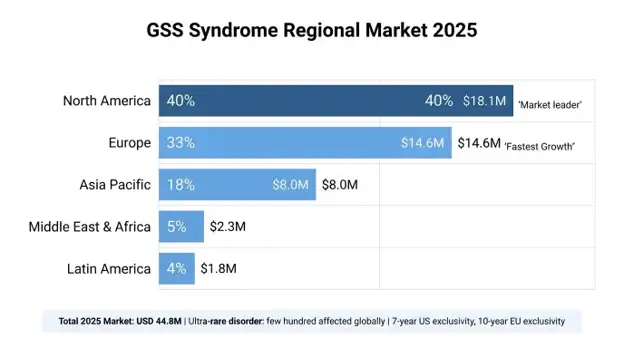
North America constitutes the leading regional market; In 2025 the market in North America is projected to reach USD 18.1M (supported by concentration of expertise in prion diseases at academic medical centers, National Prion Disease Pathology Surveillance Center, and existing long-term collaborative relationship with Prion Watch; availability of effective and expedited orphan drug regulatory incentives; mature and accessible patient advocacy network with an established patient base to fuel translational research programs, including antisense oligonucleotide development, etc.). As a result of all factors previously addressed. In 2025 the European market is projected at USD 14.6M and is poised to emerge as the fastest-growing regional market over the forecast period (supported by, for example, coordination of national prion surveillance units among a number of European countries (e.g.
The United Kingdom, Germany, France, and Italy have a long history of the established network of European surveillance for Creutzfeldt-Jakob disease, which can readily synchronize multi-country data collection, and a long 10-year period of market exclusivity for approved drugs as an orphan product. The combined Asian Pacific, Middle Eastern and African, and Latin American markets account for the balance worth approximately USD 12.1M in 2025 (supported by increased reach to readily available genetic tests within all those regions in an ongoing fashion; increase in consciousness at the university academic neurology groups in Asia, particularly China and Japan; and persistent ongoing necessity for collaboration between local institutions and North America as well as the EU reference centers for laboratory testing, patient inclusion, and studies).
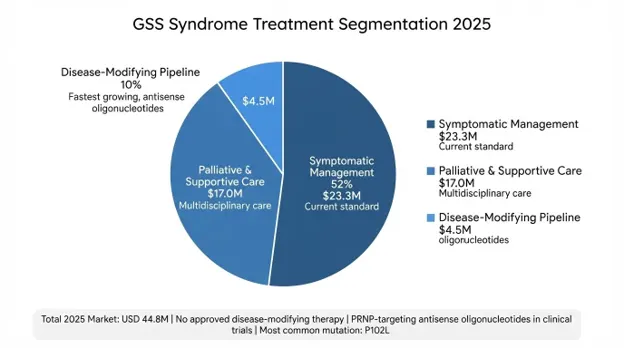
Symptomatic Management and Palliative & Supportive Care now an extremely unbalanced proportion of current market size is a very large section owing to the complete lack of an approved disease-modifying therapy, a fact which has spawned a market sector supporting physiotherapy, speech and swallowing therapy, neuropsychiatric therapy, and palliative and end-of-life care. Disease-Modifying Pipeline Therapies small, yet swiftly expanding due to the rise of clinical activity and compassionate use of available unapproved anti-prion agents are expected to experience rapid growth after approval and following of the first such entities.
The diagnostic segment with the largest area comprises the Gene Testing / PRNP Testing and is explained by increased utilization of neurogenetic panels and cascade testing of relatives at risk. MRI imaging and CSF biomarker analysis, especially RT-QuIC assay testing and 14-3-3 protein testing, have definitive suggestive diagnostic value; however, diagnostic sensitivity and specificity as against sporadic CJD are lower, validating Gene Testing the confirmatory modality. EEG and brain biopsy are reserved for specific time points and confirmed posthumously, respectively.
Competitive forces for the GSS market resemble an emergence-stage market because there are currently no effective disease modifiers. Pipeline prioritization (within prion protein-reducing platforms specifically) has been a more important competitive force in GSS than other fields; this ordering has, until most recently, been led by positioning concerning the IP around centralized nervous system (CNS) penetration technologies; strategic alliances between the company/universities with prions experts and subsequent characterization and proprietary ownership/access to patients; and the importance of a scientific team where evidence is through refereed publications as opposed to typical assessment of relative market share. Competitive elements relevant for diagnostics concern the speed at which testing is completed, the variety of tests, and the sophistication of counselors’ service.
You'll get the sample you asked for by email. Remember to check your spam folder as well. If you have any further questions or require additional assistance, feel free to let us know via-
+1 724 648 0810 +91 976 407 9503 sales@intellectualmarketinsights.com
24 Aug 2026
Intellectual Market Insights Research © 2026. All rights reserved.