Share this link via:

The global Gitelman syndrome market was valued at USD 286.4 million in 2025 and is projected to reach USD 309.9 million in 2026, expanding to approximately USD 582.2 million by 2034, growing at a CAGR of 8.2% during the forecast period (2026-2034).
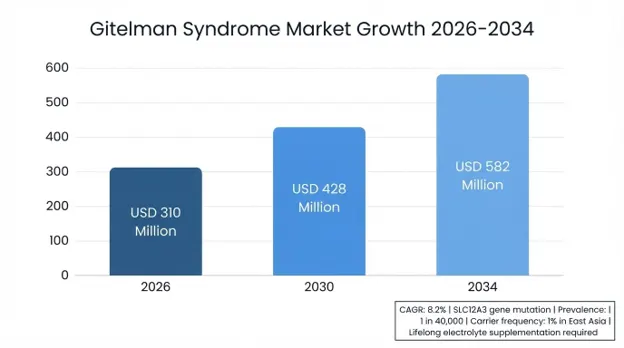
Gitelman syndrome is an inherited renal tubular disorder with autosomal recessive inheritance, resulting from mutations that cause loss of function of the thiazide-sensitive sodium-chloride cotransporter (NCC) in the apical membrane of the distal convoluted tubule of the nephron. The disorder was first described by Hillel Jonathan Gitelman in 1966 as a clinically separate entity characterized by hypokalemic metabolic alkalosis, hypomagnesemia, and hypocalciuria and was subsequently differentiated from the closely related Bartter syndrome on biochemical and molecular levels; SLC12A3 has since been identified as the causative gene in 1996. The syndrome's biochemical signature is due to impaired sodium and chloride reabsorption in the distal convoluted tubule, which leads to compensatory activation of the renin-angiotensin-aldosterone system and to urinary potassium and hydrogen ion wasting.
Based on a global prevalence of approximately 1 in 40,000 individuals, Gitelman syndrome is one of the more prevalent inherited renal tubulopathies, although population genetic studies suggest that the prevalence of heterozygous carriers of SLC12A3 may be as high as 1 percent in some populations, particularly parts of East Asia, leading to significant underdiagnosis of homozygous and compound heterozygous cases worldwide. Clinical features are usually apparent in late childhood or early adulthood and may include a mild electrolyte abnormality incidentally diagnosed or more severe features such as fatigue, muscle weakness, muscle cramps, salt craving, tetany, cardiac arrhythmias caused by hypokalemia, and growth retardation in affected children and chondrocalcinosis in many cases of longstanding disease. The blood pressure is usually low normal, and the diagnosis is often delayed for years since non-specific symptoms are often confused with eating disorders, chronic fatigue, diuretic abuse, and/or functional complaints.
In contrast to many other serious inherited neurodegenerative and metabolic diseases, Gitelman syndrome has a normal or near-normal life expectancy, and affected people need lifelong, continuous therapy, not just treatment for a few years. There is no known cure or disease-modifying drug; treatment is purely symptomatic and generally consists of chronic oral magnesium and potassium supplements, frequently combined with RAAS inhibitors, NSAIDs, or potassium-sparing diuretics if supplementation is not enough or is poorly tolerated. The product thus establishes a unique market dynamic, namely one that is driven by high-volume, low-cost generic electrolyte products, rather than costly high-value biologics with the incremental value of gastrointestinal-tolerable sustained release products, growing molecular diagnostics and specialist nephrology follow-up, and early, but scientifically convincing, pipeline of mutation-targeted therapeutics.
| Report Coverage | Details |
|---|---|
| Base Year | 2025 |
| Base Year Value | USD 286.4 Million |
| Forecast Value | USD 582.2 Million |
| CAGR | 8.2% |
| Forecast Period | 2025-2034 |
| Historical Data | 2022-2025 |
| Largest Market | North America |
| Fastest Growing Market | Asia Pacific |
| Segments Covered | By Treatment Type, Diagnostic Modality, Route of Administration, End-User, Region |
| Region Covered | North America, Europe, Asia Pacific, Middle East & Africa, Latin America |
| Countries Covered | US, Canada, UK, Germany, France, Italy, Spain, Japan, China, South Korea, Australia, Brazil, UAE |
| Key Market Playes | Advicenne SA, Recordati Rare Diseases, Teva Pharmaceutical Industries, Viatris Inc., Sandoz Group AG, Centogene N.V., Invitae Corporation, Quest Diagnostics, Labcorp |
Get more details on this report - Request Free Sample
Market growth is mainly attributed to the growing use of next-generation sequencing panels in the clinical practice of nephrologists that has resulted in the diagnosis of Gitelman syndrome changing from one that involves excluding other conditions to one that involves rapid SLC12A3 gene sequencing. In the past, non-specific features and preserved kidney function resulted in the misdiagnosis of the syndrome among patients with diuretic abuse, eating disorders, and primary aldosteronism for many years.
Since electrolyte losses are unending and constant because of the inherent tubular defect, the need for lifelong supplementation is guaranteed, thereby creating a regular flow of income for the makers of potassium and magnesium supplements. The primary mover in this market is the consistent efforts by drug developers to create more palatable formulations of sustained release and organic salts.
A considerable proportion of individuals suffering from this condition remain unrecognized due to vague symptoms, intermittently normalized electrolytes, and inadequate knowledge of inherited tubulopathies among clinicians, particularly in developing countries where there is no availability of genetic testing facilities. As a result, the pool of genetically confirmed patients available for participation in clinical trials becomes limited, and a delay in diagnosis occurs until adulthood.
Diarrhea and abdominal pain are common consequences of the high pill intake per day and the osmotic laxative action of the magnesium and potassium salts, resulting in underdosing and repeated episodes of symptoms of hypokalemia/hypomagnesemia, which may require expensive rescue intravenous administration. Furthermore, even though improved-tolerance formulas are not always reimbursable, and due to the lack of an FDA-approved DMARD, some payers regard GS as a condition that is relatively easy to manage without high-cost treatments.
A relatively large fraction of missense mutations in SLC12A3 responsible for Gitelman syndrome led to folding and degradation of the cotransporter protein in the absence of its arrival at the cell surface. The preclinical discovery of small-molecule chaperones able to rescue the transport and activity of the mutant protein, combined with the emerging knowledge about the regulatory kinase cascade of the WNK-SPAK/OSR1 signaling pathway, which regulates cotransporter function, suggests an approach for disease modification that can be compared with CFTR modulation in cystic fibrosis.
The most significant advance in terms of clinical development within the area is the prolonged-release oral medication, ADV7103, manufactured by Advicenne SA, which consists of both potassium citrate and bicarbonate and is aimed at ensuring a gradual supply of electrolytes and minimizing the pronounced peak-and-trough effect associated with ordinary formulations. This medication is available as an orphan drug in Europe and the US, indicated for Gitelman and Bartter syndrome, and constitutes the first purpose-specific medication for this disease. At the same time, there has already been some progress regarding digital symptom tracking apps and remote biochemical monitoring tools among specialized centers.
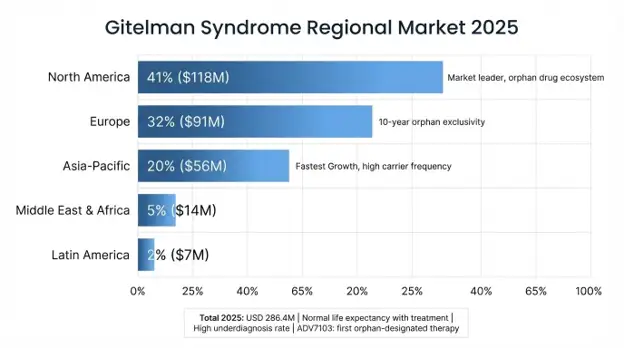
The North American region is the leading market, accounting for USD 118.2 million in 2025, about the well-established nephrology subspecialty infrastructure, wide insurance coverage for genetic testing, and a mature orphan drug regulatory ecosystem, which has been more conducive to investigational designations for Gitelman-related drugs.
Rare kidney disease surveillance is coordinated via European reference networks that connect clinical centers from different countries, and it was estimated to be worth around USD 91.4 million in Europe in 2025, with France, Italy, Germany, and the Netherlands having the most active clinical research programs and a 10-year ‘orphan exclusivity' period for further development.
Growth in the region is driven by the proportion of SLC12A3 carriers in the Japanese, Chinese, and South Korean populations, which are particularly high; the expansion of genetic testing facilities; and the increasing recognition of Gitelman syndrome by clinicians as a major cause of inherited hypokalemia in the region, as the Asia Pacific is expected to reach a value of roughly USD 56.3 million in 2025.
The remaining USD 20.5 million (10%) is in the Middle East & Africa and Latin America, where there is still limited specialist nephrology capacity and most cases are diagnosed by biochemical diagnosis, although there are some initiatives in place to improve case ascertainment through partnerships with international reference laboratories.
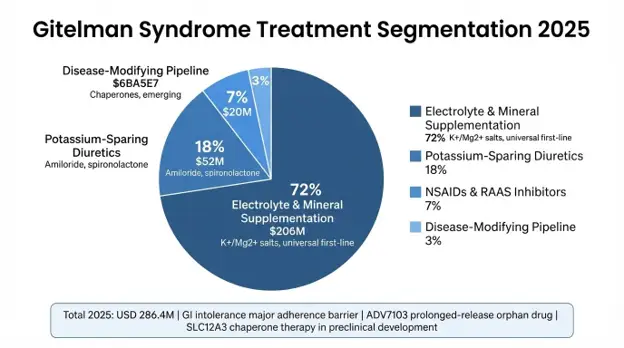
Treatment Type Insights: The Electrolyte & Mineral Supplementation segment occupies the largest share of the treatment market, as it is the universal first-line therapy for all the patients diagnosed with the disease. Potassium-sparing diuretics (amiloride and spironolactone) are the most popular supplementary drugs, whereas NSAIDs and RAAS inhibitors take the supportive position to a lesser extent. The disease-modifying pipeline therapies constitute a relatively minor but quickly growing segment that will deliver disproportional growth with the development of chaperones and molecular targets.
Diagnostic Modality Insights: Blood and urine biochemistry continue to be the primary first-line test used, which identifies the typical triad of hypokalemia, hypomagnesemia, metabolic alkalosis, and hypocalciuria. Genetic/SLC12A3 testing is the fastest-growing segment of diagnostic tests that is becoming more popular as being the confirmatory test of choice as sequencing becomes cheaper, although renin-aldosterone profile and ECG testing are crucial for confirmation and risk stratification, especially for differentiation between Gitelman’s and Bartter’s syndromes.
End-User Insights: Hospitals & Nephrology Clinics emerge as the largest user group due to the critical significance of specialist intervention for lifelong monitoring. The Diagnostic Laboratories account for consistent revenues through biochemistry and genetics tests, whereas Home Healthcare emerges as a key and rapidly growing user group due to the shift towards at-home IV infusion of magnesium programs.
The market for Gitelman syndrome presents itself as very segmented. The treatment market is divided into a group of fragmented generic manufacturers providing conventional potassium and magnesium salts, and a small handful of rare disease specialists such as Advicenne SA, who provide innovative formulations which can be tolerated more effectively under orphan drug designations. The diagnostic side of the market is relatively consolidated, with competing laboratories around the world using their abilities to conduct comprehensive genetic panels, provide timely turnaround, and offer genetic counseling services. The ability to distinguish oneself in the market is through formulary tolerance, menu of tests offered, and participation in international registries.
You'll get the sample you asked for by email. Remember to check your spam folder as well. If you have any further questions or require additional assistance, feel free to let us know via-
+1 724 648 0810 +91 976 407 9503 sales@intellectualmarketinsights.com
24 Aug 2026
Intellectual Market Insights Research © 2026. All rights reserved.