Share this link via:

The global Glanzmann thrombasthenia market size was valued at USD 148.2 million in 2025 and is projected to reach USD 160.8 million in 2026, expanding to USD 311.1 million by 2034, growing at a CAGR of 8.6% during the forecast period (2026-2034).
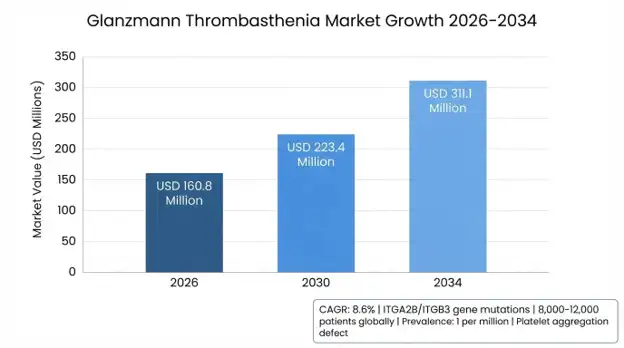
ITGA2B and ITGB3 are the genes of a synthetic platelet surface protein called "integrin αIIbβ3," also known as "glycoprotein IIb/IIIa," which are defective in Glanzmann thrombasthenia, a rare autosomal recessive hereditary platelet function defect. In normal hemostasis, this integrin is the major platelet receptor for platelet-to-platelet aggregation via binding of fibrinogen, von Willebrand factor, fibronectin, and vitronectin on activated platelets to form the platelet plug at sites of vascular injury. In affected persons, the platelets are normal in number and shape but are essentially incapable of aggregation due to the absence or dysfunction of this receptor and lead to a profound bleeding tendency, despite the presence of all normal coagulation factors and a normal number of platelets. The condition was first clinically described in 1918 by the Swiss pediatrician Eduard Glanzmann, who described children with a bleeding tendency with normal platelet counts but with the presence of an abnormal clumping into the clot by the platelets. A molecular defect in glycoprotein IIb/IIIa, which was not defined till later in the decades of platelet biology research, has been established as the cause of the condition.
There are three recognized clinical variants depending on the amount of residual glycoprotein IIb/IIIa expression: Type I, the most severe, is characterized by less than 5% of its normal expression and lack of clot retraction; Type II, which is characterized by the presence of 5-20% of normal expression and a generally milder bleeding phenotype; and the variant form, in which near-normal amounts of the receptor complex are present but there are qualitative mutations that impair binding of fibrinogen and platelet aggregation despite adequate receptor density. Clinical presentation usually starts in infancy or childhood with nosebleeds, gum bleeding, easy bruising, purpura, and gastrointestinal bleeding; menorrhagia is a particularly disabling and common symptom in women and a frequent cause of iron-deficiency anemia. Trauma, dental extraction, surgery, or childbirth can lead to life-threatening bleeding, but conventional bleeding agents like desmopressin are not as effective as they would be in a disorder involving a deficiency of coagulation factors.
There are no objective estimates of the prevalence of this disease in the world, although in consanguineously mated populations, the prevalence is estimated at about 1 in 1 million, as has been documented in communities with high rates of consanguineous marriage, including in the Middle East and South Asia, where certain founder mutations in both ITGA2B and ITGB3 genes have been concentrated over generations. Using the baseline prevalence on the current global population gives an illustrative theoretical patient population of the following:
The number of genetically confirmed and treated patients is estimated to be between 8000 and 12000 people worldwide, but the true number of patients with inherited bleeding disorders is probably significantly under-diagnosed in areas where platelet aggregometry, flow cytometry, and genetic confirmation testing are not available.
Management is supportive and episodic. Until now, platelet transfusion has been the treatment of choice for significant bleeding, but repeated exposure is associated with a significant risk of alloimmunization to glycoprotein IIb/IIIa or HLA antigen that can make a substantial number of chronically transfused individuals refractory to further transfusion. Given the need for this, recombinant activated factor VIIa (rFVIIa) has emerged as a key therapeutic option; interestingly, the use of rFVIIa has a specific regulatory-approved indication in both the United States and the European Union for the treatment and prevention of bleeding in Glanzmann thrombasthenia patients who have been previously unresponsive to platelet transfusion, and this use is outside of the broad category of off-label use associated with many other rare bleeding disorder drugs. Antifibrinolytic drugs, such as tranexamic acid and epsilon-aminocaproic acid, are important adjuncts in cases of mucosal bleeding and menorrhagia. Allogeneic hematopoietic stem cell transplantation is the only curative method currently available and is limited to severe, transfusion-refractory disease due to its morbidity, and early-stage gene therapy and new bispecific antibody platforms that simultaneously link platelets to fibrin independent of glycoprotein IIb/IIIa are the next steps in the development of disease-modifying innovations.
| Report Coverage | Details |
|---|---|
| Base Year | 2025 |
| Base Year Value | USD 148.2 Million |
| Forecast Value | USD 311.1 Million |
| CAGR | 8.6% |
| Forecast Period | 2025-2034 |
| Historical Data | 2022-2025 |
| Largest Market | North America |
| Fastest Growing Market | Middle East & Africa |
| Segments Covered | By Treatment Type, Type (Clinical Subtype), End-User |
| Region Covered | North America, Europe, Asia Pacific, Middle East & Africa, Latin America |
| Countries Covered | US, Canada, Mexico, UK, Germany, France, Italy, Spain, Israel, Saudi Arabia, UAE, Iran, India, China, Japan, South Korea, Brazil |
| Key Market Playes | Novo Nordisk A/S, Takeda Pharmaceutical Company, CSL Behring, Octapharma AG, Grifols S.A., Pfizer Inc., Sanofi, Hemab Therapeutics |
Get more details on this report - Request Free Sample
The increasing availability of platelet aggregation studies, flow cytometric quantitation of expression of glycoprotein IIb/IIIa, and next-generation sequencing panels is gradually decreasing diagnostic delays when bleeding presentations were previously mistaken for iron deficiency or general coagulopathy. Increasing awareness on the part of hematologists, pediatricians, and gynecologists dealing with cases of unexplained menorrhagia is helping to decrease the time to diagnose, while cascade genetic testing of affected families after a first case is diagnosed is increasing the number of identified patients, especially among consanguineous populations.
The approval of rFVIIa in GT patients having refractoriness to transfusion has made it the main high-value pharmaceutical sub-segment in this market. As a large percentage of patients on chronic transfusion develop platelet-specific or HLA antibodies, making transfusion ineffective, rFVIIa remains the main hemostatic agent in case of major bleeds, surgeries, and delivery in these patients. One major bleed necessitating repeat dosing may lead to a lot of expense being incurred in concentrated form:
Considering the size of the patient population of the ultra-rare disease that is estimated at 8,000-12,000 individuals scattered throughout the world, it is rather difficult to conduct randomized clinical trials on a sufficiently large number of patients, and it is not possible to consider the commercial scale due to the use of expensive orphan drugs.
The treatment of GT patients, especially in developing countries, involves platelet transfusion due to the absence of recombinant drugs. Alloimmunization associated with repeated transfusions decreases the effectiveness of treatment, and the only way out is to use expensive bypassing products, which are unaffordable to purchase in resource-poor regions, such as the Middle East, North Africa, and South Asia, where the largest proportion of patients reside.
The monogenetic aspect of Glanzmann thrombasthenia and the detailed understanding of megakaryocyte biology offer good scientific backing to cure this disease. In vitro lentiviral delivery of a functional ITGA2B or ITGB3 gene to hematopoietic stem cells that results in restored platelet aggregation has been proven in preclinical studies; on the other hand, the development of clinically oriented non-alloimmunizing bispecific antibodies to bridge platelets to fibrinogen independent of glycoprotein IIb/IIIa, such as those from specialty rare bleeding disorder developers like Hemab Therapeutics, is a more immediate commercial application.
Menorrhagia continues to be among the most distressing and neglected consequences of GT, often leading to iron deficiency anemia and frequent admissions to the hospital. The development of novel, sustained-release, locally acting hemostatic drugs and enhanced hormonal or non-hormonal prevention approaches that would suit the needs of hereditary bleeding disorders would provide an interesting unmet need, which could yield a recurring revenue stream.
GT care is becoming more centralized through comprehensive treatment centers that have facilities for hemophilia and other bleeding disorder management along with hematology, gynecology, dental, and genetic counseling. This has enhanced the consistency of diagnosis and made it easier to get HLA-matched platelets and registry participation. The pharmaceutical industry has found it much easier to collect real-world data and recruit patients for trials.
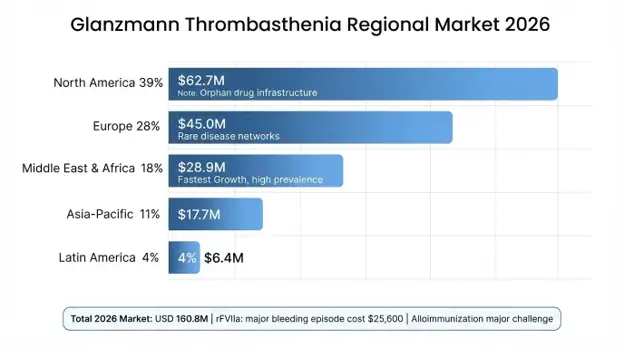
North America accounts for the largest share of the worldwide GT market owing to the high specialization in hematology subspecialties, the presence of a network of centers for treating bleeding disorders backed by the government, and a favorable regulatory framework that encourages the development of orphan drugs via prolonged exclusivity periods. Insurance coverage of rFVIIa in difficult-to-treat bleeding conditions remains a key driver of regional market revenue.
High incidences of marriages among first-degree relatives in several countries such as Saudi Arabia, Iraq, Jordan, Israel, and the UAE cause GT incidences to be higher compared to the rest of the world. Increased investments by governments in GCC nations in genetic tests and specialty hematology centers will be the key growth drivers over the next few years; however, inequalities in accessibility to diagnoses and treatments exist between rich GCC nations and poor nations in the broader region.
Europe is an important segment of the market owing to the well-developed reference networks for rare bleeding disorders in Europe, the rare disease plans in France, Germany, Italy, and the United Kingdom, and the orphan medicinal product system in the European Medicines Agency.
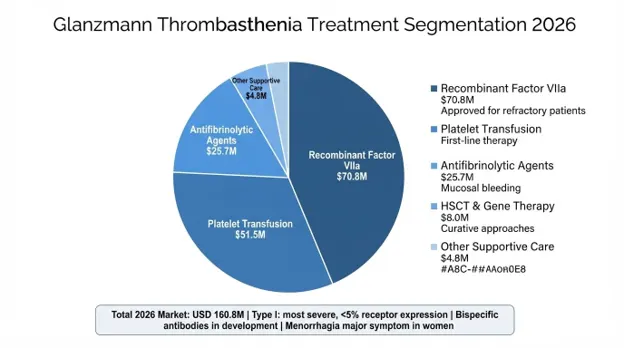
Recombinant activated factor VIIa is the most valuable segment within the treatment pipeline, owing to the approved indication for refractory patients and its significant contribution towards perioperative and obstetric hemostasis. The Platelet Transfusion segment is the most extensively used therapy segment owing to its usage in non-alloimmunized patients and resource-limited situations. Antifibrinolytics are the lower-cost adjunctive treatment segment that plays an important role in mucosal bleeding and menorrhagia, whereas the Hematopoietic Stem Cell Transplant and novel Gene Therapy & Biologics segments are smaller segments that are strategically important and are anticipated to grow further.
The segment of Type I GT accounts for the highest value in terms of treatment owing to its relation to the most extreme form of disease and consequently high use of the therapy. Type II and variants are smaller segments; the increasing number of people suffering from these types is associated with enhanced diagnostic capabilities.
Hemophilia & Bleeding Disorder Treatment Centers emerge as the key end-user segment due to their proficiency in the field of platelet functionality testing, as well as a multidisciplinary approach to treatment. Hospitals & clinics constitute a significant portion owing to acute bleed management and surgeries, and home healthcare emerges as a rising end-user segment on account of oral antifibrinolytic prophylaxis.
GT market players consist of several biologics producers that produce recombinant factor VIIa and plasma-derived products, as well as a group of developers focused on rare diseases and working on the development of bispecific antibodies and gene therapies. Differentiation in the market is achieved via evidence from clinical trials using registries, manufacturing efficiency, price-sensitive patient support programs, and pipeline commitment to non-immunogenic and potentially curative options.
March 2026: The developer of a specialty rare bleeding disorder made significant progress in the clinical development of a bispecific antibody that aims at achieving hemostasis in GT patients regardless of glycoprotein IIb/IIIa function, with promising data on safety and reduction in bleeding reported.
January 2026: A global registry for a rare bleeding disorder collected additional data regarding alloimmunization and quality-of-life measures among GT treatment facilities.
November 2025: Multinational case series have supported the safety and effectiveness of early rFVIIa administration in preventing alloimmunization to factor VIII in patients undergoing minor surgeries without prior transfusions.
September 2025: The updated international consensus recommendations in hematology highlighted the importance of using flow cytometry and genetic panels in children with unexplained severe mucocutaneous bleeding.
You'll get the sample you asked for by email. Remember to check your spam folder as well. If you have any further questions or require additional assistance, feel free to let us know via-
+1 724 648 0810 +91 976 407 9503 sales@intellectualmarketinsights.com
24 Aug 2026
Intellectual Market Insights Research © 2026. All rights reserved.