Share this link via:

The global 3D-printed pharmaceuticals market size was valued at USD 285 million in 2025 and is projected to reach USD 348 million in 2026, expanding to USD 1.8 billion by 2034, growing at a CAGR of 22.4% during the forecast period (2026-2034).
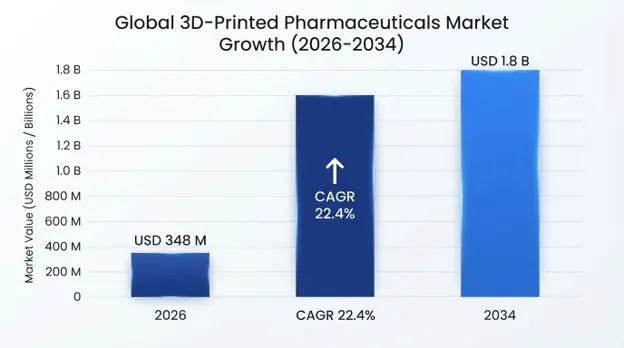
The introduction of 3D-printed pharmaceuticals marks a paradigm shift from mass manufacturing toward patient-centric, digitally controlled, additive manufacturing that enables unprecedented customization of drug dose, release kinetics, tablet geometry and combinations of multiple drugs in individual dosage units. This revolutionary process builds the pharmaceutical product layer-by-layer from a digital design file, allowing real-time changes in the therapeutic parameters, e.g. to individual patient pharmacokinetic profiles, genetic polymorphisms, age-specific dosing requirements, and complex polypharmacy management requirements, which are not cost-effective to achieve using conventional batch manufacturing.
In August of 2015, FDA approved Spritam (levetiracetam) from Aprecia Pharmaceuticals, the first pharmaceutical product manufactured using proprietary binder jetting technology to receive approval, providing key precedent for use of additive manufacturing in pharmaceutical quality frameworks. With only a few seconds of contact with the liquid, the innovative rapidly disintegrating tablet design of Spritam achieves complete dissolution thanks to 3D printing's ability to produce highly porous internal microstructures, which cannot be created through conventional compression tableting and represent the technology's capacity to solve clinical problems that can't be addressed by conventional compression tableting processes.
Commercial ecosystem components include pharmaceutical-grade 3D printing hardware that complies with Good Manufacturing Practice, specialized printable pharmaceutical formulations (e.g., drug-loaded filaments, semi-solid extrusion material), process analytical technology systems (PAT) for real-time quality monitoring, regulatory consultation services to navigate complex approval processes, and integrated digital pharmacy platforms that seamlessly link electronic prescriptions with personalized manufacturing execution systems. This technology addresses critical clinical needs for pediatric patients who need a weight-based dose, geriatric patients who need to manage complex polypharmacy, oncology patients that require pharmacogenomically guided individualized dosing, and rare disease patients where the small population size makes traditional manufacturing economically untenable.
In addition to individual dose customization, 3D printing can also be used to make complex “polypills”, incorporating several active pharmaceutical ingredients in a single dosage unit and with individual, spatially controlled release profiles. This architectural control enables the combination of incompatible drugs by discrete drug separation in printed matrices, the formulation of multi-layer tablets with an immediate release from the outer layer and sustained release from the inner layer, and the development of chronotherapeutic formulations that release the drug at the optimum time, in line with circadian rhythms, as is the case with drugs used in the treatment of conditions such as hypertension and arthritis.
| Report Coverage | Details |
|---|---|
| Base Year | 2025 |
| Base Year Value | USD 285 Million |
| Forecast Value | USD 1.8 Billion |
| CAGR | 22.4% |
| Forecast Period | 2025-2034 |
| Historical Data | 2022-2025 |
| Largest Market | North America |
| Fastest Growing Market | Asia Pacific |
| Segments Covered | By Technology, Application, Drug Type, Dosage Form, End-User |
| Region Covered | North America, Europe, Asia Pacific, Middle East & Africa, Latin America |
| Countries Covered | US, Canada, Mexico, UK, Germany, France, Italy, Spain, Netherlands, China, Japan, India, Australia, South Korea, Brazil, Argentina, UAE, Saudi Arabia, South Africa |
| Key Market Playes | Aprecia Pharmaceuticals, FabRx Ltd., Triastek Inc., Merck KGaA, GlaxoSmithKline plc, AstraZeneca plc, Cycle Pharmaceuticals |
Get more details on this report - Request Free Sample
The underlying structural factor behind the growth in the 3D printing of pharmaceuticals lies in the move toward precision medicine in the healthcare industry wherein therapy is customized based on the characteristics of individual patients such as genetic variations of drugs in their metabolisms, age-specific pharmacokinetics, body weight-dependent dosing needs, and disease condition-specific modifications in therapy. Conventional pharmaceutical manufacturing is designed for average population requirements in general and thus provides optimal therapy for the median members of the population in question but falls short when it comes to a significant section of the population that needs individualized dosing such as children requiring weight-dependent dosing and the elderly with polypharmacy and age-specific pharmacokinetics, among others.
The pediatric drug development gap is one of the most critical clinical issues pushing the need for 3D printing, since about 50-75% of drugs used in pediatrics are not supported by any pediatric research or formulation and thus require off-label usage of adult medicines, which involve dose modification in a way of tablet splitting or crushing, leading to high dosing variability, poor drug stability, and low palatability problems. Developmental programs such as FDA’s Pediatric Research Equity Act and EMA’s Pediatric Regulation have been established as an incentive for age-appropriate drug formulation, whereas 3D printing provides elegant technical solutions for accurate dose modulation among all ages of pediatric patients.
Implementation of pharmacogenomic medicine is leading to the growing demand for personalized dosing considering the clinical use of genetic tests for CYP2D6, CYP2C19, CYP2C9, among others, where it has been found that 30-40% of people are either poor, intermediate or ultrarapid metabolizers needing substantial modifications of the dosage from the current algorithms of prescriptions. With the declining cost of pharmacogenomics testing under USD 200 per test and the inclusion of this genetic information into clinical decision support tools used in prescribing medications, the pool of individuals requiring personalized dosing is continuously growing.
The regulatory framework establishing standards for additive manufacturing to comply with existing quality systems of pharmaceuticals has had an immense influence on the commercial path of 3D-printed drugs. In particular, the approval of the first 3D-printed drug Spritam by the FDA back in 2015 set precedents in terms of regulatory pathway, while further guidance documents gave manufacturers a clearer understanding of technological requirements in the context of additive manufacturing of pharmaceuticals. In the 2023 FDA draft guidance on additive manufacturing of drug products, critical manufacturing issues such as layer-by-layer quality assurance, digital manufacturing process validation, and analytical methods for characterization of 3D-printed dosage form properties have been discussed.
Regulatory momentum has increased from the proactive involvement of European Medicines Agency in addressing the issue of additive manufacturing by means of reflection papers, scientific advisory processes, and research initiatives carried out by universities in relation to regulatory sciences pertaining to 3D-printed pharmaceutical assessment techniques. With the introduction of additive manufacturing into pharmaceutical development guidelines and the setting up of regulatory pathways for point-of-care hospital pharmaceuticals manufacturing through 3D printing in Netherlands, Belgium, and other European countries, appropriate regulatory frameworks for testing have been facilitated.
Regulatory development attempts to solve problems faced by existing quality systems used by pharmaceuticals in batch processing environments, where multiple identical units allow comprehensive quality sampling using statistics, when utilized for additive manufacturing processes that could potentially involve production of personalized units, which are not possible to be sampled conventionally. The development of in-process analytical techniques, real-time release testing techniques, and quality systems allowing quality assessment of individual units being manufactured is essential to regulatory science infrastructure that would facilitate wider adoption of 3D printing in pharmaceuticals.
One of the major restrictions affecting the growth of the 3D-printed drug market is the capital-intensive nature of the manufacturing facilities necessary to perform pharmaceutical-grade 3D printing. This requires pharmaceutical-grade 3D printers which meet Good Manufacturing Practice standards, an environmental control system that controls temperature, humidity, and particulates within pharmaceutical standards, Process Analytical Technology systems that provide real-time monitoring of the quality of production, and validation programs that ensure the reproducibility and consistent quality of production. The 3D printers needed for pharmaceutical grade printing range in price from USD 200,000-950,000, compared to USD 75,000-300,000 for standard tablet press machines that produce much higher volume per hour.
Limited throughput represents a fundamental business constraint, considering that the current drug 3D printers have throughput of 50-500 units per hour, while the traditional tablet pressing machine can have a throughput of 250,000-1,500,000 tablets per hour, thus allowing additive manufacturing to be financially feasible only for personalized and small volume production but not for large-scale generic drugs manufacturing. Throughput restriction is a part of the essence of additive manufacturing and clearly forms market positioning restrictions that do not allow 3D-printed drugs to compete against traditional drugs in the mainstream pharmaceutical products category.
Production cost structures are determined by capital and process throughput constraints, resulting in unit production costs in the range of USD 25-120 per dosage form unit, depending on the technology used, the complexity of the drug loading process, and volume of production, as opposed to USD 0.08-0.75 for traditional tablet manufacturing processes. Cost disparities mean that pricing must be high enough to recoup the investment, thus creating access problems in healthcare systems that are price sensitive as well as in chronic diseases.
A major emerging opportunity is hospital-based point-of-care pharmaceutical manufacturing. is the development of hospital-based systems where 3D printers can produce customized drugs on demand, removing all dependencies on the logistics involved, allowing the dosage to be adjusted in real time according to therapeutic drug monitoring, and making available customized drugs for those patients who have special needs that are not commercially feasible for drug manufacturers to cater to through their traditional production methods. The point-of-care manufacturing industry differs from the traditional commercial pharmaceutical industry in many ways and involves the presence of 3D printing machines in hospitals and academic medical centers and compounding pharmacies.
Clinical applications with strong potential include for 3D pharmaceutical manufacturing at the point of care include medicines needed by the neonatal intensive care unit, wherein very accurate microdoses in accordance with weight variation is needed; formulations used in palliative care, which need frequent dosage modifications depending on the pain management needs and symptom assessment; psychotropic medicines that require dose-titration protocols for individual patients, which are modified every week during the stabilization process of treatment; and the emergency department, where instant availability of personalized formulation might be vital for clinical purposes.
The regulatory framework to implement point-of-care 3D printing of drugs in hospitals is developing via hospital exemption frameworks in Europe that allow the preparation of unlicensed drugs for individual patients under the supervision of physicians, offering regulatory options for point-of-care manufacturing that do not need full pharmaceutical manufacturing license. Demonstrating the safety, efficacy, and quality of point-of-care drug manufacturing in hospital exemptions will provide justification for adoption in regulation and eventually implementation of standardized regulatory framework worldwide.
The pharmaceutical 3D printing industry is undergoing rapid transformation in the form of automation using artificial intelligence and machine learning techniques for designing formulations, optimizing the manufacturing process, predicting quality characteristics of the products, and developing pharmacokinetic dosing algorithms that provide customized medicines for individual patients; these developments have cut down the development time of 6-9 months from 18 to 24 months for common applications. The machine learning models developed using large-scale databases of pharmaceutical formulations can predict the composition of the excipients, drug loadings, printing parameters, and tablet geometries of the novel active pharmaceutical ingredients.
Integration of process analytical technology with machine learning–powered manufacturing control will allow the adjustment of printing parameters such as extrusion rates, layer thickness, nozzle temperatures, and environmental parameters in accordance with the constant monitoring of quality parameters, thereby maintaining consistent dosage-form characteristics notwithstanding the variability in the rheological properties of pharmaceutical inks naturally inherent to prolonged printing processes. The described closed-loop manufacturing control is a solution to core quality assurance issues in pharmaceutical additive manufacturing since process variability means drug content and dissolution profile variability in the resulting dosage forms.
Personalized dosing algorithms based on pharmacokinetics modeling, therapeutic drug monitoring, pharmacogenomics analysis, drug response assessment, and adverse drug reactions monitoring to automate dose calculations are a piece of digital infrastructure required for personalized manufacturing of pharmaceuticals in clinical settings. These dosing algorithms will interface seamlessly with EHRs, LIMS, and pharmaceutical 3D printing execution software.
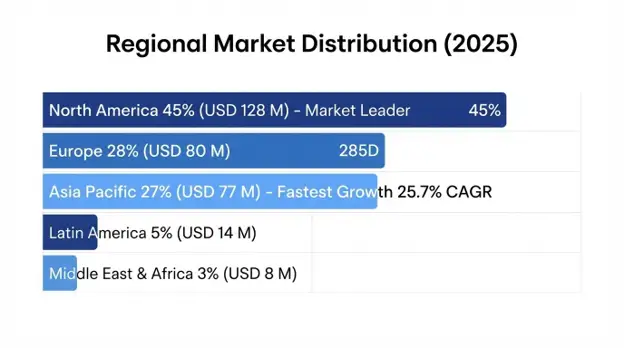
North America holds the largest share of the 3D-printed pharmaceuticals market, which is expected to reach USD 128 million in 2025 and to grow at 21.8% CAGR up to 2034, reaching USD 785 million in total revenue. 89% of the regional market is represented by the U.S., with the market growth being driven by such factors as FDA regulatory precedence through the approval of Spritam drug, strong pharmaceutical innovation ecosystem, including venture capital-funded startups and pharmaceutical companies' own research and development initiatives, as well as the presence of advanced infrastructure for clinical research. All these components form an ecosystem fostering technological innovations and adoption.
The region enjoys existing reimbursement policies for specialty drugs, compounded drugs, and personalized medicines, providing existing commercial opportunities for 3D printed drugs before the development of reimbursement code and policies specifically for 3D printed pharmaceuticals. 503B outsourcing facilities and hospital compounding pharmacies provide potential adoption channels provide immediate adoption channels for 3D printing technology in pharmaceuticals due to need to improve efficiency of production and increasing quality of products offered by these specialty facilities.
Asia Pacific is projected to be the fastest-growing regional market with a CAGR of 25.7% till 2034 from USD 78 million in 2025 to USD 485 million in 2034 owing to the huge government expenditure on pharmaceutical manufacturing upgrades in the region. China will see maximum growth within the region thanks to its efforts towards modernizing its pharmaceutical manufacturing sector with the Made in China 2025 initiative focusing on advanced pharmaceutical manufacturing technologies, including additive manufacturing, among other strategic priorities for development of its domestic pharmaceutical industry. The region’s dominance in generic pharmaceutical manufacturing, accounting for roughly 42% of generics manufacturing globally, will also provide the opportunity to adopt 3D printing technology due to the differentiation offered through dosages and personalized medicines.
Japan will emerge as one of the key growth markets in the region owing to its mature regulatory system, aging population requiring formulation for geriatrics, and its manufacturing technology capabilities; the Pharmaceuticals and Medical Devices Agency is developing regulations for manufacturing pharmaceuticals using additive manufacturing. South Korea, owing to its advanced pharmaceutical manufacturing segment and innovative research, will experience accelerated adoption of 3D printed pharmaceuticals.
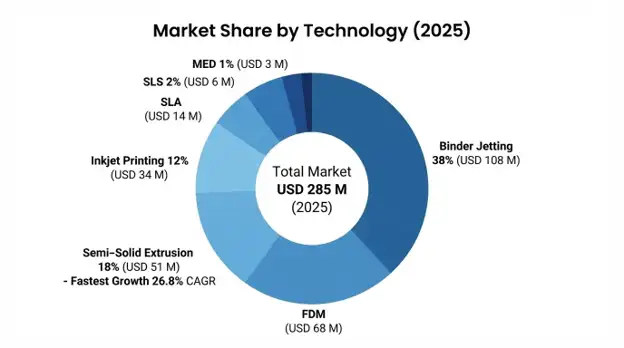
Binder Jetting leads the technology segment, accounting for 38% of the market (USD 108 million). in 2025, owing to commercial provenness due to successful use in Spritam, ability to form highly porous rapidly disintegrating tablets without heating, and applicability with thermally labile active pharmaceutical ingredients. It allows the manufacturing of tablets with complex internal structures such as controlled porosity formation, hollow compartments for sustained release applications, and multi-compartment structures where incompatible drug formulations can be isolated within one tablet.
Semi-Solid Extrusion is the fastest-growing technology segment because it operates at room temperature with 26.8% CAGR till 2034, due to better formulation flexibility in various pharmaceutical applications, process occurring at room temperature thus maintaining the integrity of drugs, multiple nozzles for forming complex polypills, and its applicability with aqueous gels, lipid-based delivery systems, and high drug loading formulations which other technologies cannot handle efficiently.
Fused Deposition Modeling holds 24% market share because of existing hardware infrastructure, wide availability of pharmaceutical formulation compatibility data, and relatively low equipment cost which makes it applicable for point of care applications in hospitals and compounding pharmacies.
Personalized Medicine constitutes the largest application segment with 44% market share of USD 125 million in 2025, covering dose customizations in pediatric, geriatric, and pharmacogenomic guided treatment applications wherein individual patient needs differ widely from available commercial product doses. The application area gains benefit from strong clinical justification, documented medical needs, rising physician awareness of benefits of personalized dose adjustments, and healthcare system readiness to pay premium prices for better outcomes.
Polypill Development occupies 31% market share with USD 88 million in 2025 and 24.2% CAGR from 2025 to 2034 in applications of chronic disease management wherein drug consolidation into single dose forms improves compliance and reduces healthcare costs through better disease control and lower hospitalization.
Orphan Drug Manufacturing accounts for 15% market share and maximum growth potential at 28.4% CAGR through expanding rare disease therapeutics development, regulatory incentives favoring small-scale manufacture, and economic advantages of 3D printing in low volume manufacturing applications.
Hospitals & Clinics represent the largest end-user segment holding 42% market share of US$120 million in 2025, covering clinical research applications, point of care manufacturing solutions, and specific care facilities where customized formulations of medicines are required. End-User segment Research & Academic Institutions holds 28% market share, as the technology is still under development and much research needs to be done before practical applications.
End-User segment Pharmaceutical Companies hold 18% market share, comprising research activities, clinical trials applications, and commercial pharmaceutical development programs using 3D printing technology in pharmaceuticals.
The competitive landscape is characterized by companies that have successfully overcome regulatory barriers, develop proprietary technologies and establish clinical evidence for the commercialization of their products. Aprecia Pharmaceuticals enjoys first-mover advantage and is currently the only company with FDA approved 3D printed drugs, applying ZipDose binder jetting technology for production of rapidly disintegrating tablets. The leader in semi-solid extrusion technology is FabRx Ltd., which achieved its leadership status due to collaboration with academia and implementation of pilot programs in hospitals.
Triastek Inc. is the competitive player due to its proprietary Melt Extrusion Deposition technology, which is used to develop its pipeline of controlled release pharmaceutical products under clinical development in United States, China and Europe. Some of the major players in pharmaceutical industry, such as Merck KGaA, GlaxoSmithKline and AstraZeneca, continue their research in 3D printing as an additive manufacturing technology of their development pipeline.
The key competitive factors include the ownership of proprietary printing technology, library of formulated pharmaceutical compounds which are approved and supported by clinical evidence, and integration of 3D printing technology into existing development and manufacturing workflows.
March 2026: FabRx Ltd. submitted a regulatory filing to the European Medicines Agency by FabRx Ltd for their first 3D printed pediatric drug formulation platform that allows dose titration for the treatment of childhood epilepsy, which has the possibility of being approved as a European regulatory precedent for personalized 3D-printed pharmaceuticals outside the United States.
February 2026: Triastek Inc. disclosed successful Phase II study findings for their chronotherapeutic 3D-printed tablets intended for evening use and morning pulsatile release for improved blood pressure control over conventional dosage forms using circadian-based drug delivery in patients with hypertension.
January 2026: FDA issued detailed final guidelines on pharmaceutical additive manufacturing, giving clear directions on how process validation, real-time analytics testing, and post-approval changes should be managed, thereby minimizing regulatory risks that limited investments in the use of 3D printers by the industry.
December 2025: Aprecia Pharmaceuticals partnered strategically with a leading pharmacy network of hospitals to introduce point-of-care 3D pharmaceutical printing at seven academic hospitals focusing on customization of doses for children as well as polypills for cardiology and neurology departments supported by robust data collection for development of a regulatory framework.
November 2025: A consortium of European pharmaceutical companies and universities successfully concluded their research project, PRINTMED, aimed at exploring the regulatory science, quality assurance methods, and frameworks for implementing hospital-based 3D pharmaceutical printing, submitting results to EMA for development of regulatory guidelines on decentralized pharmaceutical manufacturing.
You'll get the sample you asked for by email. Remember to check your spam folder as well. If you have any further questions or require additional assistance, feel free to let us know via-
+1 724 648 0810 +91 976 407 9503 sales@intellectualmarketinsights.com
03 Jul 2026
Intellectual Market Insights Research © 2026. All rights reserved.