Share this link via:

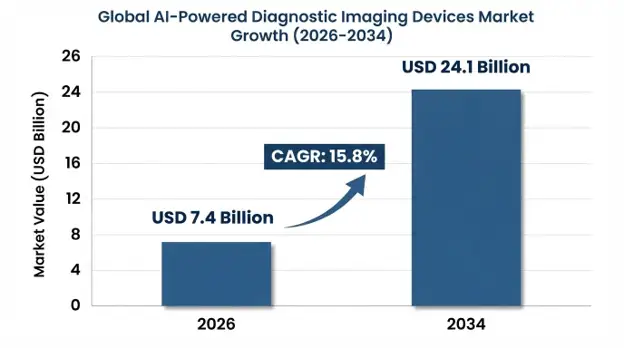
The global AI-powered diagnostic imaging devices market was valued at USD 6.2 billion in 2025 and is projected to reach USD 7.4 billion in 2026, expanding to USD 24.1 billion by 2034, growing at a CAGR of 15.8% during the forecast period (2026–2034).
The combination of AI technology with diagnostic imaging devices marks a transformative fusion of cutting-edge machine learning algorithms, deep neural networks, and medical imaging hardware designed to surpass the limitations of traditional radiological analysis and solve one of the biggest problems in today's healthcare systems. They are complex platforms that can be easily and seamlessly integrated with all main imaging equipment, including high-field MRI systems, multi-detector CT scanners, portable ultrasound units and digital mammography units, bringing a touch of intelligence to the imaging workflow and improving diagnostic accuracy, clinical decision making and patient outcomes.
The core business case is solving major systemic healthcare problems that are out of hand in all healthcare systems around the world. In many developed markets, the supply of specialists has risen by only 1% per year, in comparison to imaging volume growth of 4-5% per year, resulting in a growing diagnostic backlog and a significant lag in getting time-sensitive patients the care they need, such as for stroke, pulmonary embolism and acute coronary syndromes. Another basic limitation is the human visual system's inability to detect subtle early stages of disease, like subcentimeter pulmonary nodules or microcalcifications in dense breast tissue. AI algorithms can systematically fill this gap with pattern recognition abilities that surpass human capabilities in certain diagnosis-related tasks.
AI-powered imaging also includes a wide range of imaging technologies, such as real-time acquisition optimization that minimizes radiation exposure while preserving diagnostic quality, automated anatomical segmentation and quantification that boosts consistency among institutions, Intelligent Triage systems that filter out non-critical findings and prioritize for immediate review, and natural language processing platforms that automatically generate structured reports that seamlessly integrate with electronic health records and clinical decision support systems. These features go beyond the scope of individual diagnoses and include intelligent protocol selection according to clinical indications, automatic quality control and performance monitoring throughout distributed imaging networks, and more.
The commercial landscape is broad, including cloud-based AI processing solutions, algorithm training and validation services, regulatory compliance assistance, and full analytics solutions that enable better imaging workflow for health systems. The market meets the critical need for diagnostic imaging capacity in more than 4.7 billion people worldwide who lack adequate access to diagnostic imaging services and also enables the interpretation of over 5 billion medical images produced annually worldwide, changing the paradigm of healthcare delivery from reactive disease management to precision medicine and early intervention.
| Report Coverage | Details |
|---|---|
| Base Year | 2025 |
| Base Year Value | USD 6.2 Billion |
| Forecast Value | USD 24.1 Billion |
| CAGR | 15.8% |
| Forecast Period | 2025-2034 |
| Historical Data | 2022-2025 |
| Largest Market | North America |
| Fastest Growing Market | Asia Pacific |
| Segments Covered | By Modality, Application, Technology, End-User, Region |
| Region Covered | North America, Europe, Asia Pacific, Middle East & Africa, Latin America |
| Countries Covered | US, Canada, Mexico, UK, Germany, France, Italy, Spain, Netherlands, China, Japan, India, Australia, South Korea, Brazil, Argentina, UAE, Saudi Arabia, South Africa |
| Key Market Playes | GE HealthCare, Siemens Healthineers, Philips Healthcare, IBM Watson Health, Aidoc, Viz.ai, Zebra Medical Vision, Nuance Communications, Enlitic, Arterys |
Get more details on this report - Request Free Sample
The primary driver behind the adoption of AI-powered diagnostic imaging is the growing mismatch between the need for diagnostic imaging and the number of radiologists available to provide such services. The number of imaging procedures performed globally was expected to reach 5.2 billion examinations by 2025 due to the aging population, increased cancer screening programs, higher prevalence of chronic conditions, and growing use of imaging techniques for interventional procedures among others. Considering this situation, there are 485,000 radiologists worldwide, while forecasts indicate shortages of 35,000-42,000 radiologists by 2030 in developed countries.
This imbalance becomes apparent through the prolonged reporting cycles, which contribute to delayed diagnosis, higher diagnostic errors because of fatigue and stress, and a higher incidence of burnout in radiologists, further reducing the available workforce capacity. Reporting delays of 18-72 hours for non-urgent cases and 78 minutes on average for the evaluation of urgent cases in the emergency departments are observed in academic teaching hospitals, significantly exceeding the accepted norms. AI triaging has been proven in multiple studies of different healthcare providers to decrease time for treatment for urgent issues by 42-58 minutes, according to standard clinical scales.
AI technologies tackle these problems by automatically prioritizing the imaging queues according to the severity of pathology detected, pre-labeling suspicious findings to speed up the radiologists' work process and making measurements that minimize interpretation differences. Experience from clinical use indicates that using AI-assisted image interpretation increases radiologists’ productivity by 30-45% for standard cases while keeping the same level of diagnostic accuracy.
The development of regulatory frameworks for AI-based medical devices has improved commercial viability., driving development spending and implementation in healthcare organizations. As of 2025, the FDA had cleared more than 950 medical devices incorporating artificial intelligence technology, of which about 78% were applications involving diagnostic imaging, showing the technological readiness of imaging AI and the ease with which such algorithms can be validated compared to others. The creation of predefined change control plans will facilitate continuous improvement in the algorithms without having to resubmit them, hence minimizing development costs after approval.
Such regulatory momentum is supported by a rising body of clinical evidence pointing to AI algorithms’ superior performance compared with expert radiologists in diagnosing certain conditions. Validation studies confirm the sensitivity rates of 96.2% for detecting lung nodules compared to 88.4% achieved by radiologist readers, 94.8% sensitivity for grading diabetic retinopathy compared to 87.6% achieved by ophthalmologists, and 92.1% sensitivity for detecting breast cancer on a mammogram compared to 84.3% for double-reading. Such performance gains of AI systems are especially significant in high-volume screenings.
There are regulatory structures within the EU Medical Devices Regulations and their counterparts in other important Asian markets, which define systematic approval processes, and this ensures market accessibility as well as proper safety and efficacy guidelines for developers of AI technology. The reimbursement structure is adapting itself to account for the efficiency provided by AI technology. For example, Medicare has developed certain billing codes for AI-powered imaging interpretation for stroke triage, pulmonary embolisms, and diabetic retinopathy screening.
The greatest barrier to the widespread adoption of AI imaging technology is the deterioration in the performance of algorithms trained using data from an institution when used in clinical settings where there is a difference in patients' demographic profiles, imaging technology setups, or prevalence of diseases. Research done on external validation shows sensitivity decrease of 12-28 percentage points when applying AI technology to datasets that were not used in the development of algorithms.
Bias in algorithms is an important factor in achieving health equity since AI algorithms developed with a majority of training samples from people in high-income countries exhibit poorer performance for under-represented demographic groups such as African, Hispanic, or South Asian patients, patients who are older and have multiple conditions, and patients whose images were taken using machines not represented in the training dataset. Not only does this present an issue of ethics in the application of AI algorithms but it also poses a legal challenge for healthcare facilities when deploying these algorithms that have known performance discrepancies among patient groups.
The time and costs associated with validation efforts across varied deployment settings are significant factors that increase development costs. The effort of validating complex AI imaging tools ranges between USD 15-USD 65 million based on the number of indications and required regulations.
Market transformation lies in the development of AI solutions that will analyze information gathered from various imaging techniques, laboratory findings, genomics and longitudinal records of patients to perform diagnostics and prognostics more thoroughly than single-modality analyses can. The current applications of AI in imaging are mostly confined to the limits of their imaging techniques, performing diagnostics on the images without considering additional information that is used by skilled physicians during diagnosis.
The use of multimodal AI solutions, which involve the integration of radiomic features from sequential imaging procedures together with molecular markers, treatment responses, and clinical outcomes, is very promising in terms of personalized risk stratification and treatment optimization. The use of multimodal AI in oncology, which combines CT radiomics with genomic expression, can predict 2-year survival rates with an accuracy of 0.87-0.93.
The creation of federated learning frameworks has made it possible to conduct machine learning algorithms on distributed healthcare systems without consolidating personal data of the patients, meeting the requirements for regulatory privacy policies and making use of big and varied datasets which help in developing good algorithms. There are many academic consortiums and companies who are working to create federated learning frameworks to develop imaging AI using datasets with millions of images from different institutions worldwide.
One key trend transforming the imaging domain is the shift of AI processing from the phase of post-imaging analysis to real-time integration while acquiring images, thanks to the development of edge computing and special AI processing hardware. The latest generation of CT, MRI, and ultrasound scanners has started to integrate special-purpose AI accelerators that can support the operation of deep learning-based algorithms in real time during the scanning process to deliver the best image quality with shortened scanning duration and reduced radiation dose.
The use of deep learning reconstruction is replacing the use of iterative techniques used in CT and MRI, allowing substantial noise reduction and image resolution improvement in a shorter time frame compared to the previous lengthy processes involved. AI-based MRI imaging procedures prove to be equivalent to conventional imaging procedures in terms of accuracy but allow the scanning process to be shortened by up to half the time required by the conventional process; a scan time of 45-60 minutes becomes 12-18 minutes.
These developments ensure that AI becomes an essential part of the performance of the imaging machine itself rather than a supplementary feature of software that could be purchased for the machine. AI imaging machines have become a selling point for the machine itself.
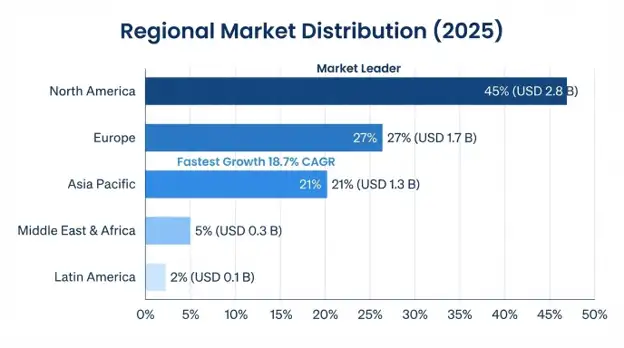
The North American region dominated the market, accounting for USD 2.8 billion in 2025. in 2025 and is estimated to grow with a CAGR of 15.2% during 2024-2034. The region’s dominance is attributed to the presence of AI imaging advancements from US-based tech giants, advanced healthcare information technology infrastructure that ensures smooth incorporation of AI into the system, full reimbursement schemes for AI-enabled imaging procedures, and substantial healthcare spending on premium technologies.
The US is the leading country with 86% regional market share and an installed base of high-end medical imaging devices, which comprises 41,000 MRI machines, 68,000 CT scan machines, and 145,000 digital radiography machines as possible targets of AI applications. The regulation framework provided by the FDA Digital Health Center of Excellence allows for well-developed clearance procedures for AI-based devices while ensuring the safety and efficacy standards of the cleared products.
Concentration of the healthcare system into a large network of healthcare organizations enables the implementation of enterprise-wide AI strategies. Such well-known health organizations as Mayo Clinic, Cleveland Clinic, and Kaiser Permanente develop their own strategies for the usage of AI in the imaging process. Large scale adoption allows gathering significant amounts of performance data, which ensures further algorithm improvements.
Asia Pacific became the fastest-growing region, having a forecasted CAGR of 18.7% till 2034 with a market valuation of USD 1.6 billion by 2025. Regional growth can be attributed to the huge healthcare infrastructural renovation projects, government-led digital health campaigns to update the imaging systems, population scale leading to high volumes of imaging for AI investments, and strong AI innovation ecosystem.
China is the leading country in terms of growth. with 43% of market shares due to the implementation of the "Healthy China 2030" program, which provides huge amounts of money for the development of the diagnostic imaging system and installation of clinical decision support systems enabled by AI in hospitals' networks. Leading Chinese companies like Infervision, Deepwise, and United Imaging have developed a full-fledged platform, installed in thousands of hospitals around the world.
India exemplifies increasing adoption owing to the creation of digital infrastructure via the National Digital Health Mission which will allow AI implementation on a large scale, massive investment from the private hospitals into diagnostic tools and programs to screen for diabetes and tuberculosis, which results in great demand for AI imaging. The production-linked incentive scheme for medical devices encourages domestic AI imaging development which is cheaper and more appropriate to the region.
CT Imaging holds the maximum modalities market segment with 36% share worth USD 2.2 billion by 2025, growing at a CAGR of 16.4% up to 2034. CT imaging generates the largest volume of complex datasets. that require fast interpretation in fields such as trauma, oncology, pulmonary, and vascular, making it an ideal application for AI-based triage and automated detection systems. Modality enjoys the advantage of uniform data format such as DICOM, which enables consistent application of AI algorithms across all manufacturers of the scanner, while high stakes in clinical outcomes in critical cases including stroke and pulmonary embolism prompt their adoption.
MRI Applications are the fastest-growing modalities market segment with 28% market share worth USD 1.7 billion in 2025 at 17.8% CAGR. Artificial intelligence applications include fast image reconstruction decreasing the time for scans by 60-75%, automated brain volumetry for monitoring neurological disorders, prostate detection and characterization, and cardiac functions quantification. The complexity of MRI examinations and their lengthy interpretation time lead to significant economic benefits for artificial intelligence, as the average time of interpreting MRI protocol by experienced radiologist is 35-55 minutes.
X-ray and Digital Radiography hold 22% market share worth USD 1.4 billion in 2025, being the most used imaging modality worldwide, and artificial intelligence proved to perform well for detecting chest diseases, fractures, and tuberculosis screenings.
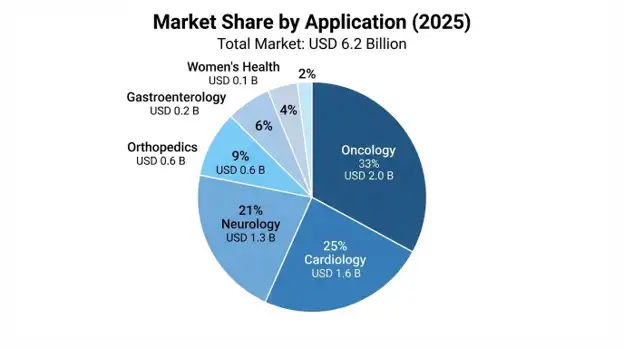
Oncology leads in application segment with 33% market share valued at USD 2.0 billion in 2025 and grows at 17.2% CAGR during 2034. AI is applied to detect and characterize lesions, staging of tumors and response to treatments, planning of therapy, and recurrence monitoring in lungs, breast, prostate, liver, and brain cancers. There is great demand for AI technology due to high clinical significance, demanding nature of imaging, and high reimbursement in oncological imaging.
Cardiology holds 25% of the market share worth USD 1.6 billion by 2025 with 16.9% CAGR growth. AI technology is being used to analyze Coronary arteries, cardiac chambers, valve diseases, and ejection fraction calculation in cardiology. Cardiovascular imaging AI is designed to cater to the worldwide cardiovascular disease burden affecting around 620 million people.
The Neurology segment constitutes 21% of the market share worth USD 1.3 billion in 2025 owing to its use in Stroke triage AI software used in over 3,200 hospitals across the world, brain lesions quantification for monitoring multiple sclerosis, and Alzheimer’s disease biomarkers analysis through structural imaging.
Hospitals are the largest end-user category, accounting for 54% of the market. and amounts to USD 3.3 billion in 2025 owing to many imaging scans, case complexity, need for sophisticated AI solutions, and presence of IT systems that allows integration and availability of financial resources for expensive technology. Comprehensive AI solutions have higher acceptance rates in academic medical centers, whereas community hospitals adopt selected use cases.
Diagnostic Imaging Centers account for 26% of the market. at USD 1.6 billion in 2025 with a CAGR of 17.1%, which is the fastest growing end user segment. The independent imaging centers have competition to distinguish themselves in terms of faster turnaround time and improved diagnostics, which results in a significant drive towards using AI that helps in improving the operational parameters.
Ambulatory & Point-of-Care Settings hold a 20% market share. at USD 1.2 billion in 2025 including urgent care centers, specialty clinics, and portable imaging centers where AI provides diagnostic abilities that require hospital level equipment and expert analysis otherwise.
The global market for AI-based diagnostic imaging devices has a hybrid competitive model with legacy vendors of medical imaging devices adding AI technology to their portfolio and with pure play software vendors building special algorithm suites. The leading eight firms account for approximately 52-58% of the market by value, while the remainder is shared between more than 280 smaller AI companies focusing on specialty applications in particular modalities or disease types.
Competitive advantage lies in the performance of algorithms based on peer-reviewed studies, in the degree of regulatory clearance in target markets, and in the ability to integrate with different imaging hardware and IT systems, along with business capability of deploying AI solutions on an enterprise level in healthcare institutions. Leading competitors strive to develop complete platform solutions rather than point products.
March 2026: FDA granted clearance to Siemens Healthineers’ AI-based MRI reconstruction technology allowing 8x faster acquisition across 24 imaging protocols with no loss of diagnostic image quality for integration into 12,000 MRI machines already installed by the company.
February 2026: GE Healthcare has launched its new AI imaging technology platform incorporating 16 clinical applications for CT, MRI, and X-ray modalities, and workflow management system, rolled out to 340 hospitals performing more than 18 million examinations per year.
January 2026: Philips Healthcare completed the acquisition of AI imaging firm Tempus AI, valued at USD 720 million and has added its proprietary multi-modal algorithmic capability to its AI suite, which now spans 22 clinical indications in radiology, cardiology, and pathology applications.
December 2025: Aidoc was granted FDA breakthrough device designation for its end-to-end AI solution addressing 18 acute conditions through CT, MRI, and X-ray imaging and deployed across 1,400 hospitals worldwide processing 15 million studies per month.
November 2025: Viz.ai expanded its AI stroke solution for detection of hemorrhagic stroke and large vessel occlusion quantification, achieving 94 percent sensitivity in clinical validation trials and deployed across 2,800 hospital stroke centers.
You'll get the sample you asked for by email. Remember to check your spam folder as well. If you have any further questions or require additional assistance, feel free to let us know via-
+1 724 648 0810 +91 976 407 9503 sales@intellectualmarketinsights.com
08 Jul 2026
Intellectual Market Insights Research © 2026. All rights reserved.