Share this link via:

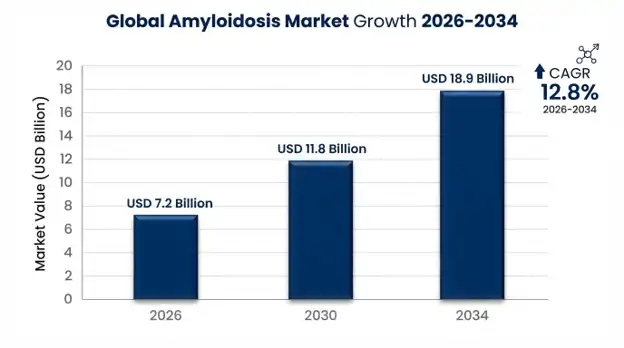
The global amyloidosis market size was valued at USD 6.1 billion in 2025 and is projected to reach USD 7.2 billion in 2026, expanding to USD 18.9 billion by 2034, growing at a CAGR of 12.8% during the forecast period (2026-2034).
Amyloidosis is a group of rare but increasingly recognized systemic diseases involving the deposition of abnormal proteins in the form of amyloid fibrils in the extracellular spaces of important organs such as the heart, kidneys, liver, nervous system and gastrointestinal tract. The deposits of these fibrillar proteins slowly affect the normal architecture of tissues and cause dysfunction of organs, if not treated, resulting in multi-organ failure. The three most common clinical forms of the disease, each with distinct therapeutic approaches, include immunoglobulin light chain amyloidosis (AL), transthyretin amyloidosis (ATTR), and secondary amyloidosis (AA).
Over the last 10 years, the therapeutic paradigm for amyloidosis has revolutionized with an improved understanding of the molecular mechanisms of amyloid fibril formation pathways, and the discovery of very targeted disease-modifying therapeutics. The traditional methods, based mainly on chemotherapy regimens to control the underlying plasma cell dyscrasia in AL amyloidosis are now complemented by advanced therapeutic platforms such as small interfering RNA (siRNA) therapeutics, antisense oligonucleotides, transthyretin stabilizers and emerging in vivo CRISPR-based gene editing technologies. These novel therapies not only reduce the production of amyloidogenic precursor proteins but also facilitate removal of the current deposits of fibrils, which marks a paradigm shift from supportive treatment to disease modification and cure.
Beyond the individual therapeutic products, the commercial value lies in the whole range of advanced diagnostic technologies, genetic counselling, platforms for patient monitoring and the multidisciplinary care model, incorporating cardiology, haematology, neurological and nephrological expertise. The market addresses significant unmet medical needs of patients with various types of amyloidosis with an estimated U.S. patient population of approximately 50,000 new patients each year with an even larger unmet medical need in the international market due to underdiagnosis.
| Report Coverage | Details |
|---|---|
| Base Year | 2025 |
| Base Year Value | USD 6.1 Billion |
| Forecast Value | USD 18.9 Billion |
| CAGR | 12.8% |
| Forecast Period | 2025-2034 |
| Historical Data | 2022-2025 |
| Largest Market | North America |
| Fastest Growing Market | Asia Pacific |
| Segments Covered | By Type, Treatment, Disease Manifestation, Route of Administration, End-User |
| Region Covered | North America, Europe, Asia Pacific, Middle East & Africa, Latin America |
| Countries Covered | US, Canada, Mexico, UK, Germany, France, Italy, Spain, Netherlands, China, Japan, India, Australia, South Korea, Brazil, Argentina, UAE, Saudi Arabia, South Africa |
| Key Market Playes | Pfizer Inc., Alnylam Pharmaceuticals, Ionis Pharmaceuticals, Johnson & Johnson, BridgeBio Pharma, AstraZeneca, Prothena Corporation, Intellia Therapeutics |
Get more details on this report - Request Free Sample
One of the most significant factors transforming the amyloidosis market is the substantial advancement made in the field of disease recognition and diagnosis, especially in case of ATTR cardiomyopathy, whose symptoms were previously similar to those of hypertensive heart disease or aging of heart, and hence it was difficult to diagnose. The use of 99mTc-PYP scanning technique with technetium labeled bone scintigraphy has now made it possible to diagnose ATTR-CM without requiring tissue biopsy in many cases.
Cardiac imaging registry studies and autopsy series have shown that wild-type ATTR cardiomyopathy can affect up to 13-16% of individuals hospitalized for heart failure with preserved ejection fraction, and around 25% of individuals older than 80 years old who underwent transcatheter aortic valve replacement. This demonstrates that the true prevalence of ATTR amyloidosis is significantly higher than was originally thought, since the currently diagnosed cases only make up a small part of all existing cases. With ongoing education efforts of professional societies and pharmaceutical companies, the number of diagnoses made is expected to grow during the forecast period.
This growth will include both the wild-type and hereditary forms of the disease”, but also hereditary form that affects 50,000 people worldwide with the disease manifestations, although the number of genetic carriers of the disease is expected to be significantly higher in certain ethnicities. The variant Val122Ile, which occurs among 3-4% of African Americans, is especially valuable due to the increased cardiovascular risk in this group.
The pace of innovation has accelerated significantly in the field of amyloidosis with several drugs being approved for treatment, all of them being disease-modifying drugs, within short time periods, thereby supporting scientific evidence for targeting APDP production and fibril clearance. Patisiran was the first siRNA drug to be approved for any indication, marking the first time that gene silencing methods were proven to be effective in disease treatment, in 2018, developed by Alnylam Pharmaceuticals. The subsequent approvals of inotersen, vutrisiran, and the eventual approval of eplontersen have added more therapeutic choices and streamlined dosing.
Approval of tafamidis for ATTR cardiomyopathy in 2019 was a historic milestone, with the first trial to date, ATTR-ACT, showing statistically significant reductions in all-cause mortality rate and hospitalisation for cardiovascular events. The commercial success was much greater than initially anticipated, with approximately USD 2.8 billion in revenues expected per annum in 2025, due to the large, underserved patient population for cardiomyopathy. This validation has been the impetus to significant investment into next-generation TTR-targeting therapies with enhanced efficacy profiles or expanded indications.
The next innovation frontier is the emerging class of amyloid fibril-clearing agents that target pre-existing deposits of fibrils with immune-mediated clearance rather than just preventing the deposition of fibrils, such as anti-amyloid monoclonal antibodies (mAbs) like birtamimab and dezamizumab. This complementary mechanism is of special interest to patients with advanced organ involvement in which prevention of new deposition may not be enough to treat a pre-established functional impairment.
The primary restraint on market growth for amyloidosis is that due to very high cost of therapy, it poses a challenge in terms of reimbursements. Tafamidis has a cost of about USD 225,000 annually in the US, whereas RNAi therapy has a cost of USD 345,000-450,000 annually.
Healthcare systems in Europe, Japan, and developing countries often negotiate much reduced prices via health technology assessments; however, such negotiations tend to delay the availability of treatments until after the prices have been negotiated, causing a delay in patient access to the therapy for up to 12-36 months after the initial approval. In addition, the reimbursement environment is further affected by the changing diagnostic criteria and broader indications that require real world effectiveness data.
The advent of CRISPR-Cas9 and Base Editing technologies, enabling the irreversible silencing of the TTR gene, represents a breakthrough development in the field that can revolutionize the approach to treating this condition, changing it from a lifelong suppressive treatment to an instant cure. Intellia Therapeutics demonstrated the feasibility of in vivo TTR gene editing in Phase I clinical trials with the help of CRISPR-Cas9 technology, delivering mean reductions in the level of TTR of 87% in six months after a single injection of NTLA-2001.
There are significant business opportunities related to such durable cures because a large number of people who require lifelong treatment is likely to become potential candidates for single administration of therapy at premium prices justified by the cost savings and return to the normal quality of life, while pricing will most probably be outcome-based with installments due to the high costs of gene editing.
The field of amyloidosis is undergoing notable transformation towards biomarker-based diagnostic procedures, disease surveillance and treatment efficacy assessment to facilitate precise patient stratification and treatment decision making. Biomarkers such as NT-proBNP and troponin form the basis of well-established staging procedures for AL and ATTR cardiomyopathies where prognostic stratification facilitates the selection of optimal therapy. TTR-based assays that measure circulating levels and stability of TTR are useful to directly monitor TTR-directed treatments.
New generation techniques based on the measurement of amyloid fibril fragments in blood through the application of liquid biopsies could lead to early diagnosis prior to organ deposition, and longitudinal follow up of fibril load in patients receiving therapy. Advances in the field of proteomics and mass spectrometry in the identification of amyloid proteins from the bloodstream could facilitate a more straightforward and non-invasive diagnosis.
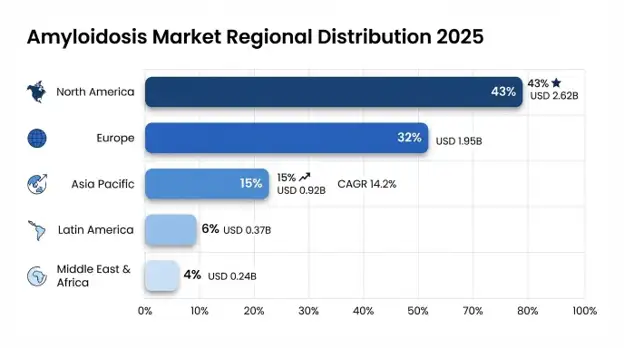
North America was found to be leading in terms of the amyloidosis market share, with its share amounting to USD 2.6 billion in 2025 and is predicted to register a CAGR of 12.4% during 2025-2034. Leadership by North America in the market is attributable to the availability of specialized amyloidosis care centers with multidisciplinary approach, full insurance coverage of expensive orphan drugs, and presence of key pharmaceutical companies.
The U.S. accounts for 84% of the regional market. Medicare coverage of approved drugs and strong infrastructure for rare diseases pharmaceuticals facilitate rapid adoption of newly approved drugs. The regulatory framework facilitates rapid development of the product owing to orphan drug designation, which offers seven years of market exclusivity, and breakthrough therapy designation, resulting in faster FDA approval process of several amyloidosis therapeutics.
The Asia Pacific region was the fastest-growing region with forecasted CAGR of 14.2% up until 2034, accounting for a market size of USD 0.9 billion in 2025. This growth would be supported by increased awareness regarding the hereditary forms of ATTR amyloidosis in the endemic regions like Japan, which has a high incidence of the Val30Met TTR variants in certain geographic clusters. Japan is the biggest market in the Asia Pacific region due to its presence of rare disease pharmaceutical frameworks, approval for treatment under national health insurance, and the availability of academic medical centers with specialized knowledge about amyloidosis.
China and India are emerging markets for amyloidosis therapies. due to increased spending on healthcare, expansion in the number of specialists, and rare disease awareness. Rare disease registries, genetic testing services, and specialist education initiatives would increase the diagnosed population significantly.
ATTR amyloidosis is the biggest market segment due to the rise in diagnosis rates, awareness, and presence of therapies that target both the inherited and wild types of this condition. Technological advancements in terms of imaging and genetic tests have made it easier to detect ATTR amyloidosis earlier, while innovation in RNA and transthyretin-stabilizing therapies will help this segment sustain its growth in the coming years.
The second largest indication segment is AL amyloidosis, which has seen considerable growth owing to the innovations in plasma cell-directed treatments and better treatment protocols that have led to better patient outcomes. Adoption of therapies involving the use of monoclonal antibodies has helped the segment grow. AA amyloidosis constitutes a small part of the overall market, where patients are treated for their underlying chronic inflammation problems.
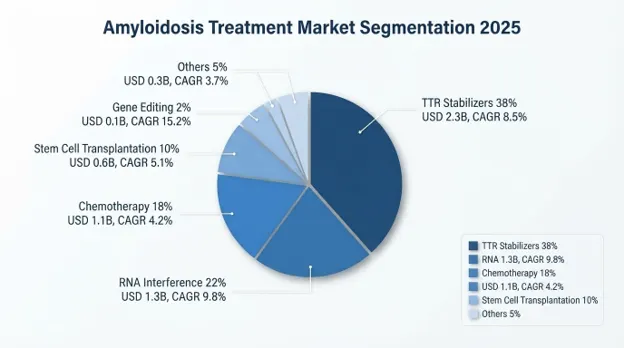
TTR Stabilizers are the biggest market segment, accounting for 38% share worth USD 2.3 billion in 2025 at a 13.1% CAGR until 2034 owing to the success of tafamidis and upcoming next-generation stabilizers such as acoramidis. RNA Interference Therapeutics are the second-biggest segment with a market share of 22% worth USD 1.3 billion in 2025 at a 18.4% CAGR until 2034 due to increased use in ATTR treatments.
Chemotherapy and stem cell transplantation together account for a 28% market share. worth USD 1.7 billion in 2025 and involve plasma cell targeting for AL amyloidosis patients using daratumumab combinations and autologous transplantation when possible. Monoclonal Antibodies for Amyloid Fibrils are the new and most promising therapy segments with maximum growth potential.
Hospitals and specialized centers collectively account for a 71% market share., because of the complicated nature of the condition’s management, which requires specialists in various fields, sophisticated diagnosis and administration of therapies. High-volume amyloidosis centers contribute to a larger part of the spending on therapy than expected.
The amyloidosis market is moderately concentrated, where some major companies such as Pfizer, Alnylam Pharmaceuticals, Ionis Pharmaceuticals, Johnson & Johnson, and BridgeBio Pharma together control a market share of 65-70% through their effective products that have been launched along with a highly developed product pipeline. Competitor differentiation is based on clinical evidence, ease of administration, broad indications covering both neurological and heart-based conditions, and next generation drugs with better performance.
April 2026: Vutrisiran has been approved by the FDA for the treatment of ATTR cardiomyopathy based on positive results from the HELIOS-B trial, thereby widening the approved indication from only polyneuropathy and bringing in competition with tafamidis.
March 2026: Acoramidis has been approved by the FDA for ATTR cardiomyopathy, becoming the first competitor for tafamidis and intensifying price competition.
February 2026: NTLA-2001 by Intellia Therapeutics achieved positive interim Phase II data showing a sustained 90% TTR lowering at 18 months after a single dose treatment, moving to Phase III.
January 2026: Eplontersen received FDA approval by Ionis Pharmaceuticals and AstraZeneca for treating hereditary ATTR with polyneuropathy, which allows monthly subcutaneous dosing compared to weekly inotersen.
You'll get the sample you asked for by email. Remember to check your spam folder as well. If you have any further questions or require additional assistance, feel free to let us know via-
+1 724 648 0810 +91 976 407 9503 sales@intellectualmarketinsights.com
23 Jul 2026
Intellectual Market Insights Research © 2026. All rights reserved.