Share this link via:

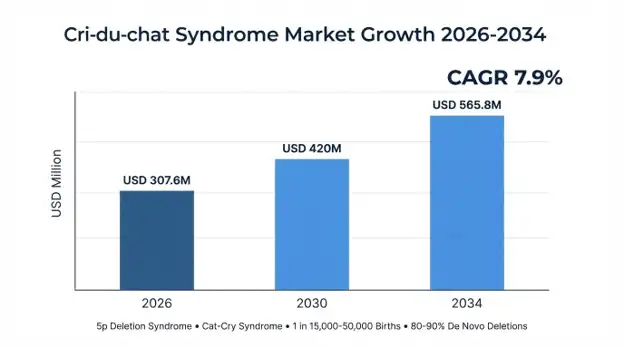
The Cri-du-chat syndrome global market size reached $285.4 million in 2025 and was anticipated to gain a value of USD 307.6 million by 2026, and then the size of the market for Cri-du-chat syndrome was USD 565.8 million by 2034, as the market was expected to grow with a CAGR of 7.9% in the forecast period (2026-2034).
Cri-du-chat syndrome, referred to also as the 5p- (5p minus) syndrome or cat-cry syndrome, is a rare chromosomal disorder and a genetically caused syndrome in which there is a partial deletion of the short arm of chromosome 5. The syndrome is named so because the cry of babies with this syndrome tends to be shrill and sounds like a cat, and this occurs because of the structural and neurological abnormalities of the larynx. The disorder has a wide spectrum of presentations, such as moderate-to-severe mental retardation, global developmental delay, microcephaly, hypotonia, specific characteristic dysmorphism of the face (hypertelorism, rounded face, low-set ears), feeding difficulties, and, among a subset of patients, congenital cardiac and skeletal anomalies. Clinical severity of the condition depends much on the size and location of the missing chromosomal material, with larger deletions towards the telomeric end typically presenting a stronger developmental or somatic impairment, and 80-90% of all cases being caused by the occurrence of de novo deletions, which occur spontaneously during gametogenesis, whereas the remaining 10-20% of patients have the syndrome caused by unbalanced translocations inherited from a carrier of a balanced chromosomal translocation in 5. World birth prevalence has been reported as around 1 per 15,000 to 1 in 50,000 births, resulting in a cumulative live patient’s population estimated to be in tens of thousands globally in view of survivorship of patients into adolescence or adulthood as better survival in Cri-du-chat syndrome patients in addition to the growth in the total population is accounted for.
No causal or disease-modifying pharmacotherapy for Cri-du-chat syndrome exists, so care provision for Cri-du-chat syndrome patients is a lifetime commitment, multidisciplinary, and supportive in nature. Care guidelines follow a pathway with early intervention and structured therapy sessions (intense physical and occupational therapy programs, speech and language therapy with assistive devices, and behavior intervention programs), medical management programs (managing seizures, gastroesophageal reflux, and disturbances of sleep), and drugs for treating psychiatric issues such as behavioral aberrations and self-injury. However, some of the genes in the critical genetic region of Cri-du-chat syndrome are already linked with features that are evident in patients, such as Sema5a, which has been linked with features that are suggestive of autism-like behavior, and Ctnnd2, which has been shown to correlate with the level of both speech delay and intellect, and deletions extending further towards 5p15.33 could potentially incorporate TERT, which encodes telomerase reverse transcriptase, which has already been explored for correlation with phenotype variability in some of these patients.
The diagnostic ecosystem in Cri-du-chat syndrome (CDC) is a major subdivision that contributes to the total market. Diagnostically, standard karyotyping remained the foundation of the original diagnosis in CDC syndrome, with targeted verification via fluorescence in situ hybridization (FISH) being subsequently utilized to confirm deletion. Today, however, chromosome microarray analysis (CMA) is the first-tier diagnostic approach favored for its increased resolution, enabling precise delineation of the deletion breakpoints and size, guiding the prognosis and genetic counseling. The application of NGS is becoming increasingly used for comprehensive genomic characterization, especially when a typical presentation of CDC syndrome has been confirmed or suspected, whereas prenatal detection can be achieved by use of chorionic villus sampling or amniocentesis after an abnormal sonographic examination has been obtained to detect CDC syndrome prenatally.
On the commercial scale, the market for this syndrome reaches far beyond solely a diagnostic or pharmacological product-oriented framework; rather, it spans into an expanded therapeutic ecosystem of rehabilitation services, augmentative & alternative communicative aids & multidisciplinary care systems for CDC patients. While it is true that individual treatment cost for severely affected individuals is substantial owing to their lifelong and multidisciplinary intensive care needs (dominated by therapy services, special education, and various other long-term care necessities), they don't translate entirely into increased drug spending. A major need of undeveloped remedies is the absence of genotype-targeted remedies and wide gaps present between regions for accessibility of specialized multidisciplinary care and heavy reliance on informal caregiving; these factors create a significant challenge and, on the same hand, an opportunity to create market solutions that improve outcomes and life quality for the affected population and their caregivers as well.
| Report Coverage | Details |
|---|---|
| Base Year | 2025 |
| Base Year Value | USD 285.4 Million |
| Forecast Value | USD 565.8 Million |
| CAGR | 7.9% |
| Forecast Period | 2025-2034 |
| Historical Data | 2022-2025 |
| Largest Market | North America |
| Fastest Growing Market | Asia Pacific |
| Segments Covered | By Treatment Type, Diagnostic Technique, Age Group, End-User, Region |
| Region Covered | North America, Europe, Asia Pacific, Middle East & Africa, Latin America |
| Countries Covered | US, Canada, Mexico, UK, Germany, France, Italy, Spain, China, Japan, India, Australia, South Korea, Brazil, UAE, South Africa |
| Key Market Playes | Illumina Inc., Thermo Fisher Scientific, Roche Diagnostics, Agilent Technologies, Tobii Dynavox, Ultragenyx Pharmaceutical, Ovid Therapeutics |
Get more details on this report - Request Free Sample
Increasing utilization of chromosomal microarrays in both pediatric neurology and prenatal practices, along with the expanding use of next-generation sequencing, is increasing the sensitivity of identifying chromosome 5p deletions, which would have previously been overlooked, thus increasing the patient population captured by structured care pathways. CMA adoption for unexplained developmental delays has been increasing for several years among developed healthcare systems, with a strong recommendation from established genetic societies as a first-line test.
Continued Demand Driven by Growing Clinical Evidence for Enhanced Intervention With increasing clinical evidence showing benefits in developmental and communication outcomes with early, intensified multidisciplinary intervention, persistent demand for speech and language, physical and occupational therapies, and augmentation communication systems is anticipated as early intervention support programs gain broadened coverage across high-income markets. Increased Survival Drives Long-Term Market Growth Advances in neonatal and pediatric care have led to increasing survival into adolescence and adulthood, opening a prolonged window for treatment for many and fueling growth for post-acute care facilities and services and adult neurology and psychiatry and community-based services due to the extension of the patient care journey over longer lifetimes.
No disease-modifying approved drugs for the treatment of Cri du chat, the market drug for the most part would be dominated by off-label use of generic drugs for concomitant conditions. The limited number of the world's population affected with the disease means that drug companies would not make large investments for developing disease-specific drugs. Variable availability of diagnosis and specialized rehabilitation across the region, Cri du chat remains underdiagnosed in many low- and middle-income countries due to lack of infrastructure and resources for cytogenetic testing and the poor availability of trained staff, the variability in reimbursement for ongoing care, and availability of assistive devices.
Current and upcoming research efforts exploring approaches to targeting gene(s) of interest within the critical deletion region (and thus potentially disease-modifying) by utilization of adeno-associated virus vector engineering, antisense oligonucleotide technology, and approaches proven effective in gene therapy for other rare neurogenetic disorders are just beginning to be explored.
The increasing use of telerehabilitative speech and behavior therapy services, along with innovations in augmentative and alternative communication software and the use of eye-tracking interfaces, is improving the reach of evidence-based treatment to nonverbal and minimally verbal individuals with this and other rare communication disorders in underserved areas.
The increasing growth in international patient registries and natural history studies is accumulating longitudinal data, the accumulation of which is also a benefit for more informed future clinical trials and the definition of standard outcome measures. Professional genetics and pediatrics societies are further standardizing consensus guidelines in periodical multidisciplinary assessments aiming at more regular and comprehensive pathways for complex care at specialized centers.
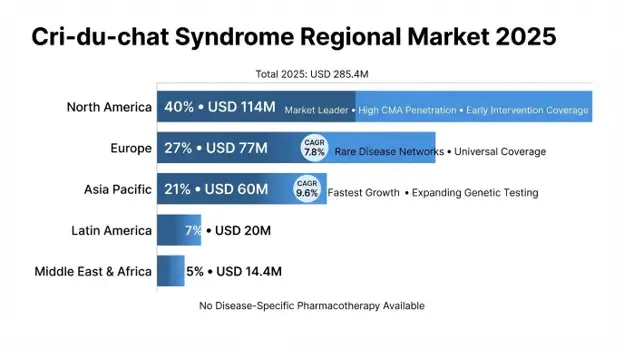
North America was the largest regional market in 2025, with $114 million and an estimated CAGR of 7.6% from 2025 to 2034, driven by high diagnostic penetration via chromosome microarray testing, well-established rare disease research facilities, strong rare-disease patient advocacy groups, and comprehensive insurance plan coverage in the US and Canada for early intervention and rehabilitation services.
Europe was the second-largest market in 2025 at $77 million, with centralized rare disease reference networks, national registries, and universal public and health insurance coverage provided to countries such as Germany, France, the United Kingdom, Italy, and Spain facilitating standardized management through a multidisciplinary approach.
Asia Pacific is the rapidly growing region expected to capture $60 million in 2025 with a projected CAGR of 9.6% through 2034, on the back of a rapidly growing infrastructure for genetic testing for the major markets such as China, Japan, India, and South Korea; increasing awareness among pediatrician groups; and favorable government policies on diagnostics and reimbursement in China. However, Latin America and the Middle East & Africa remain nascent regions; the market was USD 20 million and USD 14.4 million in 2025.
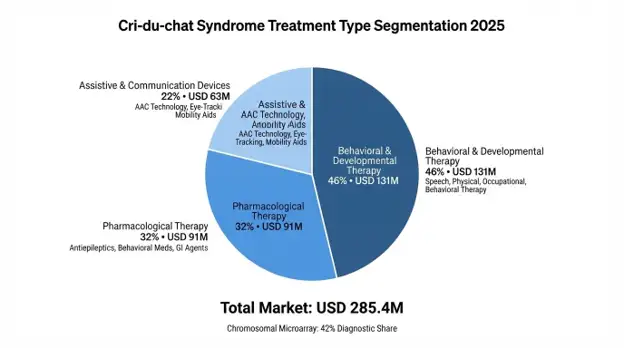
By treatment type, behavioral & developmental therapy is the biggest segment, taking up about 46 percent of the market in 2025 and valued at USD 131 million, showing the often long and involved nature of speech, physical, occupational, and behavioral therapies prescribed throughout a patient's lifetime. Pharmacological therapy makes up about 32% (worth USD 91 million and spurred by long-term chronic medication needs such as seizures, reflux, and behavioral co-morbidities), and assistive & communication devices make up 22% (worth USD 63 million and increased by the adoption of augmentative & alternative communication technology).
By diagnostic technique, chromosomal microarray is at the front of the pack, accounting for nearly about 42% of the entire market revenue (USD 120 million in sales), primarily due to its accuracy of deletion (microdeletions and microduplication) mapping in DNA and its approval as the 'first-tier' test standard for diagnoses and is directly followed by fluorescence in situ hybridization, or FISH technology, which accounted for 24% of the revenue (USD 68 million in sales). The next best technique is karyotyping, which holds about 20% of the total revenue (USD 57 million in sales), and next-generation sequencing technology holds the smallest market share of 14% of the global market revenue (USD 40 million in sales) but currently exhibits the fastest growth as it expands in scope of comprehensive genomic analysis.
By end-user, hospitals & clinics comprise the dominant sector at 40% (USD 114 million), encompassing the time of first diagnosis, specialist consultations, and management of medical comorbidities; this is followed by rehabilitation & therapy centers at 30% (USD 86 million). Home Healthcare at 18% (USD 51 million); and Specialized Genetic Centers at 12% (USD 34 million)—the latter is of growing importance in the coordination of chronic care management and a means to participate in research.
Cri-du-chat Syndrome Market Overview The Cri-du-chat syndrome market is characterized as a highly fragmented market focused mainly on services and diagnostics due to the lack of any approved specific disease pharmaceutical product. Genetic diagnostics market players focus on the analytical sensitivity of their products and the breakpoint resolution capabilities in their analytical instrumentation, as well as seamless integration into clinical laboratory settings. In the case of augmentative communication device suppliers, competitive advantages are built on their ability to make the products user-friendly and adaptable for patients who exhibit extremely limited cognitive and motor skills.
Service providers, including the centers specialized in genetic testing, specialist centers for rehabilitation, and registries run by patient advocacy groups, are the remaining market players.
Their respective comparative advantage lies in clinical expertise and the integrated approach among various professionals involved in their services.
By Treatment Type:
By Diagnostic Technique:
By Age Group:
By End-User:
By Region:
You'll get the sample you asked for by email. Remember to check your spam folder as well. If you have any further questions or require additional assistance, feel free to let us know via-
+1 724 648 0810 +91 976 407 9503 sales@intellectualmarketinsights.com
17 Sep 2026
Intellectual Market Insights Research © 2026. All rights reserved.


