Share this link via:

The global donidalorsen market was valued at approximately USD 145 million in 2025 and is projected to reach USD 216 million in 2026, expanding to USD 985 million by 2034, growing at a CAGR of 20.9% during the forecast period (2026–2034).
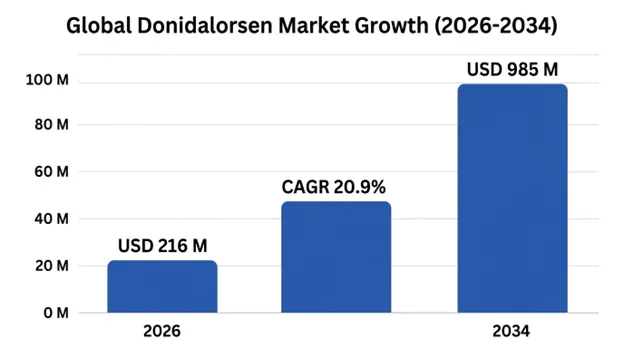
Donidalorsen emerges as one of the most significant advancements in the prophylactic treatment of hereditary angioedema due to its use of the LICA technology developed by Ionis Pharmaceuticals. As an antisense oligonucleotide under investigation, donidalorsen seeks to lower levels of prekallikrein, which is a crucial substance produced in the body of hereditary angioedema patients due to the overproduction of the protein associated with bradykinin synthesis in the kallikrein-kinin pathway.
Hereditary angioedema is relatively rare and strikes about 1 in 50,000 people around the globe. The symptoms include repeated episodes of severe swelling in subcutaneous and submucosal tissues, particularly those of the face, limbs, genitalia, and even larynx. The disease stems from a deficiency or dysfunction of the C1-inhibitor protein, thereby causing contact system activation and release of excess brain. Although several treatments exist for the disease, they require frequent administration, which poses a great challenge for those who have been suffering from this disorder for many years.
The commercial potential of donidalorsen is linked to its unique clinical differentiation that provides the patient with an injectable formulation of the drug combined with the flexibility of administration every 4 to 8 weeks, which represents a significant improvement over current therapies that must be administered every week, two weeks, or even daily. Data obtained in pivotal OASIS-HAE Phase III trials have revealed that patients experienced a significant decrease in the frequency of attacks of hereditary angioedema, achieving 81% and 55% reductions when treated every 4 weeks and every 8 weeks respectively compared to the placebo group.
| Report Coverage | Details |
|---|---|
| Base Year | 2026 |
| Base Year Value | USD 145 Million |
| Forecast Value | USD 985 Million |
| CAGR | 20.9% |
| Forecast Period | 2025-2034 |
| Historical Data | 2022-2025 |
| Largest Market | North America |
| Fastest Growing Market | Europe |
| Segments Covered | Age Group, Dosing Regimen, Distribution Channel, End-User, Region |
| Region Covered | North America, Europe, Asia Pacific, Middle East & Africa, Latin America |
| Countries Covered | US, Canada, UK, Germany, France, Italy, Spain, Japan, China, Australia, Brazil, Mexico, UAE, Saudi Arabia |
| Key Market Playes | Ionis Pharmaceuticals Inc,Otsuka Pharmaceutical Co., Ltd,Takeda Pharmaceutical Company Limited (Competitive) ,BioCryst Pharmaceuticals Inc. (Competitive) ,CSL Behring LLC (Competitive |
Get more details on this report - Request Free Sample
The main factor driving donidalorsen market growth is driven by its impressive synergy between significant clinical effectiveness and flexible dosing capability to meet treatment burden issues associated with hereditary angioedema therapy. The OASIS-HAE clinical trials confirmed the significant attack reduction and the most convenient administration schedule of any subcutaneous prophylactic drug available. The novel eight-week dosing regimen represents a transformative approach, cutting down the number of annual injections to six compared to 26-52 administered with competitive alternatives.
The benefits gained from flexible dosing schedules manifest into significant patient compliance, improved quality of life, and greater satisfaction with treatments. Clinical trials have revealed that more than 70% of patients receiving every-4-week dosing had complete attack freedom after the observation period, and patients’ quality of life was improved by 65% compared to baseline levels. Flexibility in switching between 4-week and 8-week dosing schedules is one of the advantages physicians can leverage when optimizing patients' treatment regimens as there are no similar opportunities with competing drugs.
The antisense oligonucleotide strategy targeting prekallikrein biosynthesis at the RNA level provides continuous efficacy due to intervention at an early stage of the pathway. Such a feature distinguishes donidalorsen from protein replacement treatments and direct inhibition of enzyme activity.
Market penetration for donidalorsen is significantly supported by well-designed commercialization agreements such as the exclusive licensing agreement between Ionis Pharmaceuticals and Otsuka Pharmaceutical for European countries. This is achieved through leveraging Otsuka’s existing infrastructure to access rare disease markets, along with its expertise in regulation and commercial activities within European Union member states.
This kind of arrangement helps address the challenges of the European health system that demand separate negotiations for each European country regarding pricing and reimbursement. Missing commas and awkward structure of donidalorsen help in gaining positive health technology assessments and inclusion in key formularies in Europe.
Disease awareness campaigns, genetic screening programs for patients with undiagnosed hereditary angioedema, and strong patient support programs are increasing the target market to include more patients than those currently treated. This is particularly important because hereditary angioedema remains significantly underdiagnosed, with an average diagnosis delay period of 8-10 years from symptom appearance in developed countries.
Market entry challenges associated with donidalorsen arise mainly from competition from established prophylactic options that have demonstrated superior safety records as well as high physician comfort levels. The bi-weekly to monthly dosing schedule of Takeda Pharmaceuticals lanadelumab and the convenience of oral administration of BioCryst Pharmaceuticals berotralstat twice daily make both agents leaders in this segment.
However, physician preference is characterized by clinical inertia, where physicians do not consider switching patients receiving a stable drug therapy unless there is a compelling reason such as increased efficacy in prevention of attacks or better tolerability.
The market remains highly dynamic due to the development of several promising next-generation therapies including orally administered drugs and gene therapy techniques, which makes long-term competitive success very challenging.
As a new antisense oligonucleotide used for ultra-rare diseases, donidalorsen enjoys the luxury of premium pricing associated with orphan drugs, with annual treatment costs are expected to range between USD 400,000-600,000 per patient annually. To obtain positive reimbursement, extensive pharmacoeconomic arguments must be presented in support of the high cost of the drug in exchange for lower utilization of emergency services, reduced admissions, and improved productivity through controlled disease progression.
Difficulties are anticipated in European markets due to rigorous HTA performed by organizations such as NICE, G-BA, and other reimbursement organizations that will require comparison of efficacy against current standards of care treatments available. Delays due to price negotiations as well as possible step-therapy restrictions will likely pose challenges.
The relatively small number of patients associated with ultra-rare diseases supports premium pricing but also creates reimbursement risks due to patient-specific reimbursement determinations.
There are significant growth opportunities in the development of pediatric indications due to the onset of hereditary angioedema symptoms occurring in the pediatric age group where early preventive treatment can save lives and reduce mental stress from the disease during critical developmental stages.
Due to its small volume subcutaneous delivery via autoinjector, donidalorsen is an excellent drug for pediatric indications as it minimizes the problem of injection fear while extended dosing intervals mean fewer disruptions to educational and social activities. Successful pediatric trials will not only support additional regulatory exclusivity protections but also prolong patents which can significantly extend product lifecycles.
Given the potential to optimize the oligonucleotide-based drug platform, new delivery mechanisms and combination therapies can provide additional value in protecting the drug from competition from protein-based biosimilars.
Long-term growth potential from emerging markets in Asia Pacific, Latin America and Middle Eastern countries where hereditary angioedema diagnosis rates are considerably low compared to developed markets due to poor genetic testing facilities and specialist knowledge. With improved healthcare systems and rare disease framework, significant growth opportunities exist in these emerging markets for premium products.
Short-term growth opportunity exists in Japan, South Korea, and Australia with established rare disease coverage systems and development of hereditary angioedema specialists. The national registry of rare diseases and increase in healthcare coverage among the middle-class population will provide growth opportunities in China in the long term.
Precision medicine approach for the treatment of hereditary angioedema patients based on the use of biomarker testing has been gaining importance in recent times. Donidalorsen targets the generation of prekallikrein and hence makes it possible to monitor treatment efficacy using biomarkers such as prekallikrein concentration in plasma and high molecular weight kininogen fragments.
Future protocols for patient care might include testing biomarkers at baseline to determine which individuals will respond well to antisense oligonucleotides. Therapeutic drug monitoring can be used to determine optimal dosages. Such strategies allow one to confidently make the move from 4 weeks to 8 weeks of maintenance dosing due to biochemical data.
Commercial success has become increasingly dependent on real-world evidence generation using digital health technologies, patient registries, and electronic health records. The launch of Donidalorsen will benefit from the systematic collection of data on attack rates, healthcare use, quality-of-life indicators, and treatment satisfaction in standard clinical practice settings.
The real-world evidence framework facilitates negotiations for outcomes-based agreements with payers, under which reimbursement is conditioned on the proven reduction in attacks and cost savings realized within the population undergoing treatment.
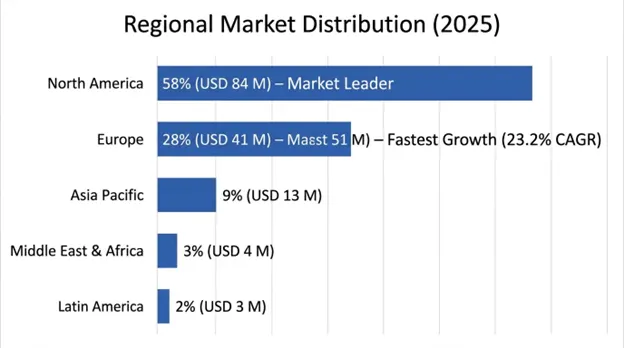
North America holds the most commanding market share position, accounting for about 58% of worldwide donidalorsen sales due to FDA approval, which allows the drug to be marketed reimbursement for rare disease patients via Medicare and commercial health insurance and high diagnosis rates for hereditary angioedema globally. The US alone accounts for 91% of the regional market’s total sales owing to well-developed commercial orphan drug infrastructure.
The region is fortunate in having developed expert networks for hereditary angioedema in academic centers, established disease advocacy groups pushing for disease recognition, and the healthcare system's ability to pay top dollar for ultra-orphan treatments in exchange for robust clinical data. The specialty pharmacy supply chain offers a cost-effective platform for the delivery of biologicals that require temperature control.
US hereditary angioedema diagnosed patient population estimated at 13,500-15,000 individuals.
Commercial insurance prior authorization approval rates for hereditary angioedema prophylaxis exceed 78%.
Average annual prophylactic therapy costs reach USD 420,000-485,000 per patient.
The fastest growing regional market segment is represented by Europe with its expected 23.2% CAGR until 2034 attributed to commercialization of Otsuka Pharmaceutical's products by leveraging its established regulatory and distribution infrastructure for EU markets. The region's growth potential is underpinned by positive outcomes of health technology assessment in key markets like Germany, France, and UK.
The profile of European hereditary angioedema treatment indicates significant dependence on conventional replacement treatment options making the transition to antisense oligonucleotides possible due to reduced need for intravenous administrations. Favorable conditions in Europe include availability of patient registries and dedicated treatment facilities dealing with difficult cases of hereditary angioedema.
The adult segment is the leading market segment, accounting for 88% of total revenues due to regulatory approvals initially targeted for adults and higher prevalence of diagnosed symptomatic HAE among adults who have been treated previously. Adult patients show preference for long-term dosing intervals without interfering with their professional and personal commitments.
Adolescents are expected to be the fastest-growing segment due to availability of clinical data among pediatrics and approval for younger patient segments. Adolescent and pediatric indications are more attractive due to donidalorsen’s ease of administration through subcutaneous injections and prolonged dosing intervals without affecting school attendance and development.
Every 4 Weeks dosing is the dominant market leader for use in initiating treatment to set up disease baseline control and physician assurance on treatment effectiveness. Every 4 Weeks dosing allows fast attainment of steady state and total disease prevention during treatment period transitions.
Every 8 Weeks dosing is the fastest-growing category that will dominate the market by 2030 once the patient attains disease stability and adopts maintenance therapy. Every 8 Weeks dosing schedule is what gives donidalorsen its key competitive advantage, unmatched convenience for injectables, but without compromising its effectiveness.
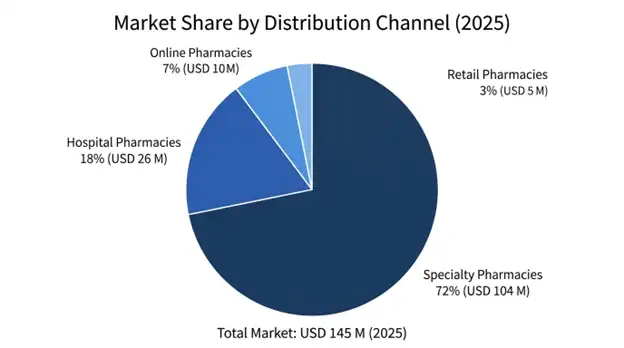
Specialty pharmacies account for the largest distribution share with 72% of market share because of the unique handling needed, reimbursement difficulties, and the additional service required in the administration of ultra-orphan therapies. This channel offers services such as insurance authorizations, adherence monitoring, and patient delivery.
Hospital pharmacies represent the second-largest distribution channel with 18% of market share. Patients undergoing therapy for the first time receive their medications within specialized HAE centers through the hospitals.
Hospitals and specialized centers account for 64% of the end-user’s market share, as the diagnosis and treatments for hereditary angioedema are mostly carried out at teaching hospitals and specialized immunology clinics. This segment provides comprehensive services ranging from genetic analysis, family screening, management of attacks, and optimization of prophylaxis.
Ambulatory care centers account for 24% of the market value, which is used to serve existing customers who need monitoring and adjustments of the dose in outpatient specialized centers. The homecare market is emerging, where patients can self-administer treatments after being initially supervised by clinicians.
The global donidalorsen market operates within the broader hereditary angioedema treatment industry in which Ionis Pharmaceuticals is the dominant player using its patented LICA antisense technology. Competitive positioning is driven by donidalorsen’s unique ability to offer flexible dosing, high effectiveness, and an improved safety profile in comparison with existing subcutaneous and oral prophylactics.
Competitive advantages include proof from clinical studies of greater efficacy in preventing attacks, convenience associated with the dosing schedule, effective patient support programs, and business alliances allowing global commercialization. Product success depends on physician education about antisense oligonucleotides, positive formulary placement due to contracting with payers, and real-world evidence creation.
March 2026: Ionis Pharmaceuticals announced the completion of open-label extension studies lasting three years which showcased sustained donidalorsen efficacy through an 87% attack reduction and good long-term safety profile, facilitating lifecycle management and competition against other prophylactic therapies available on the market.
February 2026: The European Medicines Agency granted the drug its marketing authorization for use in the prophylaxis of hereditary angioedema among adult and adolescent patients, enabling the commercial launch of the drug by Otsuka Pharmaceutical in European Union member states, including Germany, France, and the United Kingdom.
January 2026: The FDA granted marketing authorization of donidalorsen for hereditary angioedema prophylaxis using either every 4 weeks or every 8 weeks dosing regimen, offering healthcare providers increased flexibility when tailoring treatments for their patients.
December 2025: Ionis Pharmaceuticals initiated pediatric clinical trials with donidalorsen among hereditary angioedema patients aged between two to seventeen years, with the primary endpoint being safety and pharmacokinetic data.
November 2025: Otsuka Pharmaceutical managed to secure favorable pricing and reimbursement agreements from the German Federal Joint Committee as well as the French National Authority for Health.
You'll get the sample you asked for by email. Remember to check your spam folder as well. If you have any further questions or require additional assistance, feel free to let us know via-
+1 724 648 0810 +91 976 407 9503 sales@intellectualmarketinsights.com
22 May 2026
Intellectual Market Insights Research © 2026. All rights reserved.