Share this link via:

The global ethionamide booster market was valued at USD 89.2 million in 2025 and is projected to reach USD 98.6 million in 2026, expanding to USD 201.4 million by 2034, growing at a CAGR of 10.9% during the forecast period (2026-2034).
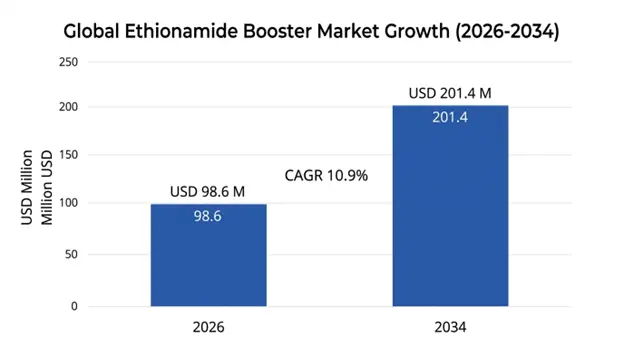
Ethionamide boosters represent an emerging generation of drug enhancers, engineered to address the inherent disadvantages associated with ethionamide, an important drug employed as a second-line antitubercular agent in the treatment of multidrug-resistant tuberculosis (MDR-TB). In this regard, these novel drugs act by inhibiting the repressor protein EthR the biosynthesis of the ethionamide monooxygenase enzyme, EthA. By derepressing the expression of EthA, these boosters promote the conversion of ethionamide to its active form, thereby increasing its bactericidal efficacy even at lower concentrations.
The molecular mechanism underlying ethionamide activation was established following key insights derived from cutting-edge structural biology studies carried out at Institut Pasteur de Lille, wherein researchers solved the crystal structure of the EthR transcriptional repressor and found the repressor’s ligand-binding site as a potential drug target. EthR acts as an inhibitor of ethA gene expression by binding specifically to the DNA regions upstream of the ethA gene and blocking gene expression, thus acting as the bioactivation enzyme. The introduction of small molecule inhibitors of EthR into its ligand-binding pocket causes a significant decrease in DNA-binding capacity, leading to transcription derepression.
This mechanism creates a powerful pharmacological amplification effect where ethionamide bioactivation is enhanced several-fold within the mycobacterial cell. The mathematical relationship can be expressed as:
$$D_{boosted} = frac{D_{standard}}{alpha} $$
Where D_boosted represents the required ethionamide dose with booster co-administration, D_standard is the conventional therapeutic dose, and α represents the enhancement factor. Clinical studies suggest α values ranging from 3-10, enabling dose reductions of 60-90% while maintaining therapeutic efficacy.
The significance of ethionamide boosters lies not only in reducing the dose but also in overcoming the major limitations associated with the use of ethionamide as part of the regimen for treating MDR-TB. The use of ethionamide alone involves the administration of large amounts of drug that usually cause severe side effects such as nausea, vomiting, and abdominal discomfort (40-60%), hepatitis (5%), and neuropsychiatric disorders including peripheral neuropathy and mental changes.
These side effects usually require dose adjustments or discontinuation of ethionamide, thus affecting its effectiveness in curing TB. Ethionamide booster is expected to overcome this limitation by ensuring bactericidal activity at a dose that does not exceed the toxicity limit, thus making ethionamide a better-tolerated therapy that can be used as a crucial drug for treating MDR-TB.
The ethionamide booster market considers the larger picture of drug-resistant TB in the world, where there are around 410,000 new cases of MDR-TB and rifampicin resistant tuberculosis every year, while treatment success rates remain only 57%. These market dynamics stem from the fact that tuberculosis is concentrated mostly among poorer developing nations, thus requiring innovative financing techniques such as donations, tier pricing, and partnerships.
| Report Coverage | Details |
|---|---|
| Base Year | 2026 |
| Base Year Value | USD 89.2 Million |
| Forecast Value | USD 201.4 Million |
| CAGR | 10.9% |
| Forecast Period | 2025-2034 |
| Historical Data | 2022-2025 |
| Largest Market | Asia Pacific |
| Fastest Growing Market | Middle East & Africa |
| Region Covered | North America, Europe, Asia Pacific, Middle East & Africa, Latin America |
| Countries Covered | India, China, Indonesia, Philippines, Pakistan, Bangladesh, South Africa, Nigeria, Russia, Ukraine |
| Key Market Playes | GlaxoSmithKline, TB Alliance, Bioversys AG, Institut Pasteur de Lille |
Get more details on this report - Request Free Sample
The key factor that drives the growth in the market for ethionamide booster is the increasing problem of the burden of multidrug resistant tuberculosis (MDR-TB) globally, which is currently one of the most significant antimicrobial resistance threats to health security. According to WHO, around 410,000 new cases of MDR-TB and rifampicin-resistant TB emerge each year, with current treatments resulting in 57% success rate for MDR-TB and only 39% for extensive drug-resistant TB (XDR-TB). While treatment success rates remain only 57% implies that almost half of all diagnosed patients suffering from the condition will not be successfully treated, which results in the spread of the disease and its development of resistance.
Geographical distribution of the problem, with a high burden of MDR-TB cases observed in high-burden countries like India (119,000 MDR-TB cases annually), China (63,000 cases), Russia, South Africa, Indonesia, Philippines, and Pakistan, defines the target group within which the implementation of ethionamide boosters would have the highest public health impact. India alone accounts for 27% of the total global MDR-TB burden and, therefore, provides the biggest market opportunity and public health need.
WHO-recommended current MDR-TB treatment strategies, while being an improvement on historical practices, are fundamentally insufficient with respect to their duration, tolerability, and adherence. Standard treatment is associated with 18-24 months of daily therapy, monitoring, and use of drugs which have substantial adverse effects. Specifically, ethionamide is characterized by its adverse side effects of up to 40-60%, with hepatotoxicity affecting 5% of cases and neurological side effects reported for many patients.
Poor tolerability results in dose reductions, reducing efficacy of treatment, and increased dropout rate, thus creating treatment failure and promoting drug resistance. Mathematical models show that boosting MDR-TB therapy with ethionamide can result in improved success rates of 12-18% if 50-70% decrease in dosage can be achieved, constituting a revolutionary advance in treating the disease.
The first major challenge associated with the development of the ethionamide booster is the difficulty of proving clinical effectiveness through randomized trials with patients having MDR-TB owing to specific difficulties with this group of subjects such as extended treatment periods, heterogeneity of patients' resistance patterns, and ethical considerations regarding providing treatment to every participant in case of a placebo group. Clinical trials for MDR-TB medicines usually take about 3-5 years for a follow-up on the efficiency of treatments administered, which means an overall development period of 8-12 years.
The process of obtaining authorization for ethionamide boosters may also involve difficulties due to the nature of these drugs as pharmaceutical modifiers instead of antibacterial medications; therefore, there is no previous experience on the part of the FDA and the EMA in evaluating such preparations for treating tuberculosis.
Though there are clear justifications from a public health standpoint, the ethionamide booster drug will have natural business limitations including low patient volume relative to other diseases, where MDR-TB patients will be in lower income countries which depend on international financial support for their tuberculosis treatments. Complicated and costly trials for MDR-TB patients will involve multi-national and time-consuming processes, thus raising research costs, with price ceilings being determined by global health budgets and generics of second-line TB treatments.
A groundbreaking market opportunity lies in the development of ethionamide boosting compounds for inclusion in cutting-edge all-oral, short course MDR-TB therapy programs that embody the future trend in TB treatment. The international TB community is rapidly abandoning the use of injectable drugs in favor of safer and shorter courses of oral drugs aimed at 6–9-month regimens. Low-dose ethionamide-boosted preparations would be excellent candidates for inclusion in such therapies, taking the place of other costly or toxic compounds in the process.
According to mathematical models, boosting ethionamide by 5-10 times would make it possible to shorten MDR-TB therapy regimens from today's 18–24-month duration to 9-12 months, with enormous benefits for treatment compliance and cost reduction.
Therapeutic areas in tuberculosis offer special regulatory and economic incentives that add to business appeal despite the inherent characteristics associated with traditional markets. In the United States, novel tuberculosis drugs successfully approved qualify for the Tropical Disease Priority Review Vouchers worth anywhere from USD 90 million-110 million, thus serving as a great economic incentive to counterbalance the cost of drug development and make it a profitable venture.
Collaboration between the public sector and private organizations such as TB Alliance, UNITAID, and the Bill & Melinda Gates Foundation will help access non-dilutive financing that supports clinical development as well as create conditions for affordable drug distribution in high-burden regions.
The introduction of whole-genome sequencing for diagnosis of TB is changing the management of drug resistance and providing new possibilities of developing precision medicine in relation to the use of ethionamide boosters. With increased availability of whole-genome sequencing in high-burden countries via initiatives like the WHO Global Laboratory Initiative, health professionals will be able to quickly detect ethA and ethR mutations, which play a role in ethionamide resistance and booster efficacy.
This genetic information will make possible the use of ethionamide boosters only in those patients, whose isolation shows resistance mutations, which can be overcome using such boosters. The development of a companion diagnostic for patient stratification is among promising trends in the area.
The shift toward fixed-dose combination formulations combining ethionamide and booster compounds constitutes an important trend that can facilitate programmatic delivery and patient compliance. By simplifying treatment schedules, improving compliance due to reduced number of tablets, preventing the selective administration of individual components.
Offering more control to drug manufacturers over the value chain via innovative technologies, fixed-dose combination therapy is favored by national TB control programs and international donors.
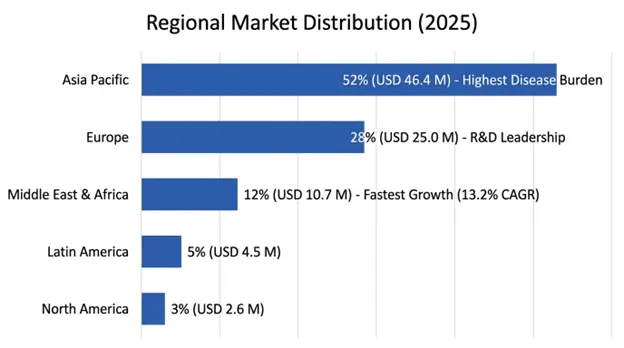
The Asia-Pacific region holds the largest market opportunity at around 52% of the world’s ethionamide booster market driven by the high burden of disease. The region accounts for about 56% of the total number of cases of MDR-TB globally, and among these, India, China, Indonesia, Philippines, and Pakistan account for most of those cases needing second-line therapies. India leads all the countries in terms of market potential due to the 119,000 annual MDR-TB cases in India and the country’s advanced tuberculosis elimination programs.
The Chinese national tuberculosis control program manages about 63,000 cases of MDR-TB annually using the highly developed healthcare system in the country that can easily implement new therapy systems once the product obtains regulatory approvals. There is ongoing regulatory reform in the country, and this has greatly improved the approval process.
About 28% of market value comes from Europe since this continent serves as the main hub of ethionamide boosting research and development rather than a market for such products. The origin of EthR inhibitor technology is found in France, represented by various research programs led by the research institutes of Institut Pasteur de Lille and Université de Lille and funded by grants from French National Research Agency and European Research Council, making Europe scientifically dominant in this field.
The regulatory framework developed by the European Medicines Agency for neglected diseases and antimicrobial resistance, which offers scientific advice and adaptive pathways to drugs for severe diseases, creates a favorable regulatory environment for the ethionamide booster product development programs aimed at obtaining European approval.
The Middle East & Africa segment is anticipated to be the most rapidly expanding regional market, exhibiting a CAGR of 13.2%, from 2022 to 2034. The factors that will drive the growth in this region include the expansion of infrastructure related to tuberculosis programs, increase in awareness of the drug-resistant tuberculosis condition as a key health concern, and investments by several donors in improving diagnostic and therapeutic capacities.
Fixed-Dose Combination Formulations are the most successful segment within the market of the drug under investigation, which are projected to account for 58% market share by 2034. Combining ethionamide with booster drugs in fixed-dose combinations simplifies the therapy regimen, increases compliance, eliminates selective dosing and pill burden for patients using multidrug regimens to treat their MDR-TB.
EthR Inhibitors as standalone entities constitute 52% of the market in 2025, representing a pre-clinical development segment where booster drugs are being developed on an individual basis before moving on to their combined development. This segment includes drug candidates during clinical trials as well as other preparations meant to be administered along with ethionamide.
BVL-GSK098 is the most clinically advanced ethionamide booster candidate, having reached Phase I clinical trials with good safety and pharmacokinetics in healthy volunteers, following the collaboration of GlaxoSmithKline and the Institut Pasteur de Lille. The success of this compound not only confirms the concept but also marks the successful establishment of a proof-of-concept for the booster strategy, where Phase II trials are being conducted with reduced ethionamide and booster combination.
SMARt-420 series of compounds belong to the group with considerable research effort made, being spiroisoxazoline-based EthR inhibitors from academic research projects that can overcome ethionamide resistance and achieve bioactivation through alternative pathways.
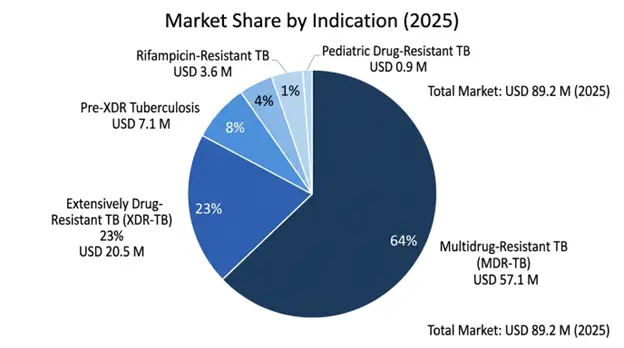
The Multidrug-Resistant Tuberculosis application makes up the largest portion of the market, constituting 64% of the total market. This application describes the situation under which treatment will yield most benefit using ethionamide boosting. It is for people who have rifampicin resistance or those with MDR-TB that require second-line treatment with ethionamide as part of the WHO protocol.
Drug-Resistant Tuberculosis represents the second-largest indication segment, 23%, of the total market. The application is not as large as the former, but due to the limited options available and the dire consequences, the need for ethionamide boosting is high.
The market for the ethionamide booster has some unique characteristics with respect to competition which make it quite different from other conventional pharmaceutical markets and include early development of its products along with significant influence from academia, product development partnerships, and public health organizations. GlaxoSmithKline and its collaboration with Institut Pasteur de Lille through the development of their compound BVL-GSK098 is the most advanced commercial development program, combining pharmaceutical and academic expertise.
TB Alliance plays an important coordinating role in the market by being a nonprofit organization for the development of new tuberculosis products. Their previous success with pretomanid makes it likely that this model will prove successful for the development of ethionamide boosters.
Bioversys AG is considered a notable leader in developing specific ethionamide boosters through networks of academics.
March 2026: GlaxoSmithKline and TB Alliance signed collaboration agreement on developing BVL-GSK098, where TB Alliance will take the lead role in designing the Phase II clinical trial in India and South Africa, with funding worth USD 48 million from UNITAID and Wellcome Trust.
February 2026: The Institut Pasteur de Lille released Phase I pharmacokinetics information on BVL-GSK098 that shows favorable drug-drug interactions with bedaquiline and linezolid, which increases the potential to develop it into innovative MDR-TB combination therapies.
January 2026: WHO Global Tuberculosis Programme issued revised treatment guidelines recognizing ethionamide booster concurrent administration as a research area of focus and setting the standard endpoints for Phase II clinical trials on booster-based treatments.
December 2025: UNITAID approved a grant worth USD 32 million for implementing booster ethionamide readiness activities, such as regulatory pathways in endemic nations, technology transfer in manufacturing processes, and health economics analysis for national medicine listing.
November 2025: Bioversys AG presented preclinical efficacy results of the next-generation EthR inhibitor, which showed a significant 650-fold increase in potency compared to its predecessor generation drugs.
You'll get the sample you asked for by email. Remember to check your spam folder as well. If you have any further questions or require additional assistance, feel free to let us know via-
+1 724 648 0810 +91 976 407 9503 sales@intellectualmarketinsights.com
22 May 2026
Intellectual Market Insights Research © 2026. All rights reserved.