Share this link via:

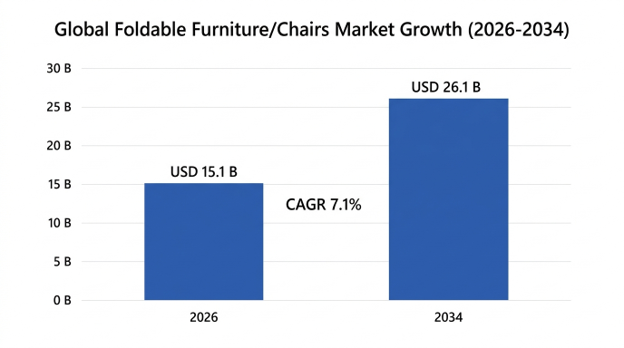
The global foldable furniture/chairs market size was valued at USD 13.9 billion in 2025 and is projected to reach USD 15.1 billion in 2026, expanding to USD 26.1 billion by 2034, growing at a CAGR of 7.1% during the forecast period (2026-2034).
Foldable furniture can be defined as an intelligent range of furnishings that is made through careful articulation of joints, machined hinges, telescopic and linkage designs for quick transition between operational states and storage states. The development of such furniture is driven by the need to solve inherent spatial challenges in modern life by using engineering that provides strength, functionality, and aesthetics, while still retaining the core attribute of folding or collapsing into a neat storage position. The evolution of foldable furniture from mere folding seats to architectural furniture has seen the incorporation of sophisticated locking mechanisms.
Modern folding furniture incorporates technologies ranging from basic joint mechanisms in bi-fold designs to advanced multi-joint systems that incorporate pneumatic help, spring-loaded folding, and locking mechanisms that have been tested to work thousands of times. Materials such as aerospace aluminum alloy, wood composites, high-density polyethylene, and performance fabric make up furniture that is comfortable, durable, and aesthetically pleasing like regular non-folding furniture but with added features of being compact and portable.
The commercial importance goes far beyond mere sales to encompass space management systems that merge the use of foldable furniture with interior design solutions, flexible workspaces, event management solutions, and sustainable living solutions. These solutions cover essential aspects of modern living such as urban apartment dwellings with very limited space, flexible hybrid working conditions with quick room conversion needs, changing occupancies of commercial spaces, and recreational outdoor activities.
| Report Coverage | Details |
|---|---|
| Base Year | 2025 |
| Base Year Value | USD 13.9 Billion |
| Forecast Value | USD 26.1 Billion |
| CAGR | 7.1% |
| Forecast Period | 2025-2034 |
| Historical Data | 2022-2025 |
| Largest Market | Asia Pacific |
| Fastest Growing Market | Asia Pacific |
| Segments Covered | By Product Type, Material, Application, Distribution Channel, Price Segment |
| Region Covered | North America, Europe, Asia Pacific, Middle East & Africa, Latin America |
| Countries Covered | US, Canada, Mexico, UK, Germany, France, Italy, Spain, China, Japan, India, Australia, South Korea, Brazil, Argentina, UAE, Saudi Arabia, South Africa |
| Key Market Playes | IKEA Group, Lifetime Products Inc., Dorel Industries, MillerKnoll, Steelcase Inc., Ashley Furniture Industries, Haworth Inc. |
Get more details on this report - Request Free Sample
The main factor influencing the growth of the foldable furniture market is the rise of the worldwide urbanization phenomenon that generates an increasing demand for space-saving living arrangements due to the spatial compression in metropolitan cities and increasing prices for real estate. According to UN estimates, there will be 4.5 billion people living in cities in 2025, growing to 6.7 billion in 2050. Over the past 10 years, city dwellers had to deal with the average reduction of 8-12% in apartment sizes owing to the need to maximize the number of units within the area. Apartments with 150 to 400 square feet of floor space became quite common in Tokyo, Hong Kong, New York, London, and Singapore.
These compressed spaces require furniture that can offer maximum functionality when used but be invisible in the utilized space after completing its main function, something which regular furniture fails to achieve. Foldable dining sets allow individuals living in apartments to hold dinner parties in the living room and then have the space restored for recreation right away, whereas foldable desks mounted on the walls allow individuals to establish workstations without disturbing the overall look of the bedroom. Micro-apartments witnessed an annual growth rate of 14.5% in development from 2022-2025.
Furniture that can be folded is now being used more frequently by real estate developers as a feature in small-scale residential projects, moving the market towards B2B contract sales rather than consumer-driven sales. According to property management firms, units that are furnished using foldable furniture can fetch premium prices of 15%-25% above those of unfurnished units.
Permanent establishment of remote and hybrid working practices has had a radical impact on space needs for housing, generating continuous demand for furniture that allows quick transformation of domestic spaces into professional spaces without leaving the place where one lives. It is estimated that around 38% of the world’s knowledge workers will be engaged in hybrid work by 2025, and most of them will not have home offices and thus will need to temporarily create an office in their bedroom, living room, or dining area. This trend has created significant demand for foldable chairs and desks as well as office systems that can transform a domestic space into an office space.
Spatial division between work and personal time has become increasingly crucial for psychological reasons and thus has led to folding office furniture being more than just an accessory. Folding office furniture that comes with such ergonomic features as lumbar support and adjustable height settings, as well as durability, has witnessed remarkable growth in the last years. The premium ergonomic foldable chair market has grown by 22% in 2025.
The digital nomad trend that includes about 4.8 million people worldwide by 2025 has increased the need for ultra-light portable and folding furniture with professional usability regardless of the type of accommodation. The key characteristic that defines products in this segment is the combination of minimal weight and optimal ergonomic efficiency.
The significant growth of the event management, hospitality, and flexible workspace sectors has created substantial commercial demand for foldable furniture products which allow for fast space modifications, storage efficiency, and effective stock management. As the global events sector, worth $1.8 trillion by 2025, is dependent upon foldable chairs and tables as its core furnishing component for organizing conferences, expos, wedding ceremonies, business meetings, and other gatherings involving different numbers of people.
Hotels and convention centers maintain hundreds of foldable chairs that require periodic replacement due to wear and tear over time, hence creating replacement opportunities for commercial manufacturers. Foldable chairs made for commercial use can easily last between 250,000-500,000 open-close cycles, come with upholstery that can endure at least 100,000 double rubs, and frames capable of withstanding static loads of more than 250 kilograms.
The co-working and flexible office space industry, which grew from 19,000 centers worldwide in 2019 to 42,000 centers by 2025, requires a constant supply of configurable furniture that can be easily reconfigured from individual workspaces to meeting rooms to event spaces. The main objective for co-working operators would be to adopt foldable and stackable furniture to boost revenue per square foot.
One of the biggest limitations on the growth of the market for foldable furniture is that there are many consumers who have a negative perception about this type of furniture and believe that it will be of lower quality and less durable than other traditional types of furniture. This is largely because of experience, when this type of furniture was not as advanced and had problems with unstable structures, poor seating surfaces, and a design that lacked aesthetic appeal. Foldable furniture is more structurally complex and has more parts that can break down than static furniture.
Cost pressures in economy and mid-tier products can lead to poor component quality, such as thin gauge metals, lower quality plastics and poor-quality fasteners, which shorten product life cycles and negatively impact consumer experience. The quality difference is also limiting its use in high-end residential properties and high traffic commercial spaces where durability and reliability are key considerations.
Challenges are more evident in residential applications where furniture is more likely to reflect personal taste and home aesthetic identity and where there is reluctance among design conscious consumers to use furniture in their main living areas when it would be of some real benefit to them in terms of saving space.
The process of manufacturing foldable furniture is more complex and expensive than traditional furniture because it requires precise machining, complex assembly methods, and stringent quality control. Designing reliable furniture hinges also demands considerable investment in terms of engineering efforts and testing to ensure their safety and durability over thousands of operations. High fluctuations in prices of raw materials such as steel, aluminum, and special plastics which make up 45-65% of production cost create margins constraints for companies.
The potential for a market transformation arises from the creation of foldable furniture using sustainable materials such as recycled ocean plastics, engineered bamboo, reclaimed wood or bio-based polymers that meet rising consumer and institutional demand for sustainable products. The lightweight properties of foldable furniture automatically grant them shipping volume reduction and less carbon emissions that can be attributed to transportation activities versus conventional furniture, which can be made sustainable by communicating the true environmental impact of the furniture.
Utilization of modular foldable systems for repair, component replacement and end-of-life recycling puts manufacturers at a competitive edge in the context of the growing corporate requirement to comply with circular economic principles and consumers' growing awareness of the environment. Portable, foldable furniture solutions are key to the success of furniture rental and furniture subscription models that are taking off among urban millennials, as they are easily transportable and relocatable from place to place.
There are significant premium market opportunities for foldable furniture that integrates more complex design concepts, hidden mechanisms and smart technology elements that do not require compromises in terms of visual or functional design but are only possible with foldable furniture. The integration of “invisible” folding mechanisms into sleek, modern frames, plus high-end materials like brushed metals and genuine leather, make it possible to sell folding furniture into premium residential and commercial spaces that otherwise would be out of reach.
Smart features, such as wireless charging surfaces, embedded LED lights, space monitoring via an IoT platform and app-controlled motorized deployment, provide differentiated value propositions that attract technology-savvy urban audiences who value connectivity and convenience and pay a premium price.
Traditional furniture manufacturers are making interesting strides in the foldable furniture market by investing in furniture designs that are as aesthetically appealing as luxury conventional furniture yet can be folded. International industrial designers and manufacturers are coming together to create foldable collections that scream out visually with their unique design, material finishes and sophisticated color palette, as a design choice instead of a practical one.
Today's design styles such as Scandinavian minimalism, mid-century modern revival and industrial chic are creating an upscale trend in the residential market and consumers are ready to pay a premium for foldable furniture that adds to, rather than detracts from, interior design themes.
The market witnessed a significant transformation in online retailing of foldable furniture, with 2025 marking, 41% of the total market value came from online retailing against 22% in 2019, largely due to the inherent shipping benefits of compact foldable products that are packed efficiently within a standardized carton, allowing items to be delivered at a lower cost than bulky conventional furniture, which requires special freight services. E-commerce offers huge advantages to the category, because products are generally delivered using regular parcel services, rather than specific logistical solutions for furniture, which makes it easier to keep prices competitive online.
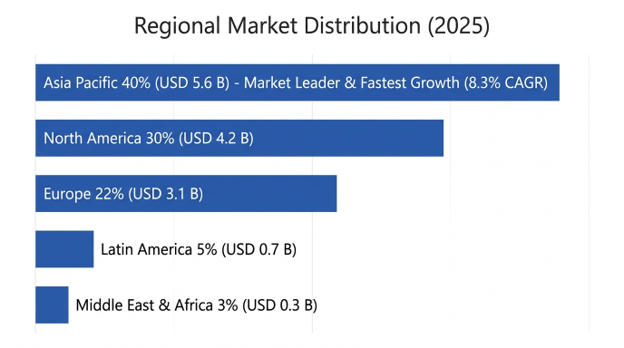
The Asia Pacific region leads the global market for foldable furniture with USD 5.6 billion in revenues in 2025, holding its share of being the fastest-growing regional market with an 8.3% CAGR from 2024-2034. Its dominance is owing to a huge level of urbanization, high population density, and a favorable attitude towards space-saving products in large cities. China accounts for 42% of the value of the regional market, because of millions of newly built apartments annually due to urbanization.
Japan exhibits highly developed premium market segments due to cultural significance attached to maximizing space, hence leading to a very high penetration rate of advanced furniture products with folding capabilities and premium features. South Korea and Singapore also exhibit the same trend due to the limited space and rich populace in these cities.
This region benefits from manufacturing agglomeration that ensures that the domestic market gets access to a variety of products at competitive prices, while it is a global producer center catering to export markets. The local manufacturers have shown sophistication in designs and materials usage, moving away from purely price-based competition.
North America is the second-largest market, worth USD 4.2 billion in 2025 and growing at a 6.4% CAGR till 2034. This market shows clear bifurcation between the adoption of such products on account of hybrid work and strong commercial demand from events, hospitality, and institutions. Over 82% of the total value in the region originates from the US owing to an existing setup in its event industry, outdoor recreation, and commercial furniture replacement cycles.
Strengths of commercial sectors include their capabilities through hospitality establishments, conference centers, educational institutions, and business establishments that keep considerable stock of foldable furniture, which undergoes frequent change. Outdoor recreation culture of the area, which includes 58 million camping families and tailgating practices, provides a constant market for weather-proof portable furniture with high-end features like built-in cooling, heating, and entertainment systems.
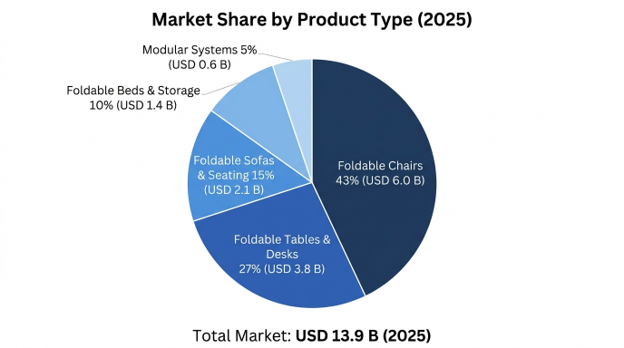
The foldable chairs segment holds the largest market share of 43%, valued at USD 6.0 billion in 2025, as these are used in the widest application areas starting from domestic dining to business purposes, as well as in recreational activities. This market is positively impacted by innovations related to ergonomic design and material that increases the comfort level without compromising on portability. The market share held by the foldable tables and desks categories is around 27% and valued at USD 3.8 billion in 2025.
Metal/aluminum-based products have the highest market share at USD 5.1 billion, accounting for 37% of market value in 2025, owing to their perfect balance of strength and weight, high resistance to corrosion and degradation. Wood/wood-based products account for 29% market share and cater to premium residential customers who demand better aesthetic compatibility with current decorations. Advanced polymer composites are expected to have the highest CAGR at 12.4%.
The residential segment holds the highest market share of 52%, estimated to be worth USD 7.2 billion by 2025, owing to the impact of urbanization and the emergence of hybrid work practices. Commercial & office occupies the second-largest market share of 31%, which includes co-working facilities, corporate offices, and flexible workspaces that necessitate adjustable furniture options. The hospitality & events sector commands 17% of the market share.
The global foldable furniture market is moderately fragmented, with the top eight players commanding approximately 42–48% market share. Competition is driven by product design, material quality Material quality, mechanism durability, and distribution strength., particularly those in e-commerce space.
March 2026: The IKEA Group introduced their SMART SPACE range which comprises of app-driven, motorized foldable furniture that combines charging capability, wireless lighting, and other innovative features to meet the needs of the new millennial generation spread across 28 countries around the world.
February 2026: MillerKnoll has invested $145 million in an European modular furniture design company that specializes in ergonomic office chairs which incorporate sophisticated concealed hinge technology.
January 2026: Lifetime Products offered commercial grade aluminum foldable chairs featuring 35 percent weight reduction using advanced alloys, which had a durability rating of 750,000 cycles at competitive prices.
December 2025: Steelcase offered IoT enabled furniture products to be used in smart offices, with occupancy sensors and space utilization reporting capability for facility management in corporations.
You'll get the sample you asked for by email. Remember to check your spam folder as well. If you have any further questions or require additional assistance, feel free to let us know via-
+1 724 648 0810 +91 976 407 9503 sales@intellectualmarketinsights.com
01 Jun 2026
Intellectual Market Insights Research © 2026. All rights reserved.