Share this link via:

The global Goldenhar syndrome market size was valued at USD 1.2 billion in 2025 and is projected to reach USD 1.4 billion in 2026, expanding to USD 2.8 billion by 2034, growing at a CAGR of 8.6% during the forecast period (2026-2034).
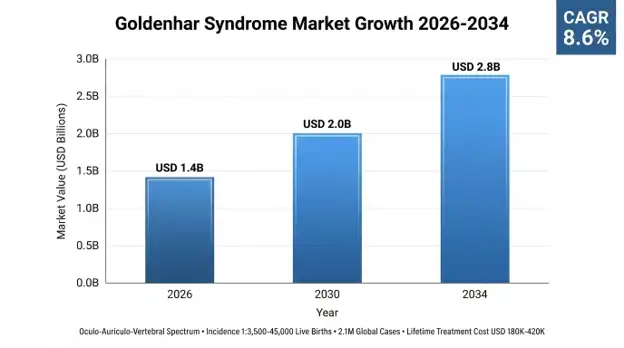
Goldenhar syndrome (also known as oculo-auriculo-vertebral spectrum (OAVS)) represents a highly variable phenotypic spectrum of congenital anomalies of craniofacial morphogenesis, which involve the derivatives of the first and second pharyngeal arches, auricular malformations (microtia, preauricular tags of the external ear), ocular abnormalities (epibulbar dermoids, lipodermoids, causing visual defects), vertebral anomalies (hemivertebrae, spina bifida occulta, affecting mainly the cervical and thoracic spine), and frequent multisystem involvement affecting cardiac, renal, central nervous, and skeletal systems. Clinical diagnosis is difficult, and management is complex due to the syndrome's highly complex clinical heterogeneity that reflects varying penetrance and expressivity, arising from multifactorial genetic and environmental etiologies.
The market covers in-depth therapeutic environments that combine a range of specialized craniofacial surgical procedures with the use of sophisticated diagnostic imaging technology and genetic testing platforms, orthodontic management systems, otolaryngologic procedures, ophthalmologic interventions, orthopedic treatment protocols, and psychosocial support services that all have a role in addressing the multi-dimensional clinical burden of this complex congenital condition. The market value of Goldenhar syndrome is not limited to the average sales of drugs and devices but is also tied to the treatment pathways that span from the neonatal period to the adolescent and adult years of life, where an average of USD 180,000–420,000 in treatment costs for the disease are incurred over the lifetime of each patient depending upon the severity of the disease and the multisystem involvement and surgical interventions required.
| Report Coverage | Details |
|---|---|
| Base Year | 2025 |
| Base Year Value | USD 1.2 Billion |
| Forecast Value | USD 2.8 billion |
| CAGR | 8.6% |
| Forecast Period | 2025-2034 |
| Historical Data | 2022-2025 |
| Largest Market | North America |
| Fastest Growing Market | Asia Pacific |
| Segments Covered | By Treatment Type, Surgical Procedure, Diagnostic Method, Disease Severity, End-User |
| Region Covered | North America, Europe, Asia Pacific, Middle East & Africa, Latin America |
| Countries Covered | US, Canada, Mexico, UK, Germany, France, Italy, Spain, Netherlands, China, Japan, India, Australia, South Korea, Brazil, Argentina, UAE, Saudi Arabia, South Africa |
| Key Market Playes | Boston Children's Hospital Craniofacial Center, Cincinnati Children's Craniofacial Center, Children's Hospital Los Angeles, Great Ormond Street Hospital, Hospital Sant Joan de Déu, Shanghai Jiao Tong University Affiliated Children's Hospital |
Get more details on this report - Request Free Sample
The increasing awareness of congenital craniofacial abnormalities, along with improved diagnostic techniques both before and after delivery, has led to an increase in the early diagnosis and management plans for Goldenhar syndrome. The reported incidence is 1 in 3,500-45,000 live births and translates into 3,100-40,000 new diagnoses per year considering the worldwide birth rates. Rising awareness within healthcare professionals, expectant mothers, and even organizations is leading to early referral to a craniofacial clinic. It presents more commonly in males with an approximate ratio of 3:2 and about 85% of the cases being unilateral facial abnormalities, often on the right side. Bilateral asymmetry requires even more complicated treatment strategies.
Goldenhar syndrome has been revolutionized by the rapid developments in craniofacial surgery, 3-D imaging, computer-aided planning, and regenerative medicine. Distraction osteogenesis, costochondral grafting, endoscopic techniques, and computer-assisted navigation all allow for more accurate correction of complex abnormalities of the mandible, auricle, and orbit, with a lowered surgical morbidity. The cone beam CT and advanced MRI enable detailed visualization of the bone structure and facilitate virtual surgical planning, thus promoting surgical precision and prognosis. 3D printing also allows for the creation of patient-specific implants customized to complex craniofacial defects, which will lead to improved functional and esthetic restoration. The development of biologically engineered bones and cartilage is becoming more of a reality through tissue engineering and regenerative medicine, consequently decreasing reliance on autologous tissue harvesting and enabling more physiological reconstruction.
Disparity in access to craniofacial care specialists is a major restriction that affects the Goldenhar syndrome market. This is because of underdeveloped healthcare systems. Poor disease recognition, diagnostics, imaging technology, genetic testing, and multidisciplinary approaches hinder the diagnosis and treatment process in different parts of the world. Many areas are plagued by a lack of skilled craniofacial surgeons and specialized centers, while insufficient patient numbers complicate the development of specialized expertise. Therefore, such services are currently available primarily in large tertiary hospitals in developed countries. On average, diagnostic delay is 2.4 years in developing countries compared to 0.6 years in developed countries, thus aggravating facial malformation and resulting in breathing problems, feeding difficulties, and other adverse effects.
The advances made in genetic research pose many possibilities of developing disease-modifying drugs for Goldenhar syndrome via targeting the molecular mechanism at the root of the syndrome. Genes discovered, including SF3B2, MYT1, PAX1, EYA3, and ZIC3, are possible candidates to be used in gene therapy, antisense oligonucleotides, RNA drugs, and protein replacement. Better genetics and better animal models would help study the pathways that include dysfunction of the spliceosome, neural crest cell migration, and craniofacial development. CRISPR-Cas9 technology and other precision medicine platforms may one day allow the modification of pathogenic variants. While there are many technical challenges, safety issues, and regulatory barriers, the development of disease-modifying or even curative treatment can bring many benefits.
The management of Goldenhar syndrome has been changing with the advent of specialized multidisciplinary craniofacial centers with expertise in surgery, diagnosis, rehabilitation, and psychosocial aspects. Multidisciplinary coordination includes specialists in craniofacial surgery, otolaryngology, ophthalmology, orthodontics, genetics, audiology, speech therapy, cardiology, orthopedics, psychiatry, and social work. Major centers have created guidelines for evaluation, outcome databases, and special training programs. With a multidisciplinary approach, it becomes possible to optimize treatment, surgical sequence, follow-up, and results. Greater awareness of these advantages makes more people choose referrals to specialized centers, thus contributing to further market concentration and multidisciplinary management of Goldenhar syndrome.
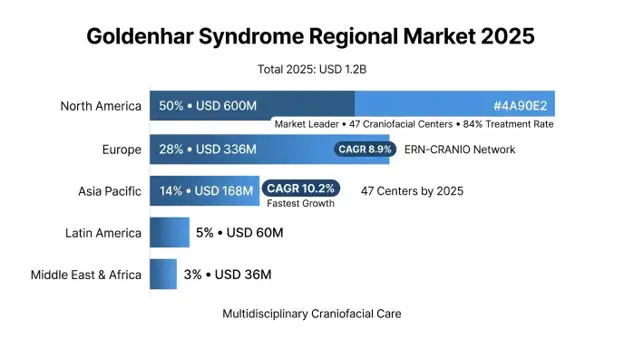
The North American market accounted for the highest market share of USD 0.6 billion in 2025 and is expected to grow at a rate of 8.4% CAGR till 2034. Growth drivers are the presence of an already existing network of craniofacial surgery, skilled surgeons, insurance, and high awareness levels about Goldenhar syndrome. The US is responsible for 82% of total North American market share backed by Medicare and commercial insurance payments. There are 47 multi-specialty craniofacial centers that offer special treatments and telemedicine solutions. FDA pathway, coding, NIH research funding, and academic medical centers drive innovation.
The Asia Pacific region is the fastest-growing region, expected to grow at a rate of 10.2% CAGR to reach USD 0.34 billion in 2025. This growth is fueled by the large pool of the population, better healthcare infrastructure, an increase in healthcare expenditure, a growing middle-class population, and an increasing number of craniofacial surgery facilities. Leading the way is China with around 28% market share owing to the availability of technologically advanced teaching hospitals, improved diagnostic facilities, and rare disease programs. The growth in India is fueled by the growing birth rates, increasing insurance penetration, and low-cost high-volume surgery centers.
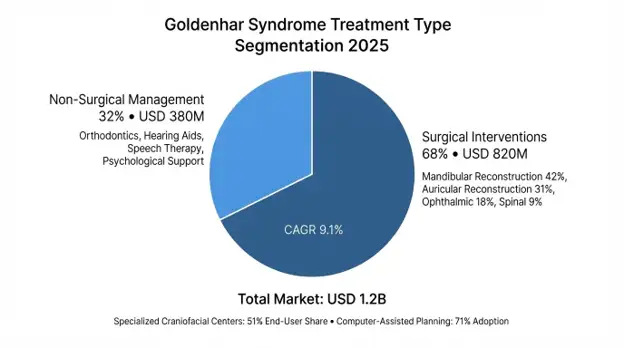
Surgical intervention is the most popular type of treatment in the market, and it is responsible for a 68% market share, with an estimated value of USD 0.82 billion in 2025 and will continue to grow at a 9.1% CAGR from 2025 till 2034. The procedures used are mandibular reconstructive surgery, auricular reconstructive surgery, ophthalmic surgery, and spinal correction with the help of well-established methods and craniofacial specialization. Non-surgical management accounts for 32% of the market share and is worth USD 0.38 billion in 2025, which includes orthodontics, hearing aids, speech therapy, psychological assistance, and monitoring.
Market dominance belongs to mandibular reconstruction, which occupies 42% of the market share, worth USD 0.52 billion in 2025 and expected to register an 8.8% CAGR up until 2034. It is due to such reconstructive methods as distraction osteogenesis and bone grafting that restore the mandible structure and ensure facial asymmetry correction, as well as improve speaking and eating functions. 31% of the market belongs to auricular reconstruction, worth USD 0.38 billion and designed for staging the cases of microtia and ear dysplasia. Ophthalmic surgery is 18% of the market, worth USD 0.22 billion, while spinal surgery takes 9%, worth USD 0.11 billion.
The market segment of moderate Goldenhar syndrome has the highest market share of 42%, with a value of USD 0.51 billion in 2025. The condition entails unilateral facial involvement, moderate mandibular hypoplasia, abnormalities of the ears, and few systemic abnormalities. The severe Goldenhar Syndrome makes up 38% market share and is valued at USD 0.46 billion, with a predicted CAGR of 9.4% through 2034. The condition demands multiple and staged operations because of extensive involvement of the craniofacial region and systems. Mild Goldenhar syndrome makes up 20% market share and is valued at USD 0.24 billion.
Specialized Craniofacial Centers hold the highest end-user market share position with 51%, accounting for USD 0.61 billion in 2025, including special multidisciplinary programs that offer complete Goldenhar syndrome diagnosis and treatment. Hospitals & General Surgical Practices make up 32% of the market share, accounting for USD 0.39 billion in 2025, and include general pediatric and plastic surgery departments offering surgical procedures. Diagnostic Imaging Centers account for 12% market share, accounting for USD 0.14 billion in 2025, and include cone-beam computed tomography and advanced MRI with three-dimensional imaging reconstruction.
The global market for Goldenhar syndrome consists of low to moderate consolidation, where the specialized craniofacial centers and academic medical centers occupy major market shares due to their competence in terms of specialization, multi-disciplinarianism, imaging technology, and patient follow-up. Competition in this industry is based on surgical performance, multidisciplinarianism, use of high-tech technologies, surgical technique innovation, psychological care, and training programs. Unlike other pharmaceutical industries, where the main competitors are commercial firms, in the Goldenhar syndrome market, non-profit organizations and hospital programs dominate. The emergence of new craniofacial centers in developing countries adds more competition because of their affordable surgical procedures.
June 2026: Boston Children's Hospital has reported that it has completed the development of an outcomes registry that comprises 1,247 cases of Goldenhar syndrome patients with thorough records about the operations performed, complications that occurred, and results achieved from the surgery. Patients undergoing surgery at craniofacial centers had better outcomes than those operated on at regular operating rooms, with 12% and 31% revision surgeries, respectively.
May 2026: Cincinnati Children’s Craniofacial Center reported findings of a randomized control study that compared distraction osteogenesis to traditional bone grafting techniques in patients with Goldenhar syndrome with better results of 89 percent patient satisfaction for distraction osteogenesis compared to 71 percent for traditional bone grafting but with increased treatment time from 6-8 months to 18-24 months.
April 2026: The Great Ormond Street Hospital in London adopted a novel telemedicine scheme allowing for teleconsultations for patients suffering from Goldenhar syndrome in poorly serviced areas; the hospital recorded 187 teleconsultations during the first three months, resulting in saving travel distance that averaged 340 kilometers.
March 2026: Stanford University reported that development of patient-specific 3D-printed mandibular implants for complicated cases of Goldenhar syndrome had been achieved, with 12 initial patients exhibiting better aesthetics and a shorter operative time of about 2.1 hours, compared to the traditional procedure of 4.8 hours.
February 2026: The American Academy of Pediatrics updated clinical practice guidelines for Goldenhar syndrome evaluation and management, emphasizing the importance of early psychological screening, comprehensive multidisciplinary assessment, standardized surgical protocols, and family-centered care models to optimize both physical and psychosocial outcomes.
You'll get the sample you asked for by email. Remember to check your spam folder as well. If you have any further questions or require additional assistance, feel free to let us know via-
+1 724 648 0810 +91 976 407 9503 sales@intellectualmarketinsights.com
16 Sep 2026
Intellectual Market Insights Research © 2026. All rights reserved.