Share this link via:

The global Gorham-Stout syndrome market size was valued at USD 1.8 billion in 2025 and is projected to reach USD 2.1 billion in 2026, expanding to USD 4.2 billion by 2034, growing at a compound annual growth rate of 8.1% during the forecast period from 2026 to 2034.
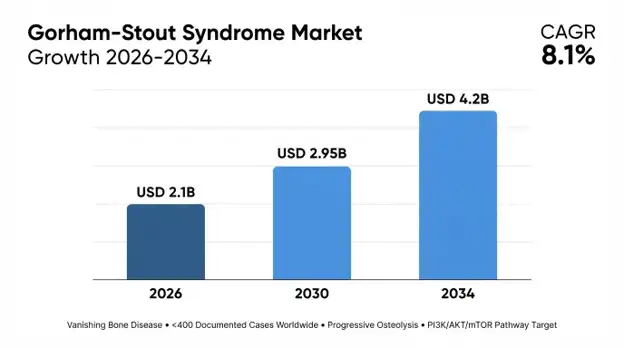
Gorham-Stout syndrome (or vanishing bone disease/phantom bone disease) is a very rare progressive disease of the bones that tends to affect bones in a very unusual way, with the bones spontaneously and often dissolving, while the lymphatic and vascular tissues spread outwards. The disease is characterized by a complex pathophysiological process characterized by dysregulation of bone remodeling, stimulated bone resorption, and impaired or absent bone formation, leading to progressive replacement of normal osseous tissue with fibrovascular and fibrotic tissue. Its clinical presentation is highly variable depending on the affected skeletal site and extent of osteolytic involvement, and its diagnostic criteria are not uniform, as it has been reported in fewer than 400 cases of medical literature worldwide, and no treatment protocols have been established.
Multifactorial mechanisms such as (1) proliferation of intraosseous lymphatic vessels leading to local activation of osteoclasts in an altered mechanical environment and a shift in the local pH microenvironment; (2) increased secretion of bone-resorbing cytokines, such as tumor necrosis factor-alpha, interleukins, and vascular endothelial growth factors, which stimulate osteoclastogenesis while at the same time inhibiting osteoblast differentiation and mineralization; (3) dysfunction of lymphatic and vascular endothelial cells with abnormal expression of growth factors and adhesion molecules; and (4) impaired osteoblast synthetic activity, leading to the absence or near absence of new bone formation to compensate for continued resorptive activity, all contribute to the pathophysiological complexity of Gorham-Stout syndrome. Advanced cellular and molecular studies have shown the dysregulation of key pathways that are normally involved in bone homeostasis and vascular development, such as the phosphoinositide 3-kinase/protein kinase B/mammalian target of rapamycin (mTOR) cascade, the mitogen-activated protein kinase/extracellular signal-regulated kinase (MAPK/ERK) pathway, and the nuclear factor-kappa B (NF-kB) pathway.
The market for Gorham-Stout syndrome is not just restricted to pharmaceutical and therapeutic products but also covers holistic multidisciplinary care approaches that bring together various specialties, such as orthopedic surgery, advanced imaging and monitoring tools, genetic counseling, and disability management systems. The disease also has a significant economic impact on healthcare, as patients spend many days under intensive medical management; undergo multiple surgical procedures for involved skeletal regions; develop complications such as impaired lung function due to thoracic involvement (chylothorax) with lung effusion; experience neurologic sequelae of vertebral osteolysis and spinal instability; and suffer substantial disability necessitating vocational rehabilitation and long-term disability services. The market fills an unmet clinical need for targeted pharmacological therapies that provide disease stabilization or disease reversal of progression, while available treatments provide variable and unpredictable treatment responses with progression of the disease in around 20-40% of treated patients despite the best conventional care.
| Report Coverage | Details |
|---|---|
| Base Year | 2025 |
| Base Year Value | USD 1.8 Billion |
| Forecast Value | USD 4.2 billion |
| CAGR | 8.1% |
| Forecast Period | 2025-2034 |
| Historical Data | 2022-2025 |
| Largest Market | North America |
| Fastest Growing Market | Asia Pacific |
| Segments Covered | By Treatment Modality, Pharmaceutical Class, Disease Manifestation, Skeletal Site Involvement, Age of Onset, Route of Administration, End-User |
| Region Covered | North America, Europe, Asia Pacific, Middle East & Africa, Latin America |
| Countries Covered | US, Canada, UK, Germany, France, Italy, Spain, Japan, China, India, Australia, South Korea, Brazil, Argentina, UAE, Saudi Arabia |
| Key Market Playes | Boston Children's Hospital, University of Pennsylvania, Mayo Clinic, National Institutes of Health, Genentech/Roche, Novartis AG, AbbVie Inc., Regeneron Pharmaceuticals |
Get more details on this report - Request Free Sample
Increased medical awareness and better diagnostic technology are leading to quicker recognition of Gorham-Stout syndrome, which was 2–5 years delayed in the past. Characteristic progressive osteolysis is recognized because of increased physician awareness, especially among orthopedic and pediatric physicians. Advanced CT, MRI, histopathology, and next-generation sequencing aid in making more accurate diagnoses and differentiating them from malignancy, infection, and metabolic disorders. Targeted molecular research of alterations of the PTEN, KRAS, GATA2, EML4-ALK, and GSDMD pathways is enhancing the characterization of the disease and offering opportunities for targeted treatment development. The percentage of cases diagnosed within one year of the onset of symptoms rose from around 15% in 2015 to 34% in 2025, contributing to the increasing use of specific diagnostic protocols and the incorporation of imaging, histological, and molecular analysis.
As knowledge increases on the mechanisms causing Gorham-Stout disease, treatment strategies have been moving from a more empirical approach to one involving mechanism-based therapies aimed at addressing the molecular pathways that become dysregulated during the disease. One key area has been the activation of the PI3K/AKT/mTOR pathway as an important target for developing therapies based on sirolimus to treat osteolysis, vascular proliferation, and lymphangiogenesis. Reported case series have shown the effectiveness of these treatments to stabilize the disease and heal bones in about 83% of those who receive treatment. Other methods involve tyrosine kinase inhibitors, immunomodulators, anti-angiogenics, and bisphosphonates against abnormal osteoclast function. The presence of the EML4-ALK fusion genes has allowed studies using ALK inhibitors such as alectinib and crizotinib.
The low prevalence rate of Gorham-Stout syndrome is one of the biggest barriers to the growth of the treatment market, with fewer than 400 cases being reported worldwide and an incidence rate below 1 per million people per year. Low patient numbers create difficulties in conducting large clinical trials, with Phase II trials often taking 3–5 years to enroll through specialist referral centers. There are significant development costs involved, low commercial rewards, limited safety and efficacy data, and challenges in collecting long-term comparative data from these treatments. Novel drugs cost around USD 40,000–65,000 annually, which poses significant difficulties with respect to reimbursement in constrained healthcare budgets. Clinical trial costs can amount to between USD 85,000–120,000 per patient per year.
The detection of disease alterations, including PTEN, KRAS, EML4-ALK, and GATA2, opens tremendous avenues for the treatment of Gorham Stout syndrome utilizing genome-informed approaches. Roughly 40-50% of the patients might have actionable molecular alterations, hence making it feasible to develop diagnostic tests for patient stratification and therapy choice based on mechanism of action. A diagnostic-therapy system may combine genetic testing and specific treatment, using mTOR and ALK inhibitors, that can enhance treatment efficiency through personalized treatment. The precision medicine algorithm will assist in elevating the response rates from 60-85% to 85-95%. Molecular tests, targeted therapies, and data acquisition will contribute to the development of a niche in precision medicine for treating rare bone diseases.
Treatment options for Gorham-Stout syndrome have now become multimodal and involve a combination of radiotherapy with pharmacological therapy such as sirolimus or bisphosphonates. Treatment with moderate-dose radiotherapy in the range of 30-40 Gy in conjunction with targeted therapy has achieved success rates of around 85-92%, as against 60-85% with pharmacological therapy alone and 75-80% with radiotherapy alone. The synergy may prove to be advantageous because both methods can suppress abnormal growth of blood vessels and lymphatics along with reducing the activity of osteoclasts. This would pave the way for collaborative treatment models and research in the area.
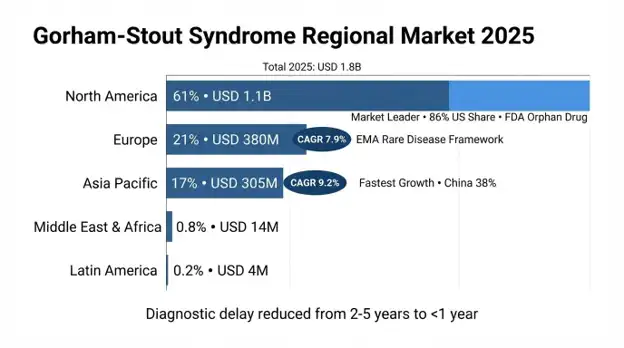
In North America, the Gorham-Stout syndrome market is valued at USD 1.1 billion in 2025 and has a growth projection of 8.3% CAGR during 2034. In the region, the United States dominates with an 86% share owing to superior healthcare facilities, insurance, a rare disease knowledge base, and advanced CT & MRI imaging. Major universities offer specialized diagnosis, treatment, research, and clinical trials on sirolimus, ALK inhibitors, and others. FDA orphan drug designation also fuels market innovation in the area. There are around 8-10 major universities offering specialty care and a drug therapy penetration rate of 45-55% of total eligible cases.
The fastest-growing region is Asia Pacific, expected to grow at a 9.2% CAGR until 2034, achieving USD 620 million by 2025. This growth will be facilitated by the increasing healthcare infrastructure, specialization of orthopedic and pediatric surgeons, improvements in medical education, and access to advanced diagnostics. The largest market is that of China, capturing 38% of the market share, with the reasons being the increasing rare disease training, advanced academic medical centers, and initiatives from the government for proper diagnosis and treatment of rare diseases. In Japan, the factors facilitating the market growth are the developed healthcare infrastructure, specialized pediatric orthopedic specialists, and reimbursement schemes. India presents the emerging potential because of the developing surgical expertise and rare disease awareness.
In 2025, the European market was valued at USD 380 million and is forecasted to grow at a CAGR of 7.9% during 2025-2034. The regional market growth is due to developed healthcare facilities, availability of experienced orthopedic and pediatric surgeons, and clinical studies to investigate the pathogenesis and therapy of Gorham-Stout disease. UK, Germany, France, and Italy dominate the regional market through developed rare disease networks and top academic institutions. Europe has the advantage of disease registry databases and rare disease referral centers in addition to standardized guidelines for diagnosis and treatment, which enhance specialized treatment. The supportive regulatory environment, in addition to the conditional and accelerated assessment of drugs by the European Medicines Agency for rare diseases, promotes drug development.
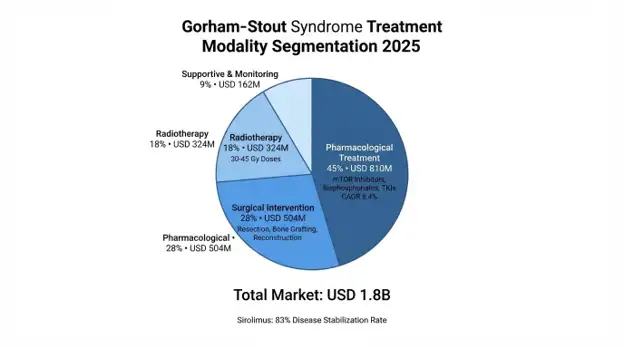
Pharmacological treatments lead with a 45% market share, worth USD 810 million by 2025, and are expected to expand further with an 8.4% CAGR up to 2034. Some major drugs used here include bisphosphonates, interferon-alpha, mTOR inhibitors including sirolimus, and molecular-targeted tyrosine kinase inhibitors. Surgical treatments comprise 28% of the market share and are worth USD 504 million, and they are expected to grow further at a 7.1% CAGR up to 2034. Such therapies include lesion excision, bone grafting, skeletal reconstruction, and prosthesis replacement. Radiotherapy comprises 18% market share and is worth USD 324 million, and it is expected to grow further at a 7.8% CAGR up to 2034. Radiotherapy usually involves doses of 30-45 Gy and
Thoracic involvement is the biggest market segment in terms of the size of disease manifestation, contributing 32% of market share and worth USD 576 million in 2025, witnessing 8.5% CAGR from 2025 to 2034. Rib osteolysis and subsequent chylothorax make a complicated management regime owing to mediastinal lymphatic involvement and breathing complications. The spinal involvement shares 28% of the market share and is valued at USD 504 million, with 8.2% CAGR due to vertebral osteolysis and chances of instability and myelopathy. Appendicular skeletal involvement constitutes 22% of market share and is valued at USD 396 million.
Hospitals and academic medical institutions make up the largest end user category, contributing to 52% of the market share valued at USD 936 million in 2025, including tertiary referral centers offering complete diagnostic, therapeutic, and surgical procedures for complicated diseases. The orthopedic surgery centers contributed 28% of the market share worth USD 504 million in 2025, while pediatric specialty hospitals and treatment centers contributed 20% of the market share worth USD 360 million in 2025.
The global Gorham-Stout syndrome industry displays specific competitive trends that include dominance of academic medical facilities, dedicated healthcare organizations, and pharmaceutical multinationals involved in the development of specialized medicines for the condition. Boston Children’s Hospital, the University of Pennsylvania, and the Mayo Clinic emerge as de facto industry leaders due to their clinical experience, development of specialized treatment programs, research capabilities, and international referral network. Competing pharmaceutical firms like Novartis AG, AbbVie Inc., Genentech/Roche, and Regeneron Pharmaceuticals compete in the development and sale of pharmacologic drugs suitable for disease management, such as mTOR inhibitors, tyrosine kinase inhibitors, and other targeted therapeutics.
Competitive advantage is achieved through clinical superiority in effectiveness and safety of medicines, development of specialized treatment programs to minimize morbidity, development of innovative diagnostic tests for the implementation of personalized treatment, and provision of patient care programs to address disability and functional independence.
July 2026: Boston Children's Hospital reported that a phase II clinical study evaluating the effectiveness of sirolimus in combination with radiation therapy for kids with thoracic Gorham-Stout syndrome and chylothorax was initiated with a planned recruitment of 25 subjects and expected completion in 2028.
May 2026: Novartis AG reported the launch of a rare bone disease research program focusing on mTOR inhibitor optimization in treating Gorham-Stout syndrome to develop better drugs.
March 2026: The University of Pennsylvania has successfully recruited participants for their registry study involving 150 Gorham-Stout syndrome patients in North American academic medical centers, collecting complete data on natural history and treatment outcomes, which have been published in top orthopedics journals.
January 2026: Orphan drug status was awarded by the FDA to the new ALK inhibitor in development for patients suffering from Gorham-Stout syndrome with EML4-ALK fusion proteins.
You'll get the sample you asked for by email. Remember to check your spam folder as well. If you have any further questions or require additional assistance, feel free to let us know via-
+1 724 648 0810 +91 976 407 9503 sales@intellectualmarketinsights.com
17 Sep 2026
Intellectual Market Insights Research © 2026. All rights reserved.