Share this link via:

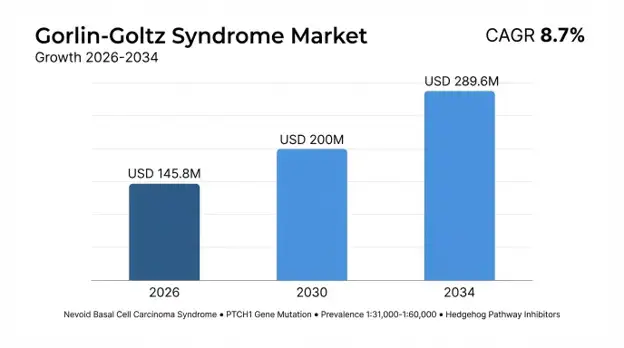
The global Gorlin-Goltz syndrome market was valued at USD 125.4 million in 2025 and is projected to reach USD 145.8 million in 2026, expanding to USD 289.6 million by 2034, growing at a compound annual growth rate of 8.7% during the forecast period (2026-2034).
Gorlin-Goltz syndrome (also referred to as nevoid basal cell carcinoma syndrome or Gorlin syndrome) is a rare, autosomal dominant, genetic condition caused by mutations in the PTCH1 (less frequently SUFU or PTCH2) tumor suppressor genes on chromosome 9. These mutations lead to disruption of the hedgehog signaling pathway and permanently alter the processes that regulate the growth of cells and their development. The disease is characterized by a variety of clinical presentations, such as numerous basal cell carcinomas usually occurring in childhood or early adulthood, painful and dysfunctional odontogenic jaw keratocysts, typical skeletal anomalies such as bifid or splayed ribs, and markedly increased risk of medulloblastoma in children. Estimates of its global prevalence have been from 1 in 31,000 to 1 in 60,000 people, with no significant gender disparity in prevalence, though there is variable disease expression with genetic diversity influencing penetrance of the phenotype.
Sophisticated multidisciplinary approaches must be used to manage Gorlin-Goltz syndrome, involving dermatologic surveillance and interventions, genetic counseling and testing, pediatric and adult oncology surveillance, dental and radiologic surveillance, and ophthalmologic surveillance for related eye complications. Disease management has shifted from a supportive surveillance-based approach to the use of pharmacologic agents that act on the hedgehog pathway that is dysregulated in the lesion. Therapies currently available include small molecule systemic hedgehog pathway inhibitors, such as vismodegib and sonidegib, which have demonstrated efficacy in advanced and unresectable basal cell carcinoma, and hedgehog pathway inhibitors that are now emerging as topical agents for preventive use to decrease new basal cell carcinoma development while avoiding systemic side effects; small molecule systemic hedgehog pathway inhibitors are also in use as repurposed antifungal drugs. Patients with Gorlin syndrome who have high numbers of lesions are also undergoing aggressive surveillance, which has led to early detection and intervention for serious complications such as medulloblastoma, which can be treated without radiation.
In a vulnerable population with complex unmet medical needs, current management strategies of repeated surgical removals, destructive treatments, and lifelong surveillance place a high burden of treatment, impacting quality of life and psychological health. The small patient size of Gorlin-Goltz syndrome provides regulatory advantages and incentives such as orphan drug designation, accelerated product approval processes, extended market exclusivity, and fewer regulatory filing requirements that encourage investments in disease-specific treatments. Emerging therapies focusing on disease pathogenesis, increasing disease awareness and diagnostic tools (genetic testing), and increased unmet treatment needs combine to give the Gorlin-Goltz syndrome significant potential for growth given its small patient population as compared to common disorders.
| Report Coverage | Details |
|---|---|
| Base Year | 2025 |
| Base Year Value | USD 125.4 Million |
| Forecast Value | USD 289.6 Million |
| CAGR | 8.7% |
| Forecast Period | 2025-2034 |
| Historical Data | 2022-2025 |
| Largest Market | North America |
| Fastest Growing Market | Asia Pacific |
| Segments Covered | By Treatment Approach, Therapeutic Agent, Indication Management, End-User Type |
| Region Covered | North America, Europe, Asia Pacific, Middle East & Africa, Latin America |
| Countries Covered | US, Canada, Mexico, UK, Germany, France, Italy, Spain, Netherlands, China, Japan, India, Australia, South Korea, Brazil, Argentina, UAE, Saudi Arabia, South Africa |
| Key Market Playes | Sol-Gel Technologies, Inhibitor Therapeutics, Palvella Therapeutics, Ascend Biopharmaceuticals, Regeneron Pharmaceuticals, Novartis AG |
Get more details on this report - Request Free Sample
Innovations in genetic testing technologies are one of the crucial factors propelling the growth of the Gorlin-Goltz syndrome market because these technologies will allow for an accurate identification of mutations in genes PTCH1, SUFU, and PTCH2, contributing to a more precise diagnosis. About 20–30% of all patients with this disease have new mutations with no genetic background and family history; thus, genetic testing is very helpful for a confirmatory diagnosis in these cases. Mutations in the gene PTCH1 are found in about 61% of all patients suspected of having this disease, which increases the importance of genetic confirmation and family screening. Early diagnosis contributes to increasing the number of patients who can be successfully treated and monitored all their lives.
The introduction of hedgehog inhibitors marks a turning point in Gorlin-Goltz syndrome treatment since the pathway inhibitor targets the root cause of the disorder, which is abnormal activation of the PTCH1 gene. Vismodegib has proven to be effective at lowering the tumor burden and inhibiting hedgehog signaling, but the agent may result in certain side effects such as muscle cramps, changes in taste, alopecia, and weight loss that prevent its prolonged use. Sonidegib presents another option with different pharmacodynamic properties. Patidegib, used topically, allows inhibiting hedgehog signaling with reduced exposure to the drug and a lower risk of developing adverse effects.
The extremely low prevalence rate of Gorlin-Goltz syndrome, which is around one case in 31,000-60,000 people, poses constraints on market growth. The total addressable population of the disease is thought to be between 80,000 and 100,000 people worldwide, out of which there are about 10,000-12,000 in the United States. The limited number of patients constrains profitability despite having high orphan drug prices. Thus, specialized biopharmaceutical companies that specialize in orphaned diseases are more suited for the development of such treatments. Market saturation can occur due to high treatment penetration. Growth in future, therefore, will depend greatly on increasing diagnoses, identifying undiagnosed patients, developing preventive treatments, and keeping up treatment for the limited patient base.
The development of therapies to modify disease processes and prevent the onset of basal cell carcinoma is an important commercial opportunity in the Gorlin-Goltz syndrome market. Patidegib gel is an example of such therapy, where the hedgehog signaling pathway is inhibited locally without the risk of exposure to the entire body and its side effects. Upon approval, it will be the first-ever medication intended to treat Gorlin syndrome, thus generating significant disease-specific commercial value. Other commercial opportunities include the development of combination therapies and more efficient delivery systems, as well as other hedgehog pathway inhibitors, such as itraconazole. Starting therapy at an early age or even in childhood will lower the burden of surgery and basal cell carcinoma development and create longer-lasting commercial opportunities.
The invention of the patidegib gel is a breakthrough in the management of the Gorlin-Goltz syndrome from a treatment-oriented to a prevention-oriented strategy. As a topical smoothened-receptor antagonist, patidegib facilitates the inhibition of the hedgehog signaling pathway with minimal systemic exposure and toxicity. The preventive role of the drug means that it can be used for prolonged periods with better tolerance than systemic drugs inhibiting the hedgehog pathway. In case the drug is approved and well-reimbursed, it may serve as an essential preventive therapy starting from childhood and adolescence, lowering the tumor load, surgeries, scars, and morbidity. The paradigm of the preventive therapy opens doors to the development of more topical drugs that inhibit the hedgehog signaling pathway.
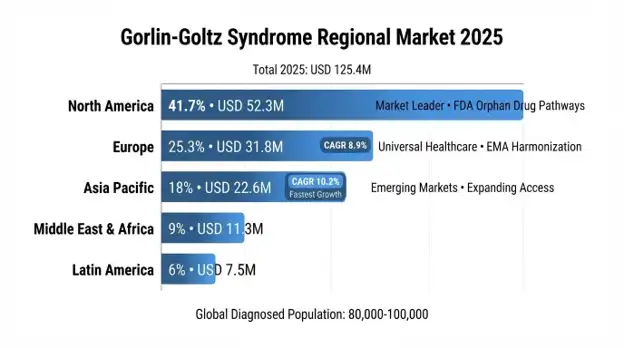
North America held the major Gorlin-Goltz syndrome market share at USD 52.3 million in 2025 and is expected to expand to an 8.4% CAGR between 2026 and 2034. This is due to the existence of sophisticated medical genetics programs, multidisciplinary tumor predisposition clinics, insurance coverage, health care spending, and pharmaceutical research facilities in this region. North America's United States accounts for around 78% of the market's regional revenue, owing to the availability of genetic tests, consultations, monitoring, and innovative treatments. Other contributing factors include the availability of orphan drugs, breakthrough therapies, and priority review designation processes by the FDA.
The European market stood as the second largest for Gorlin-Goltz syndrome at USD 31.8 million in 2025, with an 8.9% CAGR expected during 2026–2034. Growth will be driven by universal health insurance coverage, increasing availability of genetic testing and rare disease treatments, standardization of guidelines for interdisciplinary approaches, and increased development of medical genetics infrastructure. Regional leaders include the United Kingdom, Germany, France, and the Netherlands, owing to already developed genetics services and multidisciplinary programs. The centralized regulation process from the European Medicines Agency facilitates harmonization of therapeutic access. National rare disease policies are progressively incorporating patient registries, specialized clinics, research infrastructure, and clinical trials. Patient registries of the United Kingdom and diagnostic protocols of Germany contribute more towards the regional progress.
The Asia Pacific is the region with the highest growth rate, estimated to grow at a 10.2% CAGR to reach USD 28.4 million by 2034. The factors contributing to growth include growing health infrastructure, increased availability of genetic tests, higher healthcare expenditures by the growing middle class, and the implementation of various government schemes to support the diagnoses of rare diseases. China has huge potential in terms of patients and is backed by various healthcare reforms that have led to improvements in genetic testing and cancer predisposition programs. Japan has universal healthcare coverage, advanced genetics service offerings, and multidisciplinary care. India too is an emerging market and is backed by a huge potential patient population, expanding insurance coverage, and development of medical genetics facilities.
Top of Form
Bottom of Form
Multidisciplinary surveillance is one of the dominating treatment approaches in the segment, accounting for 52% of the market share worth USD 65.2 million in 2025. It includes lifelong imaging, genetic counseling, clinical evaluation, and specialist surveillance. The segment of dermatologic intervention accounts for 26% of the market share worth USD 32.6 million, which includes surgical removal, curettage, cryosurgery, laser ablation, topical therapy, and Mohs surgery for recurring basal cell carcinomas. The share of systemic hedgehog pathway inhibition is expected to grow at a CAGR of 11.3% up to 2034, reaching USD 18.8 million, due to vismodegib and sonidegib. The share of topical hedgehog pathway inhibition stands at 7% with a CAGR of 16.4% and USD 8.8 million.
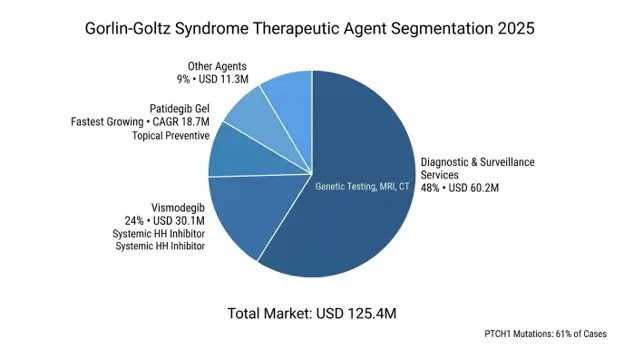
Diagnostic & Surveillance Services lead the market with a 48% market share, worth USD 60.2 million in 2025, and are expected to grow at an 8.1% CAGR up to 2034. This segment consists of genetic testing, MRI, CT scan, radiography, laboratory services, and genetic counseling. Vismodegib commands a 24% share of the market, worth USD 30.1 million and growing at a 7.8% CAGR due to vast clinical evidence, even with limited tolerability. Sonidegib commands 11% share of the market, worth USD 13.8 million and growing at 8.4% CAGR due to increasing application in selected patients. Patidegib Gel commands an 8% share of the market, worth USD 10.0 million, but will grow the fastest at 18.7% CAGR up to 2034.
Management of multiple basal cell carcinomas constitutes the largest indication segment with a market size of USD 89.4 million in 2025 and an expected CAGR of 8.6% through 2034. The growth of this segment is fueled by the recurring nature of the disease and the presence of multiple management approaches, ranging from surveillance to pharmacologic treatment, besides surgery and topical therapy. Surveillance and risk management of medulloblastoma constitute USD 78.1 million in 2025 and a CAGR of 9.2%. This is primarily attributed to the extensive screening of children using MRIs. Management of odontogenic keratocysts constitutes USD 48.2 million and a CAGR of 8.9%.
Multidisciplinary cancer centers lead the end-user market with a 42% market share worth USD 52.7 million in 2025 and forecasted to increase with a CAGR of 9.1% until 2034. The centers provide surveillance, treatment, genetics, and follow-up services. Dermatology clinics are at 28% market share with a valuation of USD 35.1 million, experiencing an 8.3% CAGR and treating mainly basal cell carcinoma. Genetic testing clinics are at an 18% market share, worth USD 22.6 million, and are set to grow at the highest rate of 10.4% CAGR among existing end-user segments. This is due to increased genetic testing and familial screenings. Pediatric oncology clinics occupy a 12% market share, worth USD 15.1 million, and grew at a 9.8% CAGR until 2034.
The Gorlin-Goltz syndrome market globally indicates a moderate to low degree of concentration, with six major players contributing about 48%-54% of the market value. Competitive dynamics are influenced by capabilities for orphan drug discovery, pipeline products targeting the hedgehog pathway, rare disease formulation capability, and strategic alliances with academic centers and advocacy groups. The leading player in the market, Sol-Gel Technologies, relies on the development of patidegib gel and the disease-specific indication, whereas Inhibitor Therapeutics' strategy revolves around the development of more effective formulations of itraconazole. Competitive advantage will lie in efficacy, safety, tolerability, innovative formulations, and the prophylactic potential of the drugs.
March 2026: Sol-Gel Technologies announced pricing of a public offering generating USD 33.1 million in gross proceeds allocated toward patidegib gel development and pre-commercialization activities. The company reaffirmed Phase III trial completion with topline results expected in Q4 2026, indicating a trajectory toward potential FDA approval in late 2026 or early 2027. Expanding compassionate use programs provides patient access to SGT-610 while trial enrollment continues, documenting real-world efficacy and safety in severe disease populations.
February 2026: Inhibitor Therapeutics reported pharmacokinetic studies demonstrating improved bioavailability of its proprietary itraconazole formulation compared to commercially available formulations. Topline results expected mid-2026 support a potential 505(b)(2) regulatory pathway, leveraging established itraconazole safety data while demonstrating improved absorption characteristics. Global patent applications filed covering novel formulation intellectual property provide competitive protection for market exclusivity.
January 2026: Multiple pharmaceutical companies reported expanded interest in Gorlin syndrome therapeutic development reflected through venture capital funding, partnership agreements, and clinical trial initiation. Academic medical centers announced the establishment of dedicated Gorlin syndrome research programs investigating novel therapeutic approaches and outcomes optimization.
December 2025: Sol-Gel Technologies initiated a Phase III trial expansion investigating patidegib gel efficacy in patients with severe, high-frequency basal cell carcinoma harboring PTCH1 mutations. Proposed 2027 pediatric trial development would extend preventive therapy evaluation to younger populations, expanding the addressable patient population and market opportunities.
You'll get the sample you asked for by email. Remember to check your spam folder as well. If you have any further questions or require additional assistance, feel free to let us know via-
+1 724 648 0810 +91 976 407 9503 sales@intellectualmarketinsights.com
17 Sep 2026
Intellectual Market Insights Research © 2026. All rights reserved.