Share this link via:

The global Griscelli syndrome market size was valued at USD 245 million in 2025 and is projected to reach USD 285 million in 2026, expanding to USD 512 million by 2034, growing at a compound annual growth rate of 7.4% during the forecast period (2026-2034).
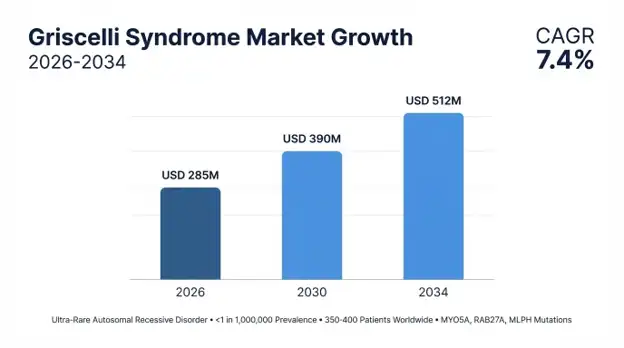
Griscelli syndrome is a rare autosomal recessive inherited disorder that occurs in less than 1 in 1,000,000 individuals worldwide, depending on the type of Griscelli syndrome, which can cause progressive multisystem dysfunction and partial albinism in patients. There are three clinical phenotypes: Type 1 with mutations in the MYO5A gene that primarily affect neurological development with progressive deterioration in early childhood; Type 2 with mutations in the RAB27A gene, which presents with primary immunodeficiency and hemophagocytic lymphohistiocytosis (HLH), is the most serious and therapeutic form; and Type 3 with mutations in the MLPH gene, which only exhibits pigmentary manifestations without systemic involvement.
Treatment of Griscelli syndrome is focused on hematopoietic stem cell transplantation, the only curative intervention for type 2 disease and the only effective therapeutic option that can achieve long-term disease remission and survival beyond the often fatal first decade of life seen in the disease because of its untreated nature. The market value comes from the high cost of transplantation (around USD 250,000-450,000 per patient); expensive immunosuppressive pharmacological regimens; complicated monitoring of patients for an infection, genetic sequencing for diagnosis, disease confirmation, etc.; long-term monitoring of patients in the immunosuppressive state; and supportive care infrastructure, such as monitoring patients for an infection, dealing with the metabolic consequences of transplantation, etc. However, due to the limited number of patients affected by the syndrome (around 350-400 patients worldwide as of 2026), the severe progressive course, lack of other therapeutic options, and need for intensive specialized care in tertiary care centers, it results in a high cost of therapy per patient, which facilitates market development despite low patient prevalence.
| Report Coverage | Details |
|---|---|
| Base Year | 2025 |
| Base Year Value | USD 245 Million |
| Forecast Value | USD 512 Million |
| CAGR | 7.4% |
| Forecast Period | 2025-2034 |
| Historical Data | 2022-2025 |
| Largest Market | Europe |
| Fastest Growing Market | Asia Pacific |
| Segments Covered | By Genetic Type, Treatment Modality, Disease Presentation, End-User Facility |
| Region Covered | North America, Europe, Asia Pacific, Middle East & Africa, Latin America |
| Countries Covered | US, Canada, Mexico, UK, Germany, France, Italy, Spain, Netherlands, China, Japan, India, Australia, South Korea, Brazil, Argentina, UAE, Saudi Arabia, South Africa |
| Key Market Playes | Grifols S.A., Lonza Group AG, Mesoblast Limited, Gamida Cell Ltd., Athersys Inc., Castle Creek Pharmaceuticals, CERY Therapeutics, Organogenesis Holdings Inc., Children's Hospital Boston, Great Ormond Street Hospital for Children |
Get more details on this report - Request Free Sample
Advancement in genetic diagnostic testing and increasing knowledge about Griscelli syndrome are leading to an early diagnosis and start of treatment. The price of genetic testing using the next-generation sequencing method has been reduced to USD 1,500-USD 2,500 in 2026 from an initial cost of USD 8,000-USD 12,000 in 2010 per patient. Exome sequencing, immunodeficiency gene panel tests, and immunological phenotyping now allow confirmation of the diagnosis in 2-4 weeks compared to previously long lead times of 8-24 months. Early genetic diagnosis allows initiation of hematopoietic stem cell transplant, which helps in improving survival prospects, especially for those who have developed severe forms of the condition. Awareness campaigns conducted by rare disease organizations and pediatric hematology societies are increasing clinical awareness and referrals to specialized transplantation centers. Italy, France, and Turkey are countries with higher diagnosis rates due to high levels of consanguinity.
Significant advances in hematopoietic stem cell transplantation technique have revolutionized the outlook of Griscelli syndrome type 2 from near 100 percent childhood death to 5-year survival above 72 percent in modern transplantation series and 84-88 percent 5-year survival among patients undergoing transplantation in the hands of pediatric immunologists, excluding early perioperative deaths. Optimization of the preparative regime, reduced intensity regimen in poor-performance patients, human leukocyte antigen matching through high-resolution typing and increased number of unrelated donors, haploidentical transplantation with post-transplantation cyclophosphamide, cord blood stem cell transplantation, and advanced graft-versus-host prophylaxis have collectively produced groundbreaking improvements in transplantation outcomes. The treatment concept stresses early transplantation before hemophagocytic lymphohistiocytosis onset, since patients undergoing HSCT before the accelerated phase have a 5-year survival of 80-88% compared to 45-55% among patients undergoing transplantation after hemophagocytic lymphohistiocytosis occurrence with organ dysfunction.
The primary market constraint is that of the extremely limited number of patients, with approximately 350-400 patients with Griscelli syndrome worldwide reported as of 2026, being insufficient in number to be viable for developing any pharmaceuticals. The economic factor of having minimum market sizes required by pharmaceutical manufacturers is at least 5,000-10,000 patients, which would be able to justify expenditures made on research and development, whereas in the case of Griscelli syndrome, its prevalence rate would only account for 4-8%. This rare disease market constraint makes entering the market difficult even with curative or very effective therapies, as they would not have a large enough patient population to make a profit from. Such a market constraint is valid irrespective of modality, making the development of orphan drugs impossible due to economic reasons even though there is high unmet medical need, as such treatment can only rely on protocols developed for hemophagocytic lymphohistiocytosis or primary immunodeficiency patients.
Market Constraint Metrics:
Genetic treatments such as gene therapy and gene editing present promising opportunities to treat Griscelli syndrome type 2 through curative interventions without the need for an allogeneic hematopoietic stem cell transplantation approach. A lentiviral gene addition therapy will involve introducing functional RAB27A genes into autologous hematopoietic stem cells, with minimal chances of graft-versus-host disease while ensuring normal cellular functioning. Base and prime editing techniques are being developed to correct any mutations involving RAB27A, but without the genotoxicity associated with the use of the CRISPR-Cas9 technique. There is precedence in successfully applying similar treatments in other primary immunodeficiencies. These therapies can be priced at around USD 400,000 – 650,000 per treatment.
Gene Therapy Opportunity Metrics:
The transplantation scenario about hematopoietic stem cell transplantation has witnessed dramatic changes with the creation of large international registries for donors with more than 35 million members around the world, enhancing the process of unrelated donor identification for ethnically diverse individuals. Transplantation procedures that utilize haploidentical transplants through post-transplantation cyclophosphamide are considered an optimal option for patients who lack matched donors with respect to human leukocyte antigen, as they allow obtaining results like those of matched unrelated donor transplantation without delays associated with donor identification. The development of cord blood banks offers another source of cells that can be used for transplantation procedures. This has completely changed the way transplantation is perceived, allowing the procedure to be made available to all patients rather than being restricted to those with matched donors.
Transplantation Access Trend Metrics:
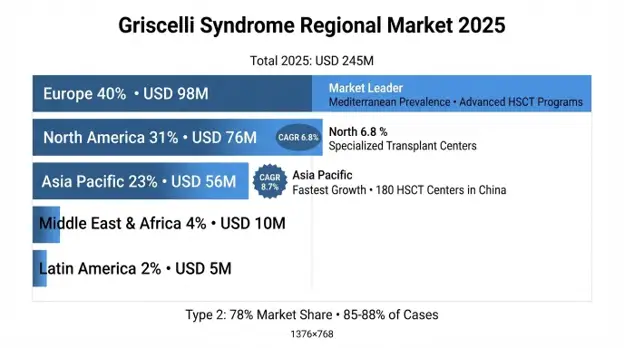
The highest share in the market of Griscelli syndrome belongs to Europe, whose market value will reach USD 98 million in 2025, recording a CAGR of 7.1% up to 2034. The leadership of the region is driven by the developed pediatric hematopoietic stem cell transplant programs, advanced clinical know-how, universal healthcare provision, and high prevalence of the disease among Mediterranean nations. Italy, Spain, and Turkey show much higher prevalence levels in comparison with Northern Europe, which is partially attributed to higher consanguinity rates. Top transplantation centers in the UK, Italy, Germany, and France possess extensive experience dealing with Griscelli syndrome and other immunodeficiency conditions.
The Asia Pacific is expected to witness the highest growth rate in the Griscelli syndrome market, growing at an 8.7% CAGR till 2034. The driving factors include the presence of a large population size in the region, expansion of hematopoietic stem cell transplantation capacity, growing diagnostic facilities for genetics, and a high rate of consanguinity in certain populations. In China, there were around 180 transplantation centers by 2025, many of which gained proficiency in primary immunodeficiency. In India, the case identification for rare diseases is improving, and about 12 to 18 cases of Griscelli syndrome type 2 are detected annually. The relatively low cost of transplantation, which is approximately USD 80,000-USD 180,000 compared to USD 250,000-USD 450,000 in Europe and North America, makes the therapy more accessible.
North America is an important market for Griscelli syndrome, estimated to be worth USD 76 million in 2025 with an expected CAGR of 6.8% until 2034. Factors responsible for this market potential include advanced expertise in pediatric hematopoietic stem cell transplantation, full insurance coverage, immunology facilities, and development of RAB27A gene therapy. Top institutions have state-of-the-art transplanting programs along with an observed five-year survival rate of 85-90%, thanks to swift diagnosis and specialty treatments. Nevertheless, growth of this market is hampered due to lack of identification of the disease, resulting in a total number of 80-120 cases being observed by 2025.
Griscelli Syndrome Type 2 holds the largest market share of 78%, worth USD 191 million in 2025, and is expected to witness a CAGR of 8.1% during 2026-2034. The high market share can be attributed to its susceptibility to respond to hemopoietic stem cell transplant and its possibility of curing the disease, together with being responsible for around 85-88% of cases. Griscelli Syndrome Type 1 has a market share of 18% worth USD 44 million, with a CAGR of 5.2%. Treatment of this type is only concerned with managing neurological symptoms. Type 3 has a market share of 4% worth USD 10 million, with a CAGR of 3.8%.
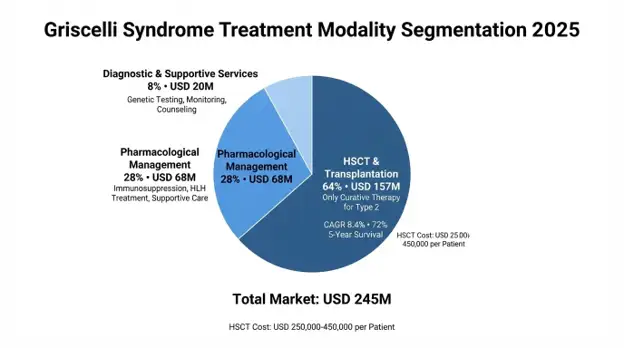
The Treatment Modalities category is the largest by market share, holding 64%, with a value of USD 157 million in 2025 and expected to register a CAGR of 8.4% until 2034. HSCT acts as a main curative treatment method for Griscelli syndrome type 2, which consists of transplantation, conditioning, supportive care, and post-transplant care. Pharmacological therapies hold a 28% share with a market value of USD 68 million, recording a CAGR of 6.8% during the period of forecast, including such medications as dexamethasone, etoposide, intrathecal methotrexate, emapalumab, and prophylactic antimicrobials.
The market is dominated by hypopigmentation with immunodeficiency, holding 72% market value of USD 176 million in 2025. This category includes Griscelli syndrome type 2 cases having immunodeficiency and hemophagocytic lymphohistiocytosis needing intense medical and transplant management.
Hypopigmentation with neurological involvement holds a 22% market share of USD 54 million in 2025. This segment includes Griscelli syndrome type 1 and atypical type 2 cases with neurological symptoms.
Hypopigmentation only holds 6% of the market share of USD 15 million in 2025. It includes Griscelli syndrome type 3 and hypopigmentation cases only.
The category of Tertiary Care Hospitals & Specialized Transplantation Centers accounts for 62% market share, worth USD 152 million in 2025, and includes centers carrying out hemopoietic stem cell transplantation with specialized skills in pediatric immunodeficiencies.
The Pediatric Immunology Centers contributed a 24% market share, worth USD 59 million, in 2025 and offer coordinated care and treatment, including pharmacological treatments and transplantation for Griscelli syndrome patients.
The category of Specialized Genetics & Rare Disease Centers contributes to 14% market share, worth USD 34 million, in 2025.
The market for treatments in Griscelli syndrome is highly uncompetitive because of the very rare occurrence of this disease and the specialized development of transplantation and gene therapy methods. Leading organizations that offer treatment are specialized pediatric centers of bone marrow transplantation and immunodeficiencies rather than pharmaceutical companies. Competitive factors that will determine success will be the quality of outcomes in transplantations, fast diagnosis and follow-up, and leading-edge gene therapy development. Among academic medical institutions are Boston Children's Hospital, Great Ormond Street Hospital, San Raffaele Hospital, and institutes of the Chinese Academy of Sciences.
August 2026: Boston Children's Hospital reported long-term outcomes of lentiviral gene therapy for RAB27A-deficient primary immunodeficiency, demonstrating sustained immune reconstitution in two treated Griscelli syndrome type 2 patients at 18-month follow-up, with restoration of natural killer cell cytotoxicity and prevention of hemophagocytic lymphohistiocytosis.
June 2026: China's China Academy of Sciences expanded hematopoietic stem cell transplantation capacity through the establishment of five new primary immunodeficiency transplantation centers, bringing total capacity to 180 centers with 45% primary immunodeficiency expertise.
April 2026: The European Medicines Agency granted orphan drug designation to a novel interferon-gamma antagonist for primary immunodeficiency-associated hemophagocytic lymphohistiocytosis, enabling an accelerated development pathway.
January 2026: Stanford University received a National Institute of Allergy and Infectious Diseases funding award of USD 8.4 million for a gene editing approach to RAB27A correction in primary immunodeficiency.
November 2025: The International Bone Marrow Transplant Registry published a comprehensive analysis of 149 Griscelli syndrome type 2 patients receiving HSCT, documenting 72% 5-year overall survival with 89% engraftment success utilizing contemporary conditioning regimens.
September 2025: Implementation of primary immunodeficiency newborn screening in 28 countries enabled identification of 67 new Griscelli syndrome cases presymptomatically, compared to 22-28 cases historically diagnosed through symptom-directed investigation annually.
You'll get the sample you asked for by email. Remember to check your spam folder as well. If you have any further questions or require additional assistance, feel free to let us know via-
+1 724 648 0810 +91 976 407 9503 sales@intellectualmarketinsights.com
17 Sep 2026
Intellectual Market Insights Research © 2026. All rights reserved.