Share this link via:

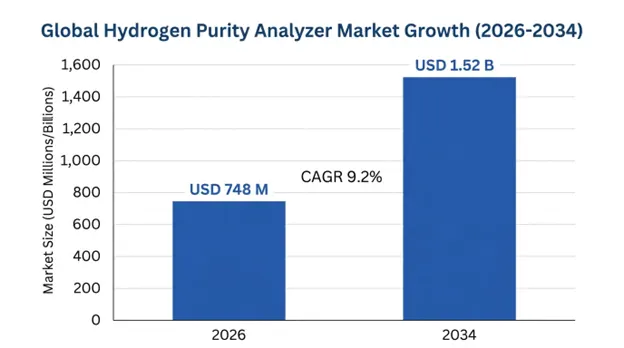
The global hydrogen purity analyzer market was valued at USD 685 million in 2025 and is projected to reach USD 748 million in 2026, expanding to USD 1.52 billion by 2034, growing at a CAGR of 9.2% during the forecast period (2026-2034).
Hydrogen purity analyzers are sophisticated analytical instrument systems whose main objective is to analyze hydrogen streams during their production, processing, and utilization by monitoring trace impurities, thus maintaining high international standards, protecting essential equipment, and improving efficiency. These specialized devices enable the identification and quantification of different types of contaminants, such as oxygen, nitrogen, carbon monoxide, carbon dioxide, water vapor, hydrocarbons, sulfur compounds, and metal contamination, at different levels of concentrations that can range from percentages to parts-per-billion, depending on application needs and regulatory guidelines.
The high degree of difficulty associated with hydrogen purity testing is explained by hydrogen’s physical properties along with the extremely stringent purity standards needed for contemporary applications, in particular proton exchange membrane fuel cells used for both automotive mobility and stationary power generation. According to ISO 14687-2 standards for fuel cell grade hydrogen, purity must be at least 99.999%, which means 14 specific impurity categories must not exceed certain concentrations, including carbon monoxide levels not higher than 0.2 ppm, total sulfur compounds concentration of less than 0.004 ppm, and water vapor level under 5 ppm, as these impurities can cause platinum catalyst poisoning and reduced fuel
The technology involved in analyzing hydrogen includes many types of measurement techniques tailored to requirements. Thermal conductivity detectors take advantage of hydrogen's high thermal conductivity compared to other potential contaminants for quick binary mixture analysis in power plant turbine cooling applications, whereas gas chromatography offers comprehensive analysis of all components with the detection limit well below parts per million required by fuel cells. Electrochemical detectors offer constant real-time monitoring of various reactive substances such as oxygen and carbon monoxide, while tunable diode laser spectroscopy allows non-contact analysis of moisture and trace gases with limited maintenance efforts. Mass spectrometers offer unambiguous identification of contaminant molecules useful in complex cases of contamination source investigation.
The economic value of hydrogen purity analyzers is hard to underestimate in view of the fast-growing hydrogen economy, as they can be found at any point where hydrogen production, storage, transportation, and end-use take place. This includes production facilities responsible for process control according to purity specifications, transportation pipelines ensuring that gas remains uncontaminated during transportation, storage facilities protecting hydrogen stored there from impurities and cross-contamination, as well as refueling stations checking purity of hydrogen to be sold to end-users such as cars with fuel cells.
The market addresses a critical technical need, one where hydrogen purity verification is not simply a matter of quality control but an absolute necessity, one where any excess in impurities leads to disastrous results, such as fuel cell failures, inefficiencies in industrial processes, power loss in turbine generators, and in some cases, safety problems associated with hydrogen usage. Such a critical technical need will ensure a continual demand for hydrogen purity analyzers that grows in step with the global build-out of hydrogen facilities.
| Report Coverage | Details |
|---|---|
| Base Year | 2026 |
| Base Year Value | USD 685 Million |
| Forecast Value | USD 1.52 Billion |
| CAGR | 9.2% |
| Forecast Period | 2025-2034 |
| Historical Data | 2022-2025 |
| Largest Market | Europe |
| Fastest Growing Market | Asia Pacific |
| Segments Covered | By Product Type, Technology, Application, End-User Industry, Gas Grade, Region |
| Region Covered | North America, Europe, Asia Pacific, Middle East & Africa, Latin America |
| Countries Covered | US, Canada, Mexico, Germany, UK, France, Italy, Netherlands, Spain, China, Japan, South Korea, India, Australia, Brazil, Argentina, Saudi Arabia, UAE, South Africa |
| Key Market Playes | ABB Ltd., Siemens AG, Emerson Electric Co., Yokogawa Electric, AMETEK Inc., Servomex Group, H2scan Corporation, Teledyne Analytical Instruments |
Get more details on this report - Request Free Sample
The core force fueling the growth of the hydrogen purity analyzer market is the unprecedented global focus on hydrogen as a key element in decarbonization efforts, which can be seen from national hydrogen roadmaps, huge infrastructure investment plans, as well as regulations compelling the use of green hydrogen in industries that are difficult to decarbonize. By 2025, over 45 national hydrogen policies have been launched around the globe, making commitments of more than USD 320 billion in public investments for hydrogen generation and usage up until 2030, where all such projects require advanced analytical tools for ensuring hydrogen quality.
According to the International Energy Agency, annual clean hydrogen production capacity needs to be increased to 90 million tons per year by 2030, considering that only about 1.2 million tons of low-carbon hydrogen is produced in 2024. Every electrolysis plant, steam methane reformer plant equipped with carbon capture technology, pipeline connection point, storage facility, and hydrogen fueling stations need dedicated purity measurement devices at different stages of the process, resulting in compound growth in the installed base of the analyzers that drive the market.
The REPowerEU strategy of the European Union aims to generate 10 million tons of domestic green hydrogen production and 10 million tons of imported hydrogen by 2030, making it the most ambitious hydrogen rollout strategy globally. This would demand enormous electrolyzing installations in member countries, the development of a hydrogen pipeline network using the existing natural gas network, and stringent QA policies mandating purity measurement at production, mixing, transportation, and delivery points. The National Hydrogen Strategy of Germany alone will invest EUR 9 billion in domestic activities with EUR 8 billion in international collaboration.
The intense commercialization of proton exchange membrane fuel cells into various sectors such as transport, stationary power, and portable devices requires extremely stringent purity analysis standards necessitating the use of highly accurate and multi-species analyzers that can detect multiple impurities simultaneously at parts-per-billion levels. The ISO 14687-2 specification that defines the quality standards of hydrogen fuel in fuel cell automobiles indicates 14 different impurities whose maximum levels are 0.2 ppm for carbon monoxide, 0.004 ppm for total sulfur, 0.2 ppm for formaldehyde, and 0.2 ppm for formic acid.
The total number of fuel cell vehicles reached 95,000 globally in 2025, with more than 2.8 million predicted by 2030 based on the government support programs announced in South Korea, Japan, China, Germany, and the United States. In addition, each hydrogen refueling station supporting such fleets must continuously monitor the purity of fuel before delivery to prevent warranty claims and protect the fuel cell stack of the vehicle, which is valued at USD 15,000 to 35,000 from any contamination damage.
There are several applications of fuel cells outside the mobility sector, including power generation, back-up power, and material handling equipment. All such applications rely on hydrogen fuel cells, thus ensuring the highest quality in terms of purity levels to meet regulatory specifications. This situation leads to the creation of solid demand for pure hydrogen analysis instruments.
The traditional use of hydrogen in the industries that constitute the major demand source for today remains a significant source of analyzers through process improvement within the petroleum refineries, quality control during chemical production, and industrial gas supply chain validation processes. The petroleum refineries alone use about 40 million tons of hydrogen each year for hydrocracking, desulfurization, and hydrotreating processes, where efficiency depends entirely on hydrogen purity because nitrogen and methane gases lower hydrogen partial pressure and increase energy consumption.
In power generation plants where hydrogen is used as coolant for turbine generators, hydrogen purity must always be monitored to ensure that its concentration is above 95% to avoid formation of explosive mixtures. In the electronics industry where semiconductor nodes are less than 5nm, the use of hydrogen for epitaxial, CVD, and annealing purposes is highly critical due to presence of metallic impurities and water which create crystal defects in the devices and cause yield failure.
The primary obstacle limiting market adoption of hydrogen purity analyzers is the large amount of money required to set up multi-component analyzers for fuel cell grade, where high performance gas chromatography-based analyzers cost between USD 45,000-180,000 each. This makes significant capital outlay for startup companies, smaller hydrogen manufacturers, and developing nation projects that do not have sufficient funds allocated for instrumentation. Not only is this an initial cost of the purchase but it also involves ongoing costs such as calibration gases, preventive maintenance, laboratory facilities, and technical personnel. This amounts to between 15-25% of the total capital cost per year.
Technical complexity also poses further challenges to operators transitioning away from fossil fuels where there is little experience in analytical chemistry operations. This includes calibration of the gas chromatograph instrument using reference gas mixture, column maintenance and replacement, detector maintenance, and software for managing the data which calls for trained personnel who may not be available in all regions in which hydrogen infrastructure is being deployed globally. Lack of instrumentation and analytical chemists has been limiting the uptake of more advanced analyzers due to regulations.
A major opportunity exists in the development and deployment of miniature solid-state hydrogen purity sensing technologies at any point in hydrogen distribution network at economic structures that will allow wide-scale adoption. Improvements in MEMS production, nano material-based sensor arrays, and signal processing within an integrated circuit allow miniaturization of sensors into a performance equivalent of laboratory instruments that can be integrated within pipelines, vessels, and dispensers at costs ranging between USD 2,000-8,000 against USD 45,000-180,000 for the conventional analytical equipment.
Internet of Things connectivity within a miniaturized analyzer platform allows real-time transmission of hydrogen purity data on a networked basis, making it possible to conduct predictive analysis, quality assurance, automated supply chain checks, and regulatory compliance reporting. An approach that utilizes this technology shifts from batch purity testing to network-based purity monitoring, resulting in a much larger market opportunity due to higher analyzer density relative to hydrogen infrastructure.
The hydrogen purity analyzers market is undergoing significant transformation due to the adoption of advanced AI algorithms that not only increase analytical accuracy but also predict maintenance needs and facilitate pattern recognition with respect to the composition of multicomponent contaminations. With the help of machine learning algorithms based on massive sets of chromatographic and spectroscopic analysis results, it is possible to recognize the presence of contaminants before their concentration reaches the limit values, to differentiate the profiles of various contamination scenarios, and to optimize analytical conditions in real-time mode.
Maintenance algorithms built into the analyzers’ control systems help to monitor the parameters of their performance including the stability of the detectors' baseline, column efficiencies, and other factors indicating an impending failure. When analyzing the hydrogen quality at refueling stations, analyzer maintenance capability is especially valuable as any analyzer downtime will disrupt the operation of the whole system and incur considerable financial losses.
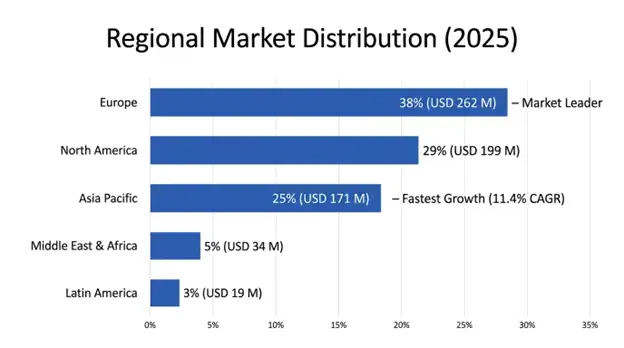
The hydrogen purity analyzers market is dominated by Europe, which was worth USD 262 million in 2025, accounting for 38% of the total market. The region has the world’s most robust hydrogen regulatory framework, combined with aggressive hydrogen strategies adopted by Germany, France, Netherlands, and Spain, together with the development of the European Hydrogen Backbone project aimed at developing a hydrogen pipeline network spanning 53,000 km by 2040. The hydrogen strategy developed by the European Union has stringent quality standards according to the Delegated Act on Renewable Fuels of Non-Biological Origin.
Germany tops European market actions with the most developed hydrogen infrastructure rollouts, including hydrogen refueling stations, hydrogen valleys, and offshore wind-to-hydrogen production in the North Sea, all requiring sophisticated monitoring infrastructure. The German government’s plan for 5 GW electrolyzers by 2030 followed by an increase to 10 GW electrolyzers by 2035 makes for systematic analyzer purchasing plans consistent with electrolyzer deployments.
Netherlands has positioned itself as the hydrogen importing and distributing center in Europe, with significant port locations in Rotterdam and Amsterdam setting up hydrogen terminals, hydrogen storages, and pipelines that will need significant purity monitoring infrastructure. In France, a national strategy towards 6.5 GW electrolyzers by 2030 is set in motion with hydrogen application to industry sectors such as steel, cement, and chemicals.
Asia-Pacific is expected to become the fastest-growing market in terms of CAGR at 11.4%, fueled by the highly developed fuel cell vehicle markets of Japan and South Korea, significant hydrogen infrastructure investments by China, and the rising popularity of India’s National Green Hydrogen Mission, which aims to produce 5 million tons of green hydrogen by 2030. Japan’s Hydrogen and Fuel Cells Strategic Roadmap has been responsible for setting up the world’s largest fuel cell vehicle adoption and hydrogen fueling stations per fleet. This has created significant demand for ISO 14687 compliant fuel cell-grade purity analyzers.
China made hydrogen economy investments worth more than USD 16 billion during the period 2021-2025. These include electrolyzer production capacity, hydrogen fueling networks along key transport corridors, and use of hydrogen for industrial purposes like steel-making and chemical production. China’s goal to have 50,000 hydrogen-powered vehicles and 1,000 hydrogen refueling stations by 2025 has prompted large-scale analyzer purchases from local and foreign suppliers.
Green New Deal in South Korea allocates USD 2.3 billion towards hydrogen economy development until 2025, involving efforts to develop fuel cell cars, hydrogen electricity production, and industrial uses of hydrogen. South Korea is the global leader in the use of fuel cell vehicles with more than 20,000 fuel cell cars and an objective of 850,000 vehicles in operation until 2030.
The hydrogen purity analyzers market is characterized by moderate levels of concentration, where industrial analytics companies compete with specialized gas analysis providers within the field of gas analysis and innovative technology providers offering cutting-edge sensing technology. ABB, Siemens, Emerson, and Yokogawa benefit from a complete suite of analysis products as well as established customer bases within their respective process analyzer categories in refineries, chemical plants, and power plants.
Hydrogen specialists such as Servomex, H2scan, and Analytical Specialties specialize in specific hydrogen-based applications that require expert knowledge in measuring hydrogen gas challenges, positioning themselves at premium prices in fuel cell-grade analysis applications requiring detection limits below the parts per million levels and multiple components. Such companies differentiate by offering instrument-specific configuration options, sampling systems designed specifically for hydrogen infrastructure users, and maintenance and calibration services.
Technology startups are working on solid-state sensor platforms, miniaturized analyzing instruments, and IoT-based systems aimed at applications of hydrogen infrastructures where analytical instruments would be expensive and hard to implement. The focus of such firms is reducing total cost of ownership by removing the need for carrier gases, supplies, and frequent calibration services.
March 2026: ABB Ltd. released a new-generation hydrogen purity analyzer that has built-in functionality of simultaneous multi-component analysis according to ISO 14687-2 with 40% faster analysis cycle in comparison with the previous generation of analyzers aimed at hydrogen fueling stations and electrolyzer monitoring applications.
February 2026: Siemens AG concluded partnership agreement with a leading European manufacturer of electrolyzers aimed at development of integrated purity monitoring systems implemented directly into the stack management platform of electrolyzers providing quality control without external analyzer devices.
December 2025: Emerson Electric presented portable hydrogen purity analyzer that uses laser absorption spectroscopy to conduct field-based hydrogen quality monitoring for hydrogen fueling stations and pipeline connection points and obtained certification of explosion-proof category.
November 2025: H2scan Corporation secured USD 28 million in Series C financing aimed at accelerated implementation of their solid-state hydrogen sensors intended for distributed monitoring of hydrogen purity at hydrogen pipelines and storage facilities.
September 2025: Yokogawa Electric has developed cloud-based hydrogen purity monitoring system based on information collected from multiple analyzer units.
You'll get the sample you asked for by email. Remember to check your spam folder as well. If you have any further questions or require additional assistance, feel free to let us know via-
+1 724 648 0810 +91 976 407 9503 sales@intellectualmarketinsights.com
22 May 2026
Intellectual Market Insights Research © 2026. All rights reserved.