Share this link via:

The global iridogoniodysgenesis (IGD) market was valued at USD 42.5 million in 2025 and is projected to reach USD 47.6 million in 2026, expanding to USD 118.2 million by 2034, growing at a CAGR of 12.0% during the forecast period (2026-2034).
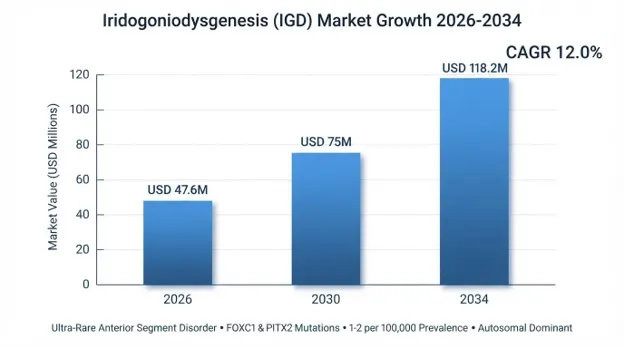
Although the disorder is an ultra-rare inherited anterior segment disorder, the market growth is above average compared to mainstream ophthalmology markets, largely due to increasing access to genetic diagnostic panels, increased clinical recognition of anterior segment dysgenesis phenotypes by pediatric ophthalmologists, and a gradual refinement of surgical and pharmacological management strategies that address structurally abnormal ocular anatomy.
Iridogoniodysgenesis is an unusual, autosomal dominant developmental disease of the anterior segment of the eye that includes two main features: bilateral iris stromal hypoplasia and anomalous development of the iridocorneal angle and congenital dysgenesis of the trabecular meshwork and Schlemm's canal outflow apparatus. It occurs mainly because of mutations in two transcription factor genes involved in the migration of neural crest cells during eye development, FOXC1 on chromosome 6p25 (IGD Type 1: IGDA1) and PITX2 on chromosome 4q25 (IGD Type 2: IGDA2), both of which have extensive phenotypic overlap with Axenfeld-Rieger syndrome. Both types affect the normal architecture involved in the drainage of aqueous humor, and they can lead to very high intraocular pressure and progressive glaucomatous optic neuropathy that is often unresponsive to medical therapy, which may start in infancy, childhood, or early adulthood.
Epidemiologically, IGD falls into the spectrum of anterior segment dysgenesis and is significantly underdiagnosed, with the typical figures estimated at well below one to two per 100,000 people; this may be higher because of the many cases being misdiagnosed as ‘primary congenital glaucoma' or ‘Axenfeld-Rieger syndrome' or ‘Peters anomaly.' A significant percentage of people with pathogenic FOXC1 and/or PITX2 variants develop clinically significant glaucoma during their lifetime, often in their 30s or earlier. The IGD patient population is growing continually, building upon a small historical base, as next-generation sequencing panels for hereditary anterior segment disorders are continually integrated into routine genetics workups in children and as family cascade screening becomes available to identify previously asymptomatic carriers within affected pedigrees.
At present, management strategies for IGD-associated glaucoma are extrapolated from those used for congenital and juvenile glaucoma and involve conservative medical therapy using intraocular pressure (IOP)-lowering agents such as prostaglandin analogs, beta-blockers, carbonic anhydrase inhibitors, and alpha-2 agonists, with surgical interventions when medical therapy fails (which is very common because of the abnormal drainage angle). Angle-based techniques like goniotomy and trabeculotomy, filtration surgery (trabeculectomy), glaucoma drainage devices, and more recently, minimally invasive glaucoma surgery techniques tailored to the pediatric and digenetic eye form the mainstays of treatment for refractory glaucoma. The unusual angle structure leads to higher failure rates than is seen in conventional glaucoma populations, necessitating repeat procedures during childhood and adolescence and sustained, recurring demand for specialized devices, imaging, and follow-up.
The IGD market is embedded in a larger rare and orphan ophthalmic disease landscape that includes genetic diagnostic services, advanced anterior segment imaging technologies, patient registries, and genetic counseling infrastructure, all of which are relevant to commercial activity. Despite the commercial difficulties stemming from an inherently small addressable market, the increasing number of investments in the study of FOXC1 and PITX2 as targets for therapeutic development and the extended exclusivity, reduced regulatory fees, and priority review incentives offered by favorable regulatory environments in key markets indicate a long-term trend toward disease-modifying treatment strategies.
| Report Coverage | Details |
|---|---|
| Base Year | 2025 |
| Base Year Value | USD 42.5 Million |
| Forecast Value | USD 118.2 Million |
| CAGR | 12.0% |
| Forecast Period | 2025-2034 |
| Historical Data | 2022-2025 |
| Largest Market | North America |
| Fastest Growing Market | Europe |
| Segments Covered | By Disease Subtype, Treatment Type, Drug Class, Diagnostic Modality, End-User |
| Region Covered | North America, Europe, Asia Pacific, Middle East & Africa, Latin America |
| Countries Covered | US, Canada, UK, Germany, France, Netherlands, Italy, Spain, Japan, China, India, Australia, South Korea, Brazil, UAE, Saudi Arabia |
| Key Market Playes | Novartis AG, Alcon Inc., AbbVie Inc. (Allergan), Glaukos Corporation, Bausch + Lomb, Santen Pharmaceutical Co. Ltd., Johnson & Johnson Vision |
Get more details on this report - Request Free Sample
The most significant factor influencing the development of the IGD market is the rapid increase in the use of genetic testing by pediatric ophthalmologists and glaucoma specialists that has helped correct decades of underdiagnosis and misdiagnosis. For many years, the IGD patients were considered to be suffering from primary congenital glaucoma or the Axenfeld-Rieger syndrome complex because of similarities between the phenotypes and lack of genetic testing. With the advent of genetic sequencing panels for FOXC1, PITX2, and other anterior chamber developmental genes in clinical practice, the diagnostic accuracy has been improved, while the systematic cascade family screening has revealed more affected family members.
The surgical treatment of IGD is currently undergoing changes because of the increasing usage of micro-invasive glaucoma surgery that provides higher safety and a lower incidence of complications compared with standard trabeculectomy and drainage device implantation. In fact, it should be emphasized that the majority of IGD patients need to be surgically treated within childhood or adolescence; they will require long-term treatment for decades. Micro-invasive angle surgeries specifically target the abnormal trabecular meshwork in the pathogenesis of IGD and provide efficient intraocular pressure lowering with a good safety profile.
The major constraint related to the IGD market lies in the extremely small number of people who have this disease and who live in a large geographic area, making it impossible to develop medicines and medical devices designed specifically for this group of people. Tertiary care hospitals treat only a few patients annually with IGD, which creates difficulties in enrolling patients into appropriate trials. Thus, most products that can be used in the treatment of this disease are not specifically designed for this purpose but for the wider population of glaucoma patients.
The most transformative long-term development in the field of IGDs is the development of gene therapies that can either correct or compensate for the deficiencies in the FOXC1 and PITX2 transcription factors. In effect, this will move treatment from symptom alleviation to the modification or prevention of the disease. The proven success of gene therapy for monogenic eye conditions through FDA-approved vector-based treatments in the field of eye diseases makes such treatments more practical for the haploinsufficiency of FOXC1. Studies have shown successful regeneration of developmental markers using viral vector-based treatments on the anterior segment tissue model.
Leading academic research institutions are now incorporating the use of molecular diagnostics, genetic counseling, and family cascade testing within the care pathways for anterior segment dysgenesis patients, thus facilitating early detection of family members at risk prior to developing symptoms of glaucoma. This is based on the autosomal dominant inheritance mode of IGD, which carries a 50% chance of being transmitted to the offspring of the affected patient, and the new eye disease network for rare disorders is leading the way in this respect.
North America:
North America has the biggest share of the total market size for IGD, owing to concentrated subspecialized pediatric glaucoma expertise, existing rare disease registries, and a reimbursement-friendly environment for genetic testing and complicated surgeries. The United States has the major chunk of the regional market due to its insurance coverage of hereditary glaucoma genetic panel tests and the availability of board-certified pediatric glaucoma surgeons able to treat anterior segment dysgenesis.
Europe:
Europe is the region experiencing the highest growth in terms of its market, driven by the presence of coordinated reference networks for rare eye diseases that will aid in the diagnosis and research of rare eye diseases. The Netherlands, United Kingdom, and Germany are leading national markets due to their advanced research programs on anterior segment dysgenesis.
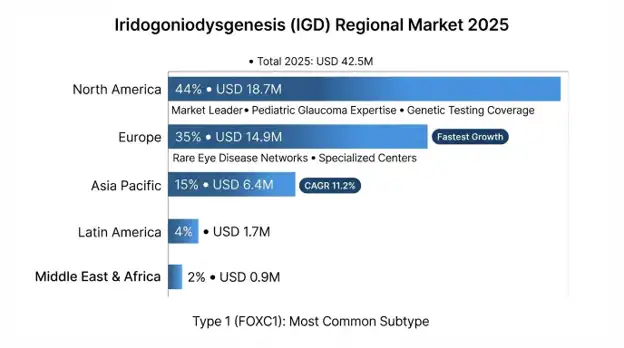
Disease Subtype Insights: Type 1 of IGD is caused by mutations in FOXC1 genes and represents a more common type that has variable expressivity even among family members who have the same mutations. Type 2 of IGD is caused by mutations in PITX2 and overlaps clinically with Axenfeld-Rieger syndrome; its differentiation depends on the presence of systemic features such as teeth, face, and umbilical anomalies.
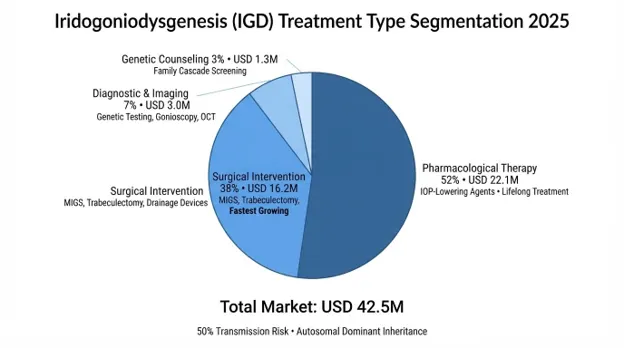
Treatment Type Insights: Pharmacologic treatment is still the primary treatment, and it includes prostaglandin analogs, beta-blockers, carbonic anhydrase inhibitors, and alpha agonists used either individually or in combination, creating total revenues since the disease requires lifelong management starting at early ages. Surgery is currently the most rapidly growing segment of treatments, which results from a high number of patients who need angle surgery or filtration due to non-response to the maximal medical therapy.
End-User Insights: The hospitals and academic tertiary centers are the major end-user group. This is since it takes expertise and skills in genetics and surgery to diagnose and treat IGD. The specialized pediatric ophthalmology and glaucoma centers are currently emerging as the most rapidly growing end-user segments.
Fragmentation continues to characterize the IGD market due to the rarity of this condition and the lack of pharmaceutical drugs developed to manage this disease. The commercial focus has been mainly on the pharmaceutical companies dealing with glaucoma drugs, surgical devices suitable for children, and genetic testing services that have their products used to manage IGD patients with similar pathogenesis to other types of glaucoma. Competitive advantage has been through clinical data showing the safety of these drugs for use in children, surgical devices that fit small anterior chamber structures, and rare disease programs that develop clinical relationships.
March 2026: Glaukos Corporation reported expanded outcomes data for angle-based minimally invasive glaucoma surgery devices in pediatric anterior segment dysgenesis populations, demonstrating meaningful intraocular pressure reduction with favorable long-term safety.
January 2026: A European rare eye disease reference network published clinical management guidelines for iridogoniodysgenesis, establishing standardized diagnostic criteria and surgical intervention thresholds based on multicenter expert review.
November 2025: An academic consortium spanning North American and European tertiary centers initiated a prospective multicenter natural history registry for molecularly confirmed IGD patients to characterize disease progression and treatment response.
September 2025: A genetic diagnostics provider launched an expanded hereditary anterior segment dysgenesis testing panel incorporating comprehensive FOXC1 and PITX2 variant analysis, improving diagnostic yield for IGD confirmation.
By Disease Subtype
By Treatment Type
By Drug Class
By Diagnostic Modality
By End-User
By Region
You'll get the sample you asked for by email. Remember to check your spam folder as well. If you have any further questions or require additional assistance, feel free to let us know via-
+1 724 648 0810 +91 976 407 9503 sales@intellectualmarketinsights.com
17 Sep 2026
Intellectual Market Insights Research © 2026. All rights reserved.