Share this link via:

The global isolated aniridia market size was valued at approximately USD 218 million in 2025 and is projected to reach USD 233 million in 2026, expanding to nearly USD 405 million by 2034, growing at a CAGR of around 7.2% during the forecast period (2026-2034).
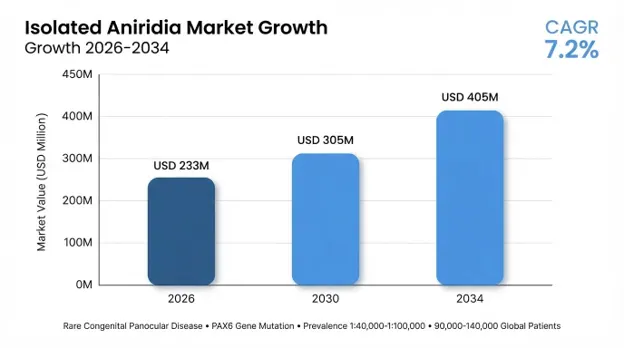
Isolated aniridia is a rare congenital, bilateral panocular disease that results from a 50% chance of carrying a heterozygous mutation of the PAX6 gene on the 11p13 chromosome. Isolated aniridia does not occur in a syndrome with Wilms tumor, genitourinary anomalies, and developmental delay associated with a contiguous gene deletion and is seen because of point mutations, small insertions/deletions, or splice-site defects within PAX6 itself. The haploinsufficiency of PAX6 affects the development of the iris, cornea, lens, trabecular meshwork, optic nerve, and fovea at the same time, and therefore aniridia is a lifelong multi-structural disease and not just a cosmetic or iris-limited condition. Global prevalence is estimated to be around 1 in 40,000 to 1 in 100,000 individuals (90,000-140,000 diagnosed and undiagnosed patients worldwide), predominantly in regions where there is access to specialist pediatric ophthalmology and genetic testing services.
Isolated aniridia is not a single dominant product class, but rather a broad spectrum of therapeutic and supportive products. It contains preservative-free lubricating and anti-inflammatory topical medications for the chronic management of the ocular surface; intraocular pressure-lowering medications tailored for structurally abnormal drainage angles; surgical procedures that have been modified for the absence of iris support, such as cataract extraction and glaucoma drainage device implantation; minimally invasive glaucoma surgery; corneal transplantation and limbal stem cell transplantation for progressive keratopathy; specialty tinted contact lenses and scleral lenses for cosmetic rehabilitation and/or photophobia; low vision optical aids for permanent foveal hypoplasia and nystagmus; and an emerging pipeline of gene therapies and nonsense-mutation read-through agents designed to target the underlying genetic defect rather than its downstream consequences.
In this market, commercial significance is more about the absolute numbers of patients and, over longer time periods, the cumulative per-patient lifetime treatment cost, as decades of surgical, pharmacological, and rehabilitative care are delivered within focused networks of tertiary academic and specialty eye centers. Isolated aniridia is an orphan and rare disease indication for regulatory jurisdictions, offering market exclusivity, development fee reductions, and expedient review pathways, which have become more appealing to biotechnology and device companies seeking to enter this historically under-served field. With the development of genetic diagnostic capacity and the emergence and growth of multidisciplinary centers of excellence, the market is slowly moving from purely symptomatic (reconstructive) management to a future characterized by an increasing influence of disease-modifying genetic and cell-based approaches.
| Report Coverage | Details |
|---|---|
| Base Year | 2025 |
| Base Year Value | USD 218 Million |
| Forecast Value | USD 405 Million |
| CAGR | 7.2% |
| Forecast Period | 2025-2034 |
| Historical Data | 2022-2025 |
| Largest Market | North America |
| Fastest Growing Market | Europe |
| Segments Covered | By Treatment Type, Associated Ocular Complication, Age Group, End-User, Region |
| Region Covered | North America, Europe, Asia Pacific, Middle East & Africa, Latin America |
| Countries Covered | US, Canada, UK, Germany, France, Italy, Spain, Netherlands, China, Japan, India, Australia, South Korea, Brazil, UAE, Saudi Arabia, South Africa |
| Key Market Playes | HumanOptics AG, MORCHER GmbH, Rayner Group, Santen Pharmaceutical, Dompé Farmaceutici, Alcon Inc., Glaukos Corporation, REGENXBIO Inc. |
Get more details on this report - Request Free Sample
The ability to identify inherited ocular disorders using next-generation sequencing panels, as well as the integration of genetic counseling into the pediatric ophthalmology practice, has made it possible to identify earlier and correctly mutations in PAX6, which cause aniridia without any associated syndromes, separating isolated aniridia from the WAGR syndrome-associated one and making it necessary to undertake a different approach to systemic treatment of patients. The early diagnosis allows the patient to be treated for glaucoma, cataracts, and visual improvement and, furthermore, provides the chance to attract sponsors interested in the development of drugs for such disorders because there is a genetically defined patient population. As shown by statistics from aniridia associations, there are two to four other disorders present simultaneously in aniridia patients, and the yearly cost of their treatment is about USD 8,000-14,000 per patient.
Aniridia keratopathy resulting from progressive limbal stem cell deficiency is prevalent among a significant majority of individuals, contributing to the high incidence of corneal blindness in this patient population; secondary glaucoma occurs in approximately 50%-75% of affected individuals owing to angle dysgenesis, and cataracts are prevalent in most individuals during adulthood. Due to the lack of any treatment modality targeting the PAX6 haploinsufficiency, current approaches to this condition have been predominantly reactive in nature, maintaining a strong interest in the development of pharmacologic and genetic orphan drugs, such as nonsense mutation correction for PAX6 restoration.
The key limitation to market growth is the intrinsically small pool of patients globally, who continue to be limited even with increased diagnostic accuracy and confined to a few specialized tertiary hospitals. It is difficult to reach clinically significant numbers for trials in such situations, making international collaboration essential along with increased time to enroll patients and posing limitations to the economic scale at which marketing efforts can be justified without orphan pricing and regulatory incentives. Premium-priced therapies that have existing surgery or supportive therapies pose issues for payers with regard to cost-effectiveness.
The most revolutionary long-term opportunity lies in developing genes and cell therapies that tackle PAX6 haploinsufficiency directly rather than treating its secondary effects. Preclinical results from the use of viral vectors to introduce functioning copies of PAX6 into ocular surface and corneal cells have shown successful phenotypic correction and improvement in the function of the limbal stem cell in experimental setups, and the successful commercialization of premium-priced treatments based on ocular gene therapies for other inherited diseases of the retina shows that it is economically viable even in the smallest patient populations, provided that disease modification is achieved.
Aniridia care for isolated cases is progressively being performed in collaborative centers consisting of experts in pediatric ophthalmology, adult ophthalmology, corneal experts, glaucomatologists, geneticists, and low-vision rehabilitation specialists, in addition to patient registries at national and international levels run by patient organizations for aniridia. Registries have been providing useful information on natural history, clinical trials, and regulatory submissions, as well as the improved management of complications for patients managed in the specialized network.
North America is the largest regional market due to the presence of subspecialties like pediatrics and cornea, reimbursement for the devices and surgeries related to prosthesis of the iris and glaucoma surgeries through Medicare and commercial insurance carriers, an active orphan drugs incentives program, and the presence of robust patient advocacy infrastructure, which will help in building up the registries and recruiting patients in clinical trials. The United States forms the bulk of this regional market value with an increasing number of aniridia clinics.
Europe is the fastest-growing market owing to the integration of rare disease reference networks across several nations to facilitate cross-border referrals, common clinical guidelines, and clinical trials in rare eye diseases. Germany, the United Kingdom, and France together account for a significant percentage of market value in Europe due to the concentration of subspecialties such as cornea and glaucoma, while the EU’s orphan designation and central approval procedure ensure viability for ultra-rare disease treatments.
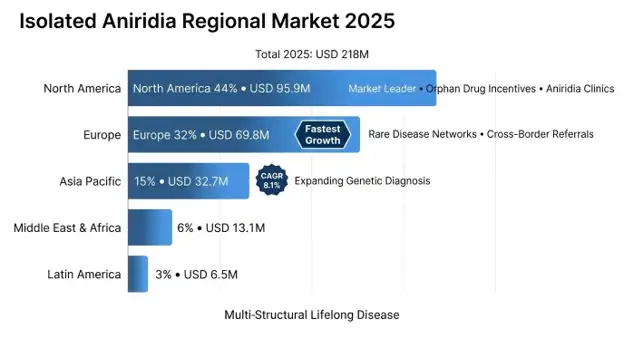
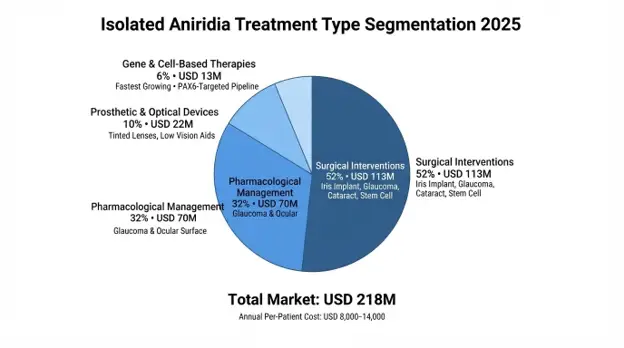
By Treatment Type: The major portion of market value includes surgical treatment options such as iris implant surgery, glaucoma draining surgeries, cataract removal, and transplanting of stem cells from the cornea and limbus. Pharmacologic treatment for chronic glaucoma and ocular surface disease is another treatment category, whereas vision rehabilitation devices and other new emerging therapy options constitute the smallest category but are growing quickly.
By associated ocular complications, the revenues are generated by the management of aniridia-associated keratopathy, glaucoma, and cataracts because of the frequent surgical and medical treatments that these conditions require throughout life, while the management of foveal hypoplasia and nystagmus mainly helps through the low vision rehabilitation domain.
By end-user, the largest market share belongs to hospitals and specialty eye clinics due to the difficulty involved in the surgical procedure, while ambulatory surgery centers and vision rehabilitation centers are becoming more complementary.
Aniridia represents a fragmented market because there is no dominant player in any treatment category. The competition is fragmented along the lines of modality, where prosthetic iris devices have a few players; glaucoma and ocular surface medications are available from large ophthalmic pharmaceutical companies, while emerging gene and cell therapies are being worked upon by a few biotech companies and partnerships. Competitiveness would depend upon clinical data from aniridic patients, connections with specialized reference centers, and experience with orphan drugs.
By Treatment Type:
By Associated Ocular Complication:
By Age Group:
By End-User:
By Region:
You'll get the sample you asked for by email. Remember to check your spam folder as well. If you have any further questions or require additional assistance, feel free to let us know via-
+1 724 648 0810 +91 976 407 9503 sales@intellectualmarketinsights.com
17 Sep 2026
Intellectual Market Insights Research © 2026. All rights reserved.