Share this link via:

The global isolated cortical dysplasia market was valued at USD 1.25 billion in 2025 and is projected to reach USD 1.34 billion in 2026, expanding to USD 2.45 billion by 2034, growing at a CAGR of 8.1% during the forecast period (2026-2034).
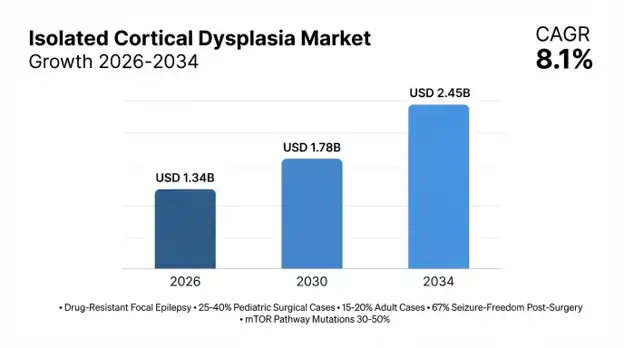
Isolated cortical dysplasia is a focal malformation of the cortex resulting from an abnormal process that disrupts the normal proliferation, migration, or post-migrational organization of the neurons forming the cortex during fetal brain development, leaving a discrete area of disorganized cortex without an associated hippocampal sclerosis, tumor, vascular malformation, or main structural lesion. Isolated cortical dysplasia, defined by the sole presence of dysplastic tissue, is a term used to describe all forms of focal cortical dysplasia, as per the classification system accepted internationally, which are subdivided as follows: Type I lesions are subtle disruptions of the laminar structure of the cortex; Type II lesions are dysmorphic neurons, with or without balloon cells; Type III presentations, in which a dysplastic cortex is associated with a secondary lesion, but the dysplastic tissue itself is the only cause of the clinical presentation. It is now known to be one of the most frequently seen structurally abnormal brain substrates of medically refractory focal epilepsy in children and adults, characterized by early-onset treatment-resistant seizures, developmental delay, cognitive impairment, and behavioral disturbance if surgery is delayed or not performed.
The clinical management of isolated cortical dysplasia is a multidisciplinary area of neurology, neurosurgery, neuroradiology, and epileptology that requires long-term video-EEG monitoring to identify the during-clinic seizures in the patient and a multimodal diagnostic approach that starts with high-resolution structural imaging, using 7-Tesla MR protocols for the future and 3-Tesla MR with specific protocols optimized for the detection of the subtle gray-white matter blurring, focal cortical thickening, and transmantle sign typical of dysplastic tissue. If imaging is inconclusive in a clinically significant number of patients, P.E.T. and S.P.E.C.T. can be used to demonstrate metabolic or perfusion abnormalities, M.E.G. can be used for non-invasive source localization, and finally, S.E.E.G. can be used to directly map the epileptogenic zone. Clinically, the treatment usually starts with antiseizure medication, but in most cases, lesions in the dysplastic cortex are inherently pharmacoresistant, and the treatment rapidly progresses to resective surgery, minimally invasive laser interstitial thermal ablation, and neuromodulatory devices (responsive neurostimulation and vagus nerve stimulation) for lesions located within the eloquent cortex where resection has unacceptable functional risk.
The sales of pharmaceuticals, the isolated cortical dysplasia market, include an interconnected commercial ecosystem of advanced neuroimaging equipment, post-processing software, in-operative electrocorticography and neuronavigation systems, robotic-assisted stereotactic electrode implantation platforms, genetic and molecular diagnostic services focusing on somatic mTOR pathway mutations, and a growing portfolio of neuromodulation devices and precision pharmacotherapies. Comprehensive presurgical evaluation and definitive surgical or device-based treatment are largely restricted to tertiary and quaternary comprehensive epilepsy centers, resulting in a unique marketplace that has low patient volumes and high per-patient value because of early onset, decades of duration, and the resources required for accurate lesion localization and intervention.
Epilepsy is estimated to affect 50 million people around the world, and 30-40% of these people do not get good seizure control with optimal doses of antiseizure drugs and are classified as pharmacoresistant. Isolated cortical dysplasia is the most frequent structural lesion, and it accounts for about 25-40% of the samples of children undergoing presurgical evaluation at specialized centers for epilepsy surgery and 15-20% of adults with drug-resistant focal epilepsy referred for surgical evaluation. Deep next-generation sequencing of surgically removed type II lesions has identified somatic mutations in genes of the mTOR pathway, including MTOR, PIK3CA, AKT3, TSC1, and TSC2, in approximately 30-50% of cases, creating a molecular basis for the disorder and a new treatment space for targeted pharmacotherapy beyond traditional seizure control.
| Report Coverage | Details |
|---|---|
| Base Year | 2025 |
| Base Year Value | USD 1.25 billion |
| Forecast Value | USD 2.45 billion |
| CAGR | 8.1% |
| Forecast Period | 2025-2034 |
| Historical Data | 2022-2025 |
| Largest Market | North America |
| Fastest Growing Market | Asia Pacific |
| Segments Covered | By Type, Diagnostic Modality, Treatment Modality, Drug Class, Patient Demographics, End-User, Region |
| Region Covered | North America, Europe, Asia Pacific, Middle East & Africa, Latin America |
| Countries Covered | US, Canada, Mexico, UK, Germany, France, Italy, Spain, Netherlands, China, Japan, India, Australia, South Korea, Brazil, Argentina, UAE, Saudi Arabia, South Africa |
| Key Market Playes | UCB S.A., Eisai Co. Ltd., Novartis AG, LivaNova PLC, Medtronic plc, NeuroPace Inc., Jazz Pharmaceuticals |
Get more details on this report - Request Free Sample
The increased evidence among clinicians of isolated focal cortical dysplasia as an important, surgically correctable cause of refractory epilepsy has resulted in a change in the referral process from extensive trial of different medications to presurgical evaluation sooner rather than later. The international recommendations are that surgery should be done following failure to achieve seizure freedom using only two appropriate antiepileptic medications, and this has increased the number of patients who qualify each year for surgery and has created a need for prolonged video-EEG studies, stereoelectroencephalography, and ultimately surgical treatment.
A significant portion of dysplasia is not detectable through conventional imaging studies. The advent of ultra-high field 7 Tesla magnetic resonance imaging, epilepsy imaging protocol sequences, and morphometric analysis with machine learning techniques has greatly enhanced the detection of the previously so-called "MRI negative" form of cortical dysplasia. Post-processing algorithms that can measure cortical thickening, blurring of the gray and white matter interface, and transmantle sign make it possible for small- and medium-sized epilepsy centers to have the same diagnostic power as expert neuroradiologists even in the absence of such radiologist expertise at all sites.
Mutations in the mTOR pathway occurring in somatic cells have been found to be the molecular driver for the development of Type II cortical dysplasia. Approval of mTOR inhibitors for the treatment of seizures associated with tuberous sclerosis complex, which is a functionally similar mTORopathy, offers not only the clinical proof of concept but also the regulatory guidance for investigating everolimus and rapamycin derivatives for the treatment of isolated cases of cortical dysplasia. Genetic testing is increasingly being used in the process of candidate selection for surgery.
The most important limitation on growth of the market is the costly and complicated process of presurgical evaluation that usually entails continuous video-EEG monitoring, advanced imaging, neuropsychological examination, and often involves invasive implantation of stereoelectroencephalography (SEEG), an evaluation process that is carried out in very few Level 3 and Level 4 epilepsy centers and can cost more than USD 100,000 for each patient before any form of treatment begins. This makes access to services highly geographically disparate and leads to an average time of more than 15 years from seizure diagnosis to surgery.
The potential to increase the availability of minimally invasive ablative technology, especially MR laser interstitial thermal therapy, provides considerable growth potential because of the possibility to perform stereotactic thermal ablation through one burr hole in real-time with thermometry guidance, without requiring open craniotomy. Such a solution would allow reducing hospital stays, decreasing complications, and improving the acceptability of surgery to turn a hesitant but eligible patient into a treated one.
A further area for growth would be the introduction of molecular or biomarker-based diagnostics that would be able to detect mutations in the mTOR signaling pathway either from surgical tissue or cerebrospinal fluid, providing the possibility to stratify patients and conduct targeted pharmacotherapy trials and create a business model like those used in oncology.
The use of robotic-assisted stereoelectroencephalography has gained momentum at comprehensive epilepsy centers as a means of achieving three-dimensional sampling of deep and perisylvian areas of the cerebral cortex through greater precision and a more rapid process as opposed to frame-based stereoelectroencephalography with the increasing need for advanced software analysis of multi-channel signals.
Neurostimulation devices capable of detecting abnormality within the cerebral cortex and delivering stimulation to block seizure genesis have found their applications in cases of cortical dysplasia localized in eloquent parts of the brain, where resection is impossible, with favorable long-term outcomes demonstrated by years of seizure reduction with stimulation.
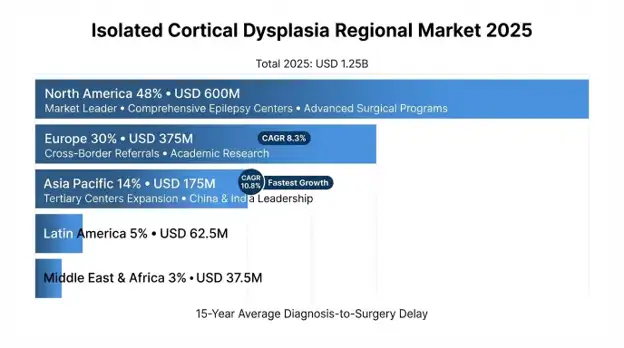
North America leads in terms of market shares held by isolated cortical dysplasia, driven by the presence of many centers for comprehensive epilepsy care equipped with complete surgical and neuromodulation facilities and a well-developed clinical research framework for developing evidence in favor of surgical and pharmaceutical applications. The US dominates the regional market share, driven by the presence of a considerable number of accredited centers for epilepsy care, which carry out a significant number of presurgical procedures.
Europe is the second largest regional market, with well-developed epilepsy surgery programs in Western and Northern Europe, active academic research programs, and increasing referral of patients from one country to another, although reimbursement schemes are quite different between countries.
Asia-Pacific is the fastest-growing region due to its huge underlying patient base suffering from epilepsy along with the development of tertiary neuroscience centers and increased awareness among physicians regarding surgical options for drug-resistant epilepsy patients. The major leaders in regional growth are China and India due to the establishment of specialized epilepsy surgery programs, but there is still a huge treatment gap with respect to the number of potential surgical candidates.
The Middle East & Africa is a region where there are examples of capabilities emerging within a few specific countries that establish regional referral centers for neurosurgical care, whereas the rest of the region does not yet have the capability to deliver such care on a larger scale, although international cooperation and telemedicine are contributing factors.
Latin America is a region showing continuous growth led by Brazil, Mexico, and Argentina, where tertiary centers provide more sophisticated surgery and monitoring services for epilepsy.
Type Insights: Type II focal cortical dysplasia is the biggest player on the market, capturing about 54% share, based on its high epileptogenicity, association with somatic mTOR mutations, and better results following surgery than other types. Type I has about 31% of types of the market, being harder to diagnose owing to less distinctive imaging appearance and worse chances of achieving seizure freedom after surgery.
Diagnostic Modality Insights: The biggest diagnostics segment is MRI-based diagnosis driven by universal acceptance as well as migration to ultra-high field and AI-enhanced MRIs. The second largest segment comprises EEG and video-EEG monitoring, which also includes invasive stereoelectroencephalography. PET/SPECT and MEG are important adjuncts used in negative MRIs. Genetic and molecular diagnostics emerge as the fastest-growing diagnostics category due to standardization of mTOR pathway testing.
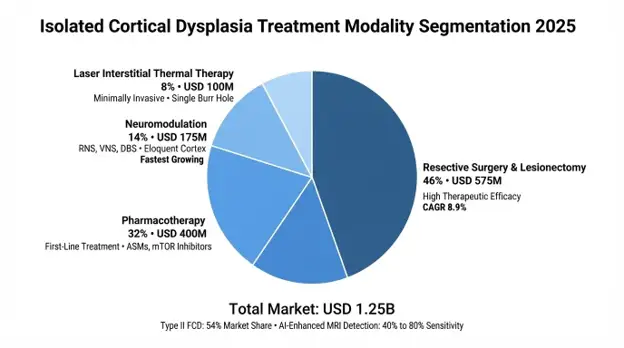
Treatment Modality Insights: The surgical procedure, including respective surgery and laser interstitial thermal therapy, contributes to the highest percentage of the revenue from the treatment because of its therapeutic efficacy and value of procedures, while pharmacotherapy still stays the first choice for the patients who are not eligible for surgery. Neuromodulation is the area that is developing rapidly because of responsive neurostimulation and vagus nerve stimulation usage.
End-User Insights: Hospitals and neurological centers are the biggest end-user market segments due to their involvement in the diagnosis and treatment process, while epilepsy centers hold a large portion of the high-margin market because of their involvement in pre-surgical evaluation, surgery, and device placement. Other growing market segments include ambulatory surgical centers and imaging/research centers.
The market for isolated cortical dysplasia is highly fragmented in terms of the three segments, namely pharmaceuticals, devices, and diagnostics, and there is no one company that holds a dominant position in the total market. The main area of pharmaceutical competition is the efficacy of the drugs for treating seizures along with their tolerability in pediatric patients and pipeline development of mTOR pathway inhibitors. Device makers compete on the basis of clinical data, safety of the procedure, and compatibility with other diagnostic tools.
March 2026: A specialized neuromodulation manufacturer received expanded regulatory clearance for a directional lead system supporting responsive neurostimulation in focal cortical dysplasia affecting eloquent cortex, supported by multi-year outcome data.
February 2026: A consortium of academic epilepsy centers published validation data for an AI-based cortical dysplasia detection algorithm demonstrating substantially improved sensitivity in previously MRI-negative cases using standardized imaging protocols.
January 2026: A leading pharmaceutical company announced a research collaboration to investigate mTOR inhibitor efficacy in isolated cortical dysplasia patients with confirmed somatic mutations identified through surgical specimen sequencing.
December 2025: A specialty pharmaceutical company reported encouraging results from a pediatric compassionate-use program evaluating cannabidiol as adjunctive therapy for cortical dysplasia-associated drug-resistant epilepsy.
November 2025: A major medical device company expanded regulatory approval for a minimally invasive laser ablation platform used in cortical dysplasia treatment, citing reduced hospitalization and complication rates.
By Type:
By Diagnostic Modality:
By Treatment Modality:
By Drug Class:
By Patient Demographics:
By End-User:
By Region:
You'll get the sample you asked for by email. Remember to check your spam folder as well. If you have any further questions or require additional assistance, feel free to let us know via-
+1 724 648 0810 +91 976 407 9503 sales@intellectualmarketinsights.com
18 Sep 2026
Intellectual Market Insights Research © 2026. All rights reserved.