Share this link via:

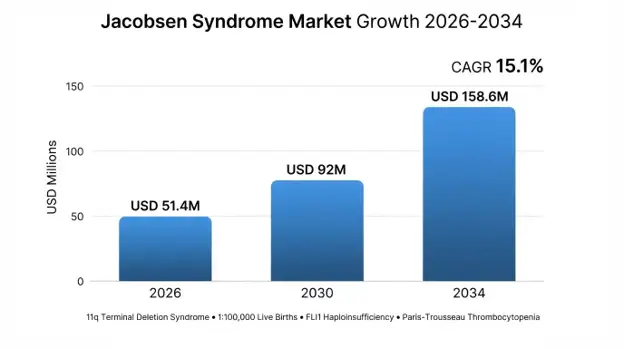
The global Jacobsen syndrome market size was valued at USD 45.2 million in 2025 and is projected to reach USD 51.4 million in 2026, expanding to USD 158.6 million by 2034, growing at a compound annual growth rate (CAGR) of 15.1% during the forecast period (2026-2034).
Jacobsen syndrome, or 11q terminal deletion syndrome, is a rare contiguous gene deletion disorder caused by the loss of genetic material at the terminal end of the long arm of chromosome 11, usually from 11q23.3 to 11q25. It was first clinically described by Danish cytogeneticist Petra Jacobsen in 1973, and more recently, molecular studies have revealed that the size of the deletion is variable among patients, from approximately 7-20 megabases, with larger deletions corresponding to more complex and severe phenotypes. A minority are cases with an unstable fragile site at 11q23.3 (FRA11B) that predisposes to breakage of the chromosome, while most are sporadic, de novo, and are not linked to a familial chromosomal rearrangement. The estimated prevalence of birth is about one in 100,000 live births, and the ratio of affected females to males is about 2:1, in part because of higher rates of spontaneous pregnancy loss among affected male fetuses.
Clinically, Jacobsen syndrome manifests as a multisystem disease, which will require lifelong, multidisciplinary therapy. In about 50-60% of cases, the heart defect is congenital (present at birth) and may be a left-sided obstructive lesion, hypoplastic left heart syndrome, or a ventricular or atrial septal defect, and these are the primary factors that determine the risk of early death. Almost all patients have a very characteristic congenital bleeding disorder known as Paris-Trousseau syndrome, which is defined by two abnormalities: thrombocytopenia and impaired megakaryocyte maturation, which is associated with a functional defect of large platelets. This is very closely related to a haploinsufficiency of the FLI1 gene within the deleted region, and platelet counts may improve with age despite the persistent functional defect. Other characteristic features are cranial dysmorphism such as trigonocephaly and metopic suture involvement, hypertelorism, a broad or flattened nasal bridge, low-set ears, intellectual disability, behavioral problems that may mimic those of attention-deficit/hyperactivity disorder, autism, and obsessive-compulsive traits, humoral immune defects that increase susceptibility to infective diseases, and growth and feeding disorders and skeletal and renal abnormalities.
Unlike other diseases with a single specific gene deletion, the commercialization of the disease will focus not on a single proprietary orphan drug but on advanced diagnostics in cytogenetics, on symptomatic management of the disease with pharmaceuticals, on complex interventions in cardiac and hematological diseases, and on long-term multidisciplinary supportive care. Today, the diagnostic arm of this platform has been revolutionized using chromosomal microarray analysis as the first-line approach to developmental delay and multiple congenital anomalies, while therapeutic revenue has been achieved by platelet transfusion services, cardiac surgical repair, immunoglobulin replacement in immunodeficiency patients, and neurodevelopmental and behavioral services throughout childhood and more recently into adulthood. There is an increasing infrastructure of patient registries in the international setting, coordinated by the 11q Research & Resource Group and Unique (Rare Chromosome Disorder Support Group), providing the natural history data that will be vital for future targeted molecular interventions to go beyond simply a supportive-care model and become a more integrated approach to treatment that includes diagnostic innovation and early-stage targeted therapeutics.
| Report Coverage | Details |
|---|---|
| Base Year | 2025 |
| Base Year Value | USD 45.2 Million |
| Forecast Value | USD 158.6 Million |
| CAGR | 15.1% |
| Forecast Period | 2025-2034 |
| Historical Data | 2022-2025 |
| Largest Market | North America |
| Fastest Growing Market | Europe |
| Segments Covered | By Treatment Type, Diagnostic Modality, Disease Manifestation, End-User, Region |
| Region Covered | North America, Europe, Asia Pacific, Middle East & Africa, Latin America |
| Countries Covered | US, Canada, UK, Germany, France, Italy, Spain, Netherlands, Denmark, China, Japan, India, Australia, South Korea, Brazil, UAE, Saudi Arabia |
| Key Market Playes | Illumina Inc., Thermo Fisher Scientific, Agilent Technologies, CSL Behring, Takeda Pharmaceutical, Novartis AG, Amgen Inc. |
Get more details on this report - Request Free Sample
The major growth factor for the Jacobsen syndrome market is the increasing usage of chromosomal microarrays as the preferred first-line genetic test in pediatric patients suffering from developmental delay, congenital anomalies, or symptoms suggestive of autism spectrum disorder. Traditional karyotyping often failed to detect the smaller 11q terminal deletions because of its low-resolution capabilities, causing delayed diagnoses. In contrast, chromosomal microarrays can accurately identify any copy number variations in high resolution, even those that were small, thus detecting new cases of the disease that were not detected before. Every newly diagnosed patient joins a multidisciplinary treatment protocol that includes cardiology, hematology, immunology, and development services, resulting in increased health care utilization.
Neonatal intensive care, pediatric cardiac surgery, and the use of a standardized hematologic approach have resulted in a considerable decrease in early childhood mortality caused by severe congenital heart disease and bleeding problems. With the survival of more children into the teenage years and adulthood, the need for an acute neonatal approach has been replaced with the requirement for a sustained multidisciplinary approach, including follow-ups by a cardiologist, platelet testing, immunoglobulin treatment, when necessary, speech and behavioral therapies, as well as a transition program. The extended longevity transforms a short-term segment that would otherwise have had no disease-modifying medication into a higher-value market segment.
Jacobsen syndrome is characterized by haploinsufficiency of several contiguous genes and is thus not attributable to one tractable anomaly; traditional approaches to treatment through gene replacement or drug therapy used in monogenic rare diseases cannot be applied. Treatment is thus based on standard treatments, procedures, and protocols that do not bring significant revenue through proprietary treatments but offer limited potential for the development of drugs specific to the condition.
Mechanistic insight into the contribution of each individual gene within the deletion region has paved the way for targeted interventions that will attempt to correct only the specific deficiencies instead of attempting to compensate for the overall chromosome deletion. As FLI1 haploinsufficiency is responsible for most Paris-Trousseau thrombocytopenia cases, it is a potentially viable molecule that can be targeted through RNA or small-molecule treatments aimed at increasing the expression from the remaining allele. It is known from other diseases where antisense oligonucleotide drugs have been approved that such an approach is scientifically and legally feasible.
Globally established databases of rare chromosome disorders, created by organizations like Unique and the 11q Research & Resource Group, have become more adept at connecting the exact deletion point on the chromosome to the presence or absence of certain genes, thereby allowing a transition from reactive care to proactive care.
Multidisciplinary specialty clinics that combine cardiologists, hematologists, geneticists, and developmental experts are becoming commonplace in academic settings. Such clinics improve care coordination and create aggregated demand. With survival extending into adulthood, care-transition systems that bridge pediatric to adult specialties have become a hallmark of effective management of the condition known as Jacobsen syndrome.
North America is the dominant region with the highest market share of Jacobsen syndrome owing to the extensive insurance coverage for chromosomal microarray analysis, the presence of a high concentration of pediatric cardiosurgical and hematology expertise, the established advocacy infrastructure of the 11q Research & Resource Group, and orphan drug incentives, including the FDA orphan designation and priority review pathway for rare pediatric diseases.
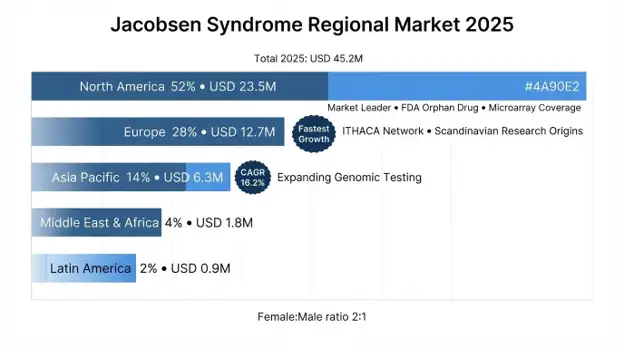
Europe is the fastest-growing region due to the Scandinavian research origins of the condition; the robust clinical genetics programs of the UK, Germany, France, and the Netherlands; and the influence of the European Reference Network ITHACA, which establishes standardized guidelines for rare congenital malformation and intellectual disability syndromes, including Jacobsen syndrome.
Asia Pacific continues to grow continuously due to the better availability of genomic testing facilities in China, Japan, and South Korea, but major differences still exist between large metropolitan areas and remote rural places. Latin America and the Middle East & Africa are at present smaller shares in the market due to restricted access to diagnostics, but selected centers in larger nations are growing their capabilities.
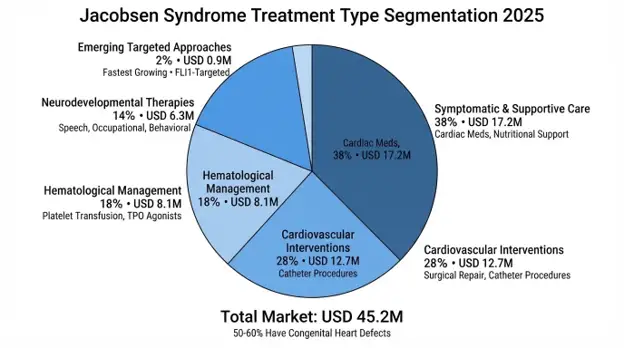
By treatment type, symptomatic treatment continues to be the largest segment in this market, including cardiac surgery procedures and catheters, platelet transfusion and management of bleeding risk, immunoglobulin treatment, and neuromodulatory services. Targeted molecular therapies are the fastest-growing yet most nascent segments.
Of diagnostic techniques, chromosomal microarray is the most dominant one, being the gold standard, while fluorescence in situ hybridization is valuable for confirmation, and next-generation sequencing is gaining importance in rare cases.
By disease manifestation, congenital heart defects and Paris-Trousseau thrombocytopenia have the highest cost per incident, whereas neurodevelopmental/behavioral services are the highest-volume type of care provided over the course of a patient’s lifetime.
By end-user, hospitals and tertiary pediatric genetics centers provide the largest proportion of care services, while academic/research institutes contribute disproportionately to registries and natural history studies.
The Jacobsen syndrome market demonstrates a fragmented competitive environment, based on services and diagnostics, in contrast to a market dominated by a specific therapy for the disease. The diagnostic equipment manufacturers providing chromosomal microarray and sequencing technologies generate significant value through patient identification, whereas the pharmaceutical and biologics firms specializing in hematology and immunology provide the biologics employed in symptomatic treatment. Patient advocacy groups have a disproportionately large impact on research agendas and the linkage between families and clinical researchers, typical for ultra-rare diseases with insufficient commercial drive.
January 2026: A comprehensive clinical and neuropsychological characterization study of patients with Jacobsen syndrome was published, providing updated evidence on the syndrome's developmental, behavioral, cognitive, and psychiatric manifestations and supporting more structured multidisciplinary patient management.
October 2025: A case report examining Jacobsen syndrome with white matter abnormalities and MRI follow-up added further evidence regarding neurological involvement and the importance of longitudinal neuroimaging in monitoring affected patients.
April 2025: Updated clinical guidance emphasized comprehensive management of Jacobsen syndrome, including genetic diagnosis, congenital heart defect management, monitoring of Paris-Trousseau thrombocytopenia, immunological assessment, and developmental support.
March 2025: Advances in chromosomal microarray analysis, next-generation sequencing, and other genetic diagnostic technologies continued to improve the identification and characterization of chromosome 11q deletions associated with Jacobsen syndrome.
February 2025: Increased emphasis was placed on early multidisciplinary intervention programs, including developmental therapy, speech and language support, physical therapy, and specialized educational interventions to improve long-term patient outcomes.
By Treatment Type:
By Diagnostic Modality:
By Disease Manifestation:
By End-User:
By Region:
You'll get the sample you asked for by email. Remember to check your spam folder as well. If you have any further questions or require additional assistance, feel free to let us know via-
+1 724 648 0810 +91 976 407 9503 sales@intellectualmarketinsights.com
18 Sep 2026
Intellectual Market Insights Research © 2026. All rights reserved.