Share this link via:

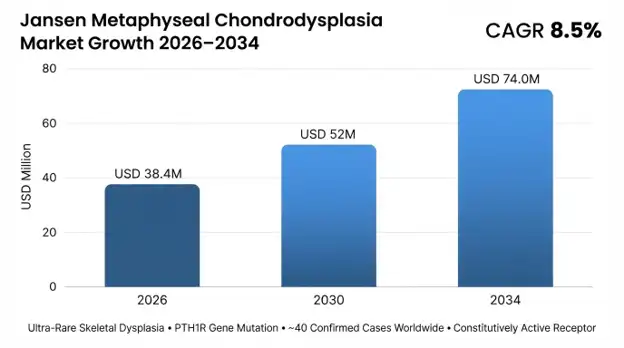
The global Jansen metaphyseal chondrodysplasia market size was valued at USD 35.0 million in 2025 and is estimated to reach USD 38.4 million in 2026, expanding to USD 74.0 million by 2034, growing at a CAGR of 8.5% during the forecast period (2026-2034).
Jansen metaphyseal chondrodysplasia is a very rare, autosomal dominant, skeletal dysplasia due to heterozygous activating mutations of the parathyroid hormone receptor type 1 gene (PTH1R). The most common pathogenic variant is a change of histidine to arginine at residue 223 in the transmembrane region of the receptor; further recurrent mutations are found at threonine 410 and isoleucine 458, which render the receptor constitutively active in the absence of ligand. This continuous, uncontrolled receptor signaling causes constant elevated levels of cyclic adenosine monophosphate in growth plate chondrocytes, inhibiting the normal successive events of growth plate chondrocytes' proliferation, hypertrophic differentiation, and mineralization at the metaphysis and resulting in the characteristic radiographic features of irregular, poorly defined, widened metaphyseal ends of long bones.
The clinical features are most prominent in short-limbed dwarfism from infancy: progressive bowing of the femurs and tibiae, joint contractures, and an unusual gait (waddling) that gets worse as the child grows and places more weight on the legs. Persistent hypercalcemia and hypercalciuria are linked to constitutive activation of the same receptor, resulting in a peculiar biochemical paradox: hypercalcemia, hypercalciuria, and hypophosphatemia in the presence of normal or suppressed intact parathyroid hormone and low or undetectable parathyroid hormone-related protein. This biochemical profile has historically caused diagnostic confusion with primary hyperparathyroidism, and case reports have been published of children that had unnecessary exploration of the parathyroid glands or partial parathyroidectomy before the correct underlying receptor mutation was identified. Chronic hypercalcemia also causes nephrocalcinosis and renal impairment and accounts for a clinically significant number of patients developing conductive or mixed hearing loss, caused by disordered ossification at the base of the skull, which compresses the cranial nerves.
There is no disease-modifying pharmacotherapeutic treatment for Jansen metaphyseal chondrodysplasia, and treatment is entirely supportive currently. Off-label bisphosphonate uses to limit excessive bone turnover from hypercalcemia; dietary calcium reduction; vigorous hydration; and, in selected cases, use of calcimimetic agents to modulate the activity of the calcium-sensing receptor, as well as monitoring of renal function and hearing, are standard practice in specialized centers. There are surgical interventions that can be carried out using repeated corrective osteotomies, guided growth procedures, and limb realignment by pediatric orthopedic specialists, usually involving multiple operations throughout childhood and adolescence, to correct the skeletal deformity. In fact, the commercial landscape of the condition extends beyond genetic diagnostic testing infrastructure and off-label pharmacotherapy to specialized pediatric orthopedic hardware and surgical services and into this early-stage pipeline of receptor-targeted investigational compounds.
Although Jansen metaphyseal chondrodysplasia has been clinically recognized for almost a century by the Dutch surgeon Murk Jansen in 1934, only about 40 cases have been genetically confirmed in the peer-reviewed medical literature worldwide to date, making it one of the ultra-orphan diseases. This extreme rarity is balanced, commercially, by the unsung scientific importance of the PTH1R signaling pathway to the wider study of bone and mineral metabolism and by the availability of orphan drug incentive programs, which can even make a narrowly focused therapeutic program economically viable. With multiple orthopedic surgeries, specialized imaging, genetic testing, biochemical and renal monitoring for life, and multi-specialty follow-up, the total cost of care for an affected patient can be more than a few hundred thousand dollars per patient, even in the face of a very small patient population worldwide.
| Report Coverage | Details |
|---|---|
| Base Year | 2025 |
| Base Year Value | USD 35.0 Million |
| Forecast Value | USD 74.0 Million |
| CAGR | 8.5% |
| Forecast Period | 2025-2034 |
| Historical Data | 2022-2025 |
| Largest Market | North America |
| Fastest Growing Market | Europe |
| Segments Covered | By Disease Subtype, Treatment Type, Drug Class, Diagnostic Modality, End-User |
| Region Covered | North America, Europe, Asia Pacific, Middle East & Africa, Latin America |
| Countries Covered | US, Canada, UK, Germany, France, Italy, Netherlands, Japan, China, India, Australia, South Korea, Brazil, UAE, Saudi Arabia, South Africa |
| Key Market Playes | Rare Bone Disease Biopharmaceutical Developers, Genetic Diagnostic Laboratories, Pediatric Orthopedic Device Manufacturers |
Get more details on this report - Request Free Sample
The major factor influencing the market dynamics for Jansen metaphyseal chondrodysplasia is the growing implementation of next-generation sequencing and gene panels for skeletal dysplasia into pediatric diagnostics workflow, leading to a significant reduction of time spent on diagnosis traditionally associated with the disorder in question. Without genetic testing, the combination of hypercalcemia and short stature would frequently mislead doctors to make an erroneous conclusion regarding the presence of primary hyperparathyroidism, sometimes leading to the unnecessary surgery of the parathyroid gland until the existence of a mutation in the PTH1R gene became clear. The growing inclusion of PTH1R in the targeted gene panels of skeletal dysplasia and hypercalcemia allows confirming the diagnosis at the earliest age, providing the necessary information for treatment and family counseling.
Key Performance Metrics:
The other major factor is the advancement in regulatory frameworks for orphan and ultra-orphan drugs in the US, EU, and Japan, which substantially enhance the economic viability of developing an agent for a rare condition that affects just a few dozen people. The US Orphan Drug Act offers a seven-year period of market exclusivity after approval, tax credits on expenditures incurred for qualifying clinical trials, and qualifications for fast-track designations, whereas the European Medicines Agency offers ten years of market exclusivity for orphan products, with additional time granted for pediatric development programs. The above incentives, together with precedents in pricing of ultra-rare skeletal and mineral metabolic diseases, where approved treatments have high annual treatment costs, provide economic viability to drug development targeting PTH1R despite its rarity.
Key Performance Metrics:
Probably the most important limitation to Jansen metaphyseal chondrodysplasia market is its extremely rare nature since fewer than 40 cases of it have been reported in the entire world. In such a situation, the design of a randomized control study would be statistically impossible. An interventional study would require the use of small, geographically isolated sample sizes and a single-arm design with the use of synthetic controls.
The greatest transformative potential is found in the possibility to develop small molecules or peptide molecules that could stabilize the PTH1R receptor in its inactive state, thus tackling the underlying cause of the disease and not its downstream effects related to hypercalcemia and bone disorders. Since standard receptor antagonists that only inhibit the interaction with the ligand cannot effectively inhibit a constitutively active receptor without a ligand, studies have been conducted to identify inverse agonists or allosteric modulators that could reduce signaling even when no ligand is present. If successfully developed, such a molecule would be able to treat both growth plate abnormalities and calcium homeostasis at once with a single mechanism of action and therefore could obtain very high orphan drug pricing.
Management of Jansen metaphyseal chondrodysplasia is gradually centralizing in specialized facilities for rare bone dysplasias located within academic pediatric hospitals, whereby medical geneticists, pediatric endocrinologists, orthopedic surgeons, nephrologists, and audiologists cooperate in treating patients longitudinally. It helps to ensure more precise diagnoses, biochemical and radiologic surveillance, and establish a platform for natural history investigations and clinical trials.
North America
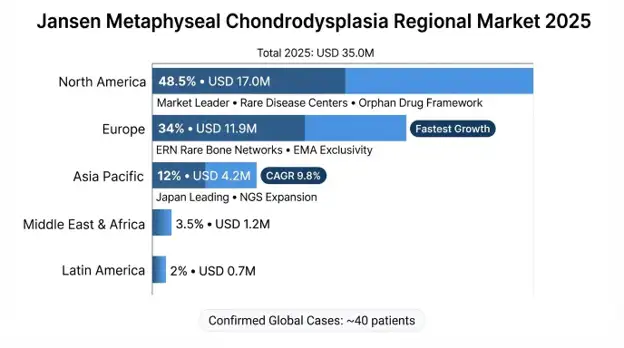
North America stands as the predominant regional market, owing to the presence of focused expertise in rare skeletal dysplasias among prominent academic pediatric hospitals, the most advanced orphan drug regulations and reimbursement policies globally, and the densest molecular genetic diagnostics available for precise diagnosis. The US comprises the greatest share of the regional market due to significant government funding allocated towards rare diseases' genetics, including skeletal and endocrine conditions; rare disease advocacy groups that encourage registry enrollment; and an economic setting that offers less resistance to pricing of orphan drugs through health technology assessments.
Europe
Europe represents the second largest regional market, based on the presence of an established orphan drug regulation system at the European Medicines Agency and the rare bone disease research facilities in place in Europe through the European Reference Networks, linking centers specializing in rare bone diseases in various member states to conduct international referrals and diagnostics.
Asia Pacific
The Asia-Pacific region is a relatively small yet developing market, thanks to increasing availability of genetic diagnosis facilities in key academic institutions in Japan, South Korea, and Australia, along with increased use of orphan drug designation models inspired by Western countries. Japan, with a well-developed orphan drugs market and high level of academic research on skeletal genetics, can be considered the most developed market in the region, whereas China and India are steadily improving case identification due to widespread usage of next-generation sequencing technology in tertiary pediatric centers.
The classic Jansen metaphyseal chondrodysplasia, which is linked to the highly recognized mutations of histidine 223 and threonine 410 of the PTH1R gene, represents a major proportion of known cases and manifests with severe short stature and marked metaphyseal changes since infancy. However, other types of this syndrome caused by PTH1R mutations, which show milder biochemical and radiographic features, are increasingly reported with advances in genetic studies.
Orthopedic surgeries now constitute the most significant costs associated with the disease due to the universal need for several osteotomies and limb correction surgeries in childhood and adolescence. Medications are the second most important cost component related to pharmacotherapy that involves off-label bisphosphonates and calcimimetics. Novel targeted therapies have yet to emerge from preclinical studies, but the fastest-growing sector will become their use if a disease-modifying modulator of the PTH1R is developed.
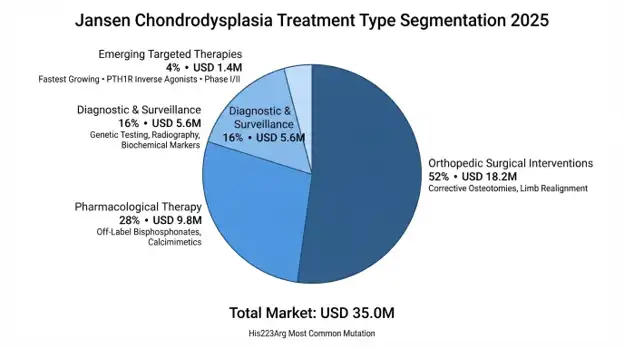
Genetic and molecular testing has emerged as the gold standard for diagnosing this condition, as PTH1R sequencing is an unequivocal test to differentiate Jansen metaphyseal chondrodysplasia from other metaphyseal dysplasias and from primary hyperparathyroidism. Skeletal imaging is important for phenotyping and surgical planning, and biochemical markers of serum calcium, phosphate, and intact parathyroid hormone help in following the progress of the disease.
The tertiary pediatric hospitals and the rare disease centers are the leading end users because of the need for the expertise, capabilities, and resources involved in dealing with this disorder. Orthopedic and metabolic bone centers are important players in the management of adult patients. The academic research institutions play a pivotal role in collecting natural history data and developing therapies.
The competitive environment about the development of treatments for Jansen metaphyseal chondrodysplasia is very fragmented and primarily in the pre-commercial phase. Competition is limited to companies that are working on rare bone diseases and studying the biology of PTH1R receptors and other pathways; genetic laboratories performing testing of PTH1R mutations; and device companies manufacturing the surgical hardware used in the treatment of children. The key competitive advantage lies in the knowledge of PTH1R receptors' structure, natural history, and orphan drug approval process in multiple jurisdictions for a very limited patient base.
July 2026: The Phase 1/2 clinical study evaluating PTH receptor inverse agonist (PTH-IA) continued to progress, representing a major step toward the first targeted pharmacological treatment for Jansen metaphyseal chondrodysplasia.
May 2026: The first-in-human PTH-IA clinical trial commenced, evaluating the safety, tolerability, dose escalation, and preliminary therapeutic effects of the investigational treatment in affected patients.
April 2026: The PTH-IA clinical study was formally registered, marking the transition of this targeted therapy from extensive preclinical development into human clinical evaluation.
July 2025: Updated clinical guidance for PTH1R-related Jansen metaphyseal chondrodysplasia strengthened recommendations for genetic diagnosis, monitoring of skeletal abnormalities, hypercalcemia, hypercalciuria, kidney complications, and multidisciplinary care.
June 2025: New research reported an improved mouse model of Jansen metaphyseal chondrodysplasia, providing researchers with a more effective platform for investigating disease mechanisms and evaluating potential therapeutic candidates.
January 2025: Research on the craniofacial manifestations of Jansen metaphyseal chondrodysplasia highlighted the importance of monitoring complications such as craniosynostosis, hearing impairment, airway narrowing, dental abnormalities, and facial nerve compression.
By Disease Subtype:
By Treatment Type:
By Drug Class:
By Diagnostic Modality:
By End-User:
By Region:
You'll get the sample you asked for by email. Remember to check your spam folder as well. If you have any further questions or require additional assistance, feel free to let us know via-
+1 724 648 0810 +91 976 407 9503 sales@intellectualmarketinsights.com
18 Sep 2026
Intellectual Market Insights Research © 2026. All rights reserved.


