Share this link via:

The global Jervell and Lange-Nielsen syndrome (JLNS) market size was valued at approximately USD 138 million in 2025 and is projected to reach USD 148 million in 2026, expanding to nearly USD 258 million by 2034, growing at a CAGR of around 7.2% during the forecast period (2026-2034).
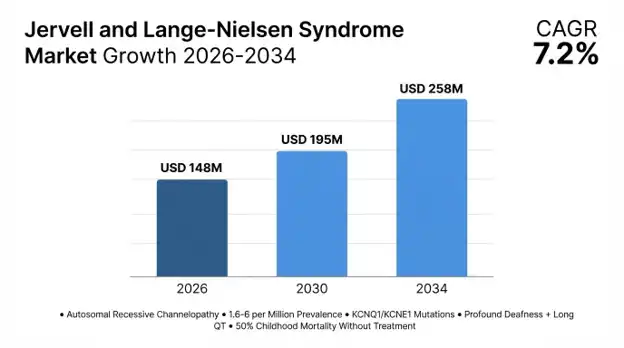
Jervell and Lange-Nielsen syndrome is an extremely rare channelopathy, an autosomal recessive disorder, unique from all other forms of congenital long QT syndrome by the concurrent presence of profound bilateral congenital sensorineural hearing loss and a markedly prolonged QT interval. It is caused by mutations in the KCNE1 or KCNQ1 genes, which encode the alpha and beta subunits of the voltage-gated potassium channel, which is responsible for the slow delayed rectifier current (IKs), and in about 90% of cases, the mutations are of the loss-of-function type. This single ion channel has two very different anatomical roles, having a critical role in the inner ear endolymphatic potassium content and in the phase 3 ventricular repolarization in cardiac myocytes. Individuals with biallelic mutations to the gene because of the loss of function, then, suffer from both cardiac electrical instability and complete hearing loss; meanwhile, heterozygous carriers of the same mutations tend to exhibit only the less severe Romano-Ward type of LQTS, with normal hearing. JLNS is a condition where the corrected QT interval is often over 550 msec, well outside the normal range of Romano-Ward carriers (460-500 msec), and historical case series show mortality rates of close to 50% before age 15 without treatment, emphasizing a compelling medical need to guide clinical management from early infancy.
The prevalence in the general population is estimated to be about 1.6-6 cases per million people but increases significantly in genetically isolated communities with founder mutations, as in the Norwegian and Swedish families in which the condition was first described in 1957 by Jervell and Lange-Nielsen, where the prevalence is approximately 1:200,000. High frequencies have also been reported in some consanguineous populations in the Middle East and South Asia. With the addition of the estimated undiagnosed cases, it is estimated that between 8,000 and 15,000 children are living with undiagnosed congenital deafness, with important gaps in diagnosis in areas with inadequate integration between pediatric cardiology and audiology services to address the cardiac risk in children with congenital deafness.
The characteristics of the JLNS market are not the volume of pharmaceuticals but rather the high complexity and high cost of interventions involving two organ systems simultaneously. This includes lifelong non-selective beta-blocker therapy (most often propranolol or nadolol) as the pharmacological cornerstone of arrhythmia prevention; implantable cardioverter-defibrillators (transvenous and subcutaneous) for patients at high risk of ventricular fibrillation despite best medical therapy; bilateral cochlear implantation and long-term audiological rehabilitation, as conventional hearing aids are generally sub-optimal for the profound hearing loss in the syndrome; and genetic counseling and cascade family screening (under autosomal recessive inheritance, the risk for ventricular fibrillation is 25%). With the severity of the unmet need, well-documented monogenic disease etiology, and the need for coordinated care of the cardiac, audiological, and genetic components of the disease, JLNS has become an increasingly important reference model in the broader inherited arrhythmia and hereditary deafness treatment landscape.
| Report Coverage | Details |
|---|---|
| Base Year | 2025 |
| Base Year Value | USD 138 Million |
| Forecast Value | USD 258 Million |
| CAGR | 7.2% |
| Forecast Period | 2025-2034 |
| Historical Data | 2022-2025 |
| Largest Market | North America |
| Fastest Growing Market | Europe |
| Segments Covered | By Treatment Type, Age Group, End-User, Region |
| Region Covered | North America, Europe, Asia Pacific, Middle East & Africa, Latin America |
| Countries Covered | US, Canada, UK, Germany, France, Italy, Spain, Norway, Sweden, Netherlands, China, Japan, India, Australia, South Korea, Brazil, UAE, Saudi Arabia, South Africa |
| Key Market Playes | Medtronic plc, Abbott Laboratories, Boston Scientific Corporation, Cochlear Limited, MED-EL GmbH, Sonova Holding AG, Biotronik SE, LivaNova PLC |
Get more details on this report - Request Free Sample
The single most important factor driving market growth is the ongoing convergence between universal newborn hearing screening programs and cascade cardiac evaluations that have recently classified bilateral severe sensorineural hearing loss in an infant as an indication requiring immediate electrocardiographic testing. Traditionally, there was a significant time delay between diagnosing the cardiac and auditory aspects of JLNS; in some cases, patients would undergo cochlear implant surgery when their unknown prolonged QT syndrome increased their risk of arrhythmias during the anesthesia. Modern protocols increasingly call for cardiology consultation at the same time as auditory issues are being diagnosed, while new generation next-generation sequencing panels used to diagnose hereditary deafness in North America, Europe, and increasingly East Asia include KCNQ1 and KCNE1 genes, providing molecular evidence and alerting clinicians about cardiac risks before a first syncopal episode. The convergence makes the patient population grow, facilitates beta-blocker treatment, and accelerates bilateral cochlear implantation procedures.
JLNS is associated with one of the highest lifetime per-patient expenditures in the entire rare disease space since children born with the condition need lifetime management of both the cardiovascular system and auditory system from birth onwards. The cochlear implant surgery, which needs to be performed before the age of one in order to develop the auditory cortex at optimal rates, includes device cost, surgery cost, and lifetime rehabilitation expenses, while the implantable cardioverter defibrillator (ICD), which is indicated in a considerable number of patients with syncope or failure of response to beta-blockade, involves considerable implantation cost, follow-up, and generator replacement costs throughout a patient’s lifetime. These factors, along with orphan drug designations in the United States, the European Union, and other countries, have made JLNS a target of significant interest of biotech and device companies.
The primary constraint on the expansion of the market is the very low number of patients across the globe, which despite advancements in diagnosis continues to be too low to allow conventional large-scale clinical trials in any economically sensible time frame. This factor serves as a deterrent for some pharmaceutical companies to develop drugs specifically for JLNS patients, while other indications of long QT syndrome have much wider target audiences. The fact that the treatment will cost more compared to cheap generic medications like beta-blockers also becomes a cause of concerns among the payers. In addition, the presence of both cochlear implants and implantable cardioverter-defibrillators in the same patient brings in additional challenges related to electromagnetic compatibility and anesthesia management during surgeries, and these procedures can be conducted only in a handful of institutions across the developed world due to specific expertise required.
The most compelling long-term possibility is the development of strategies to restore normal channel function in both cardiac and cochlear tissue through gene therapy, potentially providing disease modification rather than lifelong treatment of symptoms. Successful transduction of cardiac myocytes using adeno-associated viruses has been reported in pre-clinical models of KCNQ1 deficiency, where normal repolarization has been achieved, and the cochlear endolymphatic space provides an easy-to-access target via intracochlear or intratympanic delivery using techniques developed through cochlear implantation surgery. The example set by currently marketed gene therapies for other monogenic disorders, which charge premium prices per treatment for small patient populations, provides an economic model for such a gene therapy approach to JLNS that acts on both heart and ear tissues.
North American and European tertiary centers are more frequently establishing joint clinics with a multidisciplinary team of pediatric cardiology, cardiac electrophysiology, audiology, cochlear implantation, and clinical genetics under one integrated pathway of care, in contrast to the historically separated pathways of care that have been in use for cardiac and audiological issues. The tertiary centers are creating a combined registry of longitudinal data on patients, which includes coordinated rare cardiac diseases networks in Europe, with electrophysiologic and audiologic outcomes for purposes of better risk stratification and comparative effectiveness research between beta-blocker therapy, defibrillator placement, and denervation, as well as for natural history data needed for future gene therapy trials.
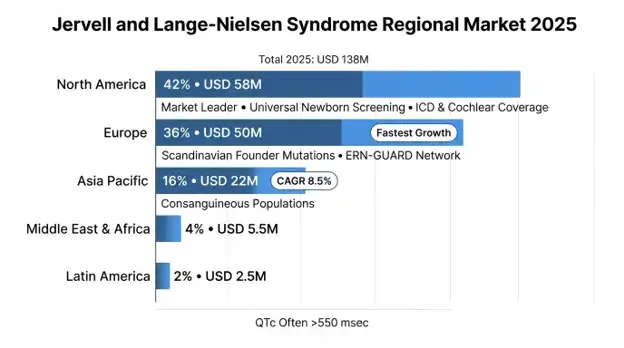
North America is the largest market, due to widespread adherence to neonatal hearing screening, Medicare and commercial insurance coverage for cochlear implantation, defibrillator implantation, and genetic testing, along with many inherited arrhythmia programs in the academic setting, which are experienced in handling complicated cases of long QT syndrome. The United States comprises most of the value in the region, due to patient advocacy groups supporting the creation of registries and research initiatives along with FDA orphan drug initiatives, providing commercial protection for companies involved in treatment and device development.
Europe is the fastest-growing region owing to true high prevalence rates of disease in Scandinavia, where founder mutations identified during the first description of the syndrome in a Norwegian family in 1957 have continued to yield a greater prevalence rate in Norway and Sweden compared to the global population. The region has a well-coordinated infrastructure through the European Reference Network for rare, low-prevalence complex diseases of the heart that involves collaboration between specialized centers across member states to establish a standardized process of diagnosis and to harmonize treatment protocols for left cardiac sympathetic denervation and defibrillator implantation as well as to conduct clinical trials. Germany, France, the UK, Norway, and Sweden make up most of the market value in Europe.
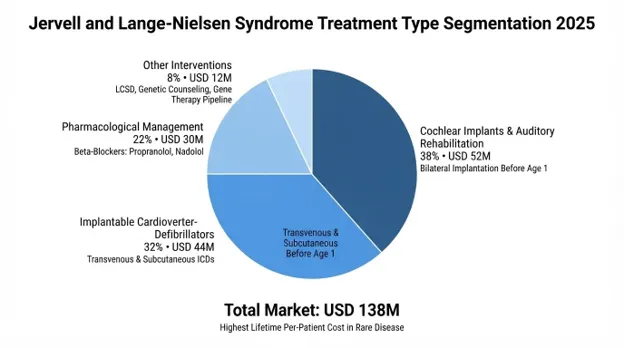
By treatment type, implantable cardioverter defibrillators and cochlear implant systems combined contribute to the highest portion of market value due to their costly nature and large numbers of people needing them throughout their lives, followed by long-term treatment using beta-blockers, left cardiac sympathetic denervation in refractory cases, and genetic counseling & family screening services, which produce lower revenue but form the basis of identifying potential candidates for gene therapy.
By age group, most new intervention start-ups are in the neonatal, infant, and pediatric age categories. Since the diseases manifest themselves from birth and need immediate treatment, the adolescent and adult age categories provide sustained income generation from replacement devices and processors as well as pharmaceutical management.
By end-user, the tertiary hospitals and cardiac centers enjoy dominance by virtue of the complicated nature of defibrillator and cochlear implant surgeries, while pediatric specialty centers and rare disease centers play an important coordinating role.
The JLNS market sees the competition of two somewhat different clusters of device manufacturers in addition to diagnostic genetic laboratories and generic drug producers. Cardiac rhythm management companies provide competition in the defibrillator and pediatric electrophysiology segment by way of device miniaturization, extended battery life, and advanced algorithms for detecting arrhythmia in children and small-bodied individuals, while manufacturers of cochlear implants focus on electrode design, atraumaticity of the procedure, MRI compatibility, and audiological support programs over long periods of time. Laboratories offering genetic testing compete on the number of genes tested and the speed of providing the results in hereditary deafness and cardiac arrhythmia panels, while there are a few biotech companies developing early-stage programs for restoring KCNQ1 and KCNE1 genes and RNA. The reason why most of the players have no separate marketing for JLNS is that this patient population is extremely rare and can be captured due to the dominance in pediatric electrophysiology and audiology markets.
By Treatment Type:
By Age Group:
By End-User:
By Region:
Latin America
You'll get the sample you asked for by email. Remember to check your spam folder as well. If you have any further questions or require additional assistance, feel free to let us know via-
+1 724 648 0810 +91 976 407 9503 sales@intellectualmarketinsights.com
18 Sep 2026
Intellectual Market Insights Research © 2026. All rights reserved.