Share this link via:

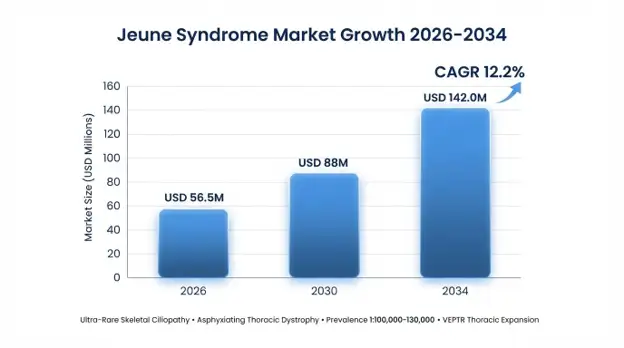
The global Jeune syndrome market was valued at USD 50.2 million in 2025 and is projected to reach USD 56.5 million in 2026, growing to USD 142.0 million in 2034 with a CAGR of 12.2% during the forecast period (2026-2034). While the prevalence of Jeune syndrome, officially known as asphyxiating thoracic dystrophy, an ultra-rare skeletal ciliopathy, the associated market is expected to grow more than proportionately against broad pediatric rare disease classes owing to improvement in neonates' survival due to advanced respiratory support, expanding molecular genetic diagnostic capability, increasing implementation of thoracic expansion surgical procedures, and a more mature rare-disease research market promoting financial investment towards the ciliopathy drug discovery space.
Jeune syndrome is a rare, predominately autosomal recessive skeletal dysplasia under the short rib polydactyly spectrum and is characterized by a severely constricted and bell-shaped thorax, which leads from the abnormally short ribs and the horizontally directed costochondral junctions, thus impacting the growth of the lungs and respiration limits. This disorder results from a disturbance in cilia structure & functions from pathogenic variants in the genes associated with ciliopathy, which involve codes for components of the inner and outer cilia, as well as molecules controlling intraflagellar transport (IFT), the process that shuttles cargo within cilia. Several ciliopathy genes, including DYNC2H1, IFT80, WDR19, WDR34, WDR35, WDR60, IFT140, IFT172, and TTC21B, were identified to cause Jeune syndrome, representing the genetic heterogeneity of these conditions. The impaired IFT will inhibit various signaling pathways like Hh, which are responsible for bone formation, and thus develop characteristic thoracic abnormalities and subsequent renal, hepatic, retinal, and digital issues in the patient.
Jeune syndrome ranges in severity and may affect affected patients differently, from the lethal end of the spectrum when hypoplastic lungs associated with chest tightness cause immediate respiratory failure. Even from infancy onwards, individuals exhibit development of renal insufficiency, hepatic complications, retinal issues, and limb shortening with polydactyly. The classic forms with a severe phenotype typically present with an extremely high risk for severe respiration failure, with neonatal management being supportive & with thoracic expository devices with improved survival for severe phenotype cases, but the complications like NPH-related nephronophthisis-related cystic disease can eventually lead to end-stage renal failure and severe hepatobiliary disease (fibrosis and cirrhosis), retinal involvement (degeneration), and also deformities in the skeletal system.
Epidemiology: Jeune syndrome is rare, with a global estimate of a frequency of around 1 for every 100,000 to 1 for every 130,000 live births, as stated in several sources, though the actual incidence and prevalence are likely higher given factors such as previous underdiagnosis (labeled broadly under general short-rib thoracic dysplasia or skeletal dysplasia categories or unobserved early death); with improved recognition with advancement in fetal ultrasound imaging and comprehensive ciliopathy testing, the overall estimate is set to increase more drastically with better diagnostics. The increasing growth in the identified patient population and their improved survivability in the coming decades is transitioning the disorder from a primarily fatal neonatal condition to a chronic pediatric multisystem disorder with better long-term management.
Current treatment and standard of care include neonatal respiratory management with supplemented oxygen & ventilation; vertical expandable prosthetic titanium rib (VESR) technology or lateral rib expansion surgeries in the neonatal age group are performed to promote lung development & improve breathing by expanding the thoracic region; and management of subsequent complications by monitoring the patient’s renal status and hepatic, vision, and eye issues. The patients require long-life management for those born, and survival in the long run is dependent on addressing issues in other organs. Currently there is no targeted disease-modulating therapy, and management is only support-based. This presents a huge opportunity space for the development of the targeted therapeutic agents, research for which is ongoing in the lab settings.
The Jeune syndrome market landscape comprises surgical equipment, diagnostic tests, medical supplies, pharmaceuticals, research organizations, and contract research organizations (CROs) working on therapies for Jeune syndrome. The availability of orphan drug designation in key regulatory markets like North America and Europe significantly reduces regulatory hurdles and offers exclusivity for an extended period of time, fostering investment.
| Report Coverage | Details |
|---|---|
| Base Year | 2025 |
| Base Year Value | USD 50.2 Million |
| Forecast Value | USD 142.0 Million |
| CAGR | 12.2% |
| Forecast Period | 2025-2034 |
| Historical Data | 2022-2025 |
| Largest Market | North America |
| Fastest Growing Market | Europe |
| Segments Covered | By Disease Classification, Treatment Type, Surgical Approach, Diagnostic Modality, End-User |
| Region Covered | North America, Europe, Asia Pacific, Middle East & Africa, Latin America |
| Countries Covered | US, Canada, UK, Germany, France, Netherlands, Italy, Spain, Japan, China, India, Australia, South Korea, Brazil, UAE, Saudi Arabia |
| Key Market Playes | Stryker Corporation, Zimmer Biomet, DePuy Synthes (Johnson & Johnson), Medtronic plc, Illumina Inc., Invitae Corporation, Blueprint Genetics |
Get more details on this report - Request Free Sample
Improving Neonatal Survival Through Advanced Respiratory Support Technologies: The single most structurally important factor contributing to increased market growth is the significant survival gains that have been seen among those suffering catastrophic cases secondary to improved neonatal care, such as high-frequency oscillatory ventilation, inhaled nitric oxide therapy, and extracorporeal membrane oxygenation, which support lung function until thoracic expansion procedures can be initiated. We have turned a previously life-threatening condition for neonates into a chronic condition that takes several decades of multidisciplinary care, since the patients we are saving today often require multiple subsequent thoracic expansion procedures to support lung growth and demand surveillance for their renal, hepatic, and retinal complications.
Expanding Molecular Genetic Diagnostic Capability and Prenatal Recognition: The expanding use of broad ciliopathy gene panels in neonatal, pediatric, and fetal medicine is starting to overcome this historic underdiagnosis, with the molecular validation of cases previously described as non-specific skeletal dysplasia and the diagnosis of less severe, unrecognized phenotypic forms. The better prenatal ultrasound detection of features of rib cage narrowing allows for earlier planning and counseling and delivery in centers with comprehensive neonatal facilities.
Ultra-Low Prevalence and Extreme Genetic Heterogeneity Complicating Therapeutic Development: Due to extremely low prevalence and to the fact that causation occurs via mutations in over a dozen different ciliary genes, it is nearly impossible to gather patient cohorts large enough with adequate genetic homogeneity for sufficiently powered clinical studies. Many centers may only have several verified cases in any one year, and a drug for one molecular subgroup would only target a minority of patients and complicate the entire development/commercialization strategy for any orphan drugs.
There exists a strong potential therapeutic entry for either a pharmacological or gene-based target that aims to address the fundamental defects in ciliary function and signaling of the hedgehog pathway that led to both skeletal and multisystem developmental defects. Because preclinical ciliopathy animal models have partially rescued developmental abnormalities by restoration of infraglabellar transport function, initial human studies are warranted for developing a portfolio of approaches ranging from small molecules to gene therapy and antisense therapeutics, and the most advantageous entry for intervention could potentially be pre-natal or early neonatal with the hope of circumventing irreversible thoracic stunting. Simultaneously, development of renal-protective therapies for ciliopathy-induced kidney disease will build upon recent work focused on the similar etiology of isolated nephronophthisis and Bardet-Biedl syndrome and will benefit those survivors that develop significant chronic kidney disease.
Development of Multidisciplinary Skeletal Ciliopathy Centers of Excellence: Medical care is becoming more concentrated at specialized centers that allow coordinated, protocol-based care by pediatric orthopaedic surgeons, neonatologists, pulmonologists, nephrologists, hepatologists, ophthalmologists, and clinical geneticists. Such centers often have standard criteria for surgical indications, routine, long-term follow-up protocols, and prospectively accumulating, worldwide natural history data needed for the development of novel therapeutic strategies and to guide reimbursement decision-making.
Regional Insights
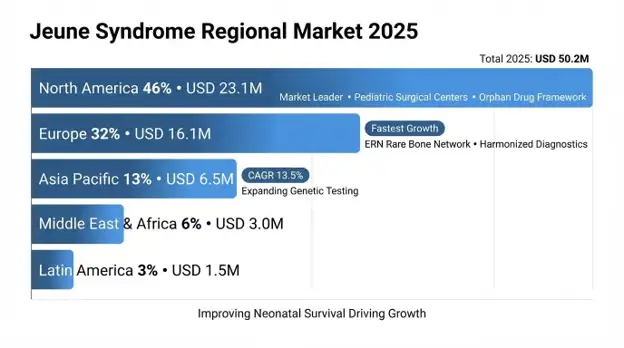
North America: Market Leadership Through Specialized Surgical Expertise and Rare Disease Infrastructure: The global market for Jeune syndrome is dominated by North America, due to the clustering of pediatric-orthopedic and thoracic-surgical know-how in leading academic children's hospitals, mature experience with chest expansion devices, substantial neonatal ICU infrastructure, and an optimal orphan disease reimbursement landscape enabling complex pediatric surgery and genetic diagnostics. The overwhelming bulk of the value share of the regional market is in the US, owing to orphan drug and rare pediatric disease designations having genuine commercial value for enabling the incentive structure of a developing market and a fully-fledged patient advocacy network able to foster natural history data collection.
Europe: Fastest Growth Through Rare Disease Network Coordination: The biggest region with the fastest growing potential in the whole market is Europe. The harmonized European rare bone disease reference networks allow standardized diagnostic procedures and multi-center cooperation; equal cross-border referrals to specialist surgical services become possible and workable, with the dominant national markets of Germany, the Netherlands, France, and the U.K. driven by established pediatric orthopedic surgery programs, advanced rare-disease genetics research facilities, and the standardized Orphan Medicinal Product Designation process, offering the same reward incentives in all member states.
Disease Classification Insights: In terms of the most marketable diagnosis, Classic Asphyxiating Thoracic Dystrophy, with severe breathing difficulties in the newborn, highest per-patient earnings occur via intensive newborn management, repeated surgeries (chest expansion procedures), and multidisciplinary care. The milder variants and late-onset conditions (less severe chest compression, more likely in the future due to genetic testing) provide another source of revenue.
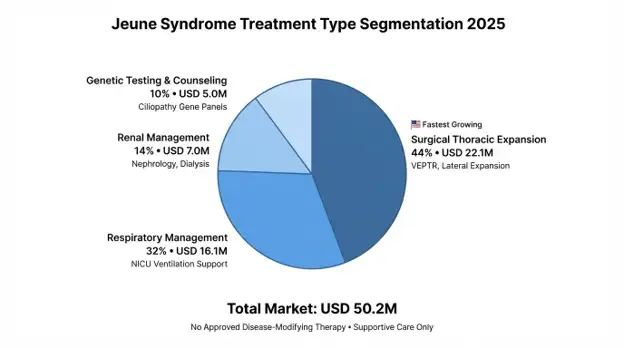
Treatment Type Insights: Surgery is both the largest category and the fastest growing, consisting of thoracic expansion and the associated implant, anesthesia, and hospitalization revenues. Critical care (e.g., ventilatory support, neonatal ICU) and respiratory therapies are the second largest, as it is vitally important for early respiratory stabilization to be established. As more patients survive and present with later-stage kidney complications, our renal segment through therapeutic renal protection, nephrology treatments, and dialysis is a growing area," concluded Andrew Jolly, Chief Commercial Officer at DDI.
Surgical Approach and Diagnostic Modality Insights: Current approaches and techniques. The vertical expandable prosthetic titanium rib (VESR) technique is the major surgical modality with the most extensive evidence in the literature, while lateral thoracic expansion methods target specific anatomical features. In diagnostics, extensive ciliopathy genetic sequencing is the fastest-growing form, for use both in postnatal confirmation and prenatal diagnostics, while radiology and ultrasound play vital roles in first diagnosis and preoperative planning, respectively.
End-User Insights: Pediatric hospitals and tertiary academic centers constitute the major end users, as these sites are typically where the most extensive surgical expertise and the specialized multidisciplinary teams needed to optimize management are centered. Academic and research institutions are the fastest-growing end-user segment due to the growth in natural history registries and the increased interest in developing translation research.
The market is segmented and controlled by companies that produce neonatal critical care devices, genetic diagnostic firms that conduct complete sets of ciliopathy testing services, and pediatric surgical device companies that provide thoracic expansion hardware and implants because there are no FDA-approved drugs for Jeune’s. Implant-based solutions differ from other methods in terms of strong evidence for reimbursement in specialty care, as well as the ability to deliver constant expansion with minimal hardware and revisions necessary to overcome problems related to the difficult exposure and manipulation of small pediatric patients.
March 2026: A major orthopedic device company released more long-term outcome data of a new generation of magnetic control rib expansion system to skeletal ciliopathy patients, demonstrating superior thoracic dimension results with lowered rates of revisional surgeries.
January 2026: A European rare bone disease reference network established more advanced consensus management for asphyxiating thoracic dystrophy by utilizing genetic classification criteria with a uniform surgical criteria threshold based on multi-center outcomes.
December 2025: A transnational ciliopathy research consortium established a prospective multi-center registry in Jeune syndrome to further understand genotype-phenotype correlation with clinical follow-up across multiple academic sites in both North America and Europe.
October 2025: A genetic diagnostics company increased a current panel of skeletal ciliopathy diagnoses to provide improved sensitivity to identify and diagnose novel causative genes and clinical manifestations.
August 2025: An academic research group published preclinical studies proving thoracic phenotype improvement in a ciliopathy model with a partially rescued skeletal phenotype by modulating the hedgehog signaling pathway.
By Disease Classification:
• Classic Asphyxiating Thoracic Dystrophy with Severe Neonatal Respiratory Compromise
• Severe Neonatal Form with Pulmonary Hypoplasia
• Mild/Later-Onset Phenotype
By Treatment Type:
• Respiratory Management
• Surgical Thoracic Expansion
• Renal Management
• Hepatic Management
• Genetic Counseling & Testing
By Surgical Approach:
• Vertical Expandable Prosthetic Titanium Rib (VEPTR)
• Lateral Thoracic Expansion
• Chest Wall Reconstruction
• Magnetically Controlled/Non-Invasive Expansion Systems
By Diagnostic Modality:
• Genetic Sequencing (NGS Panels, Whole Exome Sequencing)
• Fetal Ultrasound
• Radiography (X-Ray)
• Pulmonary Function Testing
• Renal Ultrasound & Hepatic Imaging
By End-User:
• Pediatric Hospitals & Tertiary Academic Centers
• Neonatal Intensive Care Units
• Specialized Orthopedic Centers
• Academic & Research Institutes
By Region:
• North America
• Europe
• Asia Pacific
• Middle East & Africa
• Latin America
You'll get the sample you asked for by email. Remember to check your spam folder as well. If you have any further questions or require additional assistance, feel free to let us know via-
+1 724 648 0810 +91 976 407 9503 sales@intellectualmarketinsights.com
18 Sep 2026
Intellectual Market Insights Research © 2026. All rights reserved.