Share this link via:

The global Joubert syndrome market was valued at USD 340 million in 2025, growing to USD 366 million in 2026 and increasing to a substantial USD 685 million by 2034. This growth is attributed to a CAGR of 8.2% over the forecast period (2026-2034).
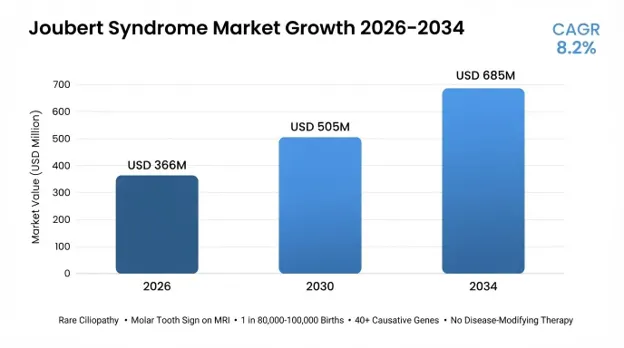
Joubert syndrome is a rare, genetically heterogeneous, autosomal recessive neurodevelopmental disorder that falls within the umbrella of ciliopathies. Radiologically, it is distinguished by the pathognomonic 'molar tooth sign' observed on axial brain MRI, indicative of cerebellar vermis hypoplasia; a characteristically deep interpeduncular fossa; and a thickened, horizontally oriented superior cerebellar peduncle. Clinically, symptoms emerge during the neonatal period, manifesting as hypotonia, oculomotor apraxia, and episodic hyperpnea/apnea, and progress throughout childhood to present as global developmental delay, ataxia, and variable degrees of intellectual disability.
The underlying causes are mutations in over 40 known genes—including AHI1, CEP290, CC2D2A, TMEM67, and CPLANE1—that encode proteins essential for the structure or function of the primary cilium, a critical signaling organelle found on nearly all human cells.
This common molecular pathway connects Joubert syndrome to a wider spectrum of related disorders, such as Senior-Loken syndrome, COACH syndrome, Dekaban-Arima syndrome, and oro-facio-digital syndrome type VI. These conditions, all sharing the molar tooth sign, differ in the degree of multisystem involvement.
As primary cilia are essential for development across many systems, a significant number of individuals with Joubert syndrome present with multiorgan disease beyond the central nervous system. This includes progressive retinal dystrophy, nephronophthisis-like cystic renal disease that may lead to end-stage renal failure, congenital hepatic fibrosis, and polydactyly. To date, no disease-modifying pharmacotherapy exists for the underlying ciliopathy.
The current commercial market primarily comprises diagnostic technologies and targeted organ-specific treatments rather than novel disease-modifying therapies.
This market includes high-resolution neuroimaging, comprehensive genetic and genomic testing, pharmacological treatments for seizures and hypertension, respiratory support equipment for infantile apnea, monitoring and intervention by nephrologists and hepatologists (including dialysis and transplant), ophthalmologic surveillance and low-vision rehabilitation, and ongoing physical, occupational, and speech therapy coordinated through specialized, multidisciplinary rare-disease clinics.
The estimated prevalence of Joubert syndrome is between 1 in 80,000 and 1 in 100,000 live births, with considerably higher frequencies among consanguineous populations. While the absolute number of patients is limited and dispersed globally, the market offers a proportionally high per-patient commercial value due to lifelong, comprehensive care requirements from neonatal stages through adulthood, increased use of orphan drug incentives by major regulatory authorities, and growing interest from biopharmaceutical companies in targeting ciliopathies with gene and RNA-based treatments, building upon success in mechanistically related retinal ciliopathies.
| Report Coverage | Details |
|---|---|
| Base Year | 2025 |
| Base Year Value | USD 340 Million |
| Forecast Value | USD 685 Million |
| CAGR | 8.2% |
| Forecast Period | 2025-2034 |
| Historical Data | 2022-2025 |
| Largest Market | North America |
| Fastest Growing Market | Asia Pacific |
| Segments Covered | By Type, Diagnostic Modality, Treatment Modality, Drug Class, Patient Demographics, End-User, Region |
| Region Covered | North America, Europe, Asia Pacific, Middle East & Africa, Latin America |
| Countries Covered | US, Canada, Mexico, UK, Germany, France, Italy, Spain, Netherlands, China, Japan, India, Australia, South Korea, Brazil, Argentina, UAE, Saudi Arabia, South Africa |
| Key Market Playes | Illumina Inc., Centogene N.V., Invitae Corporation, GeneDx, PTC Therapeutics, Ultragenyx Pharmaceutical, Medtronic plc |
Get more details on this report - Request Free Sample
The single biggest cause of market growth is the accelerating global democratization of whole-exome and whole-genome sequencing, which is now dramatically shortening the historically extensive time between clinical suspicion and establishing a definitive molecular diagnosis. Historically, the complex clinical spectrum of highly gene-diverse Joubert syndrome complicated diagnostic efforts with sequential single-gene assays, whereas modern ciliopathy gene panels enable querying of all identified causative genes and provide genotype-associated risk prediction about potential organ involvement.
One-quarter to one-third of patients develop meaningful nephronophthisis-type kidney disease, which eventually may become end-stage renal failure (ESRF) necessitating dialysis or kidney transplant, usually developing by the second or third decade, while a separate fraction may develop progressive retinal dystrophy or congenital hepatic fibrosis (CHF). This multisystemic chronic illness continues to require chronic and intensive use of medical services in nephrology, hepatology, ophthalmology, pulmonology, and rehabilitation, thus continuing to drive persistent, predictable, per-patient expenditure throughout the patients’ lives.
The major impediments to market development for Joubert Syndrome are the extreme genetic diversity within Joubert Syndrome and the very dispersed and extremely rare patient base. These features make designing natural history studies exceedingly difficult and recruiting patients into clinical trials exceptionally challenging, as no single disease-causing gene explains even a substantial minority of all patients, and companies will be forced to invest in narrow gene-specific efforts impacting subsets of patients OR more global pathway-directed treatments with a higher burden of proof required in genetically divergent patient populations. An additional complication includes the relative dearth of robust, long-duration natural history information across the multitude of genetic subtypes of this syndrome, thereby hampering efforts to prove clearly definable efficacy outcomes to regulatory authorities and thus delaying approval, along with high overall lifelong per-patient costs for integrated, multidisciplinary medical and neurological care across multiple specialty practices, from serial imaging and gene testing to single-agent treatment and management of all organ manifestations of the disease. These chronic, substantial costs of care are also problematic in regions with poorly coordinated medical care or with a high patient share or co-insurance responsibility for costly specialty care in many regions.
There is a promising opportunity with targeting common CEP290 mutations with antisense oligonucleotide or small molecule-based splicing modifiers building upon the program model for CEP290-related Leber congenital amaurosis. The retinal compartment seems highly amenable to therapeutic intervention given readily established intravitreal and subretinal delivery routes, familiar primary functional endpoints, and regulatory precedent with gene/RNA therapies targeted toward the eye; it could prove a viable entry-level proof of principle, with eventual application to kidney or nervous system targets.
The opportunity to scale up the use of established, genotype-matched multitude monitoring guidelines through the provision of telehealth and other remote home-monitoring tools to evaluate and record respiratory, kidney, and retina function for individuals dwelling remote from specialty centers, therefore extending expert care access and supporting earlier detection of renal/ocular/airway complications. The approach would also generate real-world data over longitudinal time, required in due course to support registration filing.
International patient registries and genotype-phenotype correlation consortia are accumulating ever-finer data relating specific causative genes to established renal, hepatic, or retinal manifestations, leading to the development of risk-stratified screening programs where high-intensity surveillance efforts focus on patients most vulnerable to life-threatening complications. In parallel, neuronal or renal organoid models created using patient-derived mutations and the induced pluripotent cell technology hasten the preclinical drug screening, facilitating the assessment of drug candidates for the correct genotype without the need for animal models that only partially recapitulate the ciliopathy.
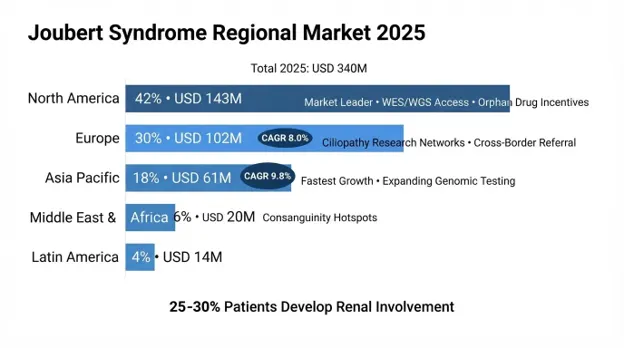
North America, being dominated by an extensive network of pediatric academic medical centers with widespread access to whole exome/whole genome sequencing, rare disease patient advocacy groups, and orphan drug incentives stimulating the biotechnology companies. The United States dominates the regional value by widespread insurance support for genetic testing and a well-established system for the management of organ-specific conditions.
Europe holds the second position of Joubert syndrome market value by well-established academic ciliopathy research programs and structured rare disease networks enabling cross-border patient referral and organized testing pathways with integrated data sharing, although the advanced genetic testing approach was found to be variable from west to east European countries.
Asia Pacific is identified as the second-fastest-growing market from established genetic testing and pediatric tertiary healthcare facilities with wide underlying birth rates among the population in China and India, along with growing government expenditure towards rare disease diagnostics among China, Japan, South Korea, and Australia.
Middle East & Africa display a regional value from high allele frequency associated with consanguineous marriage coupled with specialized genetic medicine services offered by some of the countries, although the scope of advanced genetic testing is found to be narrow.
Latin America witnesses moderate growth led by Brazil, Mexico, and Argentina, with burgeoning rare disease genetic programs of academic centers; however, entire genomic testing and care infrastructure is limited to urban areas.
Type Insights: Classic Joubert syndrome, primarily neurological without substantial systemic organ involvement, comprises the vast majority of diagnosed Joubert syndrome patients but represents a proportionally lower portion of per-patient market value. Joubert syndrome-related disorders, with associated renal, hepatic, ocular, or skeletal anomalies, account for a smaller portion of the total patient market but a disproportionately larger portion of market value due to the aggregate annual market value of organ-specific monitoring, kidney dialysis and transplantation, and retinal rehabilitation throughout a patient's life.
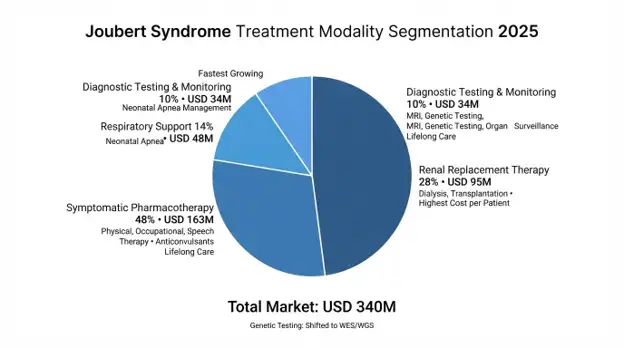
Diagnostic Modality Insights: MRI-based neuroimaging continues to represent the established and highest volume of all diagnostic modalities, with identification of the molar tooth sign essential for clinical diagnosis. Genetic and molecular testing represents the fastest growing of all market segments due to a progressive shift towards comprehensive genomic panels for joint diagnosis, causal gene identification, and prediction of multisystem involvement risk. Ophthalmologic evaluation, renal and liver function testing, and prenatal/pre-implantation genetic diagnosis complement the long-term monitoring ecosystem for affected patients.
Treatment Modality Insights: Symptomatic pharmacological intervention along with the application of physical and occupational along with speech and language therapy represents the highest ongoing treatment category in terms of total dollars expended by virtue of the prevalence of learning and motor impairments associated with this disorder. Oxygen therapy is vital for patients with episodes of apnea in the neonatal phase, and kidney failure (end-stage renal disease) with renal replacement therapy represents the highest single cost treatment category for patients who reach end-stage renal failure.
End-User Insights: Hospitals and pediatric neurology centers represent the dominant end-users for the diagnostic, monitoring, and hospital treatment needs for patients. Genetic and rare disease specialists represent the fastest-growing portion as academic centers establish dedicated, comprehensive programs for multidisciplinary care and treatment of Joubert syndrome patients.
The Joubert syndrome market is extremely fragmented, as no one company has significant commercial leadership due to the lack of any disease-modifying treatments. There currently is intense competition among the genomic diagnosis labs in terms of total ciliopathy gene panels and WES due to differences in their diagnostic yield, turn-around time, and variant interpretation knowhow. The evolving therapeutic space is characterized by the proliferation of early-stage biotech companies and academia-based spin-offs developing gene therapy, oligonucleotide-based, and small-molecule therapies against defined genes and product opportunities within device companies focused on respiratory monitoring and renal support. Joint development activities between the scientific academic consortiums and commercial companies are the major pathway through which pipelines get transferred to commercial, as the expertise on the natural history of disease remains concentrated within academic research.
March 2026: A genome testing company released an updated ciliopathy sequencing panel featuring long-read technology for deeper detection of mutations in introns up to thousands of bases from the coding sequence and structural variants in well-characterized Joubert syndrome genes.
February 2026: An international research effort reported results of a massive genotype-phenotype correlation study to guide gene-based, risk-stratified monitoring of patients with ciliopathies for complications such as renal and hepatic disease.
January 2026: A provider of diagnostics for rare diseases announced an expanded insurance reimbursement framework for its full ciliopathy whole-exome sequencing panels by top U.S. health plans.
December 2025: A pediatric academic medical center announced the opening of a specialized, multidisciplinary clinic devoted to the care of patients with Joubert syndrome, coordinating neurology, nephrology, ophthalmology, pulmonology, and genetic medicine.
November 2025: A biotech firm revealed early data from a development candidate, an antisense oligonucleotide aimed at a common CEP290 mutation, in disease models derived from patient retina cells.
By Type:
By Diagnostic Modality:
By Treatment Modality:
By Drug Class:
By Patient Demographics:
By End-User:
By Region:
You'll get the sample you asked for by email. Remember to check your spam folder as well. If you have any further questions or require additional assistance, feel free to let us know via-
+1 724 648 0810 +91 976 407 9503 sales@intellectualmarketinsights.com
18 Sep 2026
Intellectual Market Insights Research © 2026. All rights reserved.