Share this link via:

The global juvenile dermatomyositis market size was valued at USD 312.6 million in 2025 and is projected to reach USD 340.8 million in 2026, expanding to USD 668.4 million by 2034, growing at a CAGR of 8.8% during the forecast period (2026-2034).
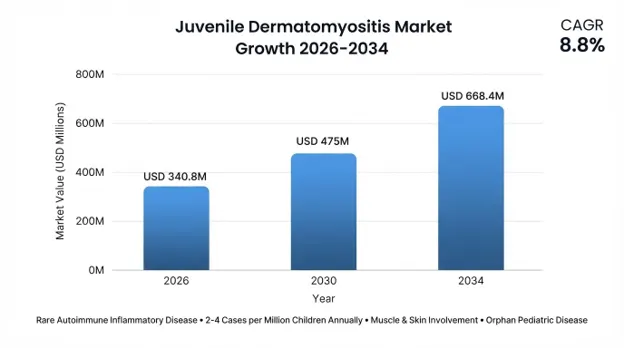
Juvenile dermatomyositis (JDM) is a rare, chronic autoimmune inflammatory disease of childhood driven by systemic capillary vasculopathy that principally targets skeletal muscle and skin, producing the hallmark clinical picture of progressive proximal muscle weakness together with pathognomonic cutaneous findings such as Gottron's papules over the knuckles and heliotrope discoloration of the eyelids. The disease most commonly emerges between five and ten years of age, though onset can occur anywhere from early childhood through adolescence, and it demonstrates a female predominance of approximately two to one. With a global incidence of roughly two to four cases per million children annually, JDM is formally classified as an orphan pediatric disease, a designation that shapes nearly every commercial and regulatory dimension of the market, from clinical trial design to pricing strategy and reimbursement policy.
At the molecular level, JDM pathogenesis involves complement-mediated microvascular injury, infiltration of muscle and dermal tissue by CD4-positive T-cells and B-cells, and a pronounced upregulation of the type I interferon signaling pathway that is now understood to be a central driver of ongoing inflammation in the majority of affected children.
The identification of myositis-specific autoantibodies, including anti-NXP2, anti-TIF1, anti-MDA5, and anti-Mi-2, has meaningfully advanced clinical practice by enabling clinicians to stratify patients according to distinct phenotypic risk profiles. Anti-NXP2 positivity is associated with a substantially elevated risk of calcinosis, a debilitating complication affecting an estimated one in five to two in five children with the disease, while anti-MDA5 positivity flags a smaller but high-risk subgroup prone to rapidly progressive interstitial lung disease. Diagnostic delay remains a persistent clinical challenge, with time from symptom onset to confirmed diagnosis averaging four to six months in most healthcare settings, underscoring the continued importance of clinical awareness campaigns and accessible autoantibody testing.
Therapeutically, the JDM market spans a spectrum from foundational high-dose systemic corticosteroids used to achieve rapid initial disease control, to conventional steroid-sparing immunosuppressants such as methotrexate, cyclosporine, azathioprine, and mycophenolate mofetil used for long-term maintenance, to intravenous immunoglobulin reserved for severe, refractory, or vasculopathy presentations, and finally to an expanding class of biologic and targeted agents, most notably rituximab and emerging Janus kinase inhibitors, that are increasingly employed off-label in patients failing conventional therapy. This progression reflects a broader clinical shift away from prolonged, indiscriminate immunosuppression—long recognized to cause growth impairment, osteoporosis, and metabolic disturbance in growing children—toward individualized, biomarker-informed treatment algorithms designed to minimize cumulative steroid exposure while achieving durable disease control.
Commercially, the market's significance extends well beyond direct pharmaceutical revenue to encompass the full multidisciplinary care ecosystem required to manage JDM effectively, including pediatric rheumatology, dermatology, physical and occupational therapy, psychological support, and long-term surveillance for cardiopulmonary and musculoskeletal sequelae. Although the absolute patient population is small, with an estimated global prevalent pool in the range of 20,000 to 25,000 children requiring active or maintenance therapy at any given time, the market is sustained by extended treatment durations often exceeding three to five years, the high per-patient cost of biologic and IVIG-based regimens, and a favorable orphan drug policy environment that increasingly incentivizes pharmaceutical developers to formalize pediatric indications for therapies historically used off-label.
| Report Coverage | Details |
|---|---|
| Base Year | 2025 |
| Base Year Value | USD 312.6 Million |
| Forecast Value | USD 668.4 Million |
| CAGR | 8.8% |
| Forecast Period | 2025-2034 |
| Historical Data | 2022-2025 |
| Largest Market | North America |
| Fastest Growing Market | Asia Pacific |
| Segments Covered | By Treatment Type, Disease Severity, Route of Administration, Diagnostic Modality, End-User |
| Region Covered | North America, Europe, Asia Pacific, Middle East & Africa, Latin America |
| Countries Covered | US, Canada, UK, Germany, France, Italy, Spain, China, Japan, India, South Korea, Australia, Brazil, Mexico, UAE, Saudi Arabia, South Africa |
| Key Market Playes | Pfizer Inc., Roche (Genentech), Novartis AG, UCB S.A., Sanofi S.A., CSL Behring, Octapharma AG |
Get more details on this report - Request Free Sample
Key drivers of value in the JDM market The JDM market benefits from greatly enhanced disease diagnosis for pediatricians, dermatologists, and rheumatologists and data generated via multinational registries on several thousand children from which real-world evidence of treatment efficacy and chronic effects has been generated. Such data have uniformly shown that early treatment of disease onset is associated with a lower incidence of calcinosis and cumulative steroid burden, building a more robust evidence base for aggressive, early treatment. The availability of complete autoantibody test panels has subsequently enhanced diagnostic accuracy, leading to improved classification of patients suitable for target development and enrichment trial design.
Increasing clinical and parental reluctance to tolerate cumulative, long-term high-dose corticosteroid exposure—given well-documented adverse outcomes on growth, bone integrity, and metabolism—is driving the shift to steroid-sparing agents and biologic therapies. Rituximab has a growing body of real-world evidence for inducing clinically relevant improvement in the majority of treatment-refractory subjects. Janus kinase inhibitors are emerging, garnering intense clinical interest owing to their potential to block the type I IFN signaling pathway responsible for inducing disease activity in the majority, even for calcinosis and cutaneous involvement in treatment-refractory disease.
The most limiting aspect of the JDM market is the disease’s ultra-rare designation, with an estimate of only 20,000–25,000 affected children globally, which severely hampers patient access to clinical trials, reduces statistical power inefficacy endpoints, and reduces the commercial opportunity for therapeutics aimed solely at JDM. This often necessitates multinomial, multicenter trials conducted across dozens of pediatric rheumatology practices with resultant development timelines and costs per patient trial exponentially higher than those associated with more common pediatric diseases. Although orphan designations facilitate access to regulatory incentives for JDM therapeutics, they still require pediatric-specific pharmacokinetic studies, patient-ready formulations, and long-term safety follow-up for many years, which adds tens of millions of dollars to total development costs and historically has dissuaded widespread participation by major pharmaceutical companies.
Orphan drug designation, rare pediatric disease status, and companion priority review voucher programs have also successfully increased the commercial value of JDM-targeted drug development by providing long-term market exclusivity and saleable regulatory credits that are distinct from the commercial value of the drug product. Similar value creation opportunities exist in the biomarker-targeted precision medicine space, with JDM's diverse autoantibody profile facilitating the development of companion diagnostics in combination with targeted therapeutics where the treatments are directed towards the correct patient group (e.g., children with anti-MDA5-positive, interstitial lung disease-risk profiles or children with anti-NXP2-positive, calcinosis-risk profiles), allowing for enrichment of trial populations and premium pricing based on documented precision-medicine value.
The most profound shift is the development of JAK inhibitors and other agents modulating the type I IFN pathway, which is constitutively expressed in most patients and strongly associated with activity. Initial findings have been particularly promising for refractory cutaneous lesions and crucially for the reversal of established, until now seemingly untreatable, calcinosis. This pharmacologic evolution is reinforced by the use of digital tools, such as tablet-based functional scales, standardized photographic skin surveillance applications, and remote patient-reported outcomes, to monitor patients between the widely separated visits to our few specialized pediatric rheumatology centers.
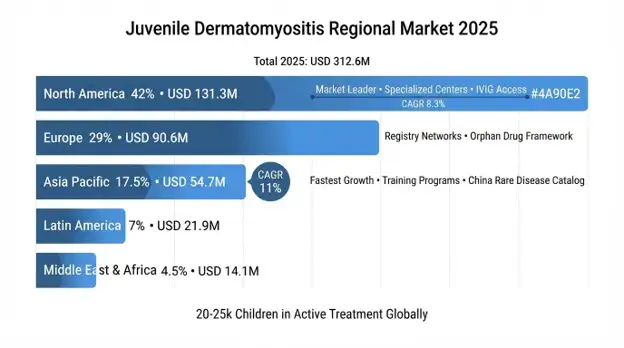
North America occupied over 43% of the value of the global JDM market, and the value was approximately USD 131.3 million with a near 8.3% CAGR through 2034. A variety of specialized pediatric rheumatology knowledge was gathered among children's hospitals and top children's academic centers in this region, a well-established international multicenter. Patient registries offered effective channels for conducting clinical research, trials, patient recruitment, and so on. Adequate insurance coverage (Medicaid, private insurers mandating coverage for the costly pediatric rare disease therapy) was ensured in order to allow the costly biologic and IVIG-based treatment to be obtained even when these biologic agents had relatively high price points.
Asia Pacific showed the highest regional growth potential and occupied about 17.5% market share, and the market was valued at about USD 53.1 million in 2025 with more than 11% CAGR through 2034. Its fastest growth in the pediatric rheumatology field is fueled by widespread training programs conducted by physicians from China, Japan, South Korea, and India and rapid recognition of this specific disease across pediatricians with diverse medical experience backgrounds. Progressively increasing healthcare expenses throughout the Asia-Pacific countries were being implemented to enable more children with JDM to have chances of receiving biologic therapy than before, since not long ago this would not be affordable to the majority of patients. Dermatomyositis has been added to China's rare disease catalog to better enable clinical research infrastructure and healthcare payment mechanism development, while Japan leads this market throughout the Asia Pacific with comprehensive insurance covering approved immune modulatory agents.
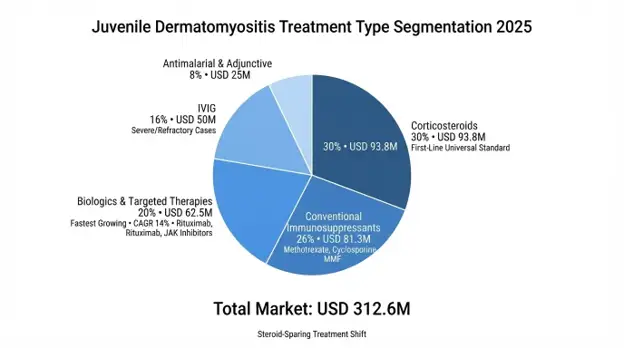
Treatment Type Insights: The largest treatment class remains corticosteroids, taking ~30% market share in 2025, valued at USD93.8 million due to their universal first-line status in nearly all severities of disease. The second largest market share belongs to conventional immunosuppressants (which include methotrexate, the second highest class after corticosteroids) with ~26% value, estimated at USD 81.3 million. The biologics and targeted therapies currently take ~20% of market value at USD62.5 million, but they are the fastest-growing market class; on the back of broadening adoption of rituximab and JAK inhibitors in refractory disease, this segment is expected to grow at a CAGR of ~14% through 2034.
Disease Severity Insights: Severe and refractory disease generates the largest revenue share despite representing a minority of the overall patient population, as these cases require the most intensive and costly combinations of IVIG and biologic therapy. Moderate disease represents the largest patient volume segment, typically managed with combination corticosteroid and conventional immunosuppressant regimens, while mild disease is managed predominantly through lower-intensity corticosteroid and antimalarial-based regimens.
End-User Insights: The leading end-use group in the market is pediatric hospitals and academic medical centers, which hold about 55% of market value due to their specialized diagnostic and management practices necessary to manage multidisciplinary JDM care. Rheumatology clinics and ambulatory infusion centers hold about 30% of the market value, being relevant for home healthcare and specialty pharmacy to handle oral maintenance adherence and patients who are in a stable maintenance stage needing IVIG treatments.
The overall JDM market possesses low-to-moderate concentration, as no treatments are still officially approved and established for this indication, leading to reliance on off-label use of immunosuppressants/biologics developed for adjacent autoimmune disorders. Therapeutic advantages now hinge more on orphan drug regulatory strategy, development of formulations approved for pediatrics, proof of reduced cumulative steroid dose, and identification of patient populations via biomarkers for more effective/convincing clinical trials in this fragmented/rare disease population.
By Treatment Type:
By Disease Severity:
By Route of Administration:
By Diagnostic Modality:
By End-User:
By Region:
You'll get the sample you asked for by email. Remember to check your spam folder as well. If you have any further questions or require additional assistance, feel free to let us know via-
+1 724 648 0810 +91 976 407 9503 sales@intellectualmarketinsights.com
18 Sep 2026
Intellectual Market Insights Research © 2026. All rights reserved.