Share this link via:

The juvenile myoclonic epilepsy (JME) market is valued at USD 1.35 billion in 2025 and is projected to reach USD 1.44 billion in 2026, then grow to USD 2.48 billion by 2034, at a CAGR of 7.0% during the forecast period (2026-2034).
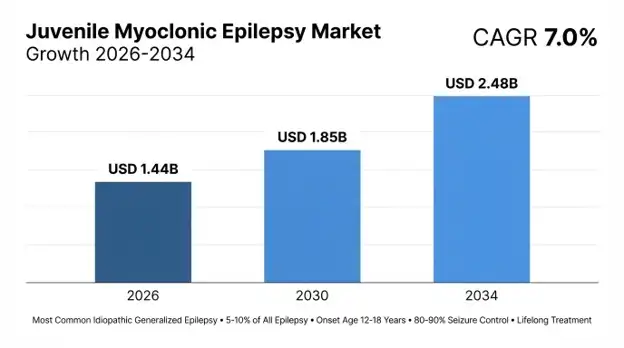
Juvenile myoclonic epilepsy is the most prevalent idiopathic generalized epilepsy syndrome. Systematically described by Janz and Christian in 1957, it is now known to comprise 5-10% of all epilepsy diagnoses and just under a quarter of worldwide idiopathic generalized epilepsy cases. The age range for JME onset is typically 12-18 years, and the clinical diagnosis depends on a characteristic combination of predominantly morning myoclonus occurring in the first hour of waking and generalized tonic-clonic (GTC) and typical absence seizures. Predictors of seizure exacerbation include sleep deprivation, alcohol use, light (photic stimuli), and emotion; the presence of such triggers differentiates JME from other epilepsy syndromes and plays a key role in diagnosis, management of life-style issues, and, of course, pharmaceutical treatment.
Although JME responds well to appropriate antiseizure drugs when appropriately identified, and seizure control can be achieved in 80-90% of individuals, it is considered a lifelong rather than self-limiting childhood condition.
Withdrawal rates from treatment (even following many seizure-free years) were found to be 80-90% within the first 12 months, resulting in treatment for life in the vast majority of diagnosed patients. Increased recognition of valproic acid's teratogenic and neurodevelopmental risks has exacerbated diagnostic delay, caused by misattribution of subtle morning myoclonus, into an expanded pool of individuals requiring lifelong treatment. Enhanced emphasis by regulatory bodies in 2018 (EMEA approval with restricted indication) and similar labeling requirements implemented by the FDA in early 2019 have significantly propelled levetiracetam, topiramate, and lamotrigine prescriptions over valproic acid.
These newer treatments are the drugs of choice, especially for adolescent girls and childbearing-aged women whose prevalence with JME suggests a strong predisposition due to the typical age of onset. The wider commercial environment for JME is characterized by long-term video EEG diagnosis, tests to determine generalized epilepsy susceptibility genes, and seizure tracking devices, all contributing to more timely, accurate diagnoses.
| Report Coverage | Details |
|---|---|
| Base Year | 2025 |
| Base Year Value | USD 1.35 billion |
| Forecast Value | USD 2.48 Billion |
| CAGR | 7.0% |
| Forecast Period | 2025-2034 |
| Historical Data | 2022-2025 |
| Largest Market | North America |
| Fastest Growing Market | Asia Pacific |
| Segments Covered | By Drug Class, Seizure Type, Treatment Line, Route of Administration, Distribution Channel, End-User |
| Region Covered | North America, Europe, Asia Pacific, Middle East & Africa, Latin America |
| Countries Covered | US, Canada, Mexico, UK, Germany, France, Italy, Spain, China, Japan, India, Australia, South Korea, Brazil, UAE, Saudi Arabia, South Africa |
| Key Market Playes | UCB Pharma, Sanofi, Novartis AG, GlaxoSmithKline, Eisai Co. Ltd., Sun Pharmaceutical Industries, Supernus Pharmaceuticals |
Get more details on this report - Request Free Sample
Underpinning JME volume growth is the long-term tailwind of syndromic normalization, translating an historically underdiagnosed population into one increasingly underrepresented. Many JME patients were for years improperly characterized as suffering from “nonspecific epilepsy” or overlooked altogether, while others were initiated on narrow-spectrum sodium-channel blocking agents (e.g., carbamazepine, oxcarbazepine) that can exacerbate myoclonus and absence seizures. Greater utilization of sleep-deprived and photic-stimulation EEGs in conjunction with improved education of neurologists (both child and adult) on epilepsy syndromology has begun to meaningfully reduce the average age of diagnosis, historically four to eight years after onset.
The benefits are early introduction and consistent use of broad-spectrum agents and improved control and acceptance of lifelong medication.
JME onset during mid-adolescence with a well-known propensity for relapse post-discontinuation suggests treatment for decades for each new correctly identified case, supporting global volume growth with improved access to EEG and increased density of neurologists throughout the Asia Pacific, Latin America, and parts of the Middle East.
Additional Growth Drivers A second important growth driver is from the acceleration of prescribing shifts within our JME female population, who represent ~half of the total JME population and are impacted most strongly by the ongoing use of restrictions for the prescription of valproate during a patient's reproductive years. Documented use of valproate in pregnancy causes a higher incidence of major congenital anomalies and impaired childhood cognitive outcomes and increases the risks for the development of neurodevelopmental disorders. Health authorities are mandating participation in pregnancy-prevention schemes as well as demonstrated failure of alternative therapies prior to providing valproate to young women for both pregnancies. This has naturally led to increased demand for levetiracetam, lamotrigine, and topiramate, along with growing investment by pharmaceutical companies into the development of extended-release formulations that improve adherence within this youth/adolescent patient group known for poor dosing discipline. Other factors in our model are the extraordinary long-term treatment duration, which is often the longest among epilepsy subtypes; increased awareness and availability of screening tools for neuropsychiatric comorbidities due to the prevalence of anxiety, depression, and trait impulsivity commonly described as being associated with JME; and greater utilization of smartphone-based seizure diaries and monitoring devices to provide the close follow-up of the pediatric/adolescent population of young patients necessary to adjust therapy readily.
Significant restriction on market value growth for the JME market remains very wide generic penetration in approximately all first- and second-line antiseizure drugs available (i.e., valproic acid, levetiracetam, lamotrigine, and topiramate) are available at a fraction of branded pricing after loss of market exclusivity. Although the patient universe increases in therapy, the preference for the cheapest generic substitution through the formulary will restrict potential pharmaceutical revenues even if the market is expanding; hence, the manufacturer will have to show that it has something unique for a brand name.
Additional pressure comes from continued misdiagnosis in primary care or resource-limited settings, thus resulting in underutilization of second-line therapy due to poor seizure control achieved with a narrow-spectrum agent, leading to added health utilization until proper medication is administered. Lack of objective and validated seizure frequency markers and a relatively high placebo response in trial design for novel agents prove more difficult in comparing new agents against the current ones in a broader sense.
The biggest potential in the JME market is in the precision medicine and pharmacogenomic selection paradigm of treatment: detection of susceptibility variation in genes including but not limited to GABRA1, GABRG2, CACNB4, and EFHC1, along with the identification of pharmacogenomic signatures associated with the metabolism and toxicity of specific drugs, is creating a path towards genotype-guided prescription, aiming at minimizing trial-and-error therapies in roughly one fifth to one third of patients who achieve only partial control on standard therapy. These investigations are becoming increasingly viable in specialized epilepsy centers owing to the shrinking cost of NGS and increased market penetration of epilepsy gene-testing specialized panels and should thus create market opportunities for diagnostic developers and drug companies with sufficient data to substantiate subset-specific treatment benefits. In tandem, there are further opportunities for the development of a new broad-spectrum antiepileptic drug specifically targeting valproate-intolerant patients that possess beneficial characteristics regarding reproductive safety and neurocognitive tolerability on account of currently insufficient therapeutic efficacy of available options.
Another key emergent theme relates to how JME is increasingly being approached with an approach based on combining lifestyle intervention and digital-seizure-monitoring technology in much of clinical management. As JME is very much linked to recognizable trigger factors that include lack of sleep, alcohol consumption, and photic stimulation, the use of accelerometry-based wearable technology capable of capturing generalized tonic-clonic seizure events alongside continuous sleep pattern analysis, which reflects frequent patient self-reporting issues regarding the presence of nocturnal or occult myoclonic seizures, is increasing. The use of such device tech increasingly supports adjunctive formal lifestyle-based intervention programs that focus on sleep health and trigger mitigation—this is increasingly the thinking among clinicians that lifestyle issues, not medication insufficiency, lead more often to breakthrough seizure phenomena. Some pharmaceutical entities in the drug class were beginning to investigate digital companion product development on the back of their antiseizure agents with the idea of supporting in-use compliance tracking and a competitive benefit in what was becoming increasingly undifferentiated, branded, and genericized in use with this disorder.
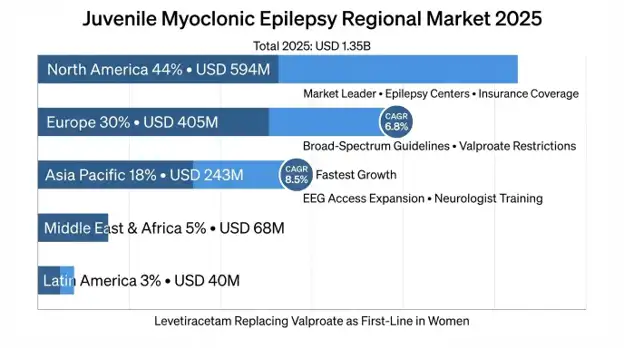
With extensive coverage and depth across complete epilepsy centers, neurology specialist access, and the robust insurance reimbursement framework for both branded and generic ASMs as well as active drug research in future broad-spectrum drugs, North America claims the majority in the global JME market. A bulk majority of regional value is held by the United States, as academic epilepsy center coverage facilitates specialized and complete care models that encompass neurology, neuropsychology, and social services focused on ASYAs.
As is evidenced by the rapid expansion of young people treated and well-developed programs of neurologist training and EEG access in China, India, Japan, and South Korea that facilitate entry of previously untreated JME into medical settings, the Asia Pacific displays the fastest rate of growth by volume among the regions. As governments pushed healthcare coverage expansions coupled with increased national pharmaceutical manufacturing capabilities, ASMs are available at better price points across the region, whereas the well-developed medical guidance of favoring broad-spectrum drugs and existing public insurance networks contributes to considerable market value in Europe.
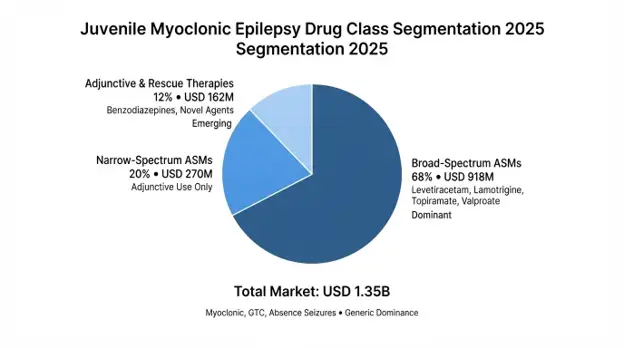
Within the drug class segment, broad-spectrum antiseizure medications dominate with the majority market share (~68%), as clinicians tend to need to be able to control myoclonic, generalized tonic-clonic, and absence seizures, as well as narrow-spectrum sodium channel blockers, which are often contraindicated for fear of worsening a seizure state. The smaller market share in narrowed-spectrum medications and adjunctive benzodiazepines can be explained by these medications only having additional utility as adjunctive agents for remaining myoclonic seizures, whereas emerging therapeutics and novel-mechanism agents take the largest slice of developing drug class growth. In terms of seizure type, generalized tonic-clonic seizure management comprises the largest portion due to its profound impact on the intensity of treatment and risk for injury, followed closely by myoclonic seizure management, which is pathognomonic to the syndrome, with absence seizure management comprising a small but still significantly clinically relevant segment. Hospitals and neurology clinics make up the majority of end users for the treatment of myoclonus, with specialized epilepsy centers comprising the largest growing segment.
The JME market globally is moderately fragmented, with strong generic competition in blockbuster antiseizures and a few innovator drug companies focused on developing future generations of broad-spectrum drugs for the treatment of JME. Differences in competition will include clearly established benefits against all three forms of JME seizures; a favorable profile in reproductive and neuropsychiatric safety permitting open prescribing to women of childbearing age; extended-release delivery forms facilitating compliance; and integrated patient support programs that aid with the unique issues of an adolescent and young adult compliance issue.
By Drug Class:
By Seizure Type:
By Treatment Line:
By Route of Administration:
By Distribution Channel:
By End-User:
By Region:
You'll get the sample you asked for by email. Remember to check your spam folder as well. If you have any further questions or require additional assistance, feel free to let us know via-
+1 724 648 0810 +91 976 407 9503 sales@intellectualmarketinsights.com
18 Sep 2026
Intellectual Market Insights Research © 2026. All rights reserved.