Share this link via:

The global Kallmann syndrome market size was valued at roughly USD 385 million in 2025 and should reach approximately USD 410 million in 2026, with global market expansion to just under USD 670 million by 2034 and a compound annual growth rate (CAGR) of around 6.3% in the forecast period (2026-2034).
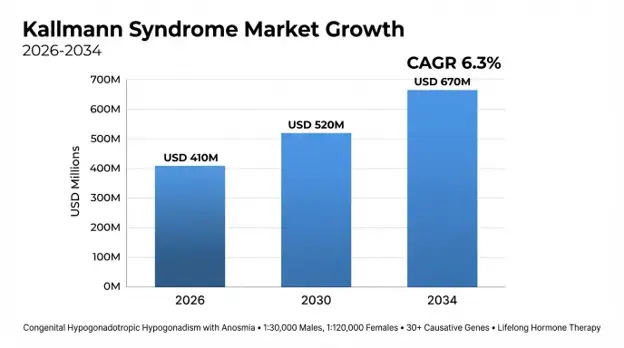
Kallmann syndrome is a genetically heterogeneous form of congenital hypogonadotropic hypogonadism (CHH) that arises from reduced- or completely absent GnRH secretion coupled with a lack of the sense of smell to greater or lesser degrees. Failure of the embryonic migration of both GnRH-secreting neuronal cells and olfactory sensory neurons from the nasal placode to the hypothalamus characterizes the diagnosis of Kallmann syndrome from normosmic CHH, in which sense of smell is preserved despite lack of adequate gonadotropin secretion. Given that gonadotropin secretion is never sufficient to initiate puberty at adequate levels, affected patients have absent or significantly delayed pubertal development, making lifelong medical hormonal care from adolescence indispensable.
Epidemiologically, Kallmann syndrome occurs in males at the estimated incidence of about 1:30,000 individuals and in females at the estimated rate of 1:120,000 to 125,000 individuals. This gives a male-to-female ratio varying from about four to five to one and reflects an estimated frequency of overall CHH (including anosmic and normosmic individuals) of 1:10,000 live births. Clinical Kallmann syndrome comprises more than thirty genes for which there exists at least one causative pathogenic variant, including ANOS1 (KAL1), FGFR1, FGF8, PROKR2, PROK2, CHD7, NELF, WDR11, HS6ST1, and SEMA3A. These variants have X-linked, autosomal dominant, autosomal recessive, and oligogenic inheritance patterns. In approximately 35-45% of clinically diagnosed patients, appropriate gene sequence analysis of relevant panels is expected to detect a causative gene mutation or variant, and other than identifying the cause, this has little role for treatment.
Beyond delayed development of adolescence, the impact of the disease includes increased risk for osteoporosis due to loss of peak bone mass, long-term issues related to untreated sex hormone deficiency, and negative psychosocial consequences from lack of reproductive potential. Up to 30% of those with Kallmann have other significant non-reproductive anomalies. Other non-reproductive anomalies are seen in about one out of 3 Kallmann syndrome people. Most of them include kidney failure on one side, cleft lip or palate, failure to develop teeth, diminished hearing, and bimanual synkinesis due to impaired movement function, which stems from the role some of these genes play as development genes. About 10-20% of patients with Kallmann syndrome have some improvement, and a number recover on their own from deficiency over a decade or more after being treated hormonally, requiring periodic therapy withdrawal cycles and lifelong continued monitoring and reassessment.
The market consists of essentially established endocrine and reproductive medicines and a growing infrastructure in diagnostics to support a specialized rare disease management pathway. Medical interventions, the treatment of choice for males, are injectable and transdermal testosterone therapies; for females, transdermal estradiol and an oral combination product of estrogen plus progestins are used. For purposes of induction of fertility, human chorionic gonadotropin, purified urinary or recombinant FSH, and pulsatile GnRH therapy (using a GnRH pump) are employed. Growth will likely occur at approximately the same rate as improved recognition of Kallmann syndrome, broader inclusion of genetic testing in endocrine practice, and increased reliance on the subfield of infertility treatments among the population.
| Report Coverage | Details |
|---|---|
| Base Year | 2025 |
| Base Year Value | USD 385 Million |
| Forecast Value | USD 670 Million |
| CAGR | 6.3% |
| Forecast Period | 2025-2034 |
| Historical Data | 2022-2025 |
| Largest Market | North America |
| Fastest Growing Market | Asia Pacific |
| Segments Covered | By Treatment Type, Diagnostic Approach, Route of Administration, Gender, End-User, Region |
| Region Covered | North America, Europe, Asia Pacific, Middle East & Africa, Latin America |
| Countries Covered | US, Canada, Mexico, UK, Germany, France, Italy, Spain, China, Japan, India, Australia, South Korea, Brazil, UAE, Saudi Arabia, South Africa |
| Key Market Playes | Ferring Pharmaceuticals, Merck KGaA (EMD Serono), Pfizer Inc., AbbVie Inc., Besins Healthcare, IBSA Institut Biochimique, Novartis AG |
Get more details on this report - Request Free Sample
An important factor fueling market growth is the ongoing enhanced clinical identification of Kallmann syndrome by both pediatric and adult endocrinologists, helping to better differentiate this uncommon condition from constitutional delays of puberty, a benign self-limited disorder that had previously resulted in prolonged periods of watchful waiting. Standardized assessment approaches incorporating testing of gonadotropin and sex steroid levels, olfaction examination, hypothalamic-olfactory magnetic resonance imaging, and selection of appropriate genetic panels facilitate confident early diagnosis and allow access to more patients for therapeutic management for the duration of each patient's professional interaction with this group, further driving continuous demand for hormone therapy replacement and monitoring and genetic counseling.
Fertility restoration is now achievable and increasingly sought after in most Kallmann syndrome patients, and it is not the structural impossibility many have been told. Gonadotropins and (when available) pulsatile GnRH can support male sperm production in most men with Kallmann and ovulation induction in women; treatments need to exceed 12 months and are resource-intensive to administer. The need and desire of these predominantly young patients to procreate organically can translate into continued high demand for these higher-cost/higher-complexity interventions and a larger percent of per-patient revenue than any other area.
The small, geographically scattered diagnosed population diminishes commercial incentive to develop proprietary therapeutics for Kallmann syndrome; thus, the marketplace is left with low-pricing-power standard, well-established hormone generics. Interventions on a higher technological level (e.g., GnRH pumps with pulsatile delivery) have been hindered from widespread uptake due to the device's high expense and the necessary infrastructure for its implementation, as well as unpredictable payment structures from healthcare payers, resulting in a small user population of specialized centers. Gonadotropin-based fertility treatments place an immense economical and logistical challenge upon patients' routine of repeated injections over a span of several months, continuous close follow-up from a physician, and, in most locations, out-of-pocket spending at a significant rate due to the sporadic coverage for fertility treatments by insurance payers.
Integrated CH Hand Kallmann syndrome pathway creation, covering a spectrum from hormonal diagnosis and testosterone replacement therapy through hormone replacement to fertility services and bone health tracking in multidisciplinary clinics and specialized clinics for CHH as well as adolescent to adult conversion of care pathways to prevent patients from "falling off the radar" during this sensitive transitional time; establishment and use of telemedicine platforms and remote monitoring devices to provide long-distance monitoring and therapy adjustment.
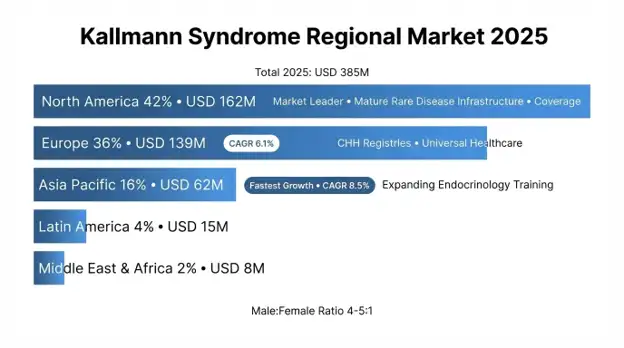
North America continues to drive the largest regional market share of the global Kallmann syndrome market with its mature and well-developed rare disease infrastructure, strong network of endocrinologists in the reproductive and pediatric fields, wide insurance policies in place to cover hormone therapies, and large number of pharmaceutical and genetic testing companies operating in the region. The second largest regional market for the Kallmann syndrome market is Europe; the region possesses an extensive network of CHH registries at national or multi-center levels, fully funded publicly covered universal medical plans, and widespread adoption of sophisticated diagnostic tools, including sophisticated imaging techniques and genetic analysis tests, to facilitate the standardized and well-documented management guidelines. The APAC region is anticipated to grow at a rapid pace due to expanding subspecialty endocrinology training programs in major countries, namely China, Japan, South Korea, and India; the rising trend of middle-income class society becoming more amenable and willing to go for fertility treatment; and the slow increase in government support towards rare-disease drug reimbursement; however, rates of diagnosis still remain very low in comparison to western regions, which provides good potential in the future as and when awareness is increasing in such regions.
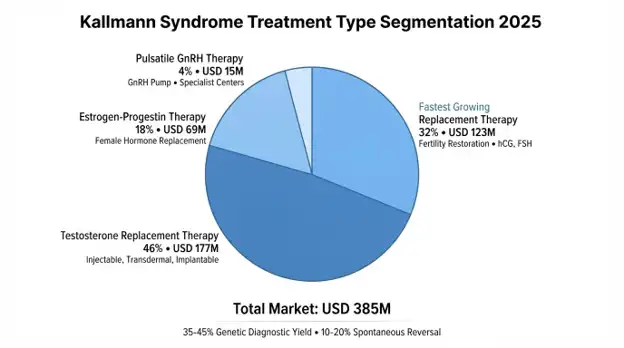
Treatment Type Insights: The largest part of the market is represented by testosterone replacement; the higher prevalence in males has driven extensive new innovation in transdermal gels and also helped increase acceptance with sustained-release injectable and implantable products. Gonadotropins will be the highest-growth market as well as the largest in value per patient, driven by increased need for fertility restoration. Pulsatile GnRH therapy is a technologically sophisticated, low-volume sub-market, constrained by specialist technology and available infrastructure.
Diagnostic Approach Insights: Hormonal assays remain the foundational diagnostic tool, but genetic testing is the fastest-growing diagnostic segment as sequencing costs decline and payer coverage expands, followed by MRI imaging of the olfactory bulbs and hypothalamus and formal olfactory function testing, both integral to differentiating Kallmann syndrome from other causes of delayed puberty.
End-User Insights: Primary end-users: Hospitals and specialized endocrinology clinics: Provide primary diagnostic services and follow-up of long-term hormone replacement; Fertility clinics and academic medical centers Key areas for advanced reproductive procedures, genetic counseling and diagnosis, and management of any anomalies. Home care and outpatient settings: Increasing importance in maintenance-phase hormone delivery.
The Kallmann syndrome market is highly fragmented since no company possesses an outright disease-specific monopoly and because treatment involves off-label use of traditional sex steroids and gonadotropins designed and marketed as general endocrine treatments and infertility therapies. Product differentiation focuses on ease of use, such as long-acting injections and better transdermal administrations, as well as expanding participation of diagnostic companies offering diagnostic and genetic test results. Academic institutions and rare-disease consortiums also have a substantial impact by informing treatment guidelines, patient registries, and referral pathways influencing this space.
During late 2005-2006, further academic and industrial endeavors have been launched to improve diagnostics of Kallmann syndrome and the ways it is treated. In addition, collaborations between various multi-center, clinical, and genetic registries will proceed so that additional causative genes will be identified and improved genotype-phenotype associations established to facilitate personalized treatment management plans. A few specialty pharmaceutical manufacturers, having a presence in the gonadotropins and testosterone-replacement industry, will continue investing in better devices of administration, specifically in a pre-filled injecting pen mechanism for improved precision and better adherence throughout long-term fertility-stimulating treatments, whereas diagnostic labs will introduce recently discovered gene panels associated with Kallmann syndrome in their overall panels of reproductive and endocrine testing.
You'll get the sample you asked for by email. Remember to check your spam folder as well. If you have any further questions or require additional assistance, feel free to let us know via-
+1 724 648 0810 +91 976 407 9503 sales@intellectualmarketinsights.com
18 Sep 2026
Intellectual Market Insights Research © 2026. All rights reserved.