Share this link via:

Global Kaposi sarcoma market: The global Kaposi sarcoma market size was valued at USD 205.0 million in 2025 and is anticipated to reach USD 220.0 million in 2026, expanding at a CAGR of 7.6% to USD 395.2 million by 2034.
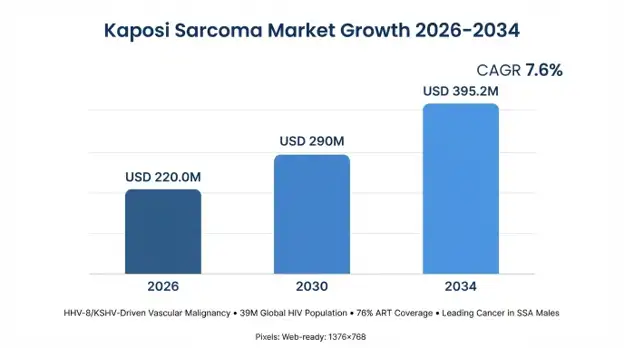
Kaposi sarcoma is a multifocal malignancy of vascular endothelium etiology caused by the infection of human herpesvirus-8 (HHV-8), also known as Kaposi's sarcoma-associated herpesvirus (KSHV). Tumors appear as violaceous lesions that can involve the skin and mucosa but often extend to the lymph nodes, oropharynx, gastrointestinal tract, and lungs in advanced cases.
The clinical behavior of the disease is primarily dictated by the patient's immune system, which leads to the manifestation of four different clinical epidemiological types: classic KS; the indolent and slow-progressing form of cutaneous KS seen in elderly men of Mediterranean, Eastern European, and Middle Eastern descent; epidemic KS, or AIDS-associated KS, which is the most common and aggressive form found in patients with a severe immune deficiency as a result of HIV infection; endemic or African KS, which is found in HIV-uninfected adults and children in sub-Saharan Africa, where the prevalence of HHV-8 seroprevalence is extremely high; and iatrogenic KS, found in the context of organ transplants or other chronic immunosuppressive therapies.
Treatment modalities vary based on the specific type of KS, the patient’s disease status, and the host’s immune integrity. In epidemic KS, optimization of antiretroviral therapy is the key in the initial management, and in some cases with limited cutaneous KS, the disease can regress in partial or total response based on immune system recovery. However, in patients with extensive disease or rapidly progressive disease, systemic treatment with cytotoxic therapy is required. Pegylated liposomal doxorubicin is the standard first line of therapy owing to its favorable cardiotoxic profile and affinity for accumulation in tumor vasculature, while paclitaxel is the main option for the second line of treatment in patients with anthracycline-resistant MS.
For localized manifestations, radiotherapy, cryotherapy, surgery, or intralesional therapy are considered valid treatment options, whereas iatrogenic KS is treated by changes in immunosuppression, where a calcineurin inhibitor is converted into an m-TOR inhibitor, which suppresses the growth of Kaposi sarcoma while preserving graft tolerance.
Commercially, KS is a unique niche in both the oncology and infectious diseases markets that are characterized by a low patient volume in high-income countries and high disease prevalence in the low-income countries, where healthcare spending is low. SSA country where Kaposi sarcoma is the leading cancer found in males, while the increasing use of long-term HIV therapy and an increased use of immunosuppression therapy Developed countries are leading to a chronically increasing caseload. KS is evolving from the use of general cytotoxics to immune checkpoint inhibitors, anti-angiogenic compounds, and virally targeted therapies targeting HHV-8 oncogenesis.
| Report Coverage | Details |
|---|---|
| Base Year | 2025 |
| Base Year Value | USD 205.0 Million |
| Forecast Value | USD 395.2 Million |
| CAGR | 7.6% |
| Forecast Period | 2025-2034 |
| Historical Data | 2022-2025 |
| Largest Market | North America |
| Fastest Growing Market | Middle East & Africa |
| Segments Covered | By Disease Type, Treatment Type, Route of Administration, End-User |
| Region Covered | North America, Europe, Asia Pacific, Middle East & Africa, Latin America |
| Countries Covered | US, Canada, Mexico, UK, Germany, France, Italy, Spain, South Africa, Kenya, Nigeria, Uganda, China, India, Japan, Australia, Brazil, Argentina, UAE, Saudi Arabia |
| Key Market Playes | Bristol-Myers Squibb, Merck & Co., Pfizer Inc., Gilead Sciences, Johnson & Johnson, Novartis AG, Teva Pharmaceutical Industries |
Get more details on this report - Request Free Sample
The underlying factor supporting the growth of the Kaposi sarcoma market will be persistent global HIV prevalence coupled with a growing chronically immunosuppressed patient pool worldwide. In 2025 nearly 39 million people were alive with HIV, and, while access to antiretroviral therapy stands at around 76%, there continues to be a substantial proportion of individuals who arrive late for care, miss treatment, or suffer from virologic treatment failure, all of which contribute to a continuous reservoir for HHV-8-mediated transformation to malignancy. Epidemic Kaposi sarcoma remains the most frequent AIDS-defining neoplasm.
It usually affects patients whose CD4 counts are lower than 200 cells per microliter, and it comprises most of the treatment burden for this disease globally, although it represents a very low proportion in the context of high-income countries that saw greatly increased incident rates during the early HIV epidemic.
Sub-Saharan Africa represents a high proportion of the total disease burden in that nearly 30-60% of all adults in several African countries remain positive for HHV-8 antibodies versus <5% of people living in the US and most of Western Europe. This co-existence of high viral seroprevalence and significant HHV-8 burden supports the development of Kaposi sarcoma as the primary cause of cancer in the region (among men), while increased transplantation and recipient lifespan have continued to add to the chronically immunosuppressed population that risks development of iC KS.
A second key driver of growth, the increasing comprehension of the molecular pathogenesis of HHV-8 infection, offers targets that do not involve the use of traditional cytotoxic chemotherapy. Since KS is a virally driven, rich vascularized, and strictly host immune-cell-controlled phenomenon, it provides a strong case for immune checkpoint inhibition as well as anti-angiogenic targeting. Preliminary data of treatment of relapsed or refractory patients, including HIV-coinfected individuals, a population previously deemed to be poor immunotherapy candidates with programmed death-1 (PD-1) inhibitors, indicate high response rates. Similarly, treatment modifications to mTOR inhibitors used in transplant patients coupled with early-stage investigation of agents targeting latency-associated HHV-8 latency-maintaining proteins will gradually swell the list of available therapeutic interventions and re-energize corporate interest in this traditionally neglected niche.
The Kaposi sarcoma market is inherently limited by both of these factors—it is an orphan oncology indication, has very low prevalence in high-income markets (as access to antiretroviral therapies has decreased disease incidence and transplant recipients are more strictly screened, and incidence is in the low thousands per year in the US/Western Europe), and therefore cannot independently support the significant investment in dedicated clinical development that is required to win approval outside of orphan indications. Adding insult to injury, there is severe geographical disharmony between where disease exists and the ability to purchase and pay for therapeutics, as the countries with the highest amount of Kaposi sarcoma (predominantly sub-Saharan Africa) lack high per capita incomes, healthcare access, and payment mechanisms.
A real potential value is in the further clinical investigation of immune checkpoint inhibitors in relapsed/refractory Kaposi sarcoma, an indication with a clear biological rationale in the context of a predominantly immune-mediated pathogenesis of the tumor. Furthermore, early-phase response rates observed in HIV-positive patients and the increasing acceptance of this formerly ineligible group into immune-oncology trials by regulators/experts may render checkpoint inhibitors a likely future second-line standard. Given the established high costs of these molecules, any level of utilization beyond the refractory population should achieve disproportionate revenues from a relatively small group of patients.
Immunological, not just oncological, emerging strategies are evolving away from widespread cytotoxic therapy to a mode of treatment focusing on the immunological and virological substrates for disease acquired by therapy (iatrogenic); transitioning from calcineurin inhibition to an mTOR inhibitor, such as sirolimus, is a routine method. This has been highly effective in leading to tumor regression for most transplant recipients, with no therapy with an anti-cancer, cytotoxic effect. In this era, mechanisms of disease-based therapy, rather than cytotoxic approaches aimed at overall tumor proliferation, may now also be pursued. The beginning of work targeting the latent phase of the virus [44] and the beginning of work developing small molecules designed to interfere with the protein required to sustain the HHV-8 latent phase are in early stages, but this also represents an important aspect of this moving toward mechanism-based treatment.
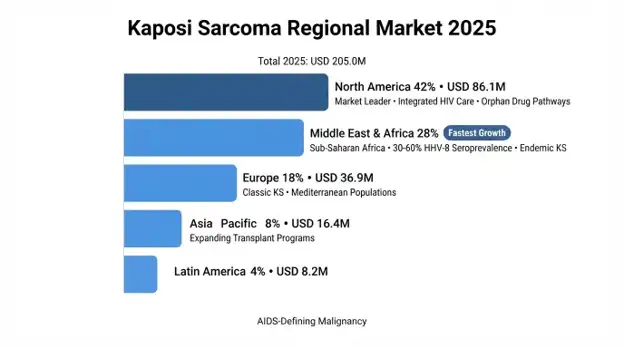
North America leads in total global Kaposi sarcoma market revenue thanks to infrastructure supporting integrated HIV care, established oncology infrastructure and expertise focusing on AIDS-defining malignancies, and reimbursement via public and private sources for pegylated liposomal doxorubicin and newer immunotherapeutic agents. In this region, the United States makes up a substantial proportion of value, supported by dedicated clinical trial networks examining novel treatments for this rare indication and an environment accustomed to supporting orphan drug development through an organized system of incentive pathways.
The Middle East & Africa region (which heavily favors sub-Saharan Africa) constitutes the epidemiological capital and the single largest growing geographic segment of the global market. High HHV-8 prevalence with a significant HIV burden means Kaposi sarcoma stands out as one of the most frequently diagnosed cancers in adult patients among certain nations. Broadening coverage of antiretroviral therapy, availability of pre-qualified generics of systemic chemotherapy via international procurement arrangements, and building slowly upon oncology/radiotherapy infrastructure mean that increasing proportions of those diagnosed are receiving active treatment. These factors, coupled with a developing global economic base, have helped spur this region to significant growth.
Together the regions of Europe, Asia Pacific, and Latin America offer a moderately sized segment of the global market value. The case numbers in Europe, particularly for classic Kaposi sarcoma in elderly (Mediterranean & East European-descended) populations and more frequently seen cases involving HIV or post-transplant immunosuppression, are relatively small. Universal or nearly universal healthcare coverage throughout much of Europe facilitates ongoing treatment for these patients and patients on newer modalities. The story in the Asia Pacific is more mixed; rare but effectively managed cases persist in developed markets like Japan and Australia. Underdiagnosis, however, is a consistent issue through portions of Southeast Asia and the Indian subcontinent, with gradually improving access to diagnostic and treatment modalities driven in part by expanded HIV testing programs and greater volumes of solid organ transplants, meaning that diagnosed prevalence and eventual treatment proportions should increase slowly. South America continues to have moderately prevalent, mostly HIV-linked disease. In major economies of the Latin American sector, oncologic facilities offer largely adequate access to systemic therapy for those patients fortunate enough to present for care at tertiary centers, despite economic volatility limiting overall patient populations.
Epidemic (AIDS-related) KCS (B), which makes up a large majority of worldwide treatment cases due to its close relation with the current HIV epidemic and proclivity for broad, systemic disease necessitating pharmacological treatment, competes as the leading disease type. Less numerous but clinically relevant contributions are provided by classic and endemic KCS, which may be treatable with local or on-again/off-again therapy by virtue of their relative indolence, and by iatrogenic KCS, a small numerical component with a significantly high patient treatment cost by virtue of the need for treatment coordination with immunosuppression.
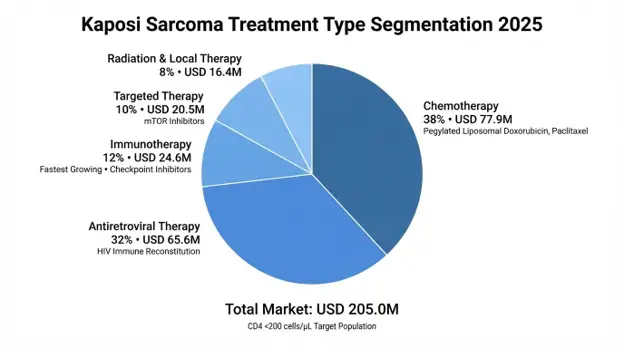
Chemotherapy is expected to remain the largest treatment segment, driven by pegylated liposomal doxorubicin, which remains the first-line standard of care for systemic disease, and paclitaxel as the standard of care for refractory disease. Antiretroviral therapies hold considerable weight within the total management value of HIV-related disease, as HIV requires immune reconstitution to be addressed, and treatment approaches that consist of targeting therapy and immunotherapy, though smaller, are the segments with the quickest overall growth through checkpoint inhibitors and mTOR-based therapies.
Hospitals & oncology centers are the largest end-user segment; this can be attributed to the multidisciplinary nature of Kaposi sarcoma treatment and management that often necessitates consultation among infectious disease specialists, oncologists, dermatologists, and, in iatrogenic patients, transplant medicine physicians. It is worth noting the burgeoning role of HIV specialty clinics in timely diagnosis and referral, while ambulatory surgical centers cater to simple procedures such as biopsy and excisional biopsy or debridement of the skin and subcutaneous tissue components.
The international market for Kaposi sarcoma is semi-concentrated and fragmented at large. There is not one company that leads the entire market for each subtype of the disease and each line of treatment, given the nature of Kaposi sarcoma as an orphan condition that relies on treatment therapies, primarily derived from broader oncology or HIV applications. Competition exists based on the supply of high-quality, stable pegylated liposomal doxorubicin; the extent of an antiretroviral therapy product portfolio for HIV-associated cases; continued clinical trial investment in targeted therapies and immunotherapies; as well as the strength of patient assistance and access programs that drive market share of high disease burden regions. Generic players from India and China are proving to be significant and powerful players across emerging markets by providing competitively priced, international pre-qualified products, priced much lower than available originator therapies.
By Disease Type:
By Treatment Type:
By Route of Administration:
By End-User:
By Region:
You'll get the sample you asked for by email. Remember to check your spam folder as well. If you have any further questions or require additional assistance, feel free to let us know via-
+1 724 648 0810 +91 976 407 9503 sales@intellectualmarketinsights.com
18 Sep 2026
Intellectual Market Insights Research © 2026. All rights reserved.


