Share this link via:

The global mRNA vaccine technologies market size was valued at USD 28.6 billion in 2025 and is projected to reach USD 33.1 billion in 2026, expanding to USD 89.4 billion by 2034, growing at a CAGR of 13.2% during the forecast period (2026-2034).
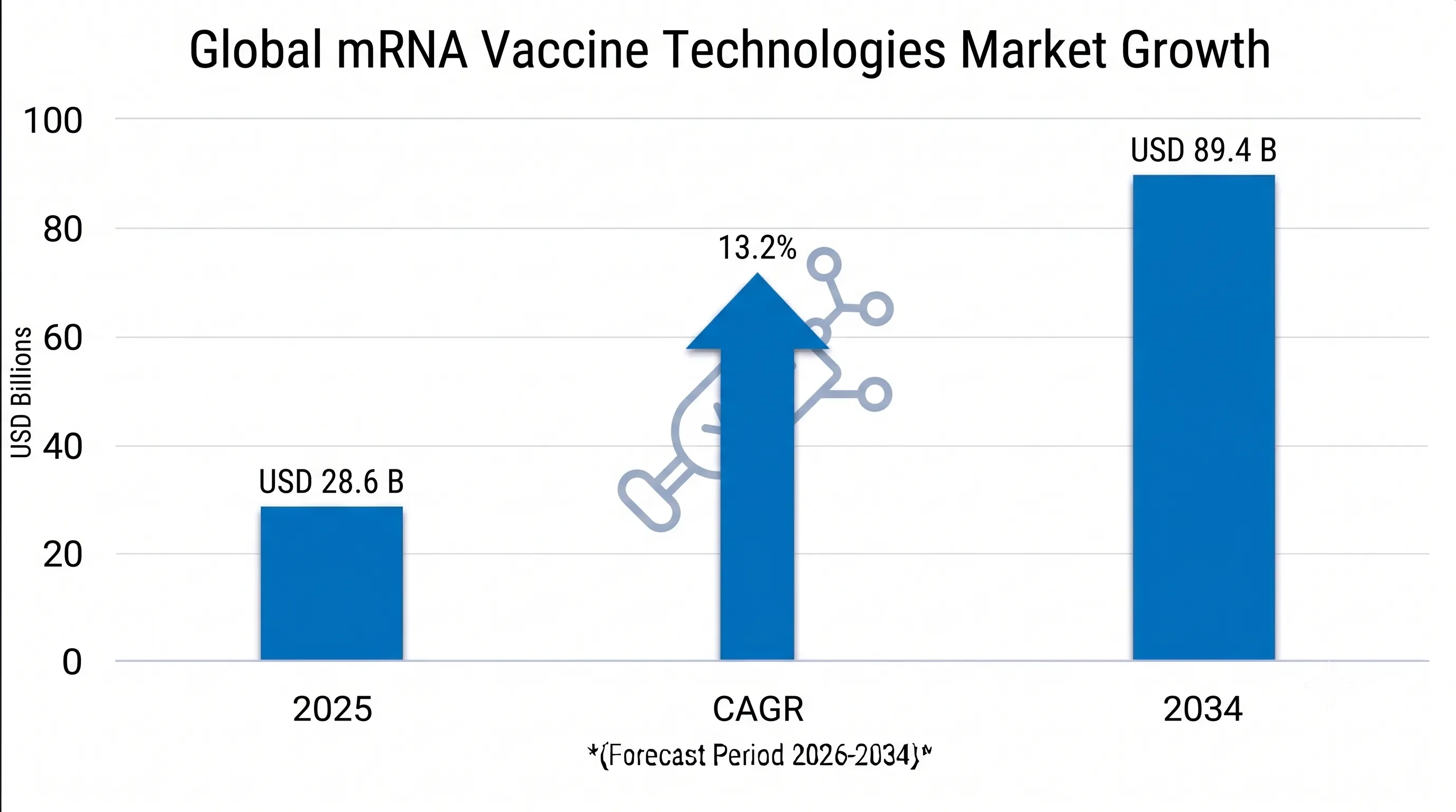
Messenger RNA vaccine technologies are a groundbreaking pharmaceutical platform capable of instructing human cells to generate specific antigens and subsequently initiate strong, specific immune responses without the presence of live or attenuated pathogens. The strategy is fundamentally different from traditional vaccine approaches, which involve the production of pre-formed antigens and are slow in vaccine design, slow to scale up for manufacturing, and incapable of inducing both humoral and cellular immunity with any accuracy. The platform has been validated globally with the emergency development and deployment of COVID-19 vaccines, which proved to be more than 90 per cent effective at tackling severe disease and also demonstrated a well-established safety profile, with billions of doses administered globally to people globally.
The key technologies behind mRNA vaccines involve complex chemical engineering of nucleosides to minimize innate immune responses to synthetic mRNA, advanced codon optimization and untranslated regions to increase mRNA translation efficiency, and novel delivery technologies to ensure safe delivery of mRNA into cells and efficient endosomal escape. The conversion of uridine to N1-methylpseudouridine is a key development that made mRNA a viable commercial drug platform for protein expression, with reduced inflammatory reactogenicity.
The current development of mRNA vaccines is based on standard manufacturing procedures, in vitro transcription, advanced purification methods to eliminate immunostimulatory by-products of in vitro transcription (dsRNA) and lipid nanoparticle (LNP) encapsulation using microfluidic mixing technologies to achieve a uniform size distribution and high LNP encapsulation efficiency. This platform approach allows for a single manufacturing platform to be used to produce several different vaccines with minimal changes, offering significant economies of scale and rapid scale-up and scale-down for a new pathogen threat or personalized therapeutic application.
Beyond pandemic use in infectious diseases, the commercial implications of these technologies are significant in other areas, such as cancer vaccines based on patient-specific tumor neoantigens identified with next-generation sequencing, therapeutic mRNA encoding functional proteins for rare genetic diseases, vaccines for endemic diseases such as influenza, RSV and CMV, and exploratory use in autoimmune disease and protein replacement therapies. The platform's flexibility also allows for combination vaccines that can be used to fight several diseases at once, which can help curb complicated disease burdens, streamline immunization programs and enhance compliance.
| Report Coverage | Details |
|---|---|
| Base Year | 2025 |
| Base Year Value | USD 28.6 Billion |
| Forecast Value | USD 89.4 Billion |
| CAGR | 13.2% |
| Forecast Period | 2025-2034 |
| Historical Data | 2022-2025 |
| Largest Market | North America |
| Fastest Growing Market | Asia Pacific |
| Segments Covered | By Product Type, Technology, Application, Delivery System, Route of Administration, End-User |
| Region Covered | North America, Europe, Asia Pacific, Middle East & Africa, Latin America |
| Countries Covered | US, Canada, Mexico, UK, Germany, France, Italy, Spain, Netherlands, China, Japan, India, Australia, South Korea, Brazil, Argentina, UAE, Saudi Arabia, South Africa |
| Key Market Playes | BioNTech SE, Moderna Inc., Pfizer Inc., Sanofi SA, CureVac N.V., Arcturus Therapeutics, GSK plc |
Get more details on this report - Request Free Sample
A key factor driving the market is the mRNA vaccine technologies market is the development of highly innovative personalized cancer vaccines based on the identification of tumor-specific neoantigens to create personalized therapeutic vaccines against cancer. Traditional treatments for cancer usually fail because of the tumor’s heterogeneous nature and side effects caused by targeting nontumor cells; however, through mRNA-based personalized cancer vaccines, it is possible to design customized vaccines using the mutational profile of each patient’s tumor. By utilizing whole-exome sequencing of tumor samples, the neoantigens of each individual patient can be determined by using computational tools for prioritization, producing a personalized mRNA vaccine.
The manufacturing cycle of the personalized cancer vaccine has greatly shortened from over 16 weeks observed in the earliest programs to a point where vaccine manufacturing and release is achieved within 6-8 weeks since biopsy submission. Clinical studies conducted on the efficacy of mRNA-based cancer vaccines along with checkpoint inhibitor immunotherapy have seen impressive results with the 44% reduction in the risk of recurrence for Phase II melanoma patients as opposed to using only checkpoint inhibitors. The oncology portfolio in the mRNA technology space grew by 45% during 2023-2025 with personalized cancer vaccine clinical programs rising to 67 programs globally in 2025.
The COVID-19 pandemic provided unprecedented real-life proof of the capabilities of mRNA-based vaccine platforms on a worldwide scale, proving that the development process of vaccines, which historically has taken between 10-15 years to complete, can now be completed in approximately 12 months while still meeting the safety and efficacy standards. These developments have irrevocably changed the way regulators and other industry participants view the technology.
Investments during the pandemic have led to the construction of mRNA manufacturing plants, increased production of lipid nanoparticles, and cold-chain distribution across the globe that is highly adaptable to other indications without requiring equivalent investments. Regulatory authorities are familiar with the evaluation process of mRNA vaccines, manufacturing processes, and safety monitoring after market approval, making any future assessment process easier and more efficient especially in case of strain changes. Clinical study protocols, large safety databases based on hundreds of millions of doses used, and the already proven economic health benefit will facilitate the approval process for other vaccines against seasonal infections.
The primary limitation is the complex manufacturing process that necessitates specific machinery, experienced staff, and advanced analytical platforms which may not be readily available in developing manufacturing facilities. The manufacturing process includes the steps of synthesizing mRNA from DNA templates, purifying the mRNA to eliminate any stimulatory products, lipid nanoparticle formulation by microfluidic mixing, and detailed analysis including verification of particle sizes and sterilization.
Costs associated with producing mRNA vaccines are considerably more expensive in comparison to traditional methods, where manufacturing costs range from USD 3-7 per dose using optimized large-scale procedures, in comparison to USD 0.50-2.00 for manufacturing with traditional techniques. The supply chain is further exposed due to its heavy reliance on four main manufacturers that produce 70% of all ionizable lipids globally.
A major opportunity lies in developing combination mRNA vaccines targeting multiple respiratory viruses in a single dose. using the versatility of the technology by encoding for influenza, SARS-CoV-2, and respiratory syncytial virus within one formulation. This opportunity is driven by the overlapping epidemiology of seasonal respiratory illnesses which places tremendous pressure on the public health system each year.
The ability of mRNA technology to encapsulate several different mRNA sequences allows for the creation of broad-acting respiratory vaccines, which can help capture a substantial share of the USD 15 billion per year seasonal respiratory vaccines industry. These vaccines will significantly lower the logistics and delivery costs and guarantee predictable seasonal demand.
Incorporation of artificial intelligence and machine learning across mRNA vaccine development processes has has improved development efficiency and enhanced performance metrics in vaccine efficacy. AI technologies are used in multiple stages including identification of antigen targets and sequence optimizations, design and patient selection in clinical trials, and process controls during production processes which would be impossible through traditional analysis methods.
Machine learning algorithms based on databases of protein structure can predict the stability and immunogenicity of antigens with a degree of accuracy that rivals experiments, whereas reinforcement learning is used to optimize codon utilization, sequences of untranslated regions, and nucleoside modifications for maximum translation efficiency. Large language models are used to process big genomic data and characterize pathogens for vaccine design, which takes just days instead of months.
The North American market held the maximum share of USD 11.8 billion in 2025 with a steady CAGR of 12.4% over 2025-2034. This was due to the presence of top-notch mRNA biotech firms such as Moderna, US division of BioNTech, and many platform developers. The market had received strong funding support from NIH and BARDA for development of mRNA technology, effective regulatory framework that fast tracks approval of breakthrough-designated programs, and significant investments with mRNA firms raising USD 4.7 billion in VC in 2024-2025.
The US holds an 84% share in the regional market value via FDA knowledge in mRNA product assessment, well-developed infrastructure for fast-paced development of clinical trials, and the healthcare system’s openness toward adopting innovative drugs that are premium priced and have solid clinical proof. Government pandemic preparedness initiatives guarantee the demand for the platform even after the life cycle of individual products, as does excellent academic research.
The Asia-Pacific region is expected to be the fastest-growing regional segment, with an estimated CAGR of 15.8%, up to 2034, achieving USD 6.2 billion by 2025. Regional growth factors include Growth is driven by the region’s large population, strong government investment in local manufacturing, advances in biotechnology, and expanding clinical trial activity. in local production capacity advancements in the biotech industry and clinical trials.
China is leading the region with a market share of 38%, aided by 140 million diabetes sufferers that have created considerable need for therapeutic vaccines, healthcare reforms by the government that include increasing insurance cover and state-backed mRNA development initiatives progressing through clinical trials. The early approval of self-amplifying mRNA vaccines by Japan makes it the regulatory leader in the region, followed by manufacturing plants in South Korea and India.
In 2025, Prophylactic Vaccines are projected to hold the majority share, representing 71% of the market valued at USD 20.3 billion, which includes vaccines against emerging pathogen threats, infectious disease vaccines against COVID-19 variants and influenza, and RSV vaccines. This segment has proven population-level efficacy data, established regulatory pathways and government procurement frameworks that will facilitate continued platform adoption. Therapeutic Vaccines represent the largest market share of 18% valued at USD 5.1 billion in 2025 with the highest growth rate of 22.4% CAGR, by the end of the forecast period, due to the ongoing advancement of cancer vaccine programs and protein replacement application.
The technology segment with the highest growth is self-Amplifying mRNA which will account for 28.3% CAGR and 11% market share through 2034 at USD 3.1 billion in 2025. As clinical studies continue to validate the dose-sparing benefits, lower production costs, and enhanced safety of this platform, its potential for market penetration grows as more regulatory clearance is granted for its use beyond the initial COVID-19 applications.
Infectious Diseases hold 69% market share valued at USD 19.8 billion in 2025, reflecting the commercial base that is shaped by the availability of COVID-19 vaccines, influenza vaccine programs, and respiratory pathogens. On the other hand, Oncology accounts for 20% market share estimated at USD 5.8 billion in 2025 and having a CAGR of 24.1%, being the most profitable segment for growth, as it involves advanced cancer vaccine development and immunotherapy programs exhibiting positive clinical results.
Rare Genetic Disorders account for 7% market share in 2025, estimated to be worth USD 2.1 billion. The segment comprises the use of therapeutic drugs in cases of metabolic disorder and protein deficiencies. The favorable regulatory factors such as Orphan Drugs designation enable high pricing of rare diseases.
Hospitals & Clinics make up 52% of the market share at USD 14.9 billion in 2025, including those hospitals providing advanced therapeutic vaccines to their patients and dealing with patients who need customized immunotherapy treatments. Research Institutions account for 24% of the market, valued at USD 6.9 billion.
Public Health Programs is a 16% market share at USD 4.6 billion in 2025 and involves national immunization programs, pandemic preparedness stockpiling programs and population-level vaccination programs. This segment is expected to show promising growth due to government expansion of mRNA vaccine rollout in regular vaccination programs.
The mRNA vaccine technologies market is moderately concentrated with the top 5 players accounting for about 74% of the market value having proprietary platform technologies backed by extensive patent portfolios, established manufacturing capacities tailored to commercial needs, regulatory knowledge, and regulatory pathways which allow them to develop vaccines quickly, and a comprehensive clinical database that supports a wide range of application development.
In terms of platform technology benefits, lipid nanoparticle formulation chemistry expertise, mRNA sequence optimization capabilities, manufacturing scalability and cost-effectiveness, clinical pipeline breadth across various disease areas, and strategic partnering with health systems to achieve preferred access and formulary positioning. Self-amplifying mRNA platforms, thermostable formulations, combination vaccines and therapeutic use of personalized vaccines are all innovation areas.
April 2026: Moderna received FDA approval for their mRNA-1345 respiratory syncytial virus vaccine, which showed efficacy of 83.7% in protecting from lower respiratory infection in patients above 60 years of age, thus being the first non-COVID mRNA vaccine to receive regulatory approval and proving the utility of mRNA vaccines beyond pandemics.
March 2026: BioNTech announced that its BNT111 individualized neoantigen vaccine when used in combination with pembrolizumab in patients with advanced melanoma reduced distant metastasis by 44% compared to checkpoint inhibitor alone, paving the way for regulatory approval of their vaccine.
February 2026: Sanofi acquired specialized mRNA delivery technology company for USD 1.2 billion gaining proprietary self-amplifying platform and manufacturing expertise to speed up internal pipeline development in influenza, HIV and oncology applications.
January 2026: CureVac successfully transferred its technology for domestic mRNA manufacturing capacity of 400 million doses per year in India extends market access in South Asia and creates regional production capability to meet the objectives of WHO pandemic preparedness.
December 2025: Pfizer has been given FDA breakthrough therapy designation for cytomegalovirus mRNA vaccine for immunocompromised transplant recipients, which it hopes will speed development for disease that affects 30,000 patients annually and results in a substantial burden of morbidity and mortality.
You'll get the sample you asked for by email. Remember to check your spam folder as well. If you have any further questions or require additional assistance, feel free to let us know via-
+1 724 648 0810 +91 976 407 9503 sales@intellectualmarketinsights.com
01 Jul 2026
Intellectual Market Insights Research © 2026. All rights reserved.