Share this link via:

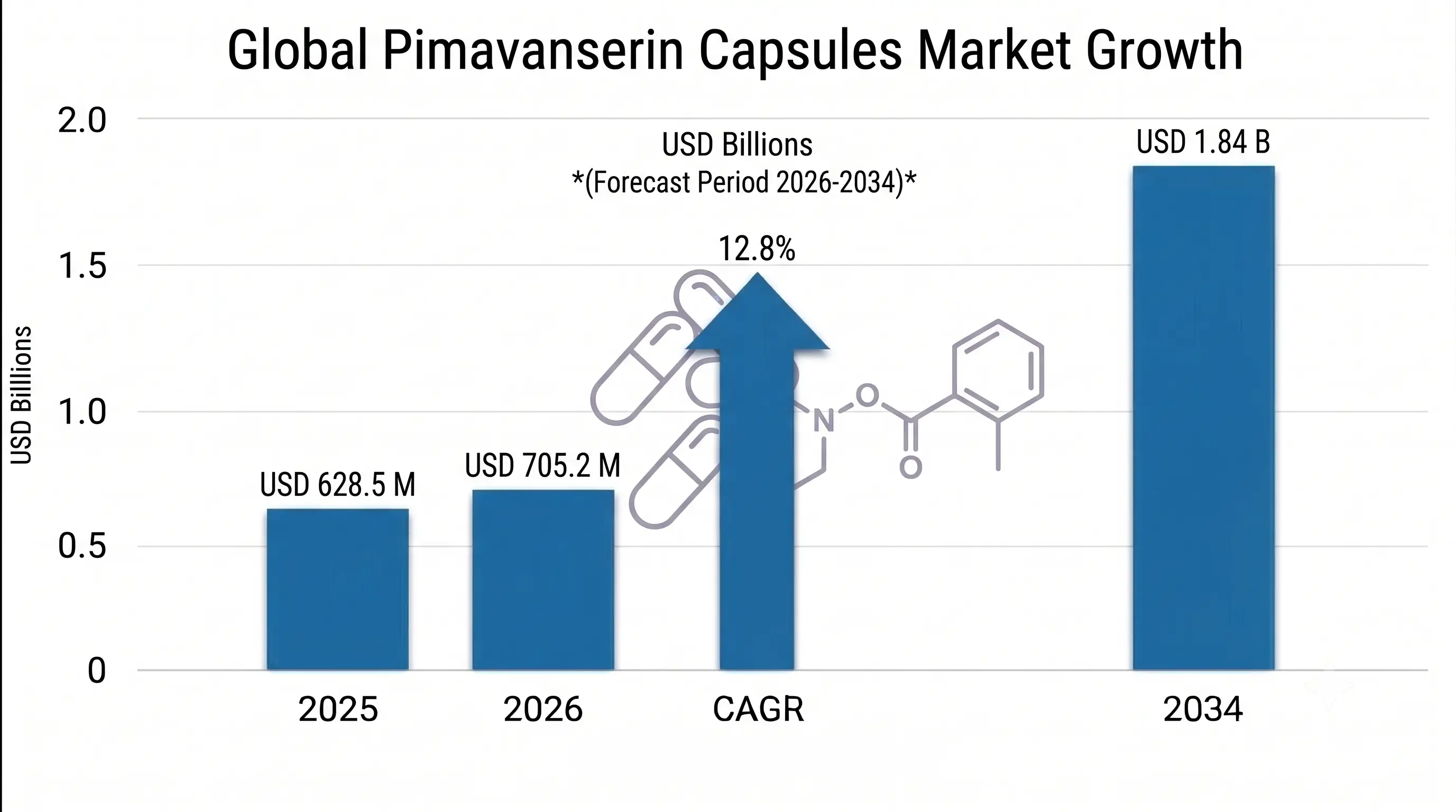
The global pimavanserin capsules market size was valued at USD 628.5 million in 2025 and is projected to reach USD 705.2 million in 2026, expanding to USD 1.84 billion by 2034, growing at a CAGR of 12.8% during the forecast period (2026-2034).
Pimavanserin is a novel neuropsychiatric drug belonging to the class of serotonin inverse agonists and antagonists. that selectively bind to 5-HT2A receptors and have no significant affinity at dopamine, histamine, muscarinic, or adrenergic receptors. Its unique pharmacological selectivity distinguishes pimavanserin from conventional and atypical antipsychotics., which all must block the dopamine D2 receptor to be effective in the treatment of psychosis. For patients with Parkinson's disease psychosis, the significance of this mechanistic distinction is more profound, since the conventional antipsychotics invariably compound the motor dysfunction by blocking the very same dopaminergic pathways that the antiparkinsonian drugs target.
The 5-HT2A receptor system plays a pivotal role in modulating sensory perception, cognitive processing and the integration of the dopaminergic signals across the cortical and subcortical regions of the brain. Selective inverse agonism at these receptors provides antipsychotic effects while preserving normal dopaminergic transmission., while maintaining normal dopaminergic transmission required for motor function, executive function and emotional regulation. Pharmacological precision allows for the effective treatment of psychosis symptoms without impacting motor function, as well as a paradigm shift from first generation neurotransmitter modulation to second generation receptor-specific intervention.
Pimavanserin was originally developed and marketed by Acadia Pharmaceuticals under the trade name Nuplazid and was approved by the Food and Drug Administration (FDA) in April 2016 as the first and only drug specifically approved for treating hallucinations and delusions in patients with Parkinson's disease psychosis. This breakthrough clearance was for a new treatment that meets an important unmet medical need for around half of the 10 million people worldwide with Parkinson's disease who experience psychotic symptoms during the disease. The therapeutic is not only a new therapeutic tool but also a paradigm shift in precision neuropsychiatry, offering clinical proof of the validity of serotonin selective antipsychotic pharmacology.
The commercial potential extends well beyond the core Parkinson’s disease psychosis indication., applying to a wide range of other neurological (and psychiatric) diseases in which psychosis is a feature and where the dopamine side effects of disease are significant. The biggest potential expansion is Alzheimer's disease psychosis, affecting an estimated 14-20 million patients worldwide and there are no currently approved pharmaceutical treatment options available. There are also additional pipeline opportunities such as adjunctive therapy in treatment resistant major depressive disorder and schizophrenia, where treatment strategies may include combining the use of pimavanserin with currently available treatment options with its unique mechanism and absence of metabolic and extrapyramidal side effects.
| Report Coverage | Details |
|---|---|
| Base Year | 2025 |
| Base Year Value | USD 628.5 Million |
| Forecast Value | USD 1.84 Billion |
| CAGR | 12.8% |
| Forecast Period | 2025-2034 |
| Historical Data | 2022-2025 |
| Largest Market | North America |
| Fastest Growing Market | Europe |
| Segments Covered | By Indication, Therapy Line, Patient Population, Distribution Channel, End-User |
| Region Covered | North America, Europe, Asia Pacific, Middle East & Africa, Latin America |
| Countries Covered | US, Canada, Mexico, UK, Germany, France, Italy, Spain, Netherlands, China, Japan, India, Australia, South Korea, Brazil, Argentina, UAE, Saudi Arabia, South Africa |
| Key Market Playes | Acadia Pharmaceuticals Inc., Teva Pharmaceutical Industries, Aurobindo Pharma, Hikma Pharmaceuticals |
Get more details on this report - Request Free Sample
Unprecedented demographic ageing around the world is expected to fuel the growth of Parkinson's disease and associated neuropsychiatrics to a significant extent, as the primary structural driver of pimavanserin market growth. Over 10 million people worldwide are currently living with Parkinson's disease, and its occurrence is linked to age, growing rapidly from less than 0.5% in those younger than 60 years to 3-4% for those over 80 years of age. The global population of people over 65 years of age reached 771 million in 2025 and is expected to grow by 2-3% per year, creating sustained demographic pressure that will drive the prevalence growth of Parkinson's disease in developed markets.
Visual and auditory hallucinations, delusions and other psychotic symptoms are part of Parkinson's disease (PD) and can occur in 20-40% of patients at any time in the disease and up to 75% during the lifetime course of Parkinson's. Such neuropsychiatric complications have been shown to lead to 2-3 times more increased rates of nursing home placement and significantly increased mortality, and are the leading cause of caregiver burden, emergency psychiatric interventions, and nursing home placement. The clinical need generated by these findings is a strong medical need for adequate, tolerable, and effective antipsychotic treatment, which pimavanserin uniquely offers with its motor-sparing profile.
Treatment gap is still high: < 25% of patients with disease gets proper treatment with pharmacology. Limited recognition of the specific benefits of pimavanserin and a lack of awareness of its motor deterioration risk limits its use and is a public health and commercial opportunity to systematically gain market share with targeted physician education and integration into clinical guidelines.
Global demographic aging in combination with the high prevalence of psychotic symptoms in all neurodegenerative conditions form an ever-growing number of addressable patient populations that extend well beyond the Parkinson's disease indication. Around 57 million people are affected by Alzheimer's disease and related dementias in 2025, and this is expected to rise to 153 million by 2050. There are 17-28 million people worldwide with dementia who develop psychotic symptoms, which include hallucinations, delusions and agitation, in 30-50% of the cases of Alzheimer's dementia and 50-80% of the cases of Lewy body dementia.
Given the lack of FDA-approved therapy specifically targeted to Alzheimer's disease psychosis prior to pimavanserin's indication extension programs, the absence of an effective treatment was a significant unmet medical need with great clinical and commercial importance. Prescribing of off-label atypical antipsychotics with black box warnings for increased mortality has led to significant concerns for prescriber liabilities and treatment hesitancy. Pimavanserin’s safety profile-characterized by the absence of dopamine-blocking and metabolic effects-makes it the most suitable treatment for this vulnerable population and regulatory differentiator.
Dementia patients reside in long-term care facilities, memory care units and specialized geriatric settings, and institutional formulary adoption and specialized prescriber education to geriatric psychiatrists, neurologists and long-term care medical directors who treat large populations with high rates of psychosis present market access opportunities.
Premium pricing of specialty neuropsychiatric therapeutics and associated reimbursement complexity in various health systems presents the biggest barrier to wide adoption of pimavanserin. Annual treatment expenses in the United States of USD 28,000-32,000 per patient highlight an important budget impact issue for payers, especially for the elderly population covered by Medicare, who form the primary target group. The price leads to a lot of eligibility requirements, step therapy and utilization management restrictions, which place an administrative burden on prescribing physicians and create delays for patients.
For those who don't have supplemental coverage, Medicare Part D coverage gaps and cost-sharing requirements can cost them USD 3,500-8,000 a year, a significant financial burden for the elderly population who are most likely to need therapy. Coverage and benefits are greatly different from state to state, and many have strict rules and regulations on prior authorization documentation and periodic reauthorization, which makes long-term treatment continuity difficult. Markets with centralized price negotiation systems outside the United States could require high levels of concession or put in place usage restrictions which can hinder commercial opportunities compared to expectations for list pricing.
A significant commercial upside would be achieved via regulatory approval for the indication of Alzheimer's disease psychosis, which has a significantly larger addressable patient base (8-12 times larger than the core indication of Parkinson’s disease psychosis). The addressable global patient population is 14-20 million with no available pharmacotherapy, and thus success in indication expansion would translate into a record-breaking largest opportunity in neuropsychiatry history. There is ample clinical development data demonstrating efficacy, with the HARMONY study indicating 2.8-fold lower risk of psychosis relapse relative to placebo treatment, providing the basis for a resubmission based on revised patient inclusion criteria.
Expansion into the Alzheimer’s disease psychosis indication will benefit significantly from existing commercial infrastructure built up during the launch of the Parkinson's disease psychosis indication, minimizing market access spend through an already-established product reputation within target prescriber audience segments.
The pimavanserin market is evolving through the adoption of digital health technologies. through the adoption of innovative digital technology that provides for remote monitoring of neuropsychiatric conditions, adherence to medication, and measurement of treatment responses. Digital biomarker platforms leveraging smartphones and wearable devices and wearables allow for continuous observation of motor behaviors, sleep cycles, and other behaviors that may be indicative of the development of psychosis or treatment reactions. In addition, digital applications that cater to caregivers allow for the monitoring of symptoms, adherence to medications, and contact with medical professionals, especially in cognitively deficient patients.
The adoption of telemedicine in neurology and psychiatry practices is allowing specialists to reach patients in underserved regions., hence broadening the scope of pimavanserin prescription and gaining real-world evidence on the benefits of the medication.
North America dominates the market, accounting for USD 589.2 million (93.7% of the global market)., with a CAGR of 12.1% between 2025-2034. This regional dominance is attributed to the fact that pimavanserin enjoys the unique status of having been approved only in the United States, thus opening international markets for future potential. The region's revenues from sales come from the use of specialty pharmacy channels and reimbursement structures via Medicare Part D, Medicaid, and commercial health insurance coverage.
North America has the advantage of an advanced neurology and psychiatry specialist structure, with more than 18,000 neurologists and 45,000 psychiatrists contributing to the prescriber base. Key opinion leaders play a vital role in influencing prescription decisions via academic medical centers and movement disorder specialist’s clinics.
Europe is expected to be the fastest-growing regional market. with a CAGR of 24.8% through 2034 and presently generating negligible revenue, but it holds great promise for fast growth after expected regulatory approval from the European Medicines Agency. The number of patients suffering from Parkinson’s disease (10 million) and dementia (14 million) means that it provides a similarly sized market opportunity to the United States, along with one centralized regulation providing access to all major regions.
65% of Europe’s pharmaceutical market value comes from Germany, France, Italy, Spain, and the United Kingdom, all with developed networks of specialists who can easily adopt the therapy. In addition, healthcare systems provide coverage for all drugs that receive approval from health technology assessments, ensuring universal access without any variance caused by insurance fragmentation.
The Parkinson’s Disease Psychosis category captures 97% market share worth USD 609.4 million in 2025 owing to it being the only approved commercial indication. along with existing familiarity among physicians for prescribing the drugs in question. This segment exhibits consistent growth due to rising penetration, growing awareness, and systematic incorporation in Parkinson’s disease guidelines based on robust clinical data.
Alzheimer’s Disease Psychosis is one of the best growth opportunities in the market and currently contributes negligibly; however, once the indication gets approval from the regulatory authorities, the market value can increase up to USD 850-1.2 billion till 2034.
The Specialty Pharmacies channel occupies an overwhelming market share of 82%, given that pimavanserin is classified under the category of Specialty pharmaceuticals require reimbursement processing, prior authorizations, and a wide range of patient assistance programs. In addition, specialty pharmacies offer a coordinated care system that ties the prescribers, insurers, and patients together for uninterrupted medication access.
The Long-Term Care pharmacies constitute the fastest growing segment, posting annual growth of 19.2%, as more hospitals use formularies and train their geriatric prescribing specialists on how to manage their dementia patients.
Patients aged 65 years and above account for the majority of the patient population. accounting for 89% of the market value due to the geriatric nature of diseases like Parkinson’s and dementia, where psychosis is common. The high sensitivity of these patients to side effects of antipsychotics makes the unique pharmacology of Pimavanserin extremely useful and suitable for premium pricing.
The pimavanserin marketplace benefits from an ideal competitive landscape where the drug enjoys exclusivity due to patent protection along with no direct competitor approval in the indication of Parkinson’s disease psychosis. Acadia Pharmaceuticals remains dominant in this space owing to the combination of composition-of-matter patents, formulation patents, and method-of-use patents valid into the early 2030s, thereby offering considerable protection against generic threats and helping generate premium prices.
Future competition is expected to increase following patent expiry and the entry of generic manufacturers., with leading players like Teva Pharmaceutical Industries and Aurobindo Pharma having already applied for abbreviated new drug applications indicating their plans of entering once the patent dispute is resolved. The strategies adopted by the originator organization for competing include life-cycle management approaches such as indication extension, patient support programs, and real-world evidence generation.
May 2026: Acadia Pharmaceuticals reported favorable outcomes from its Phase III trials for the treatment of psychosis in patients with Alzheimer’s disease, with demonstrated statistical significance in the reduction of symptoms of the disease as well as reduced chances of recurrence, which will facilitate resubmission to regulatory authorities by Q4 2026 with regulatory approval anticipated in late 2027..
April 2026: The European Medicines Agency conducted the regulatory evaluation of pimavanserin for the management of psychosis in Parkinson’s disease, with conditional marketing approval expected in Q2 2027.
March 2026: Strategic alliance formed with premier long-term care pharmacy association network of 5,800 institutions, providing enhanced entry into institutional market via favorable formulary positioning and advanced training in geriatric psychiatry.
February 2026: Study of real-world data published showing 42% lower psychiatric admissions and 35% lower nursing home placements in Parkinson’s disease psychosis patients receiving pimavanserin than historical controls.
You'll get the sample you asked for by email. Remember to check your spam folder as well. If you have any further questions or require additional assistance, feel free to let us know via-
+1 724 648 0810 +91 976 407 9503 sales@intellectualmarketinsights.com
01 Jul 2026
Intellectual Market Insights Research © 2026. All rights reserved.