Share this link via:

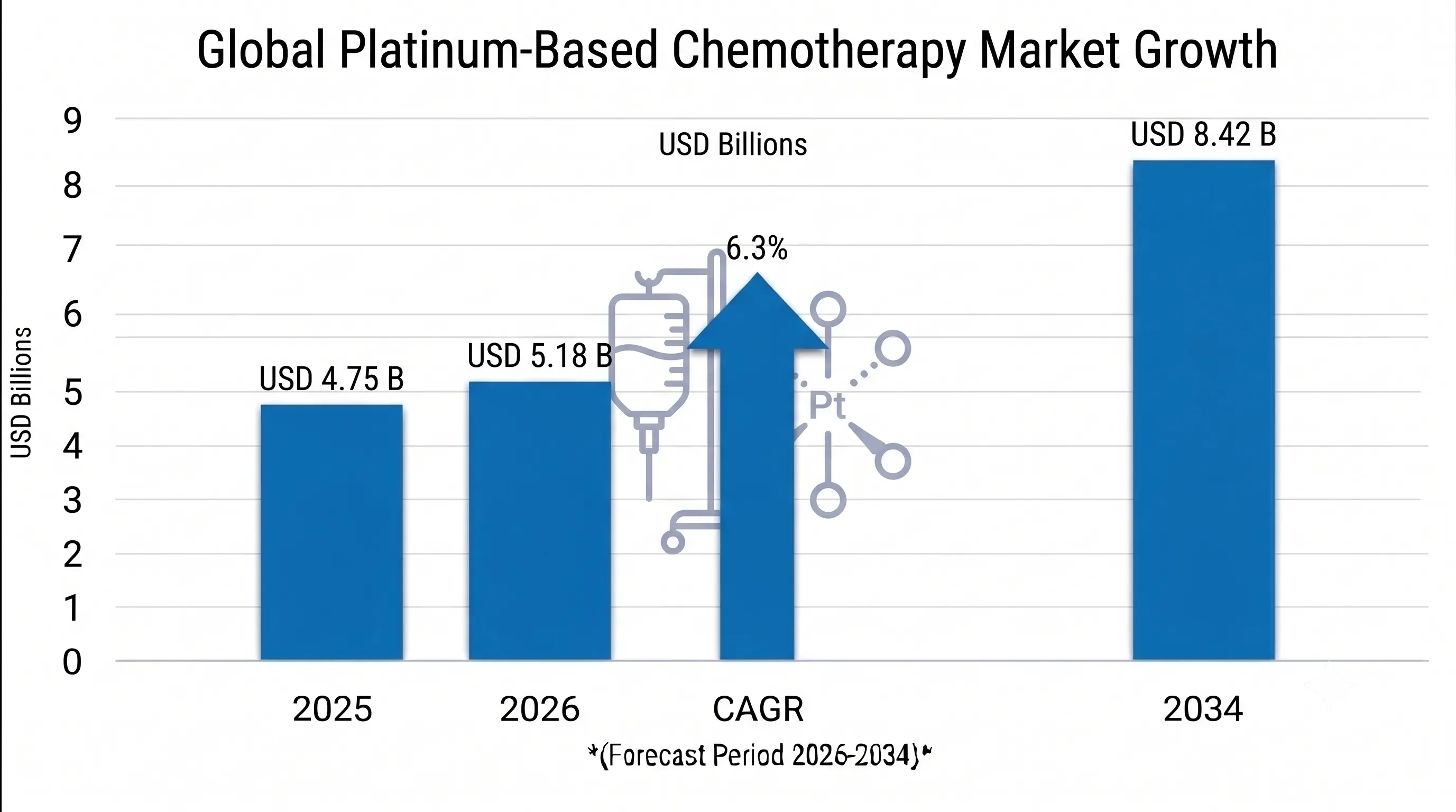
The global platinum-based chemotherapy market size was valued at USD 4.75 billion in 2025 and is projected to reach USD 5.18 billion in 2026, expanding to USD 8.42 billion by 2034, growing at a CAGR of 6.3% during the forecast period (2026-2034).
Platinum-based chemotherapeutics are one of the most clinically proven and mechanistically well understood classes of cytotoxic anticancer drugs, which act by the formation of platinum-DNA adducts leading to intra-strand and inter-strand cross-links, and ultimately to the disruption of the DNA replication and transcription processes, causing cell death by apoptosis in rapidly proliferating malignant cells. The therapeutic class includes agents with different pharmacokinetics, toxicity profiles and tumor activity which influence clinical decision-making in various oncological fields, from curative to palliative combination chemotherapy.
The first compound in this class of drugs, cisplatin, was introduced in 1978 and has set the clinical paradigm for platinum-based therapy and is still used in all curative treatment regimens for testicular cancer, head and neck squamous cell carcinoma, and extensive stage small cell lung cancer where cure rates >95%. Carboplatin was developed as a second-generation platinum analogue with less nephrotoxicity and neurotoxicity than cisplatin but similar activity against cancer, allowing the use of the drug in elderly patients and renal compromise who could otherwise not be treated with cisplatin. Due to its strong activity against colorectal cancer, which is traditionally less responsive to other platinum agents, oxaliplatin became the standard treatment in gastrointestinal malignancies and forms the backbone of FOLFOX and CAPOX regimens. in gastrointestinal malignancies and to the development of FOLFOX and CAPOX worldwide as standard treatments.
Beyond cytotoxic agents, the modern-day relevance of platinum agents is clearly reflected in their current use in combination with immune checkpoint inhibitors, targeted therapy and novel biologics, thereby shifting their status from classic chemotherapy to a crucial part of more complex multi-modal treatment strategies. This has kept these agents relevant in the market despite the competitive pressure from the molecularly targeted therapies, as platinum-induced immunogenic cell death makes the tumor antigen available and creates the environment for the tumor to be responsive to checkpoint inhibitors and their combination with the platinum drugs in premium-priced combinations that yield significantly higher per-patient revenues than the historical platinum-based monotherapy protocols.
| Report Coverage | Details |
|---|---|
| Base Year | 2025 |
| Base Year Value | USD 4.75 Billion |
| Forecast Value | USD 8.42 Billion |
| CAGR | 6.3% |
| Forecast Period | 2025-2034 |
| Historical Data | 2022-2025 |
| Largest Market | North America |
| Fastest Growing Market | Asia Pacific |
| Segments Covered | By Drug Type, Indication, Therapy Type, Line of Therapy, Route of Administration, End-User |
| Region Covered | North America, Europe, Asia Pacific, Middle East & Africa, Latin America |
| Countries Covered | US, Canada, UK, Germany, France, Italy, Spain, China, Japan, India, South Korea, Australia, Brazil, Mexico, UAE, Saudi Arabia, South Africa |
| Key Market Playes | Pfizer Inc., Fresenius Kabi, Teva Pharmaceutical, Accord Healthcare, Sandoz, Sun Pharmaceutical Industries |
Get more details on this report - Request Free Sample
The most important factor behind the development and growth of the platinum-based chemotherapy drug market is the rebranding of such drugs into key elements of treatment alongside immune checkpoint inhibitors. Instead of losing relevance due to new developments and competition with innovative cancer treatment methods, platinum-based drugs have gained importance because of their ability to trigger the phenomenon of immunogenic cell death and increase the chances of treatment success with immunotherapy agents. This is mediated through calreticulin exposure, release of ATP molecules, and HMGB1 protein production.
Clinical data favoring platinum-therapy combinations have changed the treatment landscape for various cancer types, with carboplatin and pembrolizumab combination being the standard of care for non-small cell lung cancers lacking actionable mutations, while cisplatin-nivolumab protocols have defined new standards for head and neck cancers, and platinum-atezolizumab combinations have been proven more effective in urothelial carcinomas. This ensures that there will always be high demand for platinum-chemotherapy due to most patients eligible for immunotherapy also receive platinum-based chemotherapy as well.
The mechanistic synergy not only involves additive effects but includes platinum’s contribution to breaking down immunotherapy resistance by modulating tumor microenvironment, activating DNA damage response pathways, and creating neoantigens which combine to convert immunologically ‘cold’ tumors into ‘hot’ tumors that activate immunity, thus giving room for premium pricing based on significantly increased income per patient compared to traditional chemotherapies.
The primary structural driver of market growth within the market revolves around the rising burden of cancer in the world, with the International Agency for Research on Cancer estimating that cancer would be responsible for 35 million new cases each year by 2050, owing to demographic shifts, lifestyle changes, improved diagnostics in developing countries, and urbanization. Platinum-sensitive cancer types such as lung, colon, ovarian, cervical, bladder, and stomach cancer account for some 8.4 million new cases each year in the world, creating a huge opportunity for platinum-based treatment options.
Lung cancer alone contributes to 2.2 million cases per year around the globe, with the platinum-based combination as the backbone regimen in all different histological and molecular types, whereas the 1.9 million cases of colon and rectal cancers annually result in significant use of oxaliplatin via the FOLFOX and CAPOX regimen in the adjuvant and metastatic settings. The trend towards aging populations in developed countries and increasing accessibility to cancer care services in emerging economies results in dual market growth driven by both volume expansion in low-price regions and value growth in premium combination drugs in wealthy markets.
Chronic nature of most platinum-sensitive malignancies, especially repeated platinum-sensitive recurrences in ovarian cancer patients treated with platinum multiple times during their lifetime, leads to a constant flow of sales irrespective of patient recruitment, with each ovarian cancer patient being exposed to platinum treatment on average more than 8-12 times within 5-7 years of treatment.
The most significant limitation in the growth of the platinum-based chemotherapeutic agents' market is related to the toxicity profile of these drugs with regard to their nephrotoxicity needing high-intensity hydration regimens and limiting the drug doses, their peripheral neurotoxicity causing persistent neuropathic symptoms which affect patients’ quality of life negatively, their ototoxicity resulting in permanent auditory impairment which is a major problem in pediatric patients, and their extreme emetogenicity requiring complex management approaches. These toxicities decrease the number of eligible patients for therapy, limit treatment duration, and foster efforts aimed at finding alternative drugs.
Cumulative sensory neuropathy caused by oxaliplatin is especially challenging, as it affects approximately 85% of patients receiving long treatment and often leads to dose reductions and early drug cessation which can affect clinical outcomes. The irreversible nature of platinum-induced toxicities creates long-term medical and quality of life issues affecting drug choices, especially in older and multimorbid patients.
Significant market potential can be explored by devising innovative delivery systems which solve some of the inherent problems associated with conventional platinum-based drugs by improving the delivery of treatment to target tissues, decreasing toxicity in the body, and increasing therapeutic index. Liposomes, polymeric nanoparticles, and targeted tumor conjugates utilize the increased permeability and retention of tumors to direct the delivery of treatment to tumor sites, minimizing exposure of the body’s vital organs.
The commercial success of liposomal platinum agents demonstrates the potential of this method, which has created niche markets at premium prices in a heavily genericized treatment category. For those companies seeking to develop unique methods of delivery for their existing platinum agents, there is much competitive differentiation that could be gained.
Another significant emerging development is the identification and validation of biomarkers which help identify platinum-sensitive patients and save them from futile toxicity by excluding resistant individuals from receiving unnecessary treatment. Biomarker tests like mutations in the BRCA1/2 gene, Homologous recombination deficiency score, and platinum DNA adduct measurements are becoming clinically relevant for optimal treatment choices.
North America holds the most extensive market share with USD 1.89 billion in revenue in 2025, estimated to lead because of advanced oncology systems, comprehensive insurance coverage allowing access to high-end combination therapies, and fast uptake of platinum immunotherapy treatment methods. The US accounts for 84% of regional revenue, supported by Medicare and commercial reimbursement for combination therapies. for expensive combination therapy treatments, while well-established oncology specialist network allows quick guidelines.
The region is advantaged by clinical trials activities providing real-world evidence favoring platinum combination therapies, supportive care facilities to manage toxicities, and patient advocacy systems promoting access to therapy and quality of life enhancement.
The Asia-Pacific region is the fastest-growing, with an estimated CAGR of 8.7% up to 2034 and will be valued at USD 1.92 billion in 2025. Rapid growth in the region is due to extremely high numbers of cancers due to smoking, infections, and environmental conditions, which contribute to significant numbers of lung, gastric, and hepatocellular carcinomas in addition to fast-growing healthcare facilities.
The Chinese segment accounts for 44% of the regional market value, with 4.8 million patients diagnosed with cancer per year. Meanwhile, India is showing accelerated market growth owing to the growth in healthcare insurance and oncology departments in hospitals. Generic drug manufacturing capabilities in the region also contribute to growth.
Carboplatin is the leading player, representing 37% market share worth USD 1.76 billion in 2025 with 6.8% CAGR during 2025-2034. This dominance is justified by higher tolerability resulting in broader usage of the drug across patients, greater efficacy in lung and ovarian cancers, and its preferred role as a part of immunotherapy protocols.
Oxaliplatin is responsible for 31% market share of USD 1.47 billion in 2025 with a CAGR of 7.2%, based on its role in treatment as a standard care for colorectal cancer patients under the FOLFOX and CAPOX therapy regimes and studies conducted in stomach and pancreatic tumors.
Cisplatin constitutes 26% market share of USD 1.24 billion in 2025 and is relevant due to its use in curative approaches to treating patients with testicular cancer, cervical cancer, and head and neck carcinomas.
The Non-Small Cell Lung Cancer segment holds the largest share with USD 1.71 billion in revenue forecasted by 2025 and a CAGR of 7.1% by 2034 on account of high global incidences, efficacy in platinum-doublet chemotherapy irrespective of histological types, and the compatibility of platinum with immunotherapy to increase the patient pool. The Colorectal Cancer market stands at USD 1.18 billion, owing to the crucial contribution of oxaliplatin to standard regimens.
Hospitals & Cancer Centers account for a 74% market share of USD 3.52 billion due to IV injection requirements, toxicity management, and multidisciplinary patient care required by oncologists. Meanwhile, Specialty Oncology Clinics will have 19% market share with a compound annual growth rate of 7.4%, primarily due to increased efficiency of care delivery.
Platinum chemotherapy drugs are characterized by high fragmentation among generics producers who compete mostly based on price, stability in supply, and quality of production processes. The leading ten producers account for about 48% of worldwide sales; the remaining sales are shared among many regional producers. Differentiation is achieved through supply chain management, compliance with regulations in different regions, development of ready-to-use products, and implementation of effective quality management systems.
March 2026: The Food and Drug Administration (FDA) approved a carboplatin formulation of Fresenius Kabi that is ready to use with prolonged shelf life. This will lower the pharmacy preparation needed and decrease the risk to healthcare providers.
January 2026: Carboplatin-pembrolizumab-pemetrexed regimen demonstrated improved survival rate compared to the current standard doublet treatment in patients with non-squamous non-small cell lung cancer.
November 2025: Oxaliplatin was introduced to the sub-Saharan market as a WHO-prequalified generic drug through international access collaborations by Sun Pharmaceutical Industries.
September 2025: The Debiopharm Group had successful results from its phase II trials with a novel liposomal formulation of cisplatin that was found to have 45% decreased nephrotoxicity while retaining equal efficacy against tumors.
You'll get the sample you asked for by email. Remember to check your spam folder as well. If you have any further questions or require additional assistance, feel free to let us know via-
+1 724 648 0810 +91 976 407 9503 sales@intellectualmarketinsights.com
01 Jul 2026
Intellectual Market Insights Research © 2026. All rights reserved.