Share this link via:

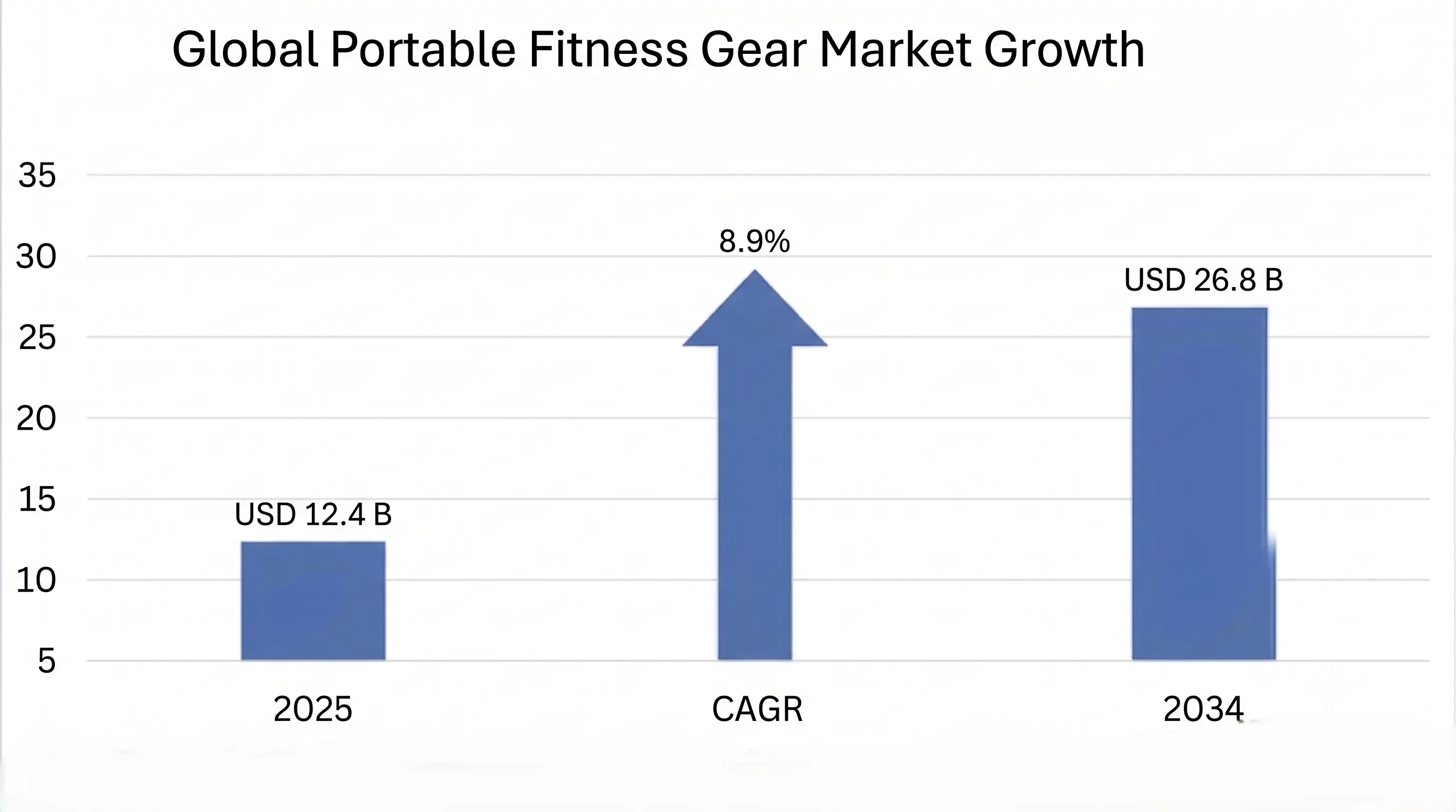
The global portable fitness gear market size was valued at USD 12.4 billion in 2025 and is projected to reach USD 13.5 billion in 2026, expanding to USD 26.8 billion by 2034, growing at a CAGR of 8.9% during the forecast period (2026-2034).
Portable fitness gear is one of the fastest-growing categories of fitness equipment, designed for convenient use at home, offices, hotels, outdoor locations, and while traveling. Such equipment is made highly adaptable and easy to use at homes, in office premises, during business trips, in hotel rooms, or even outdoors without access to the conventional gym facilities. The industry has been transformed from the production of simple items like resistance bands and cardio machines to complex products based on materials, engineering and modern technology.
Modern portable fitness equipment technology is made up of high-performing thermoplastic elastomers with controlled resistance levels, aerospace-quality aluminum alloys that make it possible for the equipment to fold into compact units, specialized EVA foams giving high-performance cushioning, and military-grade hardware enabling full-body weight training using equipment that typically weighs less than three kilograms. It is because of these technological developments that portable equipment can now offer the same stimulus and performance capabilities previously attainable only from stationary commercial gyms.
The commercial environment has expanded far beyond just individual equipment transactions to incorporate complete integration into fitness platforms that include connected workout apps, streaming class subscriptions, customized training plans, and social interaction capabilities that elevate a simple equipment transaction into a relationship in the context of a fitness service. Leading companies have managed to create recurring revenue models using their subscription model digital services which improve the usage of equipment but also create customer loyalty channels, enabling them to charge premium prices. The combination of physical equipment with digital fitness services has attracted major investments from venture capitalists.
Adoption by consumers is aided by the new behavior patterns set by remote working worldwide, with the adoption of hybrid and remote work causing a change in the schedules of millions of knowledge workers globally. This change in scheduling habits allows us to exercise at lunchtime without the need to travel to the gym due to the absence of commuting, enabling an increased use of fitness equipment that makes investing in good portable equipment worthwhile. Exercise snack sessions for 10-15 minutes at work have become the key use case for purchase of portable equipment.
| Report Coverage | Details |
|---|---|
| Base Year | 2025 |
| Base Year Value | USD 12.4 Billion |
| Forecast Value | USD 26.8 Billion |
| CAGR | 8.9% |
| Forecast Period | 2025-2034 |
| Historical Data | 2022-2025 |
| Largest Market | North America |
| Fastest Growing Market | Asia Pacific |
| Segments Covered | By Product Type, Technology Level, Portability Level, Application, Distribution Channel, End-User |
| Region Covered | North America, Europe, Asia Pacific, Middle East & Africa, Latin America |
| Countries Covered | US, Canada, Mexico, UK, Germany, France, Italy, Spain, China, Japan, India, Australia, South Korea, Brazil, UAE, Saudi Arabia, South Africa |
| Key Market Playes | TRX Training, Bowflex, Therabody, Rogue Fitness, Hyperice, Gaiam, Lululemon Athletica, Decathlon, WOD Nation, Crossrope |
Get more details on this report - Request Free Sample
The significant driver behind the growth in the market for portable fitness equipment is the permanency of hybrid and remote work that has effectively decentralized consumers' everyday routines and upended the old-fashioned model of gym attendance. Given that nearly half of all office employees (45%) operate in hybrid or remote setups by 2025, the demand for compact fitness solutions that fit easily in homes has been steadily increasing, even past the initial need for such items to meet the urgent demands brought about by the pandemic crisis.
“Exercise snacking” is made possible by portable fitness equipment in which people can take up workout sessions lasting around 10-15 minutes between their workdays, including virtual meeting times and even their lunch break. This behavior has shown its sustainability especially among the working population who care about saving time and mobility. With the help of portability, people can continue their fitness program even when traveling.
The swift convergence of the Internet of Things technology and small sensors within analog fitness equipment constitutes a significant growth drive since it enables the connection between scientific research used in professional sports and fitness devices aimed at consumers. Indeed, smart wearable equipment can turn subjective training sessions into objective ones by monitoring user performance and offering customized training programs.
Products such as smart jump ropes can monitor rotation speed and estimate calorie expenditure, fitness bands that measure exact output of force and velocity of movement, and suspension devices fitted with load sensors allow users access to detailed metrics that were once limited to expensive biomechanical labs. This technological development overcomes the traditional drawback of portable equipment in terms of recording progress in overload.
The integration of AI-powered mobile applications with smart portable devices results in customized exercise routines where the machine recommends the level of resistance according to past data from users' performance. Gamification and data visualization contribute to increased user engagement and adherence levels, allowing for the implementation of high prices in such equipment versions.
The most significant constraint affecting the growth of the premium portable fitness gear market is product quality inconsistency., which prevails throughout the segment of products but especially in online stores, where the market is flooded by cheap products that break down when subjected to heavy load, pose serious health hazards, and do not provide an adequate level of resistance for exercising due to false specifications. Examples of such limitations include resistance bands breaking off at heavy loads, foam rollers of uneven density, and failing suspension trainer parts.
This is further complicated by the fact that it is hard for consumers to differentiate between good products and their poor counterparts when it comes to buying online since advanced marketing skills and photography have made it easy for poor-quality manufacturers to market their products along the lines of their premium counterparts at reduced costs.
Proliferation of counterfeit products, white-labeled products, and poor-quality portable fitness equipment on mainstream e-commerce sites is a huge impediment to market growth and profitability of brands. Given the relatively straightforward nature of the design for resistance bands, suspension trainers, and portable cardio machines, barriers to entry for manufacturers with cost-cutting mindsets continue to be very low, leading to an oversaturation of the market with poor quality imitation products.
They weaken the market share and pricing capabilities of the established companies as well as pose safety issues that tarnish the reputation of the whole industry. It becomes necessary for premium brands to invest large amounts of money in protecting their brand, filing patent lawsuits, and educating consumers about safe versus harmful products.
Unexploited business opportunities abound in the B2B segment in areas such as employer wellness programs, hotel fitness programs, and even institutional fitness sales. Wellness programs are now being introduced by employers that involve home or office kits for physical activity, hotels have improved their facilities by providing individual room workouts instead of just gym memberships, and institutions are focusing on portable training kits.
Corporate procurement offers many opportunities for recurring income from its ability to provide portable devices to a sizable number of people who can then buy products and subscribe. Premium pricing is also made possible by the B2B channel because of volume discounts and services included.
Many possibilities arise for creating hybrid physical and digital services combining equipment purchases and training via apps and progressive programs with community aspects, making both regular revenues from subscriptions and one-off revenues from equipment sales. Personalized data analysis through tailored programs aimed at travelers, patients with certain illnesses, or even specific sports provides differentiation in crowded markets.
Opportunities for subscription services are present in complete fitness ecosystems where portable equipment can be used as the device layer in more extensive wellness ecosystems that include nutrition counseling, recovery routines, and other challenges aimed at delivering high lifetime value to customers.
The disruptive trend that affects the evolution of fitness accessories is the incorporation of Extended Reality into gamified fitness systems. With the growing availability and lightness of VR/AR headsets, fitness application software companies are joining hands with makers of wearable technology accessories for providing engaging exercise experiences. Smart bands and Bluetooth-enabled devices act as haptic controllers in virtual exercise apps that turn common home exercises into interactive games such as boxing, rowing, and rhythm fighting games.
This paradigm shift has a major impact on the psychology behind home-based workouts because now people must think about exercising through entertainment rather than through physical strain, which leads to more often and prolonged periods of workouts in categories where it is usually difficult to stick to a routine of exercise.
The market for wearable exercise equipment is seeing increasing pressure to produce sustainable, recyclable, and environmentally friendly exercise equipment. Environmentally conscious buyers will make decisions based on buying parameters that go beyond performance aspects to consider the environmental impact of the materials used, production, and how these products can be disposed of after use. This includes natural rubber resistance bands produced by sustainable plantations, yoga mats made from oceanic recycled plastics, and foam rollers made with natural materials.
Top companies are adopting environmental impact statements, becoming B Corporations, and offering product takebacks, all of which demonstrate their sustainability commitments and generate customer engagement opportunities apart from making their first purchase. The sustainability trend seems to be especially prevalent among millennials and Gen Z populations, which are considered main sources of potential future growth in the market and willing to pay extra money for eco-friendly goods.
The North American region led the regional share with USD 5.1 billion in 2025, while the expected growth of 8.2% CAGR would be maintained till 2034. This dominance is attributed to the presence of well-developed fitness culture, increased disposable income levels resulting in acceptance of luxury goods, and an advanced form of DTC e-commerce framework helping brands to develop efficiently. It is important to note that the United States alone dominates the regional market value with a share of nearly 79%, wherein portable fitness equipment sees widespread acceptance due to space crunch and time-constrained lifestyles.
North America represents the most highly developed integration between portable fitness gadgets and digital technologies, training services, and devices. This allows for the introduction of premium prices on devices, which enjoy an additional 40 to 65 percent compared to regular ones. This market includes most brands in portable fitness equipment and is known to introduce innovative business strategies that later were replicated by foreign rivals.
Asia-Pacific is the fastest-growing regional market at a rate of 10.5% CAGR during the forecast period, valued at USD 3.2 billion in 2025. The expansion in the regional market can be attributed to the growth in urban areas, which have limited spaces for having home gym equipment, growth in middle-class people who are increasingly health-conscious, and fitness culture awareness.
China is leading in terms of regional growth by holding a 38% market share owing to government initiatives on health that encourage people to exercise, increasing influence of fitness influencers, and an appreciation for premium products among urban professionals. On the other hand, India is showing the best growth trend among all regions at 15.8% CAGR.
The region is well-placed to serve as the center of the world's manufacturing sector for fitness equipment since the brands based here can provide their consumers with high quality but affordable fitness equipment. This trend is likely to be driven by the prevalence of mobile-first consumers and the increasing popularity of localized fitness apps.
Resistance Bands and Tubes have the highest market share, accounting for 34% and having a market valuation of USD 4.2 billion in 2025 and will exhibit a CAGR of 8.5% through 2034. The advantages of Resistance Bands and Tubes include their excellent versatility, which allows training of the upper, lower, and entire body through one product; their extreme portability that allows them to be stored in small spaces; their ability to provide different levels of resistance suitable for all users; and their affordable price tags. High-end resistance bands cost USD 45-85 while low-cost resistance bands cost USD 8-15.
Adjustable Dumbbells and Kettlebells are the fastest-growing category, recording a CAGR of 11.2%, to reach USD 2.8 billion by 2025, fueled by the demand for the inclusion of traditional free weight training in compact and space-efficient designs. The advanced system of adjustable weights that includes the quick-adjust feature and digital selection has completely transformed home fitness training with dumbbell rack capability.
Foam Rollers & Recovery Tools contributed USD 2.1 billion in revenue in 2025 with 13.4% CAGR, based on growing awareness among consumers about the significance of recovery for consistent training and safety from injuries, endorsements of professional athletes in making investments in recovery tools, and increasing complexity in products such as vibrating foam rollers.
Smart/IoT-Enabled Equipment, with 28% market share, shows the highest growth rate of 15.6% CAGR up until 2034. Modern consumers look for data-driven training and customization features in their workouts. Smart devices help to track all training results, provide necessary adjustments and feedback, thus enabling expensive pricing along with subscription possibilities via additional apps.
Traditional/Non-Connected Equipment accounts for approximately 72% of the market share owing to its affordability and wider availability, but slowly but steadily falls behind its connected competition in premium categories owing to better performance experience and tracking capabilities.
Online channels account for a commanding 54% share worth USD 6.7 billion in 2025, thanks to their intrinsic link to portable fitness equipment through fitness content viewing, easy access via deliveries to one’s doorstep, and price competitiveness favoring good brands that have positive reviews from consumers. Online channels make possible the development of consumer brands and subscription selling techniques, both of which enhance customer lifetime value.
The Specialty Sports and Fitness Stores represent 22% market share, reaching out to customers require touch-and-feel experience while making their buying decisions, especially in high-end products where the material used and the structure of the product determine success or failure. This distribution channel is crucial in establishing the necessary credibility through education.
This industry is characterized by high fragmentation, with several hundred companies operating in various product segments and different price points. The top ten companies account for around 28-34% of total market value. Competitive advantage in the industry revolves around product innovation and quality of materials used, integration with digital platforms and content creation, sustainability and ethical manufacturing, community building, and optimizing channels.
The biggest players are working hard on developing their technology and securing patents. They are creating complete eco-systems for fitness which consist of a combination of hardware and software solutions. Brand building by means of collaboration with influencers and professional athletes has become crucial in capturing market share.
April 2026: TRX introduced a new version of their suspension training system that featured the latest technology in terms of connected devices and sensors with Bluetooth compatibility to provide instant feedback on users’ form. This technology came equipped with a new mobile app and was targeted at the premium fitness segment, being sold for USD 249.
March 2026: Therabody added a new percussive massage device weighing just 380 grams to its portable recovery line of products and signed up 14 pro-sports organizations as partners.
February 2026: Lululemon Athletica acquired a portable strength-training company for USD 155 million, securing its own adjustable resistance system and consumer direct business to supplement its own yoga and accessory business offerings.
January 2026: The brand Bowflex unveiled the new voice-controlled kettlebell, suitable for small apartment living, using a digital control system allowing for quick weight adjustments and targeting consumers in major Asian and European cities.
December 2025: Crossrope unveiled the new “Adaptive Jump” fitness app which uses artificial intelligence to create high-intensity interval training workouts tailored to your current heart rate and fatigue levels.
You'll get the sample you asked for by email. Remember to check your spam folder as well. If you have any further questions or require additional assistance, feel free to let us know via-
+1 724 648 0810 +91 976 407 9503 sales@intellectualmarketinsights.com
01 Jul 2026
Intellectual Market Insights Research © 2026. All rights reserved.