Share this link via:

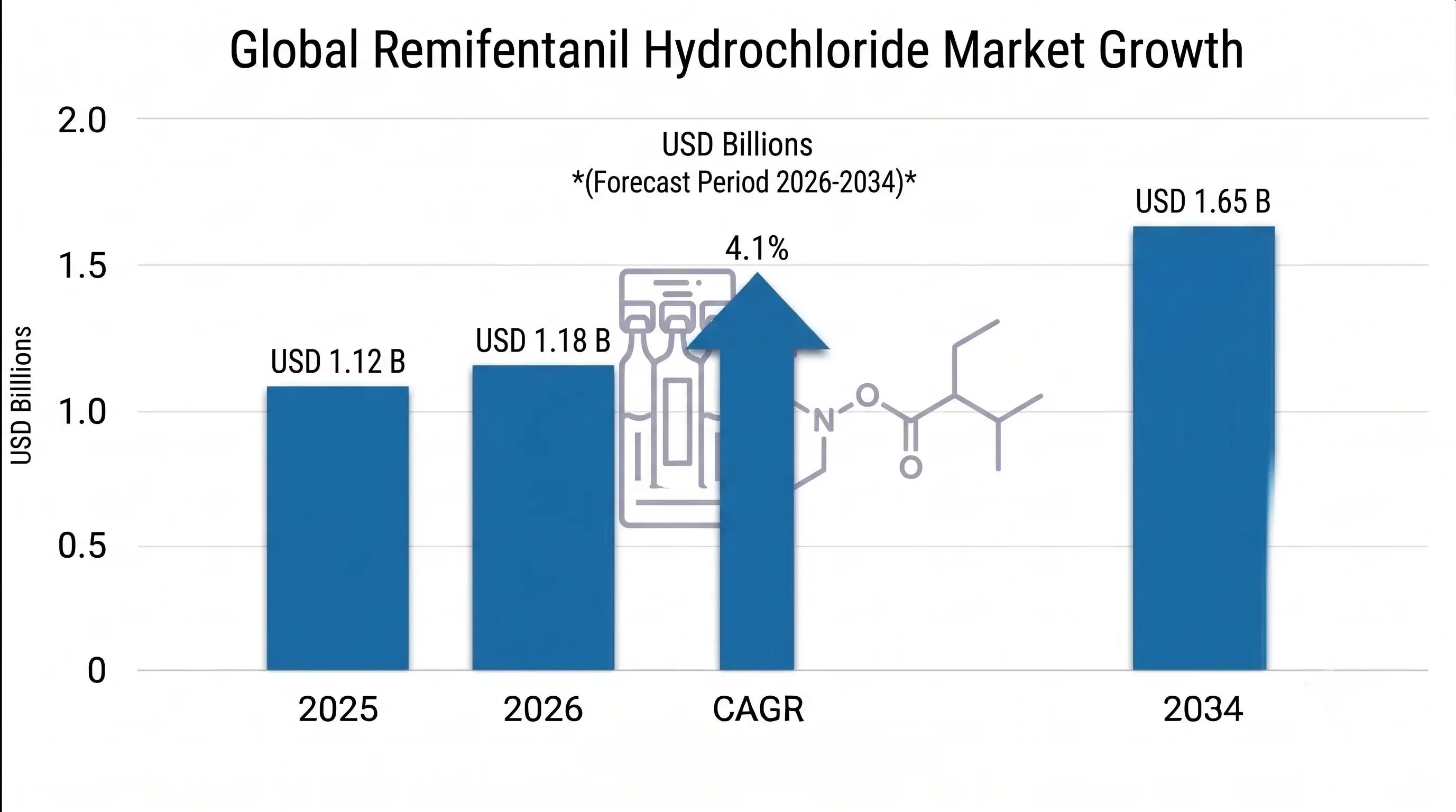
The global remifentanil hydrochloride market size was valued at USD 1.12 billion in 2025 and is projected to reach USD 1.18 billion in 2026, expanding to USD 1.65 billion by 2034, growing at a CAGR of 4.1% during the forecast period (2026-2034).
Remifentanil hydrochloride is a revolutionary ultra-short-acting synthetic opioid analgesic with an unparalleled pharmacokinetic profile, which differentiates it from all other clinically available opioids. The compound is classified into the chemical class 4-anilidopiperidine, and it has a unique ester linkage in its molecular structure that is highly susceptible to rapid hydrolysis by non-specific blood and tissue esterases. It is a metabolic pathway that does not involve hepatic cytochrome P450 enzyme systems, renal elimination processes, or plasma choline-stream activity, and hence has consistent and predictable pharmacokinetic characteristics in patients with extremely wide variations in age, hepatic disease, and renal disease, including those severely affected.
Remifentanil's context-insensitive half-life (3-10 minutes), which means that it is not affected by the duration of the infusion, is what sets it apart from other opioids, which have a clinical duration that increases over time as the infusion is continued. This allows precise analgesic depth to be attained by adjusting the infusion rate in real time, with predictable effects and offset of the infusion allowing rapid changeovers between the different intensities of surgical stimulation without residual sedation or respiratory depression affecting the patient's recovery after surgery.
Current uses include intraoperative analgesia as part of total intravenous anesthesia, intensive care unit sedation with the use of analgesia-first approach and rapid recovery (daily neurological examination), procedural sedation for painful procedures like diagnostic and therapeutic procedures, labor analgesia with patient-controlled intravenous analgesia as an option to neuraxial procedures, and specifically in awake craniotomy procedures, where precise control of analgesia allows patient cooperation during the mapping of the cortex.
The commercial landscape is mainly defined by generic formulations. after patent expiration of the original innovator product and price competition. The commercial landscape is mainly defined by generic formulations.The commercial landscape is characterized by intense price competition following the expiry of innovator patents. and increased global access, as generic formulations follow the expiry of the original innovator product patents. Market growth is driven by rising surgical volumes, the expansion of Enhanced Recovery After Surgery (ERAS) protocols, the growth of ambulatory surgical centers, and advances in target-controlled infusion technology. of ambulatory surgical centers and advances in target-controlled infusion technology, which improves the precision of remifentanil delivery.
| Report Coverage | Details |
|---|---|
| Base Year | 2025 |
| Base Year Value | USD 1.12 Billion |
| Forecast Value | USD 1.65 Billion |
| CAGR | 4.1% |
| Forecast Period | 2025-2034 |
| Historical Data | 2022-2025 |
| Largest Market | North America |
| Fastest Growing Market | Asia Pacific |
| Segments Covered | By Product Form, Application, End-User, Distribution Channel |
| Region Covered | North America, Europe, Asia Pacific, Middle East & Africa, Latin America |
| Countries Covered | US, Canada, Mexico, UK, Germany, France, Italy, Spain, Netherlands, China, Japan, India, Australia, South Korea, Brazil, Argentina, UAE, Saudi Arabia, South Africa |
| Key Market Playes | Pfizer Inc., Fresenius Kabi AG, Hikma Pharmaceuticals, Teva Pharmaceutical Industries, Mylan/Viatris, Aspen Pharmacare |
Get more details on this report - Request Free Sample
Growth of the remifentanil hydrochloride market is largely attributed to the growth in numbers of surgeries around the world, which is caused by aging populations, rising incidence of chronic diseases that can be treated only surgically, better health care availability in developing countries, and advanced technology allowing performing surgeries on more complicated cases. The number of surgeries worldwide surpassed 320 million in 2025 and increased at about 3.5% per year especially among high-risk surgeries such as cardiovascular, neurological, and abdominal surgeries.
Enhanced Recovery After Surgery protocols have gained popularity in all important surgical disciplines because they include the use of remifentanil-based total intravenous anesthesia as an optimal option thanks to the proven benefits in extubating time, decreased postoperative nausea and vomiting, early ambulation, and shorter hospitalization periods. This reduces overall healthcare costs despite the higher acquisition cost of remifentanil compared with conventional opioids.; hence, remifentanil is considered for inclusion in the formulary list.
Geriatric surgeries have some unique features where the use of remifentanil is beneficial, because this drug does not rely on hepatic or renal metabolism., which makes it safe from the risk of prolonged sedation or respiratory depression in the patients with compromised pharmacodynamics. The use of remifentanil during geriatric surgeries increased by 6.2% each year from 2020-2025.
A revolutionary force that has expanded remifentanil use beyond the operating room. is the implementation of analgesia-first sedation in intensive care units around the world. The modern practice of critical care suggests that pain should be addressed first to avoid oversedation-related complications like long-term mechanical ventilation, intensive care unit-acquired weakness, delirium, and cognitive impairment. It means that opioids should be used as a base for intensive care unit sedation, adding the sedative drugs only if analgesia does not work.
The pharmacodynamic characteristics of remifentanil provide an advantage over other opioids like morphine, fentanyl, and hydromorphone, which accumulate with prolongation of infusion in terms of the possibility of rapid assessment of the neurological state without sedation offset. Studies show that remifentanil-based analgesia-first protocol reduces mechanical ventilation by 1.5-2.3 days and shortens intensive care unit stay along with improvement of patient comfort score.
The structural shift from hospital inpatient settings to ambulatory surgical centers represents a fundamental healthcare delivery transformation driven by cost reduction needs, patient convenience preferences, and infection minimization strategies. This migration creates operational requirements for rapid patient turnover and predictable recovery times that align perfectly with remifentanil’s pharmacokinetic profile enabling fast-track anesthesia protocols.
Remifentanil facilitates total intravenous anesthesia regimens where patients regain airway reflexes and cognitive function within minutes of infusion discontinuation, bypassing prolonged grogginess associated with volatile anesthetics and longer-acting opioids. This enables rapid discharge from post-anesthesia care units, optimizing throughput in high-volume surgical centers where operational efficiency directly impacts profitability.
The primary limitation faced by the remifentanil market is that the drug has been listed as a Schedule II controlled drug around the world, making it liable to tight regulations such as production quotas, manufacturing security supply chain tracking, and dispensing regulations. In addition to the wider regulatory landscape in response to the global opioid epidemic, all opioid analgesics have come under increased scrutiny, even those used solely for hospitals and having low abuse risk.
Production quotas from the Drug Enforcement Administration and similar quotas in other countries can lead to shortages which will affect hospitals and hinder the market growth of remifentanil. The burden of regulation faced by hospitals in terms of tracking, storing, and distributing remifentanil presents a problem for small hospitals without controlled substances capabilities.
The high potency and ultra-short half-life of remifentanil cause clinically relevant cases of opioid-induced hyperalgesia and acute opioid tolerance High doses or prolonged infusions may induce opioid-induced hyperalgesia by activating NMDA receptors, resulting in increased postoperative pain sensitivity. of pain pathways by activating the N-methyl-D-aspartate receptors leading to postoperative increase in sensitivity to pain and need for higher amounts of analgesics just after stopping the infusion.
Poor handling of opioid-induced hyperalgesia associated with remifentanil might result in postoperative pain complaints from patients and even increase in hospitalization time, which is why some practitioners would rather use an intermediate-acting opioid during surgery likely to have postoperative pain consequently.
A significant market opportunity lies in the increasing off-label use of remifentanil in labor analgesia using patient-controlled IV analgesia techniques. Though epidural analgesia remains the gold standard for relieving labor pain it is contraindicated in individuals having coagulopathy, thrombocytopenia, or spine disorders. In such cases, remifentanil administration through patient-controlled systems has become a very effective and safe alternative.
Remifentanil readily crosses the placenta; however, it is rapidly metabolized by fetal esterases. by fetal esterases, avoiding significant respiratory depression among the newborn compared to the systemic opioids. Its ultra-short half-life allows the self-administration of doses by the mother in conjunction with the uterine contractions without accumulating the drug in maternal and fetal body. Studies have shown high levels of maternal satisfaction above 85%.
Pediatric anesthesia is an area that has huge potential for expansion as the metabolic independence of remifentanil gives special benefits in neonatal and pediatric patients who have immature enzyme systems in their liver and varied kidney functions, which makes conventional opioids unpredictable pharmacologically. Fentanyl and morphine clearance is very variable in neonates because of their immature cytochrome P450 system, while clearance of remifentanil through plasma esterases is relatively stable.
Neonatal intensive care applications like procedural sedation, post-operative analgesia after major surgeries, and sedation for mechanical ventilation are some examples of expanding applications where remifentanil’s predictability is beneficial over conventional opioids with unpredictable pharmacokinetics in pediatrics.
The extensive use of target-controlled infusion technology is a major trend impacting remifentanil usage practices. Target-controlled infusion devices employ pharmacokinetic models, such as the Minto model, which is developed especially for remifentanil, to accurately compute infusion rates needed to obtain certain levels of concentration of the drug in patient blood and brain tissue.
This technology enables anesthesiologists to administer precise infusions. without any need to manually calculate it. It allows the precise regulation of the analgesic depth taking into account individual patient factors like age, weight, height, and gender. Due to this fact, the combination of the fast kinetic properties of remifentanil with target-controlled infusion is changing total intravenous anesthesia for better.
North America has the biggest market share with USD 432.8 million in 2025 while retaining its CAGR at 3.8% until 2034. The region’s leading position is attributed to one of the world’s highest per-capita surgical volumes., advanced infrastructure for anesthetic practices with a wide use of TCI, and implementation of the entire enhanced recovery after surgery protocol within hospitals. The U.S. accounts for 88% of the region’s market value.
Existing reimbursement systems include the cost of anesthetic agents in bundled pricing for procedures, hence providing motivation to embrace protocols that use remifentanil since they are safer and shorter in length of stay. The increase in utilization is evidenced by the rising trend of ambulatory surgery centers doing more complex procedures.
Asia Pacific is the fastest-growing regional market of 6.5% during the period till 2034, valued at USD 224.7 million in 2025. Market development in the region is due to the increase in the infrastructure for surgeries in China and India, the rising number of anesthesiologists skilled in advanced procedures, rising healthcare spending on advanced anesthesia drugs, and healthcare reforms by governments that facilitate increased surgeries for previously underdeveloped areas.
China accounts for 44% of the regional market value as modernization of healthcare facilities drives the adoption of advanced anesthesia practices in its tertiary hospitals. Japan is well ahead in terms of sophisticated anesthesia practices with high usage of total intravenous anesthesia procedures, whereas India witnesses a fast pace of growth in this area due to the private hospital segment.
The Lyophilized Powder for Injection segment holds a dominant market share of 74%, worth USD 828.8 million in 2025 and increasing at a CAGR of 3.9% till 2034. This dosage form is the standard commercial product that requires reconstitution before use due to its superior stability during storage and transport but still retains all its clinical applications. The segment gains advantage from well-established clinical knowledge of usage as well as full compatibility with intravenous administration equipment.
The Ready-to-Use Solutions segment accounts for a 26% market share., worth USD 291.2 million in 2025, and will grow at a CAGR of 4.8%. It is the faster-growing segment owing to the preference of healthcare systems to reduce medication errors, decrease pharmacy compounding burden, and improve workflow in high-turnover surgical settings.
General Anesthesia is the largest application segment., with a market share of 58%, which is expected to be worth USD 649.6 million by 2025 and includes intraoperative analgesic usage in various types of surgeries, where remifentanil acts as an opioid part of total intravenous anesthesia or balanced anesthesia techniques. Intensive Care Unit Sedation holds the second-largest market share of 22% worth USD 246.4 million with CAGR of 5.8%, which will grow faster than others because of rising popularity of analgesia first approaches.
Monitored Anesthesia Care forms a 12% market share worth USD 134.4 million and covers procedural sedation in endoscopy, interventional radiology, and emergency departments. Labor Analgesia is another significant application. with 5% market share growing as an alternative to neuraxial techniques in contraindicated cases.
Hospitals and Surgical Centers account for a 68% market share. worth USD 761.6 million in 2025, covering the main sites of remifentanil consumption across intraoperative and intensive care use. Academic Medical Centers cover 19% market share valued at USD 212.8 million and function as development centers for sophisticated total intravenous anesthesia methods as well as educational platforms for anesthesiology residents.
Ambulatory Surgical Centers hold 10% market share estimated at USD 112 million and 6.2% CAGR, making it the fastest-growing end-user segment due to the shift of complex procedures into outpatient facilities where fast recovery properties of remifentanil help achieve operational efficiency allowing the patients to leave the hospitals on the same day.
The market for remifentanil hydrochloride is moderately fragmented as patents have expired in major markets, and competition is driven by quality, reliable supply, and pricing. The leading players account for about 70% of the market volume with competition being based on predictability of pharmacokinetics from batch to batch, avoidance of drug shortages, and adherence to regulations in different jurisdictions.
Strategic actions include expansion of capacity to support growing demand, entering into supply agreements with hospital group purchasing organizations, and producing formulations with added value such as ready-to-use preparations and improved packaging. Firms that have been able to maintain supply during previous drug shortages have developed sustainable competitive advantage through their hospital connections and placement in the formulary list.
June 2026: Fresenius Kabi received FDA approval for a ready-to-use remifentanil solution. in standard concentrations without having to reconstitute the solution, which received favorable reviews from hospital pharmacy directors because of improved medication safety.
April 2026: The European Society of Anesthesiology issued guidelines on perioperative pain management and recommended remifentanil as the preferred choice of opioid for total intravenous anesthesia in enhanced recovery pathways within surgical disciplines.
February 2026: Hikma Pharmaceuticals launched a pre-filled syringe formulation in selected European countries. with the goal of saving time and minimizing dosing errors arising from reconstitution of lyophilized powders.
December 2025: Pfizer rolled out an improved barcoding and serialization packaging for remifentanil vials to improve tracking ability to help hospitals with their controlled substance compliance.
October 2025: Teva Pharmaceuticals won multi-year procurement contracts in China, enabling its penetration into the Asia Pacific market share.
You'll get the sample you asked for by email. Remember to check your spam folder as well. If you have any further questions or require additional assistance, feel free to let us know via-
+1 724 648 0810 +91 976 407 9503 sales@intellectualmarketinsights.com
02 Jul 2026
Intellectual Market Insights Research © 2026. All rights reserved.


