Share this link via:

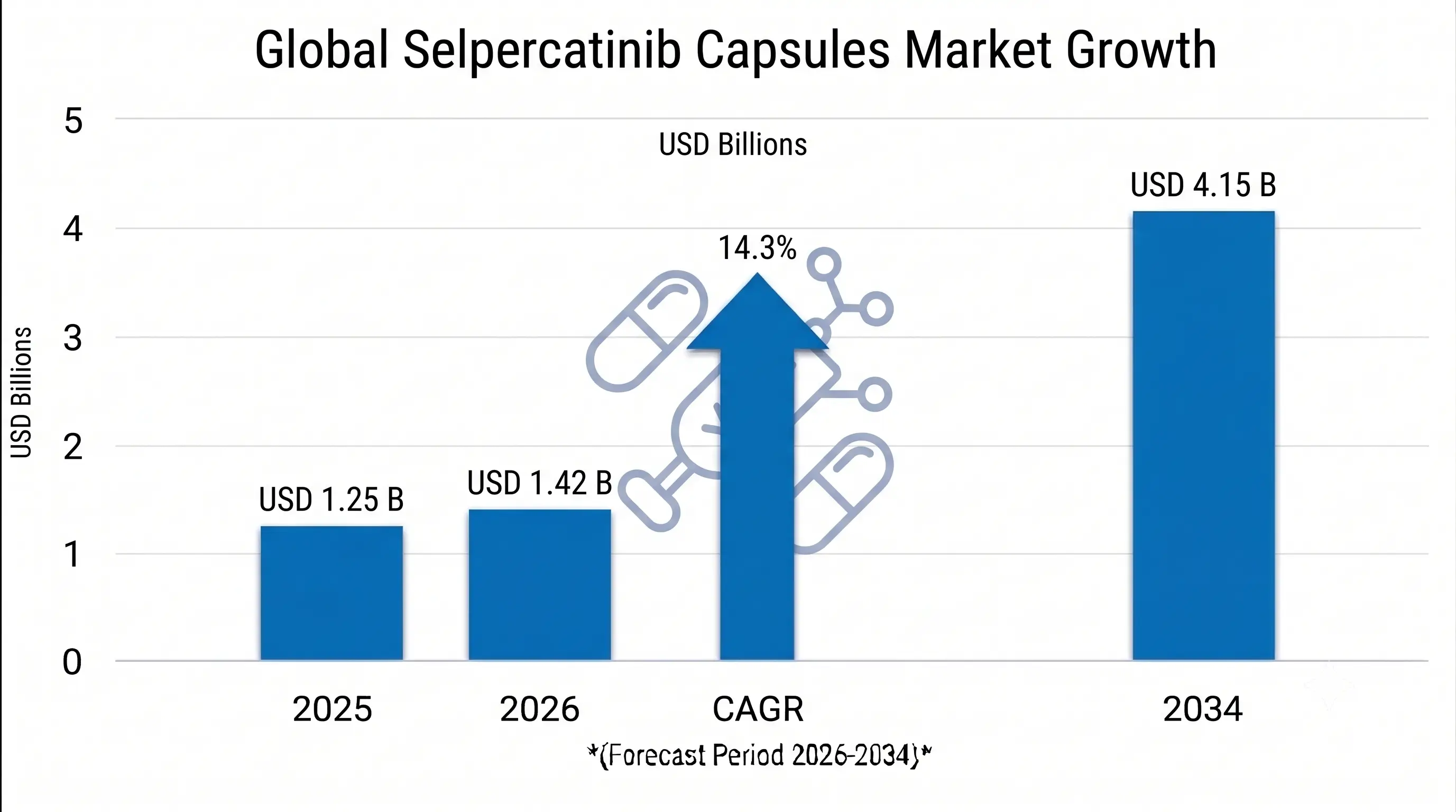
The global selpercatinib capsules market size was valued at USD 1.25 billion in 2025 and is projected to reach USD 1.42 billion in 2026, expanding to USD 4.15 billion by 2034, growing at a CAGR of 14.3% during the forecast period (2026-2034).
Selpercatinib (known as Retevmo in the United States and Retsevmo in Europe) is a highly selective RET kinase inhibitor that has revolutionized RET-driven cancer treatment. Selpercatinib was designed to bind to oncogenic change in the RET proto-oncogene and has low off-target activity, which a hallmark of the drug developed by Loxo Oncology.Selpercatinib was designed to target the oncogenic alteration of the RET proto-oncogene with low off-target activity, and a hallmark of the drug developed by Loxo Oncology. This precision design seeks to overcome the broad toxicity that has been seen with previous multikinase inhibitors (MKIs), such as cabozantinib and vandetanib, which were linked with broader toxicity profiles and sub-optimal RET inhibition.
The drug is highly active against both wild-type and a large panel of RET resistance mutations including gatekeeper and solvent-front mutations. It is effective against RET fusion-positive tumors with fusion partners including KIF5B, CCDC6 and NCOA4, typically seen in non-small cell lung cancer (NSCLC), and targets RET mutations found in medullary thyroid cancer and differentiated thyroid cancer. Selpercatinib is a selective RET inhibitor that helps to stop tumor growth and can lead to long-lasting clinical responses in several types of cancer.
Clinical success was demonstrated in the LIBRETTO-001 trial, which showed an overall response rate between 64% and 85% in patients with RET-altered malignancies, including heavily pretreated patients. The results were much better than historical outcomes with traditional therapies, making selpercatinib an attractive therapy for RET-driven cancers.
In addition to drug sales, selpercatinib enables a more extensive precision oncology ecosystem, such as companion diagnostic testing programs, next-generation sequencing diagnostics, molecular tumor boards and specialized patient identification programs. Selpercatinib targets a niche, but commercially significant area of the global targeted oncology market, as it is targeting approximately 1-2% of NSCLC and a significant percentage of thyroid cancers.
| Report Coverage | Details |
|---|---|
| Base Year | 2025 |
| Base Year Value | USD 1.25 Billion |
| Forecast Value | USD 4.15 Billion |
| CAGR | 14.3% |
| Forecast Period | 2025-2034 |
| Historical Data | 2022-2025 |
| Largest Market | North America |
| Fastest Growing Market | Asia Pacific |
| Segments Covered | By Indication, Patient Type, Line of Therapy, Dosage Strength, Distribution Channel, End-User |
| Region Covered | North America, Europe, Asia Pacific, Middle East & Africa, Latin America |
| Countries Covered | US, Canada, Mexico, UK, Germany, France, Italy, Spain, Netherlands, China, Japan, India, Australia, South Korea, Brazil, Argentina, UAE, Saudi Arabia, South Africa |
| Key Market Playes | Eli Lilly and Company, Blueprint Medicines Corporation, Foundation Medicine, Illumina Inc., Thermo Fisher Scientific |
Get more details on this report - Request Free Sample
The growth of the use of comprehensive genomic profiling and next generation sequencing (NGS) technologies is an important factor driving the selpercatinib market. Due to the increasing shift of cancer treatments from histology-based treatment to personalized treatment, molecular testing for identifying targeted genetic alterations is becoming a routine process. This, in turn, has increased the number of potential patients who can be treated with selpercatinib.
Recommendations from leading oncology societies recommend comprehensive molecular profiling on individuals with advanced non-small cell lung cancers and selected thyroid cancers; thus, RET tests have become an integral part of the diagnostic workflow for such patients. With increasing RET test rates at oncology institutions both in academic and community settings, the number of RET-positive patients receiving the treatment is growing.
Availability of cutting-edge companion diagnostics adds to positive market dynamics. Modern technologies of next-generation sequencing allow for the detection of RET mutations in both tissue and liquid biopsies in an accurate manner, thus ensuring the timely identification of patients. Moreover, circulating tumor DNA liquid biopsies allow for monitoring the response of treatment and development of resistance mutations. Taken together, increasing testing capacity, awareness of RET-driven cancers, and availability of companion diagnostics create favorable market dynamics.
The market potential of selpercatinib has been significantly boosted by its strong clinical data package generated through the extensive LIBRETTO clinical development program, which comprises the pivotal basket study LIBRETTO-001, the first-line lung cancer randomized study LIBRETTO-431, and the first-line medullary thyroid cancer study LIBRETTO-531. Overall, it can be noted that such clinical trials allowed for positioning selpercatinib as one of the best-studied and clinically validated RET inhibitors with superiority to standard treatments in terms of efficacy and tolerability.
The LIBRETTO-431 trial was an important milestone where the superiority of selpercatinib compared to conventional platinum-based chemotherapy either alone or in combination with pembrolizumab in the first line setting of RET fusion-positive non-small cell lung cancer was shown with progression-free survival of 24.8 months versus 11.2 months observed in the control group. It is important that this regulatory milestone greatly increased the size of the patient population by including in the study treatment naïve patients who had prior experience with conventional chemotherapy or immunotherapy before the start of RET-directed therapy.
The existing clinical data indicates the objective response rates of 84% in treatment naïve RET fusion-positive non-small cell lung cancer patients, indicating selpercatinib among the top targeted therapies in lung cancer with duration of response exceeding 20 months in the first line setting. Importantly, central nervous system activity is an important distinction of the drug where 85% of patients with brain metastases at baseline achieved intracranial response. The importance of the latter should not be overlooked, as central nervous system involvement occurs in up to 50% of patients with RET-positive lung cancer.
The main limitation associated with the limited market expansion of selpercatinib is related to the high cost of oncology drugs in general, which results in access challenges for different health care systems with different financing mechanisms, budget constraints, and assessments of technology. The list price of selpercatinib in the US is higher than $270,000 per year, which makes this medication one of the most expensive oral oncology treatments, and therefore it raises several questions from payers about how it should be covered and accessed.
European markets such as the UK National Institute for Health and Care Excellence, the French Haute Autorité de Santé and the German Institute for Quality and Efficiency in Health Care carry out thorough cost-effectiveness analyses which can lead to limited reimbursement conditions, price negotiations significantly below the list price, or even coverage restrictions to specific patient subgroups based on clinical and economic evidence. The relatively limited patient populations based on RET biomarker status can make it difficult to prove budget impact on a population-wide basis and to back up premium pricing based on clinical benefit and unmet medical need.
Access issues are significantly higher in emerging and developing markets since healthcare system budgets cannot cover a higher price for targeted therapy for molecularly defined patient groups for which other drugs such as chemotherapy are available, often at vastly lower prices. This economic fact makes it hard for commercial penetration to become a reality in more populous nations such as India, Brazil and Southeast Asian nations with significant incidence of lung and thyroid cancer but small per capita spend on healthcare.
Increased approval of selpercatinib in earlier stages of RET-altered cancers is also a major growth opportunity for the selpercatinib market. Selpercatinib is currently being studied as a neoadjuvant and adjuvant therapy in patients with resectable tumors, although the current indications are limited to advanced or metastatic disease. Achievement of success in these settings may significantly expand the number of patients eligible and the length of treatment.
The early stage of non-small cell lung cancer and medullary thyroid cancer are especially promising targets. For patients with RET-driven malignancies, adjuvant therapy after surgery could lower the risk of recurrence and the progression of disease. Selpercatinib is undergoing a clinical study called LIBRETTO-432 among patients with resected stage IB-IIIA non-small cell lung cancer (NSCLC) harboring RET fusion. In the case of positive outcomes, Selpercatinib might end up becoming an integral component of the therapeutics for curative intent, thereby opening its commercial prospects in the precision oncology market.
The selpercatinib drug development program is currently studying combination therapies that rationally combine RET inhibition and other targeted therapies that work on compensatory pathways, in which resistance to the former therapy can occur. Combination studies include MEK inhibitors that block RAS/MAPK pathway activation, mTOR inhibitors that work against PI3K/AKT/mTOR compensatory pathway activation, and immunotherapy agents that seek to study whether there is any synergy between RET inhibition and immune checkpoint inhibition.
Scientific rationale for the use of combination strategies is supported by preclinical studies indicating that RET inhibition resistance is associated with activation of other receptor tyrosine kinases such as MET, EGFR, and FGFR, which can be concurrently targeted using approved drugs to provide an option that is potentially clinically rapid to translate. The possibility of creating rational combinations to either avoid resistance or overcome resistance is likely to present the greatest potential for maximizing the lifespan of selpercatinib in the market.
North America leads in terms of market size for selpercatinib drugs and is estimated to account for around USD 0.58 billion by 2025 and maintain its market leadership through 2034. This can be attributed to high adoption of precision oncology, well-developed healthcare infrastructure, and favorable reimbursement systems. Most of the revenue generated within the region is contributed by the U.S., where there is good insurance penetration and many cancer treatment facilities that practice targeted therapy.
The region has a well-established companion diagnostics ecosystem. in the region, as genomic testing forms a part of clinical practice in oncology. Next-generation sequencing technologies make it possible to identify RET-positive patients more efficiently and, consequently, start treatment with selpercatinib. Furthermore, there are special oncology pharmacies that offer patient support services.
Reimbursement-friendly policies make this even more favorable for market penetration. Medicare and commercial health plans cover most indications widely, while the patient assistance programs offered by the manufacturers can overcome some cost barriers. The continued influence of academic medical centers and the precision medicine movement will drive awareness, diagnosis, and uptake of selpercatinib in North America.
Asia Pacific is one of the regions exhibiting rapid growth in the selpercatinib market, expected to grow at a CAGR of 16.2% till 2034. The factors contributing to the growth include increasing approval of drugs, growing precision oncology initiatives, and increased access to targeted cancer treatment in major countries like Japan, China, South Korea, and Australia. China emerges as a key region in terms of growth, owing to the high incidences of lung and thyroid cancer, growing use of next-generation sequencing technology, and changes in reimbursement policies favoring new oncology medicines. Growing access to genomics and precision medicine initiatives are leading to the identification of RET-positive patients, thus promoting the adoption of selpercatinib in the region.
RET Fusion-Positive Non-Small Cell Lung Cancer (NSCLC) constitutes the largest indication segment in the selpercatinib market, commanding 52% of the market’s revenues in 2025. This is largely attributed to the high number of global RET fusion-positive NSCLC patient population, increased uptake of molecular tests, and excellent clinical outcomes seen in RET fusion-positive patients. The segment will continue recording impressive growth in the future owing to precision oncology in the lung cancer therapy pathway.
RET-mutated medullary thyroid cancer comes in as the second largest indication segment, representing 31% of market revenues. The segment will continue recording significant growth owing to selpercatinib’s efficacy and safety over existing multi-kinase inhibitors in the market.
RET Fusion-Positive Thyroid Cancer constitutes 12% of the market, with growth being driven by increasing genomic tests and identification of RET-fusion positive cases. Other RET Altered Solid Tumors make up the rest of the 5% of market revenues. This segment is projected to record the highest growth rate in the future due to tumor agnostic therapies and identification of RET alterations in other cancers.
First-Line therapy occupies 58% market share worth USD 0.73 billion in 2025, growing at 16.8% CAGR through 2034, owing to the paradigm shift after receiving first-line approval for RET-fusion positive non-small cell lung cancer and RET-mutant medullary thyroid cancer in which selpercatinib moved from salvage therapy to frontline therapy due to such approvals. This therapy segment is favored by the advantage of prolonged therapy time, better results, and a greater number of patients than the later lines.
Second-line therapy accounts for 28% of the market share. and serves patients who have been previously treated with chemotherapy, immunotherapy, and multikinase inhibitors before being administered with RET-based therapies. Third Line and Beyond Therapy segment constitutes 14% market share and includes patients who are resistant to the first line of RET inhibitor therapy.
Specialty Pharmacies emerge as the dominant distribution channel with market share of 64%, representing USD 0.80 billion in 2025 owing to the dispensing requirements of high-end oral cancer drugs which require complex administration processes. Hospital pharmacies account for 24% of the market share and are becoming increasingly significant. especially in regions where institutional dispensing is predominant and where treatment commencement involves hospital pharmacy processes.
Online Pharmacies form 8% market share and growing owing to the expansion of digital health platforms in providing specialty drugs via mail order and tele pharmacy. Retail Pharmacies have captured 4% market share and are mainly used by patients who have full insurance coverage and easy access mechanisms.
The selpercatinib capsule market is characterized by concentrated competition with Eli Lilly and Company having a leading market share owing to its first-mover advantage, extensive data from clinical trials, robust commercial setup, and development of new drug pipeline addressing combination approaches, upfront disease stages, and further RET-altered cancers. Pralsetinib of Blueprint Medicines is the key competitor in the market owing to the similar approvals resulting in a duopoly situation in the market whereby the clinical differentiation, tolerability profile, and institution preference determine the prescriptions.
The competitive differentiation will be based on clinical superiority in terms of efficacy and safety, ability to penetrate the central nervous system, mutation resistance, and patient support program. The competitive dynamics include the companion diagnostics partnership whereby the firm collaborates with Foundation Medicine, Illumina, and other genomic testing firms.
April 2026: The Phase 3 LIBRETTO-432 adjuvant trial resulted in positive results with selpercatinib after resection of RET fusion-positive stage IB-IIIA NSCLC, paving the way for regulatory submission for adjuvant indication expansion that could lead to a market impact of more than USD 2 billion annually.
March 2026: For neoadjuvant treatment applications, Breakthrough Therapy Designation was granted to selpercatinib by FDA for treatment of non-small cell lung cancer with RET fusion.
February 2026: China's National Medical Products Administration approved selpercatinib for the treatment of non-small cell lung cancer (NSCLC) with a RET fusion, allowing for commercialization in China's large oncology market supported by existing distribution agreements and national reimbursement negotiations.
January 2026: The combination data from Phase II trial are positive, showing an objective response rate of 43% in molecularly selected patients with mTOR pathway activation as a rational combination therapy development strategy in patients with acquired resistance to selpercatinib monotherapy.
December 2025: The European Commission (EC) granted the extension of selpercatinib's pediatric labeling to include patients 2 years of age and older with solid tumors with a RET fusion, bringing the European regulatory framework in line with existing FDA pediatric approvals and creating orphan drug market exclusivity provisions.
You'll get the sample you asked for by email. Remember to check your spam folder as well. If you have any further questions or require additional assistance, feel free to let us know via-
+1 724 648 0810 +91 976 407 9503 sales@intellectualmarketinsights.com
02 Jul 2026
Intellectual Market Insights Research © 2026. All rights reserved.