Share this link via:

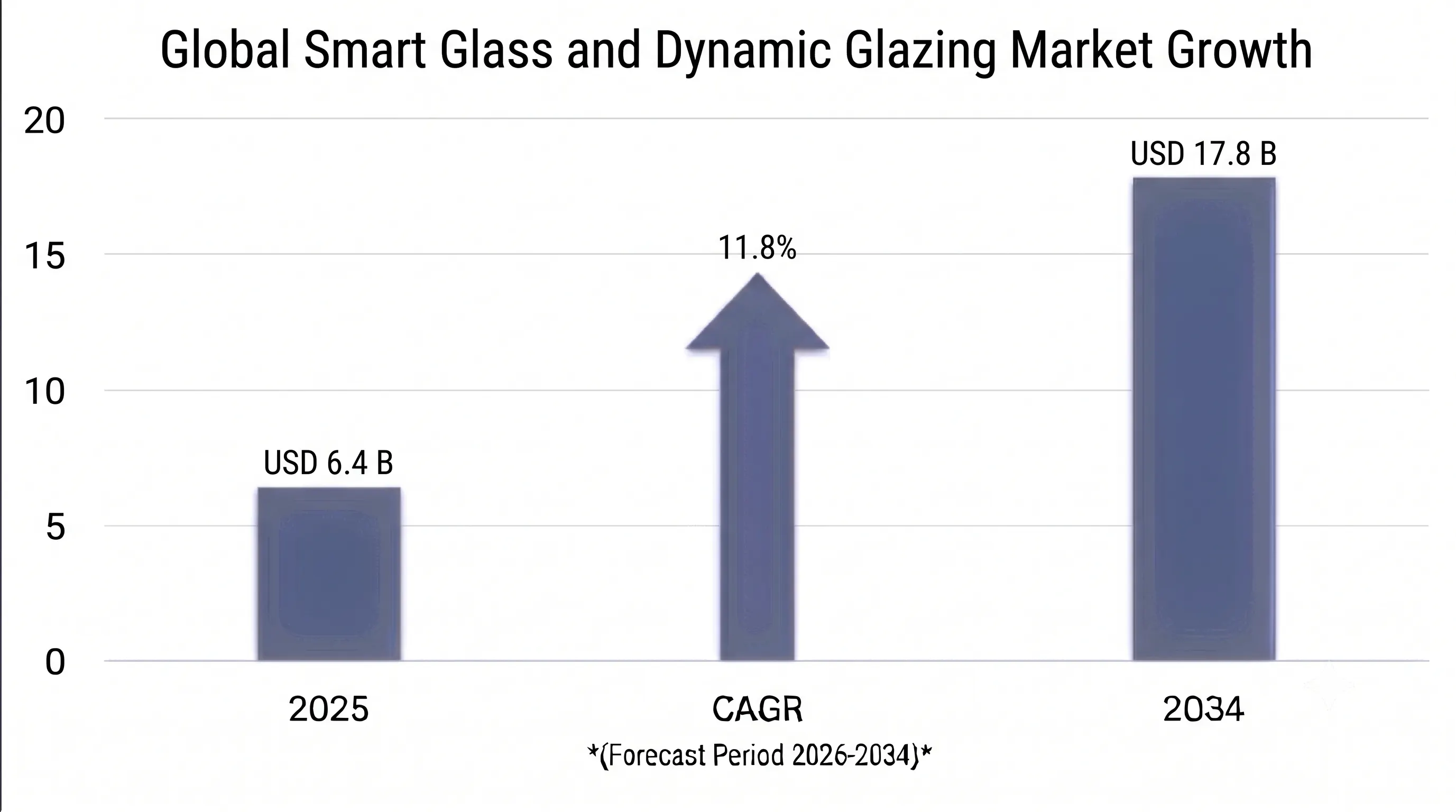
The global smart glass and dynamic glazing market was valued at USD 6.4 billion in 2025 and is projected to reach USD 7.3 billion in 2026, expanding to USD 17.8 billion by 2034, growing at a CAGR of 11.8% during the forecast period (2026-2034).
Smart glass and dynamic glazing are considered advanced examples of electroactive materials that change their optical properties, such as visible light transmittance, solar heat gain coefficient, and opacity, based on an applied electric signal, temperature changes, and incident light level. The difference between dynamic glazing and regular glazing is that the latter has unchanging optical properties despite environmental factors or needs of the occupants. On the other hand, dynamic glazing offers users real-time management of building envelope characteristics by switching between transparent, tinted, and opaque states in a few milliseconds or minutes.
However, different basic technologies have distinct modes of operation. For instance, electrochromic devices operate through ion insertion and extraction using reversible electrochemistry in thin films of transition metal oxides as cathode materials such as tungsten trioxide and anodic materials like nickel oxide, whereby the insertion and extraction of lithium ions by applying voltages ranging from 1-5 volts regulate the free electrons that influence optical absorption of visible and near-infrared light. Suspended particle devices use dichroic particles suspended in a polymer matrix, whereby the particles are aligned with an applied electric field to allow transmission of light and randomized without applied field to allow absorption of incident light.
In terms of the performance of buildings, dynamic glazing works as an active façade system like HVAC and lighting systems, rather than merely serving as a passive building material. By integrating these technologies with building management systems together with daylight sensors, occupancy detectors, and weather monitoring systems, the energy performance of the building can be enhanced through the constant optimization of solar heat gain coefficients and visible light transmittance according to the actual conditions indoors and outdoors. Energy efficiency in this case includes up to 15-25% decrease in peak cooling demand, 10-20 percent decrease in lighting electricity usage, and 8-15% increase in productivity in commercial office spaces.
The business ecosystem covers an comprehensive system integration that includes not only the glazing but also includes systems such as the low-voltage electrical system, control networks that operate wirelessly, building automation systems, and optimization software that is programmed to enhance the performance of the overall systems. Leading providers are increasingly offering fully integrated solutions that combine the use of intelligent glass products such as dynamically insulated glass units, special frames to accommodate electrical systems, control equipment modules, and protocols that allow connection to existing building management systems.
| Report Coverage | Details |
|---|---|
| Base Year | 2025 |
| Base Year Value | USD 6.4 Billion |
| Forecast Value | USD 17.8 Billion |
| CAGR | 11.8% |
| Forecast Period | 2025-2034 |
| Historical Data | 2022-2025 |
| Largest Market | North America |
| Fastest Growing Market | Asia Pacific |
| Segments Covered | By Technology, Application, Product Type, Control System, End-Use, Region |
| Region Covered | North America, Europe, Asia Pacific, Middle East & Africa, Latin America |
| Countries Covered | US, Canada, Germany, France, UK, Netherlands, Norway, China, Japan, South Korea, Australia, India, UAE, Saudi Arabia, Brazil |
| Key Market Playes | View Inc., Saint-Gobain (SageGlass), AGC Inc., Guardian Industries, Gentex Corporation, ChromoGenics AB, Halio Inc |
Get more details on this report - Request Free Sample
The primary driver of the smart glass market is the rising demand for advanced facade management solutions that will enable buildings to respond to changing solar conditions due to stricter building energy regulations and carbon reduction regulations that necessitate active facade management solutions. For example, the Energy Performance of Buildings Directive introduced in the European Union requires all new buildings to become nearly zero-energy buildings by 2030; at the same time, all buildings that are under major renovation need to comply with the increasing energy performance requirements, which conventional static glazing often fails to provide when incorporated in the highly glazed architecture. Moreover, the American Society of Heating, Refrigerating and Air Conditioning Engineers and the International Energy Conservation Code set solar heat gain coefficients for buildings, encouraging the installation of more sophisticated solutions.
The net-zero carbon commitments made by many real estate occupiers in terms of their large-scale buildings and facilities from major sectors such as the tech industry, financial services, and professional services act as strong sources of demand pull in terms of smart glass applications due to green building certification programs like LEED v4.1 and BREEAM Outstanding, which charge premium rentals of 12-28% and allocate high credit scores to buildings with dynamic daylighting controls provided through smart glass technology.
Carbon pricing initiatives such as the EU Emission Trading Scheme as well as emerging carbon border tax adjustments make it cheaper for dynamic glazing technologies that can show measurable energy performance benefits to succeed in the marketplace. Government programs like the US Inflation Reduction Act’s tax credits for energy efficiency in buildings also directly subsidize smart glass, lowering payback periods from eight to twelve years to 5-7 years.
The adoption of smart glass is increasing significantly from increased awareness regarding the impact of building environment on occupant health and cognitive function as well as productivity, particularly where there is the ability to experience changing daylight and outside view conditions in the building environment, which translates into wellness amenities that fetch higher rents for leases. Occupants of buildings featuring daylit and outdoor view conditions show improvements in cognitive function tests by 15-25%, decreases in headaches/eyestrain complaints by 18-32%, and improved sleep quality by 8-12%.
The commercial real estate landscape after the pandemic period, which is defined by competition among employers to lure their workers into office settings, has placed occupant experience on top of the list of key criteria for designing buildings. The use of smart glass allows architects to create very transparent buildings that receive ample amounts of natural light and provide great views while ensuring that glare and excessive heat from the sun do not cause discomfort using high-performance glazing techniques.
Smart glass technology has found very significant applications in healthcare settings where smart glass is widely deployed due to its proven patient benefits, including dynamic access to sunlight, automatic privacy control of patient’s rooms, and reduced risks associated with infections resulting from the lack of mechanical blinds, which are a known source of infection-causing organisms. Studies have demonstrated reductions in the length of stay by up to 8-15% and decreases in pain relief medication by up to 20-30% in such rooms.
The primary factor restraining market growth is lies in the significantly higher costs associated with their initial installation as compared to regular high-performing glazing systems. This is because the cost of installing electrochromic smart glass ranges between USD 75-140 per square foot, whereas the cost of installing premium static low-emissivity glazing systems amounts to only between USD 15-32 per square foot, yielding a simple payback period of seven to twelve years based on energy savings. This means that the period exceeds the typical timeframe of real estate investments ranging from 5-7 years.
Cost associated with the entire system includes both glazing systems and the installation of an electrical system, consisting of wiring, control panel, sensors, and integration of building management system, which collectively contributes to adding an additional 25-40% to the cost of the glazing unit and involve collaboration amongst various specialty contractors, such as glaziers, electricians, and building automation contractors. Existing buildings also incur additional retrofit costs due to façade access requirements, modification of structures for electrical lines, and building management system upgrading.
The manufacture of large electrochromic panels involves complexity due to thin film formation over a surface area larger than 60 square feet with optical and electrical uniformity. Such manufacture remains cost-inefficient because it cannot take advantage of economies of scale as seen in commodity glass manufacturing.
Significant opportunities exist in large-scale building refurbishment at a global level, where the demand for better energy performance of buildings alongside decarbonization of companies has prompted funding towards the betterment of building envelopes through the installation of smart glass instead of mere replacement of existing glass windows. The European Commission’s Renovation Wave aims to raise the annual rate of energy renovations from 1%-2%, which would equate to the refurbishment of 35 million buildings up until 2030, one of which is upgrading building façades with smart glazing.
The government programs aimed at retrofitting include the US Inflation Reduction Act for energy-efficient tax credits on commercial buildings, Federal Funding for Efficient Buildings program in Germany, UK Public Sector Decarbonization Scheme, among others, which offer significant financial aid to lower the payback period from 8-12 years to 4-7 years, thus making the investment commercially viable.
The invention of smart glass retrofit overlay films and systems that can be applied to already existing glass without replacing the entire window provides a solution whereby retrofit solutions can now be deployed for USD 35-65 per square foot instead of replacement that is usually priced between USD 75-140 per square foot, thereby increasing the size of the potential market.
Innovative change is taking place in the world of smart glass because of the application of artificial intelligence and machine learning algorithms which enable fully automated glazing management optimized to achieve more than one performance objective at once, without the need for any human involvement. Smart glass control systems make use of information provided by weather forecasting services, sensors within the BMS, occupancy detectors, solar radiation readings, and electricity rate information to determine the appropriate state of glazing before conditions deteriorate.
Machine learning algorithms that learn from individual building performance can create customized control strategies that can be 18-32% more efficient in energy consumption than those based on rules. In addition, these personalized control strategies not only save more energy but also enhance occupant satisfaction through the optimization of the indoor environment according to each person's workspace and preferences. Moreover, with electrochromic glass panels combined with AI-controlled platforms, it is possible to manage each glass panel separately.
AI technology has become very sophisticated and uses predictive weather models, thermal masses of buildings, and response time of HVACs to pre-condition the glazing hours before the expected arrival of the solar event, all while maintaining stable indoor environmental conditions.
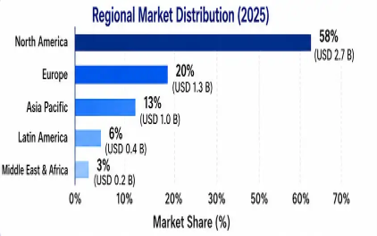
North America held the largest regional market share at USD 2.7 billion in 2025, sustaining expected CAGR of 11.4% to 2034. Leadership in the region was attributed to the presence of technologically advanced commercial property development in the region, robust corporate sustainability efforts by companies in the technology industry, well-established green building certification infrastructure via LEED and Energy Star initiatives, and favorable government policies on energy efficiency, such as Inflation Reduction Act provisions. The U.S. represented 88% of regional market revenue, owing to technology company campuses, high-end commercial office developments in gateway cities like San Francisco, New York, Seattle, and Austin, and healthcare facilities that focused on providing well-being environments for patients through smart glass applications.
California accounts for the biggest state market with 31% of smart glass installed in the United States, because of Title 24 energy codes making it almost mandatory to have dynamic glass in some buildings, along with high electrical costs, technology industry campus building constructions, and other factors. Some additional important locations include the Pacific Northwest, Texas Triangle, and Northeast corridor regions where commercial developments utilize smart glass due to incentive programs from utilities and green buildings.
Federal policies such as the Department of Energy research grants, the pilot programs of the General Services Administration in government-owned buildings, and the tax incentives of the Inflation Reduction Act contribute a great deal to market support, whereas state policies like California’s Title 24, New York’s Climate Leadership and Community Protection Act, and the Massachusetts Green Communities Act generate regulatory demand.
Asia-Pacific is projected to be the fastest-growing regional market of 14.2% up until 2034, with revenue standing at USD 1.6 billion by 2025. Growth drivers in the region include significant commercial construction in China, South Korea, Japan, and Australia due to rising adoption of green building norms requiring dynamic facades performance, along with surging production of premium vehicles equipped with smart glass.
The green building certification in China, which has a total certified area of 2.4 billion square meters by 2025, will mandate the use of dynamic glazing for any commercial purposes that exceed specific glazing ratios, whereas the supremacy of electric vehicle manufacturing in China will create huge demand for smart glass. The “Green New Deal” of South Korea and its pledge towards achieving carbon neutrality will promote the use of smart glass in public and government buildings.
The building technology industry in Japan, being highly developed, shows a significant application rate for electrochromic glazing in high-end commercial projects and health care facilities due to high cost of electricity improving energy efficiency and advanced building management system capabilities allowing glazing control systems integration. Energy efficiency provisions in the National Construction Code and sustainability initiatives of commercial real estate developers encourage adoption in office markets of Sydney, Melbourne, and Brisbane.
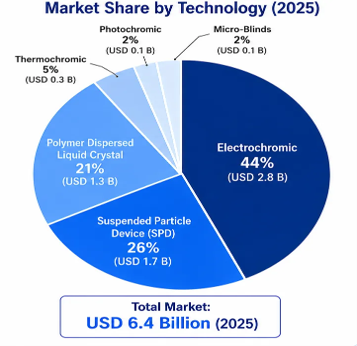
The electrochromic segment held the largest share (44%), valued at USD 2.8 billion in 2025, and exhibits a compounded annual growth rate of 12.4% up to 2034. These technologies stand out due to better performance attributes such as continuous gradation in tinting with infinite intermediate states, power usage of just 0.5-4 W per square meter during switching with near zero power consumption while in static states, as well as durability that has lasted for more than 50,000 switching cycles.
The market size of the Suspended Particle Devices is expected to be USD 1.7 billion by 2025 with a Compound Annual Growth Rate of 13.8%. SPD technology has significant application potential of 26% share of the market due to its ability to perform fast switching responses. These devices are useful in applications that require fast reaction times such as automotive panoramic roofs and aircraft windows.
Polymer Dispersed Liquid Crystal (PDLC) technology accounts for a market share of 21%, amounting to a value of USD 1.3 billion in 2025 with a CAGR of 10.9%. It leads the applications for interior privacy partitions since it switches from a clear view to a translucent one. The technology is cost-effective and easy to control relative to electrochromic technology.
Commercial buildings account for 49% of the market, valued at USD 3.1 billion in 2025 and have a 12.1% CAGR over 2025-2034 owing to regulations on energy efficiency, well-being of inhabitants, and green building certifications. Such commercial buildings include office complexes, corporate parks, retail centers, and hotels. In these areas, smart glass helps save energy, provides more comfort to the inhabitants, and helps create an edge over competitors due to its unique properties.
The Automotive & Transportation market share is projected to be at USD 1.5 billion, which corresponds to 24%. This segment also has a maximum CAGR of 15.6%, which can be attributed to the growth of electric vehicles, and the differentiation of premium vehicles with glass that have certain technical properties, as well as development of autonomous vehicles that require glazing controlled electronically. It also offers benefits such as quick development cycles and high volumes for reducing costs.
The global smart glass and dynamic glazing market is moderately concentrated., as the top seven companies hold about 54-62% of the total market share based on their unique technology platforms, production strengths, product diversification by technology and end use, as well as distribution strength. Competitive advantages are based on superior technology performance that has been tested independently and through field-building data, production capacity sufficient to drive price competition without compromising product quality, system capability to easily integrate with existing building management systems, and technical services required for proper specification, installation, and maintenance.
Partnerships among smart glass providers, glass processors, architectural glazing companies, architectural glazing, building management systems and auto original equipment manufacturing enable an integrated approach that streamlines implementation challenges and helps ensure rapid market acceptance by offering a one-stop solution for performance management of dynamic glazing systems throughout their entire lifespan.
June 2026: View Inc. launched their fifth-generation electrochromic glass technology featuring integrated transparent photovoltaics which convert sunlight to electricity at 12.8% efficiency, allowing for the installation of glass facades that can both produce electricity and perform solar management, with an energy proposition designed specifically for net zero energy buildings with payback periods between 5-7 years for south facing facades.
May 2026: Saint-Gobain announced its acquisition of an electrochromic technology company based in Sweden for EUR 320 million and obtained proprietary electrochromic solution-coating technology expected to reduce manufacturing costs by at least 42% than existing technologies that employ magnetron sputtering techniques.
April 2026: AGC Inc. introduced the next generation of Suspended Particle Device (SPD) automotive glazing, which offers 45% faster switching speeds and an expanded operating temperature range of -45°C to +90°C, securing contracts with four electric vehicle manufacturers for use in panoramic roofs of cars released from 2027-2029.
March 2026: According to Gentex Corporation, a collaboration with an industry leader in building automation was launched to create a complete, AI-powered smart glass control system that uses electrochromic technology together with machine learning algorithms that have proven to increase energy efficiency by 28 percent as opposed to traditional rule-based control systems.
February 2026: ChromoGenics AB received USD 52 million in Series D funding for the expansion of its capacity to produce electrochromic glass products in Europe and for building a manufacturing facility in North America. The company is focusing on the European market and plans to use its thin-film overlays in existing glazing products at 50% lower cost.
You'll get the sample you asked for by email. Remember to check your spam folder as well. If you have any further questions or require additional assistance, feel free to let us know via-
+1 724 648 0810 +91 976 407 9503 sales@intellectualmarketinsights.com
30 Jun 2026
Intellectual Market Insights Research © 2026. All rights reserved.


