Share this link via:

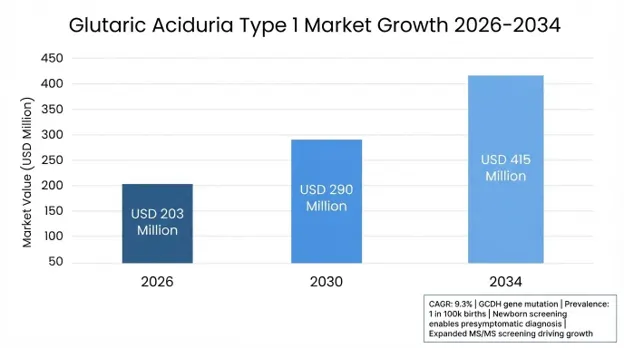
The global glutaric aciduria type 1 (GA1) market was valued at USD 185 million in 2025 and is estimated to reach USD 203 million in 2026, expanding to approximately USD 415 million by 2034, registering a compound annual growth rate of around 9.3% during the forecast period (2026-2034).
Also known as glutaric acidemia type 1, GA1 is a rare (autosomal recessive) neurometabolic disorder resulting from pathogenic variants in the GCDH gene on chromosome 19p13.2 encoding an essential enzyme, glutaryl-CoA dehydrogenase, in mitochondrial metabolism that is required for the metabolism of the amino acids lysine, hydroxylysine, and tryptophan. Progressive accumulation of glutaric acid, 3-hydroxyglutaric acid, and glutarylcarnitine in body fluids and tissues, with a specific but irreversible involvement of the basal ganglia, especially the caudate nucleus and putamen. Untreated or late-diagnosed infants are at high risk to develop acute encephalopathic crises in response to catabolic stress like febrile illness, vomiting, or surgery at a vulnerable age (3 months to 6 years), peaking between 6 and 18 months. These crises are associated with dystonia, choreoathetosis, and permanent variable motor disability, reflecting striatal necrosis. Macrocephaly, which occurs in most affected infants, is often the first clinical sign that suggests metabolic investigations into babies that have not been screened.
The most impactful change in the management of GA1 in the last decade has been the detection of glutarylcarnitine (C5DC) in expanded newborn screening (ENBS) panels based on tandem mass spectrometry (MS/MS), which enables presymptomatic diagnosis and prompt treatment with protective therapy. If infants are diagnosed by screening and appropriately treated using current metabolic management guidelines, the incidence of striatal damage is significantly reduced from what was previously reported in patients that were diagnosed with GA1 when symptomatic and treated with current metabolic management, most of these infants may develop normally or near normally. The estimated prevalence is approximately 1 in 100,000 live births in general populations, but in some genetically isolated populations the prevalence is far higher, with the Old Order Amish community in Pennsylvania, USA, having a prevalence as high as 1 in 400 and the Oji-Cree population in Canada having a prevalence of approximately 1 in 300, reflecting well-documented founder mutations.
The GA1 market is different from traditional pharmaceutical markets, as currently the market is mainly supported by specialized medical nutrition products, low-lysine amino acid formulations, and carnitine supplements, rather than approved disease-modifying drugs. The therapeutic paradigm is, however, taking a turn with the development of gene therapy, mRNA-based enzyme restoration, and pharmacological chaperones in preclinical and early clinical trials, backed by orphan drug incentives and a growing number of patients identified with newborn screening who have a lifelong need for therapeutic intervention. This combination of an increasing diagnosed population and an emerging drug-development pipeline for ultra-rare diseases will continue to drive the above-average growth in the forecast period.
| Report Coverage | Details |
|---|---|
| Base Year | 2025 |
| Base Year Value | USD 185 Million |
| Forecast Value | USD 415 Million |
| CAGR | 9.3% |
| Forecast Period | 2025-2034 |
| Historical Data | 2022-2025 |
| Largest Market | North America |
| Fastest Growing Market | Asia Pacific |
| Segments Covered | By Treatment Type, Disease Stage, Diagnosis Type, End-User, Region |
| Region Covered | North America, Europe, Asia Pacific, Middle East & Africa, Latin America |
| Countries Covered | US, Canada, Mexico, UK, Germany, France, Italy, Spain, Netherlands, China, Japan, India, Australia, South Korea, Brazil, Saudi Arabia, South Africa |
| Key Market Playes | Nutricia (Danone), Vitaflo (Nestlé Health Science), Abbott, Mead Johnson (Reckitt), Cambrooke Therapeutics (Ajinomoto), Recordati Rare Diseases, Ultragenyx Pharmaceutical |
Get more details on this report - Request Free Sample
The most important structural determinant of market growth in GA1 is the growing global implementation of newborn screening programs that include the use of C5DC using tandem mass spectrometry. GA1 was included in the Recommended Uniform Screening Panel of the United States in the middle of the 2000s decade and was followed by nationwide implementation, while Europe saw the inclusion of GA1 in national newborn screening programs in countries such as Germany, the Netherlands, Austria, and the United Kingdom during the following years. Every newborn screened will have to start taking special formulas and undergo biochemical and genetic tests right away.
GA1 is an appealing target in gene therapy due to its monogenic inheritance, known causative gene, grave nature, irreversibility of the disease if not treated, and availability of animal models of knockout of GCDH. The preclinical studies that utilized adeno-associated viruses have successfully shown enzyme normalization in the liver and glutaric acid levels, proving the concept for the translation of the research along with mRNA-based enzyme replacement and pharmacological chaperones for missense mutations.
The key limitation of the GA1 market is the very small absolute size of its patient population, with worldwide prevalence being in the tens of thousands and incidence in the low thousands annually. This presents a serious barrier to volume potential for any drug or nutritional supplement line, while the clustering of patients in remote communities formed through founder effects hardly helps on the worldwide business front.
A large opportunity exists in promoting the adoption of tandem mass spectrometry screening in countries that currently lack GA1 testing capabilities, especially those in the Asia Pacific, Latin America, and Middle East regions, where increased investments in healthcare infrastructure and commitment from governments to decrease the burden of childhood disabilities are increasing the growth rate of such screening programs. Pilot projects have already been undertaken by China, India, and Brazil in major metropolitan cities.
The field is beginning to be aware that despite not sustaining an acute injury to the striata, those who have been identified by newborn screening may have an underlying chronic vulnerability to the brain, which has led to a change in clinical guidelines from dietary liberalization at puberty to continued intensive dietary control beyond childhood. This shift, along with an increasing number of screened patients going into adulthood with retained neurological function, is leading to the development of adult-specific amino acid formulations and adult-specific metabolic transition-of-care programs for long-term sequalae and pregnancy management.
Medical nutrition companies are increasingly collaborating with biopharmaceutical developers to build out capabilities in the field of rare disease clinical liaison, while nutrition companies sponsor natural history studies, and emerging gene therapy companies seek out existing relationships with metabolic centers and patient advocacy groups, as well as the increased adoption of digital adherence technologies for dietary tracking and emergency protocol compliance.
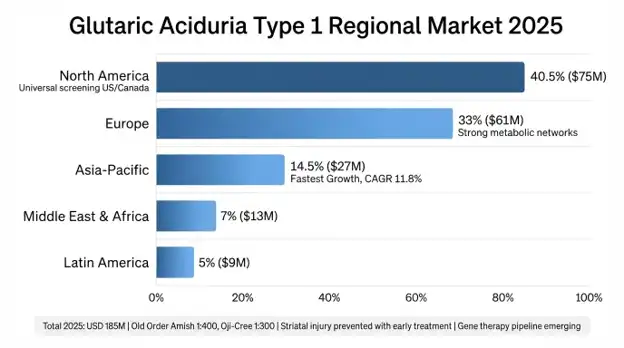
North America was the biggest market on a regional basis in 2025, with a value of approximately USD 75 million, growing at a CAGR of about 8.7% to 2034. Market dominance is due to universal newborn testing in the US and Canada, the presence of extensive metabolic specialty care centers, universal health care coverage of medical foods in most areas, and investigational gene therapy programs mostly based at academic institutions like Pittsburgh and Boston. The Old Order Amish and Mennonite communities of Pennsylvania, Ohio, and Indiana constitute a special case in which a unique patient group supports community-based management models.
The Asia Pacific region represents the fastest-growing regional market, having a value of around USD 27 million in 2025 and being expected to grow at around 11.8% per annum until 2034 owing to increasing investment in infrastructure for newborn screening, growing awareness amongst pediatricians, and healthcare spending. Japan and South Korea remain the leaders in terms of screening infrastructure and management in the region, and the large number of births annually in China represents the biggest unexploited opportunity with growing screening revealing more patients.
Europe, Latin America, and the Middle East & Africa represent the other regions of the global market, having a very strong metabolic diseases academic network and complete reimbursement in Western Europe, coupled with growing screening and management in the emerging markets.
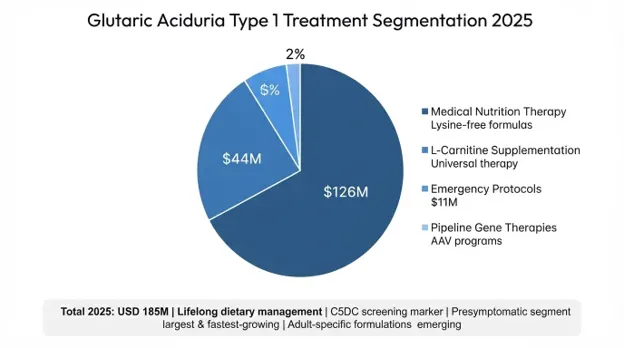
Treatment type insights: Medical nutrition therapy that consists of lysine-free and tryptophan-free amino acid formulations makes up the bulk of the market as it serves as a required, lifelong cornerstone of treatment. L-carnitine supplementation is the second largest category as a universal anti-secondary carnitine deficiency therapy, whereas pipeline genes/enzymes are a small but growing revenue stream.
The presymptomatic and newborn screening identified segment is the largest and fastest-growing segment, and screening coverage is increasing, thus yielding lifetime management revenue. The post-encephalopathic, symptomatic segment is still smaller in screened populations, but it still comprises a significant proportion of the population in areas where systematic screening is not offered.
Diagnosis Type Insights: The most prevalent mode of diagnosis is newborn screening in developed markets, and clinical diagnosis after symptom presentation dominates in countries where the infrastructure for newborn screening is not available.
End-User Insights: Formula and carnitine are administered daily by families, and end-users in metabolic disease specialty centers are the second largest market segment that offers full multidisciplinary care.
The GA1 market features a fragmented competitive environment within the dietary management category, comprising only a few specialties of medical nutrition players who compete on taste, nutritional adequacy, and age appropriateness of products, as well as a novel wave of gene therapy and orphan disease players that are pushing disease-modifying programs in the early stages. Nutricia and Vitaflo dominate the field of specialized metabolic formulas through strong clinical dietitian support and long experience in dealing with metabolic specialty centers, while the investigational therapy space is still pre-commercial with a differentiation based on vector design and preclinical data.
March 2026: The European Consortium for Gene Therapy of Academic Research Institutions was awarded orphan status for its AAV gene therapy to treat GCDH deficiency.
February 2026: Nestlé Health Science (Vitaflo) released an enhanced ready-to-drink amino acid solution designed for the adolescent and adult population affected by GA1, due to the previous non-compliance issue in that age group.
January 2026: Cambrooke Therapeutics added formulations of better-tasting low-lysine medical foods to their product line, in partnership with metabolic dietitians and patient support organizations.
December 2025: A multi-center study conducted in several countries found that patients detected by newborn screening who follow current dietary guidelines develop normally in the great majority of cases, providing further evidence for the benefits of screening programs.
You'll get the sample you asked for by email. Remember to check your spam folder as well. If you have any further questions or require additional assistance, feel free to let us know via-
+1 724 648 0810 +91 976 407 9503 sales@intellectualmarketinsights.com
24 Aug 2026
Intellectual Market Insights Research © 2026. All rights reserved.


