Share this link via:

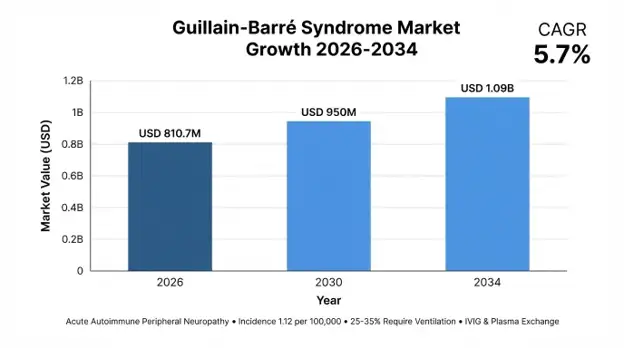
The global Guillain-Barré syndrome market size was valued at USD 767 million in 2025 and is projected to reach USD 810.7 million in 2026, expanding to USD 1.09 billion by 2034, growing at a CAGR of 5.7% during the forecast period (2026-2034). Guillain-Barré syndrome represents a rare but severe acute autoimmune disorder of the peripheral nervous system characterized by rapidly progressive ascending paralysis, profound muscle weakness, and autonomic dysfunction that develops within days to weeks following a triggering infectious episode or vaccination event. The condition affects multiple neurological systems simultaneously, involving motor nerves, sensory nerves, and autonomic fibers, creating complex clinical management requirements necessitating intensive medical care, specialized diagnostic procedures, and evidence-based immunomodulatory interventions administered during critical acute phases to prevent permanent disability and reduce mortality.
Modern GBS management encompasses sophisticated diagnostic protocols, including cerebrospinal fluid analysis through lumbar puncture revealing characteristic protein-cell dissociation patterns; electrodiagnostic studies, including nerve conduction studies and electromyography, differentiating demyelinating versus axonal disease subtypes with prognostic significance for clinical outcomes; and imaging studies assessing disease severity and complications. The therapeutic approach centers on two established evidence-based immunomodulatory treatments, intravenous immunoglobulin therapy and therapeutic plasma exchange, which substantially hasten neurological recovery when administered early in disease progression within critical therapeutic windows. The commercial significance extends beyond pharmaceutical product costs to encompass comprehensive acute care management, including intensive care unit hospitalization with mechanical ventilation for respiratory-compromised patients, invasive monitoring systems, nutrition support, rehabilitation services, and long-term disability management, creating a substantial healthcare burden.
The market addresses a critical unmet need for patients experiencing life-threatening acute paralysis, representing the most common cause of acute flaccid paralysis worldwide with substantial mortality and permanent disability rates. Approximately 15-20% of GBS patients are left with residual deficits, including persistent weakness, fatigue, cognitive dysfunction, and chronic pain, requiring ongoing rehabilitation and social support services extending beyond acute hospitalization. The economic burden of GBS exceeds USD 1.7 billion annually in the United States alone due to hospitalization costs, intensive care utilization, lost productivity, and long-term disability management, establishing substantial market drivers for optimized treatment strategies and emerging therapeutic interventions.
| Report Coverage | Details |
|---|---|
| Base Year | 2025 |
| Base Year Value | USD 767 Million |
| Forecast Value | USD 1.09 billion |
| CAGR | 5.7% |
| Forecast Period | 2025-2034 |
| Historical Data | 2022-2025 |
| Largest Market | North America |
| Fastest Growing Market | Asia Pacific |
| Segments Covered | By Product Type, Treatment Type, Diagnostic Methods, Disease Variants, End-User Categories |
| Region Covered | North America, Europe, Asia Pacific, Middle East & Africa, Latin America |
| Countries Covered | US, Canada, UK, Germany, France, Italy, Spain, China, Japan, India, Australia, South Korea, Brazil, Argentina |
| Key Market Playes | CSL Behring, Grifols, Takeda Pharmaceutical, Octapharma, Biotest AG, Kedrion, Mediwound, Argenx |
Get more details on this report - Request Free Sample
The growth of the GBS market on a global level can be attributed to the rising occurrence of the disease, improved diagnosis, and greater awareness among health care practitioners. The incidence of GBS in the world is estimated at 1.12 per 100,000 person-years, with estimations ranging from 0.98 to 1.27 cases. The prevalence increases by about 20% for every 10-year increase in age and shows high rates amongst people over 65 years old, making the case for an increased need for acute neurological care even more valid as people age. GBS occurs in all age groups, with a male predominance with an incidence ratio of 1.2-1.5:1. This disease develops quickly and leads to paralysis and hence usually needs immediate hospitalization and intensive care. About 25-35% of patients require mechanical ventilation due to respiratory and bulbar muscle impairment.
The other important market factor is the connection between pre-existing infections and Guillain Barré syndrome (GBS), where molecular mimicry after infection connects immunity with subsequent peripheral nerve injury. Campylobacter jejuni is the most common pathogen involved in about 30–40% of Western cases of GBS and as high as 60–70% in certain Asian groups along with anti-ganglioside antibodies. Fluctuations of GBS by season are also related to respiratory viruses, gastrointestinal infections, and outbreaks of Zika virus, generating temporary spikes in the need for immunomodulation treatment and intensive care services. Even though some vaccines have shown a temporal connection with GBS, the actual risk is very low. Increased awareness of infectious causes gives scope for pathogen screening, molecular diagnostics, epidemiologic surveillance, and public health initiatives to reduce GBS linked with infections.
The financial cost associated with treatments for GBS is another major barrier to the growth of the market. The primary method used is intravenous immunoglobulin (IVIG). The treatment involves a cumulative dosage of 2 g/kg in 3-5 days at a cost of around USD 10,000–25,000. Plasma exchange treatment also entails a significant cost involving special equipment and professional personnel at a cost between USD 8,000 and 18,000 for 3-5 exchanges. The total cost of hospitalization of an acute case of GBS involves diagnostics, intensive care, mechanical ventilation, immunotherapy, and rehabilitation and may go up to USD 50,000-150,000. While there are full reimbursements in the US and Western Europe, the limited budgets and inadequate insurance in other developing nations are a serious limitation to GBS therapy.
New immunomodulatory drugs targeting specific mechanisms in GBS offer a great market opportunity, outside of IVIG and plasma exchange. The idea behind complement inhibitors like eculizumab and ANX005 is that they reduce nerve damage caused by complement activity; in the initial studies, ANX005 provided other recovery effects in addition to those of IVIG. Other strategies include IgG-degrading enzymes, which degrade pathogenic antibodies, and FcRn antagonists, which block the IgG recycling and autoantibody clearance. There were around 47 therapeutic programs in development in 2024-2025, ranging from preclinical to phase III. Successful novel treatments with increased efficacy, tolerability, and/or convenience would fill a significant market, and the new complement inhibitor class may command USD 800 million – 1.2 billion in annual sales.
The trend in the GBS market is evolving towards personalized medicine based on disease variants, immunopathology, and prognostic biomarkers. Acute inflammatory demyelinating polyradiculoneuropathy, which is typical for the Western population, usually responds well to standard IVIG and plasma exchange therapy. In turn, AMAN and AMSAN are more typical for Asian and South American populations and are often accompanied by anti-ganglioside antibodies and increased complement activity, thus making complement inhibition possible. Miller Fisher syndrome is marked by the symptoms of ophthalmoplegia, ataxia, and areflexia and includes the presence of anti-GQ1b antibodies in about 80-90% of cases. The use of biomarkers of treatment based on anti-ganglioside antibodies, complement activity, and inflammation will help better to personalize the treatment approach. The size of the GBS diagnostic biomarker market may reach USD 150-200 million by 2030.
The GBS market in North America was the largest in 2025, with USD 338 million, accounting for 44.18% of the global market value, which is expected to expand at a 5.4% CAGR through 2034. There is a sophisticated healthcare infrastructure, specialized neurological centers, advanced electrodiagnostic facilities, a wide range of clinical experience, and comprehensive insurance coverage for immunomodulatory therapy. Approximately 82% of regional value is paid by the U.S. government through Medicare and commercial reimbursement for IVIG and plasma exchange. There are also over 2200 board-certified neurologists who are experienced in managing GBS in the country. Emerging complement inhibitors and FcRn-targeted therapies are also supported by FDA expedited pathways and breakthrough designations, which support development and regulatory advancement of these emerging products.
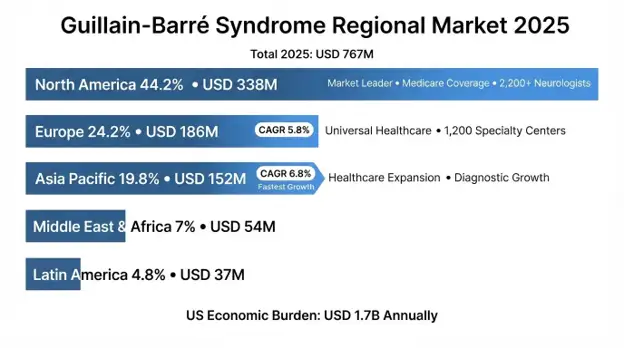
Europe emerged as the second largest market for GBS, valued at USD 186 million in 2025, representing 24.2% share in terms of global market value, with a CAGR of 5.8% during 2026-2034. The regional market is fueled by well-established neurology practices, comprehensive healthcare systems, advanced diagnostic techniques, and the use of new-age treatments. Europe records a high incidence rate of 1.2 to 1.8 per 100,000 person-years, contributing towards the sustained requirement of treatments. In addition, European healthcare systems are increasingly using home intravenous IG, specific rehabilitations, and standardization in diagnosis. The European Medicine Agency is supporting the development of innovative immunomodulatory treatments.
Asia Pacific is one of the most rapidly growing regions for GBS. It is projected that it would have a CAGR of 6.8% over the forecast period of 2024-2034. This growth can be attributed to greater availability of healthcare facilities, increased diagnosis, high insurance coverage, and greater awareness about neurological disorders. China is leading in the region due to its initiatives of increased neurological treatment centers, reforms in the health sector, extended biologic coverage, and immunotherapy treatment centers. India also has the potential to show good growth because of its infrastructure development, its insurance scheme called Ayushman Bharat, and increasing immunotherapy treatments. Japan enjoys a good healthcare infrastructure for neurological treatment and clinical expertise. Improved awareness due to outbreaks of infectious diseases like Zika also plays an important role.
Intravenous immunoglobulin accounts for 58% market share, worth USD 445 million in 2025, which is the standard-of-care treatment of choice owing to the ease of delivery and availability. Plasma exchange is responsible for a 32% market share worth USD 245 million in 2025, which involves a specialized mode of treatment that needs equipment and skilled people. Supportive care products such as respiratory support products, nutritional support products, and rehabilitative products have a 10% market share worth USD 77 million in 2025.
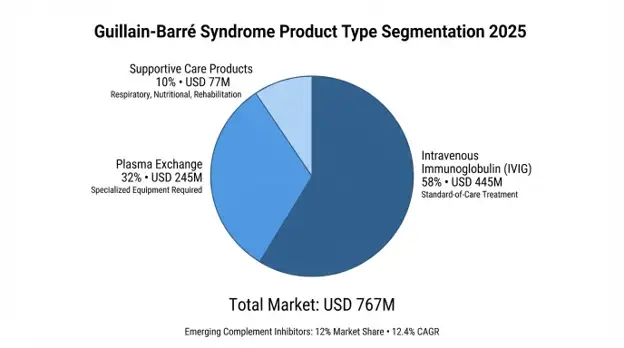
Conventional therapies such as IVIG & plasma exchange constitute 88% of the market share of the value of USD 675 million by 2025 with a 5.3% CAGR. Emerging immunomodulators like complement inhibitors & FcRn antagonists constitute 12% of the market share, valued at USD 92 million by 2025, with a 12.4% CAGR due to pipeline development.
Nerve conduction studies hold a market share of 44% with a value of USD 338 million in 2025. Cerebrospinal fluid analysis holds a market share of 35% with a value of USD 269 million in 2025. Electromyography holds a market share of 21% with
Acute inflammatory demyelinating polyneuritis has a major share of 62%, worth USD 476 million in 2025. The next important condition is acute motor axonal neuropathy, which has a 22% market share and is worth USD 169 million in 2025. The third major type of Guillain-Barré syndrome is Miller Fisher syndrome, having a 10% market share worth USD 77 million in 2025.
The end-user segments that occupy the maximum shares of the market include hospitals with a 64% market share worth USD 491 million by 2025, ICU facilities with a 22% market share valued at USD 169 million by 2025, specialty clinics with a 9% market share worth USD 69 million by 2025, and ambulatory care centers with a 5% market share worth USD 38 million by 2025.
The GBS market in the international arena exhibits fragmentation from moderate to high levels, with the top ten players holding about 58-72% of the market value by offering comprehensive products ranging from immunomodulatory medicines to diagnostics. Competitive advantages lie in having a broad array of products ranging from traditional to innovative therapeutic areas, existing ties in the health care system leading to favorable formulary status, clinical assistance in diagnosis and treatment, and an advanced research portfolio for innovative therapeutic options.
August 2026: Argenx announced positive Phase II results for efgartigimod in Guillain-Barré syndrome, demonstrating statistically significant improvement in disability scores compared to placebo when added to standard IVIg therapy. The FDA granted Breakthrough Therapy Designation for the FcRn antagonist, supporting an accelerated development timeline with a regulatory decision anticipated in late 2027.
June 2026: Mediwound reported completion of ANX005 (C1q inhibitor). Phase III international trial with positive efficacy and safety data, demonstrating significant clinical benefit when combined with standard IVIg in GBS patients. The company initiated regulatory submissions to the FDA and European Medicines Agency with anticipated approval decisions during Q1-Q2 2027.
April 2026: CSL Behring expanded intravenous immunoglobulin manufacturing capacity by 35%, addressing supply constraints and improving product availability across North American and European markets, supporting broader patient access to established GBS therapies.
February 2026: Grifols launched enhanced plasma exchange technology, reducing treatment duration and improving clinical outcomes, receiving FDA approval and CE Mark certification for expanded European adoption.
December 2025: Takeda announced the acquisition of a specialized GBS diagnostic biomarker company for USD 185 million, gaining access to proprietary anti-ganglioside antibody testing platforms supporting personalized treatment selection for axonal GBS variants.
You'll get the sample you asked for by email. Remember to check your spam folder as well. If you have any further questions or require additional assistance, feel free to let us know via-
+1 724 648 0810 +91 976 407 9503 sales@intellectualmarketinsights.com
17 Sep 2026
Intellectual Market Insights Research © 2026. All rights reserved.