Share this link via:

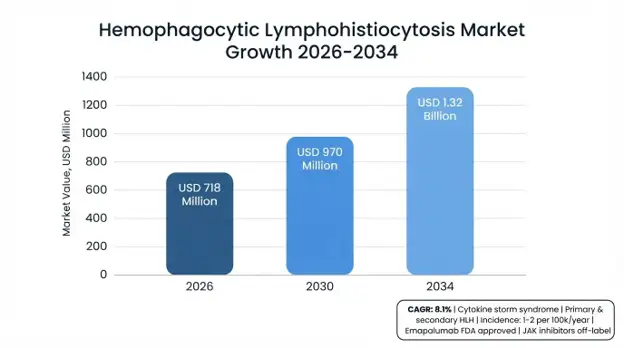
The global hemophagocytic lymphohistiocytosis (HLH) market was valued at USD 665 million in 2025 and is projected to reach USD 718 million in 2026, expanding to USD 1.32 billion by 2034, growing at a CAGR of 8.1% during the forecast period (2026-2034).
Hemophagocytic lymphohistiocytosis is a rare, life-threatening hyperinflammatory condition caused by failure of the normal mechanisms of immune cytolysis to stop the activation of cytotoxic T lymphocytes, natural killer cells, and macrophages, leading to persistent immune stimulation and production of large amounts of pro-inflammatory cytokines, often referred to as a cytokine storm. This dysregulated response leads to persistent high-grade fever, hepatosplenomegaly, cytopenias affecting two or more cell lineages, coagulopathy, very elevated ferritin, and progressive multi-organ failure, which is lethal in almost all cases if treatment is delayed.
There are two main types of disease. Primary or familial HLH is an inherited disorder of the perforin-mediated cytolytic pathway, such as biallelic mutations in PRF1, UNC13D, STX11, and STXBP2 genes that underlie Griscelli syndrome type 2 and Chédiak-Higashi syndrome and is typically observed in infancy or early childhood. Secondary or acquired HLH can develop at any age and is associated with a known precipitating cause, including Epstein-Barr virus and other viral infections; certain hematologic malignancies, including T-cell and NK/T-cell lymphomas; autoimmunity and rheumatologic disease (macrophage activation syndrome); and the hyperinflammatory reaction seen in some cases of chimeric antigen receptor T-cell therapy and immune checkpoint inhibitor therapy.
Treatment has historically focused on the Histiocyte Society's HLH-94 and HLH-2004 protocols, which include a rapid suppression of the hyperinflammatory cascade with dexamethasone and etoposide and either cyclosporine or not, with the only proven curative treatment being allogeneic hematopoietic stem cell transplantation (HSCT) in primary cases and refractory histiocytic leukoma (HL). This paradigm is changing, with emerging evidence supporting mechanism-directed biologics such as emapalumab, a monoclonal antibody to interferon-gamma, which is approved for primary HLH that is resistant to conventional therapy, and the growing number of investigational and off-label uses of JAK inhibitors and interleukin-1/interleukin-18 pathway antagonists that target specific cytokine drivers without broadly inhibiting immune function.
In the commercial arena, the HLH goes beyond therapeutics to molecular diagnostics, molecular genetics, cytokine and soluble-receptor biomarker assays, intensive supportive care, and transplant-related services. HLH is a rare orphan disease that enjoys several regulatory incentives that maintain investments in the disease despite a relatively small addressable market, including the Orphan Drug Designation, the Priority Review pathway, and breakthrough therapy pathways. Ongoing challenges in diagnostic delay, treatment toxicity, and treatment-refractory disease continue to foster innovation along the value chain.
| Report Coverage | Details |
|---|---|
| Base Year | 2025 |
| Base Year Value | USD 665 Million |
| Forecast Value | USD 1.32 billion |
| CAGR | 8.1% |
| Forecast Period | 2022-2034 |
| Historical Data | 2022-2025 |
| Largest Market | North America |
| Fastest Growing Market | Asia Pacific |
| Segments Covered | By Disease Type, Treatment Type, Drug Class, Diagnostic Approach, End-User |
| Region Covered | North America, Europe, Asia Pacific, Middle East & Africa, Latin America |
| Countries Covered | US, Canada, Mexico, UK, Germany, France, Italy, Spain, China, Japan, India, Australia, South Korea, Brazil, Saudi Arabia, UAE, South Africa |
| Key Market Playes | Sobi, Novimmune SA, Incyte Corporation, Novartis AG, Roche (Chugai), Sanofi, Pfizer Inc., AB2 Bio Ltd., Kiniksa Pharmaceuticals |
Get more details on this report - Request Free Sample
HLH has always been grossly underdiagnosed due to its clinical features of fever, cytopenias, and organ dysfunction, which are very similar to those of sepsis, fulminant hepatitis, and resistant malignancy. The increased use of HLH-2004 criteria for the diagnosis of HLH, along with the HScore, an evidence-based nine-variable score for predicting the likelihood of HLH in adult patients, has made a significant impact on decreasing diagnostic delays. Increased use of soluble CD25, ferritin cutoffs, NK function tests, and next-generation sequencing panels for familial mutations will continue increasing the number of correctly diagnosed and treated patients.
Insight into the pathophysiology of HLH, through the understanding of the interferon gamma-induced cytokine cascade, has resulted in increased movement towards the use of biologic agents rather than cytotoxic treatments. Although IL-1RA as a means of treatment in MAS arising from SJIA has proven its effectiveness and ruxolitinib, as a dual JAK1/JAK2 inhibitor, as an off-label therapy in secondary refractory HLH on account of its efficacy at down-regulating signaling from various cytokines, the FDA approval of emapalumab has cemented its effectiveness in treating primary HLH.
HLH cannot be established based on any one test, and the present diagnostic criteria entail satisfaction of various clinical and laboratory criteria or the detection of a causative gene mutation, which may not be achieved at an early stage where treatment is critical. A distinctive sign in bone marrow, the presence of hemophagocytosis, is missing in a considerable number of cases at presentation, and the availability of some specific tests like the natural killer cell function test is quite limited.
The use of perforin deficiencies and other defects of cytolytic pathways as clearly defined molecular targets for gene replacement or genome editing is a strategy that will allow reconstitution of the cytotoxic activity of lymphocytes without posing the problems of graft rejection and graft-versus-host disease, which accompany allogeneic transplantation. Experimental studies with lentiviral gene delivery vectors have shown that correction of cytolytic defects can be achieved in animal models by restoration of perforin expression in hematopoietic stem cells.
The use of ruxolitinib and other JAK1/JAK2 inhibitors is becoming a treatment choice for salvage or upfront therapy in secondary HLH that is refractory because of their oral availability, safety record from other uses of the drugs, and the ability to block signaling from interferon-gamma, interleukin-6, and interleukin-18 converging in the JAK-STAT pathway. There is an increasing trend for starting HLH-directed therapy based on clinical suspicion of HLH even before full diagnosis and using rapidly acting therapies prior to transplant.
North America: North America is the most prominent regional HLH market due to the presence of expertise in hematology and pediatric oncology, universal insurance coverage for costly biological drugs, Histiocyte Society treatment networks, and a well-developed infrastructure of clinical trials. North America comprises a great share of the revenues in this market due to the earliest regulatory access to new treatments and pediatric transplant programs, ensuring full-scale treatment of primary HLH.
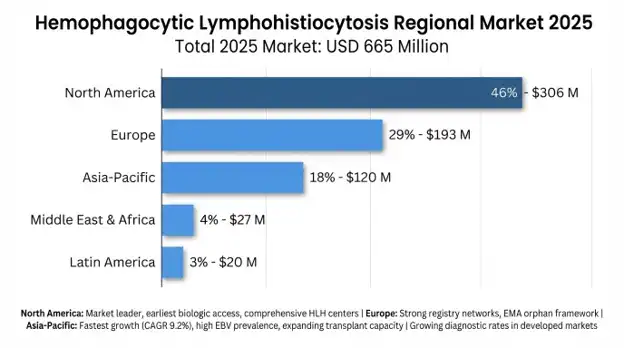
Asia Pacific: The Asia Pacific region represents the fastest-growing market due to significant population size, high prevalence of Epstein-Barr virus that increases the risk of HLH infections, increasing prevalence of hematologic cancers, and growing tertiary care and transplant capacity in China, Japan, South Korea, and India. China presents the most significant single-country market opportunity, owing to the large population size and increasing incidence of lymphoma, despite lower-than-developed-market diagnostic rates.
Europe, Latin America, and the Middle East & Africa: Europe comes second in terms of size of the market due to extensive pediatric hematology-oncology networks, established cooperation of HLH registries, and systematic market access procedures after drug approval. Latin America and the Middle East & Africa are emerging markets characterized by selective participation of certain institutions in these countries in accordance with international protocols, along with limited availability of expensive biologics and limited intensive care facilities.
Disease Type Insights: Acquired secondary HLH comprises a more considerable share of the market due to its much greater incidence in adult hematology, rheumatology, infection, and critical care settings. Primary/familial HLH comprises a relatively smaller segment of the market; however, the segment is commercially significant owing to the high pricing of biologics, the intensive care needs of the condition, and the high value of gene therapies being developed.
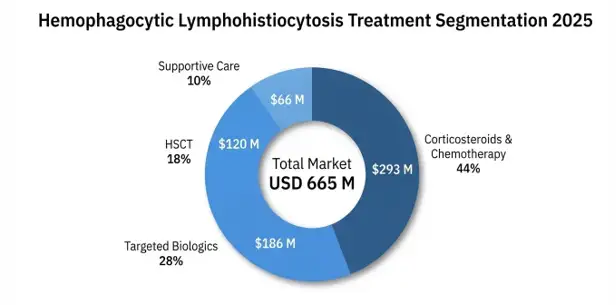
Treatment Type Insights: Classic chemotherapeutic and immunological treatments using corticosteroids and etoposide continue to be the most prominent segment, owing to decades of experience in being the preferred treatment in case of both primary and secondary forms of the disease. The fastest-growing treatment segment is that of biologics, driven by increasing usage of emapalumab and JAK inhibitors, with hematopoietic stem cell transplant remaining a key cost driver due to its curative nature.
End-User Insights: HLH care is dominated by hospitals and academic medical centers owing to the high-level diagnostic tests and intensive care required. Specialty clinics dealing with hematology and quaternary pediatric centers are critical in HLH care, trial enrollment, and transplant arrangements, while ambulatory care centers are increasingly becoming important in outpatient management of JAK inhibitors.
The HLH market on a global level is an oligopoly due to the nature of the orphan disease and the few approved and specific therapeutic options available. Sobi holds an advantageous position in the market with emapalumab, being the only regulatory-approved targeted therapy indicated for HLH, whereas Incyte and other companies developing JAK inhibitors aim at obtaining HLH indications through clinical trials. The competitive advantage lies in showing the effect on the survival rate and transplant-free survival as well as being safe enough to use in critically ill patients and children.
March 2026: Sobi presented data about the real-world efficacy of emapalumab in adult secondary HLH, indicating potential opportunities for labeling expansion with the regulatory agencies.
February 2026: Incyte Corporation took forward its Phase III development of ruxolitinib in combination with dexamethasone as first-line treatment for adult secondary HLH in multiple international centers.
January 2026: AB2 Bio Ltd reported clinical results for interleukin-18 binding protein in HLH and macrophage activation syndrome resistant to standard therapy.
December 2025: The Histiocyte Society published an updated guideline for consensus involving the use of JAK inhibitors in refractory secondary HLH and macrophage activation syndrome cases.
November 2025: Novartis presented preclinical data supporting the development of cytokine-targeted biological therapies in HLH patients.
You'll get the sample you asked for by email. Remember to check your spam folder as well. If you have any further questions or require additional assistance, feel free to let us know via-
+1 724 648 0810 +91 976 407 9503 sales@intellectualmarketinsights.com
Intellectual Market Insights Research © 2026. All rights reserved.