Share this link via:

The global hereditary angioedema market size was valued at USD 3.8 billion in 2025 and is projected to reach USD 4.2 billion in 2026, expanding to USD 8.6 billion by 2034, growing at a CAGR of 9.4% during the forecast period (2026-2034).
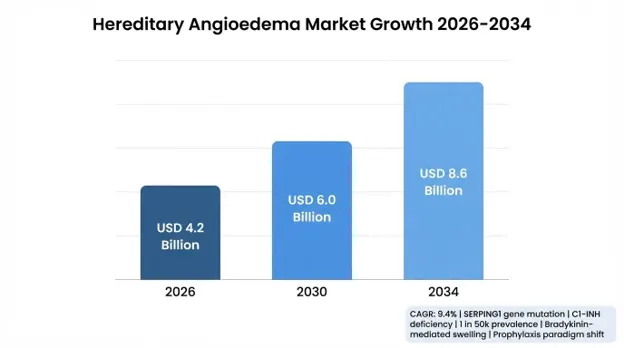
Hereditary angioedema (HAE) is a rare, autosomal dominant inherited condition that is primarily caused by mutations in the SERPING1 gene producing a protein called C1 esterase inhibitor (C1-INH), which is important in the regulation of the complement, contact, and coagulation cascades. The primary restraint on the plasma kallikrein-kinin system is lost in quantitative deficiency (Type I) or functional dysfunction (Type II) and causes excessive formation of bradykinin, a potent vasodilator that is responsible for the recurrent swelling of the extremities, face, genitalia, gastrointestinal tract, and most importantly, the upper airway. A smaller group of patients has HAE with normal levels of C1-INH but it is caused by mutations in the genes of certain components of the contact pathway (Factor XII, plasminogen, etc.) and requires specific confirmation. It is estimated to affect one in 50,000 people worldwide, with no significant gender or ethnic predilection, and can be very difficult to diagnose because of the frequent misdiagnoses along the way from onset of symptoms to a confirmed diagnosis of HAE; these include allergic angioedema, appendicitis, or idiopathic abdominal pain.
Over the last 20 years, the treatment of HAE has radically changed. Early treatments were attenuated androgens (danazol) and antifibrinolytics (tranexamic acid), which had significant long-term toxicity and only minimal efficacy in acute attacks. The introduction of plasma-derived and subsequently recombinant C1-INH concentrates allowed direct protein replacement therapy for acute treatment and short-term prophylaxis before triggering events, like surgery or dental care. The introduction of bradykinin B2 receptor antagonists and plasma kallikrein inhibitors for injection represented a second wave of innovations, offering very rapid targeted relief for acute attacks without relying on plasma-derived products. The most significant change, however, is long-term prophylaxis, in which monoclonal antibodies are given subcutaneously and, more recently, small molecule kallikrein inhibitors are administered orally daily, leading to many patients being rendered near attack-free and thus setting the benchmark for the standard of care suggested by international treatment guidelines.
HAE is a paradigm of the current paradigm of rare-disease pharmaceuticals: A small, diagnosed group that commands a high market price via orphan drug pricing, a long course of treatment, and frequent new innovations across new routes of administration. Even though the disease is rare, the annual per-patient cost of modern prophylactic biologics in the United States is often in the thousands of dollars, exceeding USD 400,000-600,000 per patient on a lifetime basis. With the market growing to include gene-editing and RNA-silencing modalities that can provide more lasting disease control, potentially in a single dose, HAE is one of the most dynamic and closely observed franchises in the rare and orphan disease pharmaceuticals industry.
| Report Coverage | Details |
|---|---|
| Base Year | 2025 |
| Base Year Value | USD 3.8 Billion |
| Forecast Value | USD 8.6 Billion |
| CAGR | 9.4% |
| Forecast Period | 2025-2034 |
| Historical Data | 2022-2025 |
| Largest Market | North America |
| Fastest Growing Market | Asia Pacific |
| Segments Covered | By Treatment Type, Drug Class, Route of Administration, Patient Type, End-User |
| Region Covered | North America, Europe, Asia Pacific, Middle East & Africa, Latin America |
| Countries Covered | US, Canada, Mexico, UK, Germany, France, Italy, Spain, Netherlands, China, Japan, India, Australia, South Korea, Brazil, Argentina, UAE, Saudi Arabia, South Africa |
| Key Market Playes | Takeda, CSL Behring, BioCryst Pharmaceuticals, Pharming Group, KalVista Pharmaceuticals, Ionis Pharmaceuticals, Intellia Therapeutics |
Get more details on this report - Request Free Sample
Historically, HAE has been characterized by extremely high diagnostic delays, with a typical delay of 8-10 years between symptom onset and accurate diagnosis because the intermittent swelling episodes may be wrongly classified as allergic reaction, irritable bowel syndrome, or appendicitis and sometimes even result in surgery before the genetic basis is known. Physician educational initiatives spearheaded by allergy and immunology associations, patient groups, and drug companies, as well as more accessibility of complement testing (C4, C1-Inhibitor, genetic testing for SERPING1 gene) have reduced the diagnostic journey in industrialized countries to about 5-7 years.
As HAE is autosomal dominant, each family member of an affected individual has a 50% chance of being a carrier of the causative mutation, making cascade testing of family members in the wake of the initial diagnosis a norm at specialized HAE centers of excellence in North America and Europe and systematically identifying asymptomatic or minimally symptomatic carriers who are at risk for developing a potentially life-threatening attack of HAE of the larynx. With the diagnosed population approaching true prevalence levels, the base of the patient pool for disease-specific treatment options is increasing.
The most significant factor that drives the commercial development of the HAE market is the clinical breakthrough from reactive and demand-based attack management to continuous long-term prophylaxis, which is supported by major international guidelines for most patients since attacks are unpredictable and sometimes can be life-threatening due to the nature of laryngeal attacks. The availability of subcutaneously administered plasma kallikrein inhibitors, which were shown to reduce attacks by more than 85-90% compared to placebo when administrated once every 2-4 weeks, was priced annually at more than USD 400,000 in the US.
The prevention market has been further expanded with the development of once-daily oral small molecule inhibitor of kallikrein, thus overcoming the barrier of injections, and making way for treatment of patients with less severe disease morphology as well as patients who were delaying systemic treatment due to various reasons. With the aid of auto-injectors, pre-filled syringes, and specialty pharmacy services providing nurse training and clinical support, both preventative and on-demand drugs are moving towards being administered from home. Patients treating HAE from home show a much higher quality of life score and adherence as compared to patients receiving hospital-based infusions, and healthcare systems benefit in reduced number of ER visits, thus improving the willingness to pay for costly prevention.
The principal constraint on the growth of the HAE market is the astronomical cost of the latest generation of targeted treatments, with the average cost of annual prophylaxis being in the range of USD 400,000-USD 600,000 per patient in the United States and USD 150,000-USD 350,000 in western European countries with centralized price negotiations and health technology assessments. Although the availability of insurance plans and pharmaceutical manufacturers' patient assistance programs mitigates this problem in high-income nations for those who have already been diagnosed with HAE, various forms of prior authorization and step therapy protocols are imposed by payers, delaying the initiation of treatment by several weeks. In the case of middle- and low-income countries in the Latin America, Asia Pacific, and Middle East & Africa regions, the availability of modern drugs and oral prophylactics is limited, and most patients are treated with obsolete and toxic therapies such as attenuated androgens and antifibrinolytics.
Upstream gene editing and antisense/RNA silencing approaches that target the disease prior to the onset of symptoms associated with bradykinin production are offering a paradigm shift where a single or less frequent drug treatment could offer durable or even curative control of the disease rather than life-long therapy. A single dose of a novel CRISPR-based in vivo gene editing drug delivered using lipid nanoparticles to silence the hepatic prekallikrein gene has shown sustained and near-complete attack freedom with long-term follow-ups. A projected cost in the ballpark of USD 2-3 million per treatment makes economic sense due to savings from lifelong prophylaxis.
Subcutaneous administration once per month, an antisense oligonucleotide that acts by inhibiting hepatic production of prekallikrein, is also another form of convenience offered by this product, other than the currently used bi-weekly injection. The first oral on-demand kallikrein inhibitor became available through regulation in the year 2025. This has enabled patients to have an alternative for injectable therapy, which is discrete and easy to carry around. This has allowed the on-demand addressable market to grow to include patients who were hesitant about taking up injections in the past due to fear of needles or because they had difficulty getting the injectable drugs when traveling due to lack of refrigeration facilities.
Inhibition of plasma kallikrein activity has been the core driver of the past decade of HAE innovation, in both subcutaneous mAbs and oral small molecules for prophylaxis, there is a trend emerging in the development of therapies aimed at inhibition of the activated factor XIIa enzyme which serves as a catalyst for initiating the contact pathway prior to the activation of kallikrein enzymes. The subcutaneous administration of mAb against factor XIIa in the dose of once per month received FDA approval for use as a prophylaxis in 2025, not only offers a longer period of treatment administration but also provides a solution to the patient complaints regarding treatment burden due to more frequent injections.
In 2025, North America will be the biggest HAE market, with the highest diagnosed-patient penetration worldwide, full coverage of commercial and government insurance, strong expertise in dedicated HAE centers of excellence, and almost all the key commercial and clinical trial infrastructure of major manufacturers. Despite high list prices of USD 400,000 or more for many of these products each year, the US offers most of the value for the region, bolstered by the presence of orphan-drug exclusivity, priority review pathways and comprehensive patient-assistance programs that facilitate uptake of these high-cost prophylactic biologics and oral treatments.
However, Europe is the second biggest regional market, with a long history of academic angioedema centers, patient registries, and high levels of health care coverage, providing easy access to approved treatments. Rigorous health technology assessment processes in markets like Germany, France, and the United Kingdom, however, can reduce the price of premium-priced therapies substantially in comparison to the United States list price, while launch timelines in other markets tend to be twelve to twenty-four months behind United States approvals until negotiation for reimbursement has been completed.
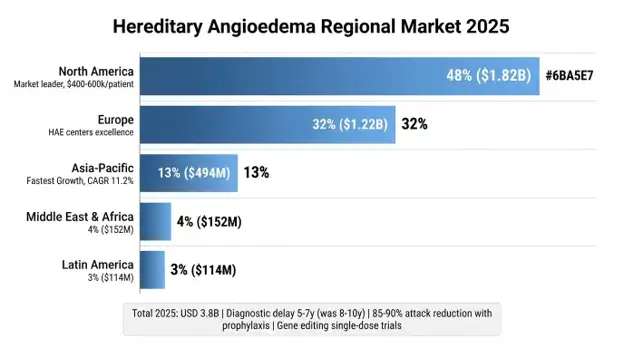
Asia Pacific is the largest region in terms of total market size, fueled by the adoption of HAE therapies in national reimbursement programs in Japan, South Korea, Australia, and in parts of China, as well as the gradual expansion of the diagnostic infrastructure and the increasing number of trained specialists in hospitals across the region. While this progress has been made, HAE still has a substantial underdiagnosed and undertreated population in most parts of the region, with China and India estimated to have less than 5% of the number of people expected to have HAE, suggesting significant latent demand as diagnostic capacity and reimbursement frameworks develop through the forecast period.
Treatment Type Insights: Long-Term Prophylaxis is the largest and the fastest-growing market segment due to guideline recommendations that support the approach of prevention of attacks rather than treatment and to the fact that there are convenient prophylactic drugs for subcutaneous and oral administration. The On-Demand/Acute Treatment segment is necessary since practically all patients need fast relief from attacks regardless of prophylactic treatment.
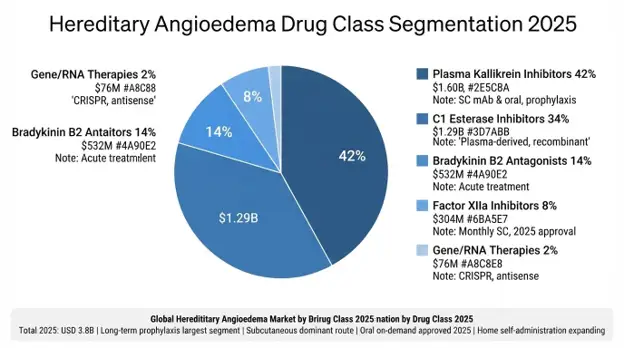
Drug Class Insights: Plasma Kallikrein Inhibitors represent the most successful drug class in terms of sales and are composed of subcutaneous monoclonal antibodies and orally active small molecules used for prophylaxis and, more recently, acute treatment. Plasma-derived and recombinant C1 esterase inhibitors continue to maintain their market presence due to decades of safe use and approvals across the pediatric and adult populations, whereas bradykinin B2 receptor antagonists and factor XIIa inhibitors play a critical supporting role in the acute and prophylactic settings, respectively.
Route of Administration Insights: The most prominent among all is subcutaneous administration, as this is mainly driven by self-administration of prophylactic biologics, while oral administration is expected to be the fastest-growing route due to the recent approvals of prophylactic and on-demand drugs in small-molecule form, which do not require injections. Intravenous administration remains relevant for acute administration and plasma C1-INH.
End-User Insights: Specialty pharmacies and home healthcare together form the biggest and fastest-growing end-user channel due to the widespread trend of patient self-administration facilitated through training programs led by nurses, and hospitals and specialty immunology clinics will continue to play a key role in the diagnosis and treatment initiation of laryngeal attacks.
The global market for HAE drugs is characterized by high levels of consolidation where a handful of niche biopharmaceutical companies make up the lion’s share of the market value via unique product portfolios that include products designed to address acute and prophylactic conditions with different modes of action and delivery methods. Competitive advantages include ease of dosing, potency and sustainability of attack inhibition, a comprehensive patient support structure, and pipeline depth in terms of next-generation prolonged-interval and gene therapy. Market leadership is sustained via lifecycle management involving formulation innovations and pediatric extensions, whereas emerging biotech firms rely on unique mechanisms and better convenience profiles.
March 2026: CSL Behring increased the real-world data associated with its Factor XIIa inhibitor for a once-a-month subcutaneous prophylactic regimen approved by the FDA in 2025, and it was confirmed that patients did not have any attacks during one year of treatment.
February 2026: KalVista Pharmaceuticals obtained insurance coverage for its oral on-demand kallikrein inhibitor, which was FDA approved in 2025, to provide patients with the first non-injection method of managing their acute attacks of HAE.
January 2026: Intellia Therapeutics reported further data from their Phase 3 in vivo gene editing program targeting hepatic prekallikrein expression, demonstrating sustained total attack suppression for two years from a single injection.
December 2025: Ionis Pharmaceuticals announced further adoption of its antisense oligonucleotide targeting prekallikrein, approved in early 2025 for preventive treatment.
November 2025: Takeda Pharmaceutical extended the label for its subcutaneous plasma kallikrein-inhibitor prophylactic treatment down to two-year-old patients.
You'll get the sample you asked for by email. Remember to check your spam folder as well. If you have any further questions or require additional assistance, feel free to let us know via-
+1 724 648 0810 +91 976 407 9503 sales@intellectualmarketinsights.com
Intellectual Market Insights Research © 2026. All rights reserved.