Share this link via:

The global Hermansky-Pudlak syndrome (HPS) market size was valued at USD 148.6 million in 2025 and is projected to reach USD 160.4 million in 2026, expanding to USD 308.0 million by 2034, growing at a CAGR of 8.5% during the forecast period (2026-2034).
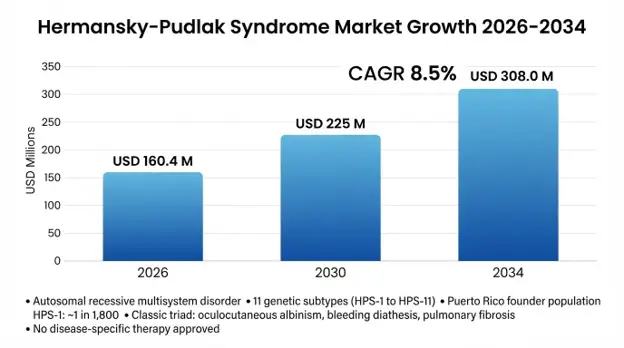
Hermansky-Pudlak syndrome is an extremely rare, autosomal recessive, multisystem disorder that results from defective biogenesis of lysosome-related organelles (LROs), such as melanosomes, platelet dense granules, and lamellar bodies of pulmonary type II alveolar epithelial cells. It was first described in 1959 and is due to pathogenic mutations in at least eleven different genes (HPS-1 to HPS-11) that each code for proteins that play a role in the trafficking of vesicles in the cell and the formation of vesicles as organelles. The classic clinical triad includes oculocutaneous albinism (due to the presence of tyrosinase), a bleeding diathesis (due to the virtual absence of platelet dense granules), and progressive accumulation of ceroid lipofuscin in several tissues. The hallmarks of the disease are the genotype-phenotype correlation: HPS-1 and HPS-4 are at the highest risk of early onset and rapidly progressive pulmonary fibrosis, while HPS-2 is unique in manifesting with neutropenia and immunodeficiency because of disruption of the AP-3 adaptor complex that is essential for lysosomal trafficking in immune cells.
Pulmonary fibrosis is the most common cause of death in HPS, usually occurring in the 3rd or 4th decade of life and, unlike idiopathic pulmonary fibrosis, often occurring at a young age and having a rapid rate of functional decline. Bleeding manifestations such as epistaxis, gingival bleeding, menorrhagia, and significant surgical or obstetric bleeding are present from early childhood and must be managed carefully throughout life. Another group of patients, especially those with the HPS-1 and HPS-4 genotypes, also develop granulomatous colitis, a Crohn's-disease-like inflammatory bowel disease, which accounts for considerable extra morbidity. Outside of the founder populations, it is estimated that between one and nine cases of the condition are present per million people worldwide, resulting in a total diagnosed population of up to a few thousand, most of which are in small clusters in many countries and were only diagnosed following individual case reports. The prevalence of HPS-1 in northwest Puerto Rico is also very high, with a well-characterized founder mutation that affects about 1 out of every 1800 individuals, making this the single largest concentrated patient community and the main center for natural history research and clinical trial recruitment worldwide.
There is at present no disease-specific therapeutic agent licensed for use in the treatment of HPS, and treatment is very largely supportive. Antifibrotic agents originally used in the treatment of idiopathic pulmonary fibrosis (IPF), such as pirfenidone and nintedanib, are used off-label for the treatment of HPS-associated pulmonary fibrosis, and the use of desmopressin and antifibrinolytic agents like tranexamic acid is indicated to help during bleeding episodes and to reduce the risk for surgical bleeding. Treatment of granulomatous colitis involves corticosteroids and biologic immunosuppressants such as anti-tumor necrosis factor (TNF) therapies; lung transplantation is only an option if there is end-stage respiratory failure, which has a higher risk because of the associated platelet defect. This sizeable unmet need, coupled with an established monogenic cause of disease that is correctable by gene-targeted approaches, is actively pursued by both academic disease-focused consortia and biopharmaceutical companies working in the rare disease fields of pulmonary and hematologic diseases.
Commercialization of the HPS market is tightly coupled with extended market exclusivity, tax credits, protocol support, and fee waivers under various orphan drug incentive programs in the United States, European Union, and Japan, which significantly impact the market economics for therapies developed for populations of just a few thousand worldwide. The number of patients previously diagnosed or misclassified with albinism, bleeding disorders, and early-onset interstitial lung disease (ILD) is growing as next-generation sequencing panels are being adopted, and these patients are being added to structured care pathways, natural history registries, and clinical trials, thereby slowly increasing the treated population and driving continued market growth over the forecast period.
| Report Coverage | Details |
|---|---|
| Base Year | 2025 |
| Base Year Value | USD 148.6 Million |
| Forecast Value | USD 308.0 Million |
| CAGR | 8.5% |
| Forecast Period | 2025-2034 |
| Historical Data | 2022-2025 |
| Largest Market | North America |
| Fastest Growing Market | Asia Pacific |
| Segments Covered | By Genetic Subtype, Disease Manifestation, Treatment Type, Route of Administration, End-User, Region |
| Region Covered | North America, Europe, Asia Pacific, Latin America, Middle East & Africa |
| Countries Covered | US, Puerto Rico, Canada, UK, Germany, France, Italy, Netherlands, Japan, China, India, South Korea, Australia, Brazil, UAE, Saudi Arabia |
| Key Market Playes | Boehringer Ingelheim, Roche (Genentech), United Therapeutics, Sanofi, Chiesi Farmaceutici, CSL Behring, Ultragenyx Pharmaceutical |
Get more details on this report - Request Free Sample
The rapid advancement in genetic testing technologies that are increasingly narrowing down the time lag between the appearance of symptoms and diagnosis of HPS is another driver of market growth. Indeed, it has been taking years for patients to be misdiagnosed as having non-syndromic albinism or idiopathic pulmonary fibrosis before the real syndromic diagnosis is established, since the features of HPS, such as oculocutaneous albinism, spontaneous bruising, and early onset of pulmonary fibrosis, are typically seen individually by dermatologists, hematologists, and pulmonologists.
Improved clinical recognition following decades of natural historical research, the increased use of next-generation sequencing panels during the diagnosis of albinism and unexplained bruising has contributed to narrowing the diagnostic delay, making it possible to start following the pathway of multidisciplinary treatment. The pool of candidates for clinical trials and supportive medications is continuously growing and, therefore, contributing to market growth.
HPS-associated pulmonary fibrosis presents earlier in life compared to idiopathic pulmonary fibrosis, is aggressive in nature, and has no disease-specific therapy approved thus far; its seriousness and the lack of effective treatment options present the most commercially compelling rationale in the market. The resulting need for the use of antifibrotic drugs off-label and, ultimately, lung transplants represents a clearly defined unmet medical need recognized by the payer and regulatory communities, thereby creating a conducive setting for the implementation of appropriately designed and genotype-stratified development programs.
The orphan drug policies existing in the US, EU, and Japan, with their provisions of extended market exclusivity, exemptions from fees, clinical trial tax credits, and other benefits, create this setting and positively impact the risk-reward dynamics for companies interested in developing therapies for this exceedingly rare indication. The founder population residing in Puerto Rico represents a relatively accessible and engaged group of patients who have participated in numerous governmental studies involving interventions for HPS-1.
The most obvious restriction on HPS market expansion is the extremely small patient population on a global scale, additionally divided into eleven different genetic types with varying clinical phenotypes and possibly distinct treatment targets. Unless it concerns the patient population originating from the Puerto Rican founders' group, national patient pools tend to be limited to tens or even just a few hundred people each, hindering the conduct of traditional randomized controlled trials, necessitating international cooperation, extended timeframes, and special statistical approaches. This fragmentation also means a restriction on the commercially viable pool of patients, as any agent efficient in treating HPS-1-related pulmonary fibrosis would be of limited relevance to other genetically distinct subtypes of HPS. The presence of a bleeding disorder makes intervention studies and surgery even more difficult, including the lung transplantation procedure, which requires a perioperative approach and facilities that are rare internationally.
HPS is a consequence of well-understood, single-gene mutations that affect distinct proteins participating in lysosomal organelle development, rendering the disease highly suited for therapeutic approaches that aim at correcting genes, which can address pulmonary, hematological, and dermatological symptoms of the disease collectively, rather than treating each individual symptom separately. Preclinical development efforts include adeno-associated virus (AAV) gene replacement therapies, lentivirus-based ex vivo approaches to hematopoietic progenitor cells, and lipid nanoparticle delivery of messenger RNA-based therapies to restore normal lamellar body structure in alveolar epithelial cells and dense granule development in platelets.
Lacking an effective conventional treatment option and considering the severity of HPS-associated pulmonary fibrosis, a novel gene- or RNA-based therapy for HPS is likely to be considered worthy of premium orphan drug pricing, similar to other FDA-approved gene therapies for rare pulmonary and hematologic diseases delivered in a single administration, while the concentration of the HPS-1 population in Puerto Rico represents a convenient environment for a clinical trial of such a therapy.
HPS research is steadily moving away from studies involving pooling across genotypes to highly stratified studies involving only those genotypes at highest risk for developing pulmonary fibrosis, HPS-1 and HPS-4 specifically, thanks to new circulating and imaging biomarkers for detecting early-stage lung involvement that precedes any changes in pulmonary function measures, including surfactant-associated proteins and high-resolution computed tomography scoring systems based on the unique fibrotic pattern seen in HPS.
Through allowing earlier initiation of treatment, improved patient stratification, and increased sensitivity in assessing treatment effect in small cohorts, these advances have made interventional research statistically feasible even for this ultrarare disease. Equally important are the efforts being made to standardize the multidisciplinary management strategies in HPS that involve pulmonology, hematology, ophthalmology, gastroenterology, and clinical genetics.
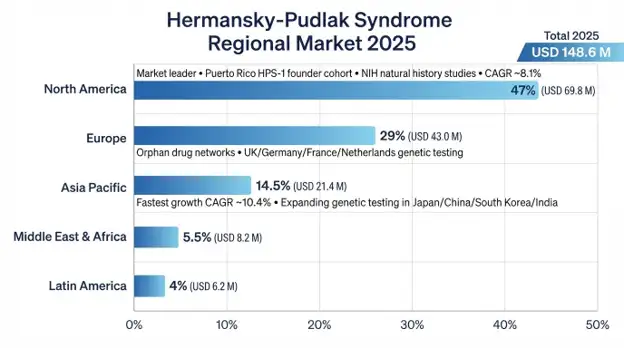
North America: North America constitutes the leading regional market, estimated to be worth about USD 69.8 million in 2025 and growing at a projected CAGR of about 8.1% up until 2034. This is due to the long-standing involvement of the government in sponsoring natural history studies of HPS, Puerto Rico being the main location of study for HPS-1 due to the high prevalence of the condition there, the presence of academic rare disease centers specializing in interstitial lung diseases, and the availability of active patient advocacy groups developing registries.
Europe: Europe stands out as the second largest market, amounting to around USD 43.0 million in 2025, due to reimbursement models favoring orphan drugs, coordinated rare disease referral networks for interstitial lung disease, and increasing ability of genetic testing in the UK, Germany, France, and Netherlands, which is helping detect cases beyond founder mutations.
Asia Pacific: The Asia Pacific, estimated to be worth USD 21.4 million in 2025, is anticipated to be the fastest-growing region with a CAGR of about 10.4% till 2034. The growth will be driven by the increasing genetic testing facilities in countries such as Japan, China, South Korea, and India; increasing awareness among clinical geneticists and dermatologists regarding syndromic albinism; and the development of national rare diseases registries, which are increasingly classifying cases of idiopathic pulmonary fibrosis and albinism as HPS.
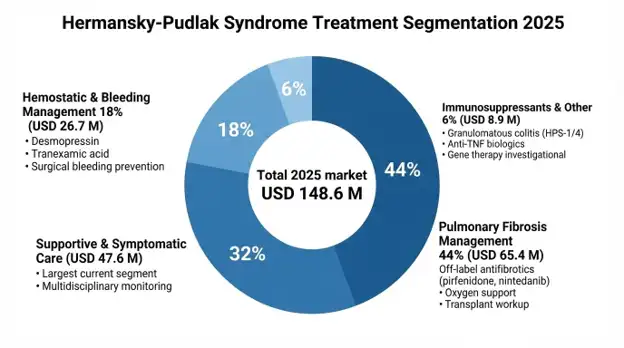
Pulmonary fibrosis is the largest segment of diseases in terms of value and will be worth about USD 65.4 million in 2025 because of the very high cost of managing the complications due to the treatment of antifibrosis, oxygen support, transplant workup, and monitoring. Oculocutaneous albinism & bleeding diathesis management constitutes most of the value in the remaining segments because of lifelong care in the ophthalmology, dermatology, and hematology departments, while granulomatous colitis and immunodeficiency associated with HPS-2 constitute the small segments.
Based on types of treatment, supportive care holds the largest market share because of the lack of any available disease-modifying drug, while the second-fastest-growing category is pharmacological therapy, comprising off-label antifibrotics, desmopressin, and immunosuppressants, because of the increasing standardization of treatment procedures. On the other hand, gene & cell therapy is an emerging category.
The academic medical centers are the foremost user category, considering the need for multidisciplinary knowledge of HPS, natural history, and clinical trial facilities to address this multisystemic condition, while the other categories include rare disease specialty clinics and general hospitals offering local support.
The HPS drug market globally continues to be at an early phase of commercialization, where there is no disease-specific therapy on approval, the drug discovery pipeline comprises primarily repurposed anti-fibrotic and immunomodulatory drugs, and a few biopharma players along with academic consortia are engaged in genetic-targeting therapies. The market position of players is not dependent so much on market shares but on their natural history studies, registry collaborations, and availability of the Puerto Rican HPS-1 patient population, which are key elements in determining the feasibility of conducting clinical trials in the indication.
April 2026: Guidelines for management of HPS were continuously updated and stressed the importance of multidisciplinary management of bleeding disorders in HPS and surveillance of pulmonary fibrosis, which is one of the most important complications of HPS.
February 2026: Scientific studies continuously concentrated on HPS-related pulmonary fibrosis and tried to understand the pathogenesis and possible therapeutic approaches for this condition besides the conventional supportive therapy.
November 2025: Scientific studies further provided information about HPS-2 and its genotype-phenotype relationship and platelet function defects, which helps in proper molecular diagnosis of the condition.
August 2025: Molecular studies identified further genetic mutations associated with HPS and highlighted the need for molecular studies to help classify HPS subtypes.
You'll get the sample you asked for by email. Remember to check your spam folder as well. If you have any further questions or require additional assistance, feel free to let us know via-
+1 724 648 0810 +91 976 407 9503 sales@intellectualmarketinsights.com
26 Aug 2026
Intellectual Market Insights Research © 2026. All rights reserved.