Share this link via:

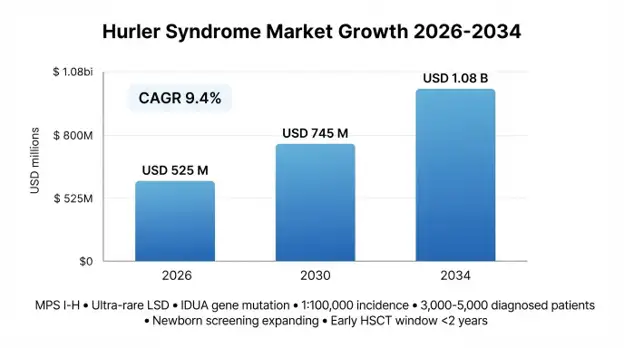
The global Hurler syndrome market size was valued at USD 480 million in 2025 and is projected to reach USD 525 million in 2026, expanding to USD 1.08 billion by 2034, growing at a CAGR of 9.4% during the forecast period (2026-2034).
The clinically defined form of MPS I (Mucopolysaccharidosis type I, Hurler phenotype (MPS I-H)) is the most severe and is an ultra-rare autosomal recessive lysosomal storage disorder (AR-LSD) due to pathogenic mutations in the IDUA gene on chromosome 4p16.3. These mutations lead to almost complete absence of the lysosomal enzyme alpha-L-iduronidase, required for the sequential degradation of the glycosaminoglycan dermatan sulfate and heparan sulfate. These partially degraded glycosaminoglycans will progressively build up inside the lysosomes in almost all organs, leading to a relentingly progressive, multi-systemic disease. The phenotypical features of infants with Hurler syndrome include coarse facial features, corneal clouding, hepatosplenomegaly, dysostosis multiplex (skeletal dysplasia), joint stiffness, upper respiratory tract infections, sensorineural hearing loss, thickening of cardiac valves, and progressive neurocognitive decline by the first year to two years of age. Most children with the disease will survive only a few years without treatment to stop the disease from getting worse, and the majority will die of cardiorespiratory complications within the first decade of life.
Two disease-modifying interventions are the backbone of the therapeutic and commercial landscape of Hurler syndrome, which are often used together rather than separately. The only treatment that may significantly influence the course of the disease is allogeneic hematopoietic stem cell transplantation performed as early as possible and preferably prior to two years of age, because donor leukocytes (and microglial precursors) are able to migrate to the central nervous system and provide a permanent source of enzyme. Recombinant alpha-L-iduronidase (laronidase) is given as a weekly intravenous infusion to help reduce hepatosplenomegaly and improve joint mobility and pulmonary function and has been used as a primary enzyme replacement therapy (ERT) for patients who are not transplant candidates and is often used to stabilize patients in the weeks leading up to transplant. Laronidase enters the bloodstream, but it does not reach the brain in clinically relevant amounts, a fact that continues to have a significant impact on research priorities and investments throughout the field, especially in the development of drugs that would be effective in treating the most debilitating symptom of the disease, namely, the neurocognitive impairment.
Hurler syndrome is safely in the realm of “ultra-rare disease economics.” The incidence of MPS I is estimated to be about 1:100,000 live births, of which the majority of patients are diagnosed as the Hurler phenotype, and the global prevalence is estimated to be 3,000-5,000 diagnosed patients at any one time, which probably underestimates the true burden of the disease, as an increasing number of cases are being underdiagnosed, especially in regions lacking newborn screening or lysosomal storage disorder testing infrastructure. Treatment of these patients is centralized in a limited number of national and regional metabolic disease and transplant reference centers, and per-patient costs are very high and are a large share of total revenue compared to very few other pediatric conditions.
Today, the market is making a shift from single-use ERT and HSCT to a more diverse therapeutic profile. Newborn screening for LSDs has been steadily expanding in the number of disorders that are being screened and the numbers of infants that are being screened, allowing for earlier identification than in the past and moving the window of eligibility for transplantations from the second year of life to the first few weeks. At the same time, an active pipeline of gene and cell therapy candidates is moving forward in clinical development, aiming to provide durable and one-time enzyme deficiency correction in both somatic tissues and the CNS, which is not possible with current standard-of-care therapies.
| Report Coverage | Details |
|---|---|
| Base Year | 2025 |
| Base Year Value | USD 480 Million |
| Forecast Value | USD 1.08 billion |
| CAGR | 9.4% |
| Forecast Period | 2025-2034 |
| Historical Data | 2022-2025 |
| Largest Market | North America |
| Fastest Growing Market | Asia Pacific |
| Segments Covered | By Treatment Type, Route of Administration, Age Group, End-User, Region |
| Region Covered | North America, Europe, Asia Pacific, Middle East & Africa, Latin America |
| Countries Covered | US, Canada, UK, Germany, France, Italy, Spain, Netherlands, China, Japan, India, Australia, South Korea, Brazil, Mexico, UAE, Saudi Arabia, South Africa |
| Key Market Playes | Sanofi (Genzyme), BioMarin Pharmaceutical, REGENXBIO, Orchard Therapeutics, JCR Pharmaceuticals, Takeda Pharmaceutical |
Get more details on this report - Request Free Sample
The primary structural factor driving the market growth in Hurler syndrome is the increasing worldwide adoption of screening programs for lysosomal storage diseases, specifically MPS I, as part of the newborn screening panel. In the past, Hurler cases were usually diagnosed only when symptoms became apparent, generally between twelve and twenty-four months after birth, at a stage where neurocognitive and musculoskeletal harm was already done. The disease was included in the Recommended Uniform Screening Panel of the United States in 2016, and a steadily rising number of states and countries in North America, Europe, and some regions of the Asia Pacific have followed suit. With the help of blood spot activity assays of enzymes and subsequent confirmatory genetic tests, babies affected by Hurler syndrome can now be detected just weeks after birth rather than years, allowing for early intervention before any organ harm is sustained.
Key Effect Metrics:
Continuous improvements in hematopoietic stem cell transplantation techniques, such as low toxicity conditioning regimens, donor selection improvement, and more extensive use of umbilical cord blood, have contributed to decreased mortality rates due to transplantations and better grafting outcomes than in previous decades. These advances help build physicians' confidence in advising on the use of transplantation and increase payers' willingness to cover the cost of the procedure for selected babies after screening.
Lentiviral ex vivo hematopoietic stem cell gene therapy programs entail isolating the patient’s own stem cells and genetically modifying them to produce alpha-L-iduronidase to combine the advantages of transplant with supraphysiologic enzyme production in addition to eliminating the need for donor matching. In vivo gene therapy candidates using AAV vectors and delivered directly to the central nervous system are being developed to tackle the neurodegeneration that cannot be effectively treated by intravenous enzyme replacement therapy.
Innovation Impact Metrics:
The first limitation regarding the expansion of Hurler syndrome markets is the extremely high cost associated with managing the disease throughout one’s life. Weekly enzyme replacement therapy involves infusions via the vein, which costs hundreds of thousands of dollars annually for each patient according to his/her weight and the pricing in that area, whereas hematopoietic stem cell transplantation, including conditioning, the procedure itself, and post-treatment care, is yet another six-figure expense for each patient. When supportive multidisciplinary treatment, surgeries for skeletal and cardiac problems, and follow-up costs are added to these expenses, then the overall lifetime cost can be even higher, amounting to millions of dollars.
These costs act as significant barriers of entry in terms of pricing sensitivity, especially in markets with underdeveloped healthcare systems where there is no specific process in place for the reimbursement of rare diseases, and even developed markets would have to go through an arduous health technology assessment process. With the imminent arrival of gene therapies at a premium cost, considering their curative nature, these barriers would be put to a test.
Another related restraint is the failure of enzyme replacement therapy through the intravenous route in crossing the blood-brain barrier, thus leaving the accumulation of glycosaminoglycans in the central nervous system unattended even in cases where the somatic part of the disease is under control. This disparity between the existing treatment and the neurological requirement reduces the value of the treatment from the perspective of the payer community.
The existence of delivery systems that can treat the nervous system manifestations of Hurler syndrome, which are considered the most incapacitating and overlooked part of the disease, is highly probable. Intrathecal delivery of enzyme preparations, direct delivery into the cerebrospinal fluid, and fusion proteins utilizing receptors to facilitate crossing of the blood-brain barrier are among those currently under consideration. Any system being made commercially viable will not only benefit newly diagnosed individuals but also a large group of transplant survivors who have controlled their somatic manifestations but still suffer from neurological impairment.
The most disruptive trend that would shape the future of the Hurler Syndrome market is the development of gene and cell therapy, which aims at permanently curing the disease by correcting the deficiency of the enzyme responsible for it. REGENXBIO’s AAV9 gene therapy candidate, directly administered into the central nervous system, and Orchard Therapeutics’ hematopoietic stem cell gene therapy candidate, delivered ex vivo using lentiviruses, have been identified as some of the most interesting candidates being developed in this area. The research seeks to provide proof of sustained enzyme activity and neurocognitive stabilization beyond what is currently achievable through organ transplantation and enzyme replacement therapy. If the program succeeds, this will transform the market completely by providing permanent cures, eliminating the need for a lifelong regimen, with the drug price reflecting this intention.
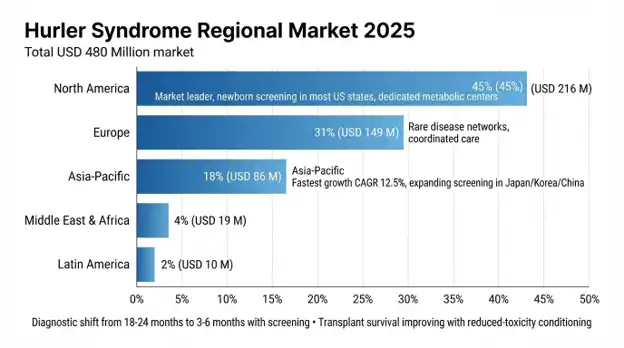
North America had the largest market share of about USD 216 million in 2025 and is forecast to expand at a CAGR of around 8.9% up to 2034. Market dominance can be attributed to wide coverage of newborn screening programs for MPS I in most U.S. states, the presence of a large number of dedicated metabolic disease and transplant centers, and well-defined insurance coverage procedures, which make it easier to obtain expensive enzyme replacement therapies and transplantation. Favorable orphan drug legislation, such as market exclusivity and priority review designation, provides additional incentive for pharma companies to invest in the region, and North American sites are among the largest contributors to global enrollment in gene therapy clinical trials for MPS I.
The fastest growing market among all regions will be that of the Asia-Pacific market, which will grow at a rate of around 12.5% from an estimated valuation of USD 86 million in 2025 until 2034. The factors responsible for the growth include the gradual adoption of newborn screening programs in Japan, South Korea, China, and some Southeast Asian countries, increased healthcare spending, and awareness of rare genetic diseases among pediatricians and geneticists. In China and India, which represent a major portion of the total number of births per year globally, a relatively small percentage of the total estimated birth population of patients suffering from Hurler syndrome is diagnosed.
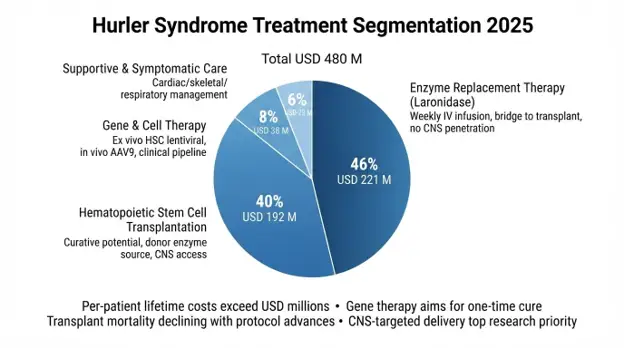
The biggest treatment segment is enzyme replacement therapy, which is expected to capture around 46% of the market revenue in 2025, owing to its established safety profile, wide regulatory approval, and continued use as a bridge to transplantation therapy as well as ongoing treatment for patients who are not transplant recipients. Hematopoietic stem cell transplantation is the next closest competitor at around 40% of market revenue, due to its high cost per procedure and the limited number of specialized transplant centers across the world. Gene & Cell Therapy and Supportive & Symptomatic Care make up the remaining stake, but gene therapy will likely expand at a growing rate as the initial candidates go on regulatory approval.
Hospitals & transplant centers account for the major end-user segment, accounting for around 68% of market revenue, as transplant procedures are mostly concentrated within tertiary care facilities, involving multidisciplinary teams and management of disease-related complications. Specialty metabolic clinics make up a significant secondary slice with their long-term monitoring responsibilities, administration of enzyme replacement therapy, and coordination of multidisciplinary follow-up services, and home healthcare is a smaller but emerging piece of the pie as home infusion options for stable, transplanted, and long-term enzyme replacement therapy patients become more prevalent.
The global market for Hurler syndrome is still extremely concentrated among just a few established companies and emerging companies. Sanofi, via its Genzyme business unit, occupies a dominant commercial footprint based on the long history of Aldurazyme, along with solid connections among the worldwide metabolic disease specialist community, while Biogen continues to be one of the key pillars since it was the initial developer of the therapy. Competitive dynamics have increasingly been defined by developers of gene therapies and cell therapies, like REGENXBIO and Orchard Therapeutics, whose programs at the clinical stage can potentially revolutionize the therapeutic approach following approval. Competition is driven by clinical proof of cognitive improvement, reliable manufacturing, and reimbursement in difficult orphan drug markets.
March 2026: REGENXBIO provided further updates on their clinical studies involving gene therapy for MPS I using an AAV9 vector, including cerebrospinal fluid glycosaminoglycan analysis in treated children.
January 2026: Orchard Therapeutics provided updates on their ex vivo lentiviral hematopoietic stem cell gene therapy program for Hurler syndrome, including enzyme activity results in treated patients.
November 2025: Sanofi extended their patient access programs for laronidase to new markets in Latin America and Southeast Asia via managed access and patient assistance programs.
September 2025: A multicenter international registry study described better outcomes in terms of long-term survival and engraftment in patients with Hurler syndrome who underwent hematopoietic stem cell transplants under a reduced toxicity conditioning regimen.
You'll get the sample you asked for by email. Remember to check your spam folder as well. If you have any further questions or require additional assistance, feel free to let us know via-
+1 724 648 0810 +91 976 407 9503 sales@intellectualmarketinsights.com
26 Aug 2026
Intellectual Market Insights Research © 2026. All rights reserved.