Share this link via:

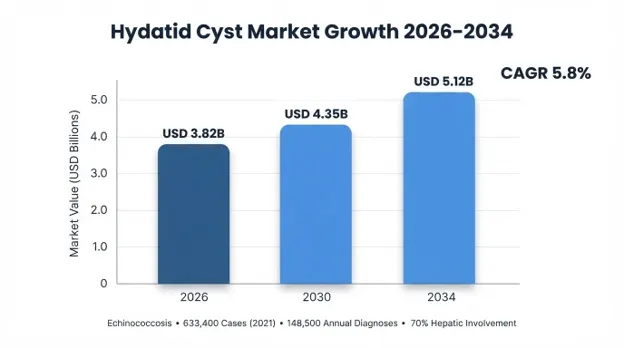
The global hydatid cyst market was valued at USD 3.34 billion in 2025 and is projected to reach USD 3.82 billion in 2026, expanding to USD 5.12 billion by 2034, growing at a CAGR of 5.8% during the forecast period (2026-2034).
Hydatid cyst disease, also known as echinococcosis or hydatidosis, is a complex zoonotic parasitic infection in which intermediate mammalian hosts are infected by larval stages of Echinococcus tapeworms, which are transmitted to humans in several ways: through ingesting water or food contaminated with the larval cysts of these worms or by direct contact with the parasitized animal feces, particularly from canines, the definitive hosts. Pathophysiology includes gradual development of cysts containing fluid mainly in the hepatic tissue, which is responsible for about 65-75% of all cases, as well as involvement of pulmonary tissue in 20-30% of cases and involvement of tissues of the spleen, kidneys, heart, and osseous tissue in lesser numbers depending on the distribution of blood vessels and the development of the different stages of the parasite.
Commercial products used in the treatment and diagnosis of hydatid cyst disease comprise a broad range of therapeutic and diagnostic products, such as pharmaceutical anthelmintic drug products (mainly albendazole and mebendazole), sophisticated imaging diagnostic equipment from ultrasound to computed tomography and magnetic resonance imaging technologies, surgical instruments for cyst resection and cavity filling, and minimally invasive percutaneous puncture-aspiration-injection-re-aspiration (PAIR) equipment. The market primarily tackles the disease burden in approximately 633,400 cases recorded in 2021 with 148,500 new diagnoses each year, particularly in economically disadvantaged countries of Central Asia, South America, Middle Eastern countries, and North African countries with poor livestock sanitation, limited veterinary disease surveillance, and poor public health infrastructure, allowing parasites to be transmitted throughout the cycle.
The therapeutic value goes beyond patient management to the inclusion of a complete zoonotic disease control system that combines veterinary measures such as deworming dogs with praziquantel, vaccination programs for livestock using recombinant antigen vaccines derived from E. granulosus, hygienic slaughtering methods to ensure that infected organs are not contaminated by humans, and community health education to decrease human exposure risk. The age-standardized prevalence rate of 9.88 per 100 000 population was seen in low-sociodemographic index regions, whereas high-sociodemographic index areas had an age-standardized prevalence rate of 1.67 per 100 000, indicating a lack of healthcare access, diagnostic ability, and clinical intervention in resource-constrained areas.
| Report Coverage | Details |
|---|---|
| Base Year | 2025 |
| Base Year Value | USD 3.34 billion |
| Forecast Value | USD 5.12 billion |
| CAGR | 5.8% |
| Forecast Period | 2025-2034 |
| Historical Data | 2022-2025 |
| Largest Market | Asia Pacific |
| Fastest Growing Market | South America |
| Segments Covered | By Product Type, Technology, Treatment Modality, Disease Indication, End-User |
| Region Covered | North America, Europe, Asia Pacific, Middle East & Africa, Latin America |
| Countries Covered | USA, Canada, Mexico, UK, Germany, France, Spain, Italy, China, Japan, India, Australia, Peru, Argentina, Chile, Brazil, Egypt, Morocco, and Central Asian Republics |
| Key Market Playes | Novartis AG, Bayer AG, Pfizer Inc., GSK Pharmaceuticals, Abbott Diagnostics, Siemens Healthineers, GE Healthcare, Medtronic PLC, Stryker Corporation |
Get more details on this report - Request Free Sample
The market dynamics for the hydatid cyst market are influenced by the continuing problem of echinococcosis globally, especially within the geographical locations where there is a lack of adequate infrastructure for control of the disease. The global prevalence has increased by 70.07% between 1990 and 2021, with global prevalence being approximately 633,400 cases in 2021, which means that there are many cases that go undiagnosed due to lack of symptoms and poor health care coverage. Major endemic markets include Central Asia, Southern Latin America, North Africa, and the Middle East due to exposure to livestock, traditional husbandry practices, and continuous zoonotic transmission. In Southern Latin America, the age-standardized prevalence was 38.15 per 100,000 in 2021, whereas it was 23.05 per 100,000 in Central Asia. About 148,500 new cases are diagnosed every year.
The developments in diagnostic imaging, serology, and point-of-care technology are increasing the market potential of the hydatid cysts by allowing early and better detection of the disease. Ultrasound is the gold standard for diagnosing hepatic hydatid cysts with the ability to detect complicated cases with sensitivities of over 95%. It allows visualization of the daughter cysts and the hydatid sand. Computed tomography helps with assessment of the anatomical structures and planning of the surgical procedure through complication detection (rupture, infection, biliary involvement). MRI offers better characterization of the cystic structures and helps identify the complicated or extrahepatic cases. Serology, including the ELISA and the immunofluorescence tests, helps with the detection of extrahepatic cases and increases the reliability of diagnosis. Furthermore, molecular diagnostics using the PCR technique help with species and genotype identification.
The hydatid cyst market is faced with challenges of lack of awareness and diagnostic capabilities in the endemic countries, causing a delay of about 4 to 7 years in diagnosis and thereby making the chances of complications from disease high. Most of the affected regions lack awareness of the symptoms of echinococcosis, making it difficult for people to access health care services and therefore the advancement of the disease. The lack of ultrasound, CT scans, and MRI facilities in the low sociodemographic index regions, the lack of radiologists, and a referral system to specialized centers hinder the hydatid cyst market. Veterinary surveillance in the regions remains weak; hence, parasite infections can still occur from dogs to sheep and other livestock. Furthermore, health programs in the endemic areas may not include adequate training on the diagnosis and treatment of echinococcosis.
The opportunities that arise from integrated One Health approaches about expanding the market of hydatid cysts are many since they integrate human health care, veterinary medicine, food safety, and environmental health measures. Echinococcosis leads to about 3 billion USD annually in terms of livestock production losses, hence creating incentives for the prevention and control of diseases. Vaccination of the livestock using recombinant E. granulosus antigen vaccines is a preventive approach that can be considered, especially in South American endemic areas. Further deworming of dogs using praziquantel can further contribute to breaking the life cycle of the parasites by reducing the infections among the definitive hosts and preventing the contamination of the environment. Furthermore, community education approaches to slaughtering, disposal of animal excrement, and personal hygiene practices can contribute to preventive efforts.
The market for treatment of hydatid cysts has been moving away from conventional open surgery to minimally invasive procedures using ultrasound, CT, and MRI as an aid to guide procedures that are less prone to complications, have shorter recovery times, and can be done in an outpatient setting. Percutaneous drainage shows efficacy equivalent to surgical methods for WHO stages I-III cysts while decreasing the time taken and complications. Advancement in techniques such as catheterization, administration of sclerocides, and imaging techniques will go a long way in enhancing efficacy and reducing complications such as biliary fistula, bleeding, puncture of organs, and anaphylaxis. The advanced catheter technique will make it possible to drain and treat cysts that are large and multi-chambered using staged techniques. Hybrid techniques using a combination of percutaneous techniques and surgery for difficult cases is another emerging trend.
The Asia Pacific market takes the lead in terms of revenues generated from hydatid cysts, expected to be worth USD 1.42 billion by 2025, growing with a CAGR of 7.3% until 2034. The regional market growth can be attributed to factors such as a huge population base, high endemicity levels, and improved healthcare infrastructure. China holds a dominant share in terms of value in the regional market owing to an estimated population of 3.2-4.1 million hydatid cyst cases. Countries in Central Asia, such as Kazakhstan, Kyrgyzstan, Tajikistan, and Uzbekistan, have a high prevalence of the disease due to the practice of farming, as well as the life cycle involving the transmission among dogs, sheep, and humans.
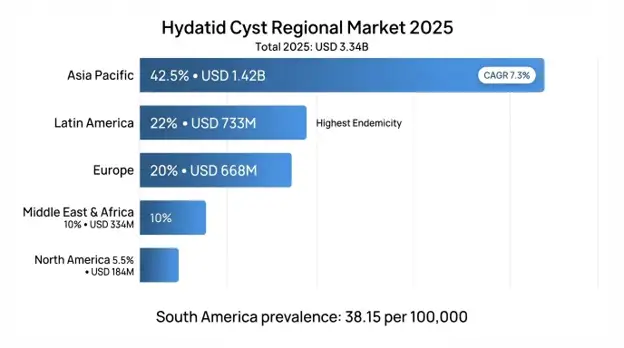
The Latin American area constitutes a significant market for hydatid cysts because of endemicity, which is very high, with prevalence rates of 38.15 cases per 100,000 individuals for southern regions. The countries of Argentina, Peru, and Chile have highly affected rural communities whose rate of incidence is between 15 and 50 cases per 100,000 individuals per year. The Patagonian part of Argentina and the Andean parts of Peru and Chile are considered echinococcosis zones because there are surgical treatment facilities and tertiary care centers. Increased use of imaging diagnostics and percutaneous treatments is building the capacity of this region to treat patients.
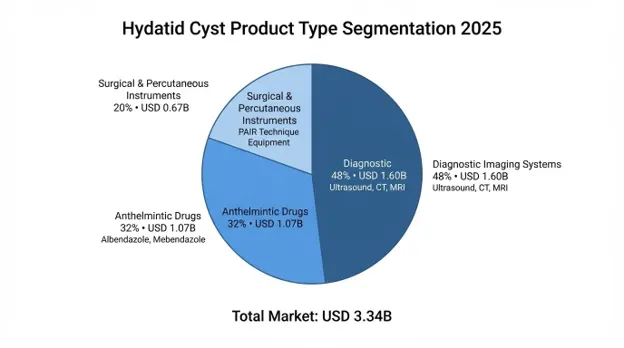
Diagnostic imaging systems have become the most dominant players in the hydatid cyst market, commanding 48% market share worth USD 1.60 billion by 2025 due to ultrasounds, computed tomography scans (CT), magnetic resonance imaging (MRI), and imaging consumables for diagnosing and planning treatment. Anthelmintic pharmaceuticals constitute a 32% market share, worth USD 1.07 billion, in terms of albendazole, mebendazole, and ancillary medicines. Surgical instruments and percutaneous intervention instruments are responsible for 20% market share worth USD 0.67 billion in surgical instruments, catheter systems, scolicidal delivery systems, and image guidance technology.
The ultrasound imaging technique holds the largest market share of 42% worth USD 1.40 billion in 2025 because of its application in screening, characterization of cysts, and guiding percutaneous interventions. The computed tomography technique holds 28% of the market and is worth USD 0.93 billion owing to its significance in evaluating complex anatomy and aiding in surgery. The serological tests and molecular diagnostics hold 18% of the market and are worth USD 0.60 billion because of the increasing use of molecular tests in epidemiological surveillance and monitoring of treatment.
Hepatic hydatidosis constitutes the leading share of indications in the market, which has been forecasted to be worth USD 2.10 billion in 2025 and growing at a 5.9% CAGR until 2034, constituting roughly 70% of all clinical cases. Pulmonary hydatidosis is forecasted to be worth USD 1.02 billion in 2025 and growing at a 6.1% CAGR due to specific needs of diagnostics and surgical interventions. Multi-organ hydatidosis is estimated to be worth USD 0.22 billion and registers the fastest growth at 7.8% CAGR from 2025 to 2034.
The hospitals segment commands the largest share of the end-user market for hydatid cysts at 56%, worth USD 1.87 billion in 2025, owing to their high-quality imaging, hepatobiliary surgeries, services related to infectious diseases, and intensive care units. The diagnostic imaging centers contribute 28% to the market revenue, amounting to USD 0.93 billion due to rising diagnostic requirements and development of facilities in endemic areas. The surgical centers contribute 16% to the market and are expected to register high growth rates on account of minimally invasive techniques.
The global market for hydatid cysts is moderately fragmented, with the top nine firms occupying about 48-55% of the market value share. Competition exists in terms of diagnostic imaging techniques, anthelmintic medicines, and surgical intervention devices, which are supported by existing networks of distribution and research funding. Some important areas of competition in the industry include the accuracy of diagnostics, effectiveness of anthelmintics, safety records, imaging guidance technology, and alliances with the healthcare institutions in the endemic regions. Some of the leading firms in the pharmaceutical industry include Novartis AG, Bayer AG, Pfizer Inc., and GSK Pharmaceuticals. Abbott Diagnostics and Roche Diagnostics are leading players in the diagnostic testing field.
March 2026: Positive Phase III trial results of a novel albendazole extended-release formulation from Chinese pharmaceutical firm Luokang, which requires only once-weekly medication instead of the tri-daily medication of existing formulations, have been reported. Submissions have been made to the NMPA of China, and approval is expected by late 2026.
February 2026: An AI-powered ultrasound analysis tool was developed by Philips Healthcare for hydatid cyst diagnosis and characterization. It helped in minimizing the dependency on operators for diagnosing and made possible the remote diagnosis of hydatid cysts. System launch was started in India and Central Asia.
January 2026: The Pan American Health Organization has launched an upgraded echinococcosis control manual that provides practical assistance for the successful implementation of the livestock vaccination program along with the training of community health workers in endemic Latin American countries.
December 2025: Siemens Healthineers received regulatory approval for a portable CT imaging system designed for resource-limited settings, enabling advanced imaging capability deployment in endemic regions previously limited to ultrasound-dependent diagnosis.
November 2025: WHO-IWGE published updated surveillance indicators framework supporting standardized global disease burden monitoring, establishing baseline epidemiological metrics and control program outcome measurement approaches.
You'll get the sample you asked for by email. Remember to check your spam folder as well. If you have any further questions or require additional assistance, feel free to let us know via-
+1 724 648 0810 +91 976 407 9503 sales@intellectualmarketinsights.com
27 Aug 2026
Intellectual Market Insights Research © 2026. All rights reserved.