Share this link via:

The global hypereosinophilic syndrome market size was valued at USD 763 million in 2025 and is projected to reach USD 887 million in 2026, expanding to USD 1.96 billion by 2036, growing at a CAGR of 8.68% during the forecast period (2026-2036).
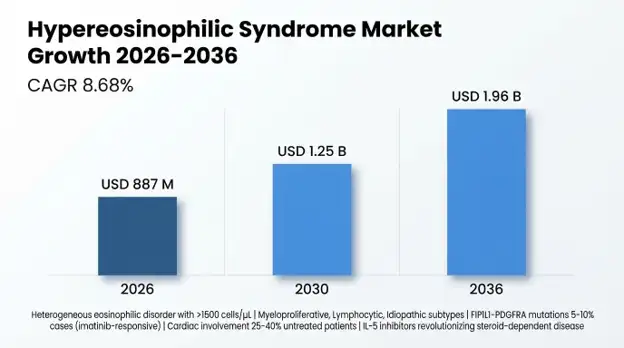
Hypereosinophilic syndrome is a heterogeneous and uncommon group of hematological conditions in which eosinophil counts are significantly elevated, usually > 1500 cells per microliter, for at least 6 months with the presence of end-organ eosinophilia and tissue damage. It is a rare but important diagnosis when all other secondary causes of eosinophils (parasites, drug hypersensitivity reactions, allergic conditions, malignancies, and immunologic abnormalities) are excluded. HES is a highly clinically heterogeneous disorder and is classified into the various categories as follows: myeloproliferative HES (cloned eosinophilic proliferation from bone marrow progenitors), lymphocytic HES (dysfunction of lymphocytic eosinophilopoietic cytokines, such as interleukin-5), single-organ systems HES (overlap disorders with peripheral hypereosinophilia), associated HES (HES developing in the context of a known systemic disease), and idiopathic HES (diagnosis of exclusion after systematic exclusion of other causes).
HES effects go beyond the level of laboratory abnormalities and may manifest as potentially life-threatening eosinophilic infiltration and release of cytotoxic eosinophil granule proteins, which can lead to endomyocardial fibrosis and restrictive cardiomyopathy with heart failure, pulmonary involvement progressing to interstitial lung disease and respiratory failure, central and peripheral neurologic involvement with encephalitis and neuropathy, inflammatory diarrhea and malabsorption, urticaria and angioedema, and hepatosplenic involvement with hepatomegaly and portal hypertension. This market expansion is due to the increasing recognition of previously unrecognized diseases as well as to the therapeutic innovations providing better outcomes in patients with more advanced disease management strategies with the objective of maintaining long-term survival and quality of life.
| Report Coverage | Details |
|---|---|
| Base Year | 2025 |
| Base Year Value | USD 763 Million |
| Forecast Value | USD 1.96 billion |
| CAGR | 8.68% |
| Forecast Period | 2025-2034 |
| Historical Data | 2022-2025 |
| Largest Market | North America |
| Fastest Growing Market | Asia Pacific |
| Segments Covered | By Product Type, Drug Class, HES Type, Disease Severity, Route of Administration, End-User |
| Region Covered | North America, Europe, Asia Pacific, Middle East & Africa, Latin America |
| Countries Covered | US, Canada, UK, Germany, France, Spain, Italy, Japan, China, India, Australia, Brazil, UAE, Saudi Arabia |
| Key Market Playes | GSK (GlaxoSmithKline), Novartis AG, AstraZeneca plc, Roche Pharmaceuticals, Celgene Corporation, Amgen Inc., Incyte Corporation, Blueprint Medicines |
Get more details on this report - Request Free Sample
The market for hypereosinophilic syndrome (HES) will continue to grow due to increased disease awareness, better diagnostic algorithms, more physician awareness, and increased access to molecular and genetic tests. Estimates of HES worldwide prevalence stand between 0.32 and 6.3 cases per 100,000 of the population. These fluctuations depend on the different capabilities and infrastructures of the countries' healthcare systems. This condition mostly affects people between 30 and 50 years old, with men showing twice the prevalence that women do, thus leading to considerable healthcare demands from economically active individuals. Due to molecular diagnostics, it became much easier to classify this condition through actionable genetic changes, including FIP1L1-PDGFRA, PDGFRB, JAK2, FGFR1, and KIT mutation. FIP1L1-PDGFRA represents 5-10% of all HES cases and may be used for tyrosine kinase inhibitor treatment.
The hypereosinophilic syndrome (HES) market is growing mostly due to increased disease awareness, advancements in diagnostic algorithms, greater awareness among physicians, and accessibility to molecular and genetic testing. The prevalence of the HES condition on a global scale varies between 0.32 and 6.3 per 100,000 population. This variation is largely caused by differences in the capacity for diagnosing the condition and healthcare infrastructure. Most often the HES patients are within the age range of 30 to 50 years. At the same time, the disease is slightly more common among men than among women, which accounts for a difference of about 1.5 times in their incidence rates. Economically active individuals form a large share of HES patients. Molecular diagnostics helped to make HES classification possible due to the discovery of several genetic abnormalities such as FIP1L1-PDGFRA, PDGFRB, JAK2, FGFR1, and KIT mutations. FIP1L1-PDGFRA mutations are found in 5-10% of HES patients and indicate a need for tyrosine kinase inhibitors.
The HES market is constrained due to diagnoses that require multidisciplinary assessment and advanced laboratory, molecular, and imaging tests. The process of diagnosis includes a complete blood count, flow cytometry, bone marrow evaluation, genetic testing, and FISH testing for FIP1L1-PDGFRA as well as organ-specific evaluations, which include echocardiography and pulmonary function tests. Such processes result in a 6-24 month delay in diagnosis in developed countries, while the delay may be even higher in emerging markets. Furthermore, the condition is a diagnosis of exclusion, and physicians should exclude allergic, infectious, rheumatological, immunological, and malignant diseases with similar symptoms. In addition, the lack of molecular laboratories makes it difficult to diagnose the disease in rural and resource-limited areas. Thus, patients can start using empiric treatment with steroids prior to proper diagnosis of HES, which causes uncertainty in therapy. Underdiagnosis and late initiation of treatment are associated with geographic distribution of advanced diagnostic centers and shortage of specialists as well as expensive testing procedures.
The key HES treatment opportunity is the creation of new drugs capable of modulating the disease-causing genetic mutations and possibly curing HES. For example, hematopoietic stem cell transplantation was effective for some PDGFRA-positive cases resistant or intolerant to imatinib, whereas new gene-editing technologies like CRISPR-Cas9 may help cure mutations of FIP1L1-PDGFRA, JAK2, and FGFR1. Another opportunity is the development of next-generation tyrosine kinase inhibitors, which will be more tolerable, more resistant to mutations, and better able to penetrate tissues. The introduction of new treatments for JAK2 and FGFR1-driven HES and new monoclonal antibodies acting against IL-5 will also contribute to more precise therapy of the disease.
Management of HES disease is moving towards risk-stratified management whereby differentiating between aggressive disease that requires immediate management and slow, indolent disease that requires monitoring will determine the treatment plan. The new management of HES disease includes risk stratification based on the absolute eosinophil count, cardiac factors such as ejection fraction and troponin, and molecular subtype. Those with severe eosinophilia, cardiac complications, splenomegaly, and myeloproliferation should be immediately managed using corticosteroids while those who do not have symptoms and are not associated with organ damage are actively observed. One new trend that is being observed is the occurrence of hypereosinophilia of uncertain significance, which means that there is persistent eosinophilia in the absence of organ involvement. Between 20 and 30% of patients with an eosinophil count more than 1,500 cells/µL have this problem.
North America leads the market for HES with a 42% market share worth USD 318 million in 2025. Leadership of the region in the market is driven by a highly developed network of specialists in hematology and immunology, adequate insurance coverage, advanced molecular diagnostics, and innovative pharmaceutical companies. The United States contributes about 88% to the regional market value owing to the Medicare coverage of mepolizumab and other advanced biological therapies. The presence of National Institutes of Health research facilities along with HES clinics in academic medical centers adds on to the strength of diagnosis and treatment of the condition.
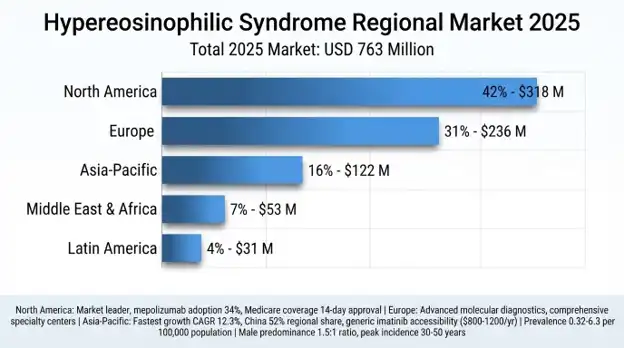
The Asia Pacific region is experiencing the highest growth rate in the HES market, expected to grow at a CAGR of 12.3% and be worth USD 487 million in 2036. The high growth rate is attributed to improvements in healthcare in both China and Japan, developments in molecular diagnostics, improved expertise among specialists, and accessibility to advanced treatments. In the region, China constitutes 52% of the market, aided by the large population and developments in the country's diagnostic facilities as well as reforms that have improved the accessibility of mepolizumab. India is an emerging market in the HES, thanks to increased availability of specialized diagnostic centers and generic imatinib, which lowers the cost of treatment in PDGFRA patients.
Novel therapies make up the largest share in the HES market, with 58%, worth USD 442 million in 2025, and are expected to register growth at a 10.2% CAGR during 2026-2036. The novel therapy market encompasses IL-5 inhibitors, advanced tyrosine kinase inhibitors, immunomodulators, and gene therapies. These therapies will see growth owing to increased efficacy and less dependency on steroids. Traditional therapies comprise 42%, with a market size of USD 321 million.
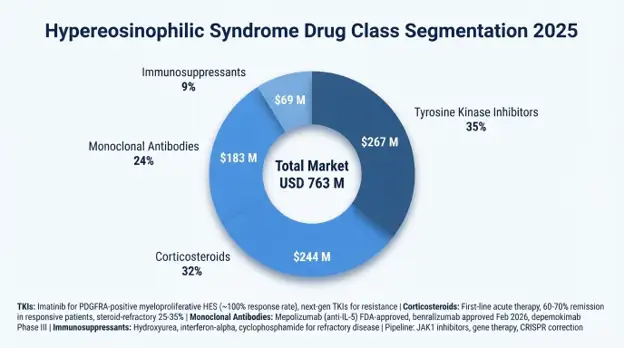
The tyrosine kinase inhibitors occupy the highest drug class segment with a 35% market share valued at USD 267 million in 2025, growing at a 9.8% compound annual growth rate through 2036. The high prevalence is due to the important function of imatinib in the treatment of PDGFRA-positive myeloproliferative HES with almost a hundred percent response rates, availability of generic versions lowering treatment costs, and development of next-generation tyrosine kinase inhibitors overcoming imatinib resistance and improving tolerability. The corticosteroids have a 32% market share valued at USD 244 million in 2025 owing to the key role played by them in the first-line acute treatment and their effectiveness in lymphocytic and idiopathic HES.
The indication segment with the highest share is that of idiopathic HES, with a value of USD 289 million in 2025 and 38% of the market with a CAGR of 9.1% up to 2036. The reasons are idiopathic HES accounting for over 50% of HES cases after elimination of secondary causes, heterogeneity of treatment responses leading to a trial-and-error process in treating patients, and availability of new agents with better response rates. Myeloproliferative HES will have a share of USD 191 million in 2025 with 8.4% CAGR due to the revolutionary impact of imatinib in PDGFRA-positive cases and increasing awareness of other molecular types.
Hospitals and Specialty Clinics are the largest end-user category at a 54% market share worth USD 412 million in 2025 that includes hematology wards, academic hospitals, and specialty clinics providing diagnosis and initial treatment. The ambulatory care and outpatient specialty clinics category constitutes 31% market share, worth USD 236 million in 2025, with 10.1% CAGR as the fastest-growing category due to a shift towards outpatient-based HES management and home infusion facilities for mepolizumab and IVIG administration. The home healthcare category constitutes 15% market share worth USD 115 million in 2025.
The global HES market has a moderately high level of concentration, wherein the eight leading companies occupy about 68-74% of the market value based on their wide range of products, including corticosteroids, biologicals, tyrosine kinase inhibitors, and novel molecular agents. GSK holds the market leader position via mepolizumab (Nucala), which is the only FDA-approved biological agent that is used for HES treatment and has an expected market share of about 42% amongst HES-specific therapies. Novartis rules the imatinib market segment via generic versions as well as through its branded versions.
March 2026: GSK announced Phase III trial completion for depemokimab (GSK3511294), a selective IL-4 receptor antagonist demonstrating superior efficacy to mepolizumab in reducing steroid dependency in lymphocytic HES. Regulatory submission filed with anticipated FDA decision in Q4 2026.
February 2026: AstraZeneca received FDA approval for benralizumab (Fasenra) expanded indication for HES treatment, positioning dual IL-5 pathway targeting as a therapeutic standard with mepolizumab offering patient choice and healthcare system options.
January 2026: Blueprint Medicines initiated a Phase II trial for avapritinib (AYVAKIT) in PDGFRA-positive HES resistant to imatinib, targeting the D842V resistance mutation with preliminary data demonstrating complete remission in 78% of previously imatinib-resistant patients.
December 2025: Incyte Corporation announced positive Phase II data for INCB054329, a JAK1-selective inhibitor for lymphocytic HES, demonstrating 68% eosinophil count normalization and 71% steroid discontinuation rates in a 24-week treatment period.
November 2025: Celgene Corporation launched a randomized controlled trial comparing allogeneic hematopoietic stem cell transplantation reduced-intensity conditioning versus conventional medical management for steroid-refractory myeloproliferative HES with enrollment targeting 120 patients across 18 North American centers.
You'll get the sample you asked for by email. Remember to check your spam folder as well. If you have any further questions or require additional assistance, feel free to let us know via-
+1 724 648 0810 +91 976 407 9503 sales@intellectualmarketinsights.com
27 Aug 2026
Intellectual Market Insights Research © 2026. All rights reserved.