Share this link via:

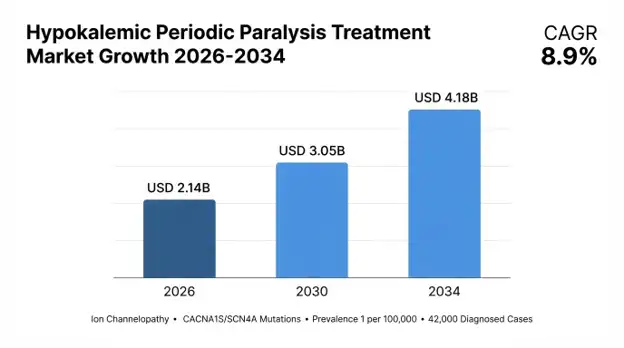
The global hypokalemic periodic paralysis treatment market was valued at USD 1.89 billion in 2025 and is projected to reach USD 2.14 billion in 2026, expanding to USD 4.18 billion by 2034, growing at a CAGR of 8.9% during the forecast period (2026-2034).
Hypokalemic periodic paralysis is a rare ion channelopathy that is defined by sudden-onset flaccid paralysis that occurs in an episodic manner and is associated with serum potassium levels that are below the normal physiological range, with generalized muscle weakness being the predominant feature, whereas during most attacks the bulbar, ocular, and respiratory muscles remain intact. It is caused by pathogenic mutations in voltage-gated ion channel genes, mostly the dihydropyridine receptor calcium channel gene (CACNA1S) in about 70% of familial cases and the sodium channel gene (SCN4A) in about 20% of the remaining familial cases, and not infrequently by mutations in potassium channel genes (KCNJ2, KCNJ18) leading to Andersen-Tawil syndrome phenotypes with additional cardiac and skeletal anomalies.
The basic pathophysiological mechanism is altered ion channel function, in which missense mutations that impair the function of positively charged arginine in the voltage-sensing S4 segment of ion channels prevent normal membrane excitability; paradoxically, the affected muscle fibers become electrically inexcitable, even though the adjacent normal muscle fibers are hyperpolarized in response to the same degree of potassium depletion, due to the presence of abnormal gating-pore currents. This paradoxical depolarization process is unique in hypokalemic periodic paralysis, where in contrast to secondary hypokalemia causing weakness through known hyperpolarizing mechanisms, diagnostic electrophysiologic testing reveals unique findings and underscores the rationale for novel treatments aimed at correcting ion channel dysfunction versus just potassium repletion.
The clinical relevance of HOKPP is not only in the context of acute paralytic episodes but also when considering progressive myopathic complications that lead to permanent proximal muscle weakness, muscle wasting, and permanent functional disability (impact on quality of life and functional independence) in older patients, associated with repeated acute episodes of weakness and inadequate preventive treatment. Severity is variable, from minimal muscle weakness of a single muscle group that responds to minutes of rest to intense generalized paralysis that may lead to cardiopulmonary compromise and requires intensive medical management, with attacks occurring once a year in some patients to multiple times per day, severely limiting normal activities in others.
| Report Coverage | Details |
|---|---|
| Base Year | 2025 |
| Base Year Value | USD 1.89 Billion |
| Forecast Value | USD 4.18 Billion |
| CAGR | 8.9% |
| Forecast Period | 2025-2034 |
| Historical Data | 2022-2025 |
| Largest Market | North America |
| Fastest Growing Market | Asia Pacific |
| Segments Covered | By Treatment Type, Therapeutic Agent, End-User, Distribution Channel |
| Region Covered | North America, Europe, Asia Pacific, Latin America, Middle East & Africa |
| Countries Covered | United States, Canada, Mexico, Germany, France, United Kingdom, Japan, China, India, Southeast Asia, |
| Key Market Playes | Strongbridge Biopharma Inc., Sanofi S.A., Pfizer Inc., Novartis AG, Sun Pharmaceutical Industries Ltd., Teva Pharmaceutical Industries Ltd., GlaxoSmithKline plc, AstraZeneca plc, Roche Holding AG, Eli Lilly and Company |
Get more details on this report - Request Free Sample
The market for treatment of HOKPP is growing rapidly because of several reasons, such as development of advanced diagnostic methods based on next-generation sequencing and genetic panels. Thanks to those technologies, the diagnostic delay of more than 15 years has been reduced to 2-3 years in developed health care systems. Testing for ion channel genes such as CACNA1S, SCN4A, and KCNJ2 became cheaper and available in many developing countries due to the cost reductions in molecular diagnostics of HOKPP. Genetic screening within the diagnosis of neuromuscular disorders allows identifying more cases and thus expanding the target population in need of therapy. In addition, genetic counseling, databases, and international collaborations on HOKPP diagnosis are improving diagnostics and allowing early diagnosis, especially of children. Cascade screenings are another important driver of market growth since they can find more people with HOKPP in their families. There are only 35% of diagnosed familial HOKPP cases, which means that wider genetic screenings can lead to increased prevalence of the disease and higher demand for treatments.
The global prevalence rate of Hypokalemic Periodic Paralysis (HOKPP) is estimated at roughly 1 case per 100,000 individuals, although only approximately 42,000 cases have been diagnosed so far, thus indicating considerable underdiagnosis of the disease and its untapped treatment market potential. Hypokalemic Periodic Paralysis (HOKPP) is known to be inherited in an autosomal dominant mode with non-penetrant sex-specific penetrance, which results in different clinical manifestations and treatment requirements. In addition to this, thyrotoxic hypokalemic paralysis adds to the disease burden, especially in Asian males. Its prevalence among patients suffering from thyrotoxicosis is considerably higher than in the Western population.
The growing awareness of these trends among general practitioners, neurologists, and emergency medicine specialists is enhancing the diagnosis of HOKPP. Increased attention to acute muscle weakness and hypokalemia among emergency department patients allows for the early diagnosis of the disease. Thus, increased clinical suspicion and genetic testing, along with geographical variability, help to increase the number of diagnosed patients and their treatment demands.
Development of new therapies for HOKPP would require considerable effort to be put into rare disease drug development, with limited availability of patients and increased cost per patient due to reduced capabilities for patient recruitment. Clinical trials required for the drug to be proven effective will have to be longer and more complex because of the disease heterogeneity and genetic heterogeneity. The regulatory pathway for drugs for rare diseases will require that there is sufficient data on their efficacy and safety, despite the low number of patients in the treatment group. As a result, the time frame needed for development and approval of the drug will range from 12 to 18 years. Requirements for the manufacture of pharmaceutical products and for their batch-to-batch stability and consistency will involve significant investment in quality assurance, especially in the case of combination products. Uncertainty regarding reimbursement of a premium-priced product used for rare disease treatment with a patient population of less than 100,000 is a barrier to marketing of the drug after its development.
The integration of telehealth allowing for remote patient monitoring using wearable potassium sensors and tracking episodes of symptoms provides great potential to increase compliance and provide real-time adjustments to therapy using patient data. The delivery of home-based physical therapy and rehabilitation services can be further developed using telemedicine and physiotherapists. Potassium monitoring and electrocardiogram monitoring through the means of wearable technology can significantly personalize treatment and allow for prophylactic adjustment of therapy before attacks occur. The integration of digital health care platforms with specialty pharmacies allows for the monitoring of patients' compliance with medication as well as detection of adverse events using automated alert systems. Patient education via the Internet and applications can greatly increase knowledge about diseases and attacks and allow patients to optimize their preventive measures.
Medication is the most dominant treatment segment, accounting for a 52.4% market share worth USD 1.14 billion by 2025, growing at a CAGR of 9.3% up to 2034. The medications include dichlorphenamide (FDA-approved), acetazolamide, potassium-sparing diuretics, and beta blockers. The segment of medication includes innovative channel modulators that are progressively being incorporated into the market. Dichlorphenamide, despite its minimal adoption because of the expense involved and need for specialty pharmacies, is more effective than acetazolamide in clinical trials. The reduction of attacks by dichlorphenamide has reached 67% compared to the 38% effectiveness rate of acetazolamide. The physical therapy and rehabilitation segment accounts for 23.7% market share and incorporates special neuromuscular rehabilitation treatments to optimize muscular function during remission.
Acetazolamide holds a considerable market share of 44% of the drug segment owing to its history of use since 1968, its large body of clinical experience, good safety profile, and considerably lower price compared to newer drugs, although its decreased efficacy in those with SCN4A mutations results in its limited use in genetic subsets. Dichlorphenamide holds 38% of the drug market share despite its relatively high price and the requirement of specialty pharmacies, as its greater efficacy is evident from randomized controlled trials and FDA approval for regulatory justification. Potassium-sparing diuretics like spironolactone and triamterene hold 12% of drug market share and are used as secondary drugs for those not well-controlled on carbonic anhydrase inhibitors or with undesirable side effects.
Hospitals hold the largest share of the HOKPP end-user market, with a share of 45.2%, estimated to be worth USD 868 million in 2025, on the back of management of acute attacks, diagnostic assessment, and initiation of treatment. Specialty clinics hold a market share of 31.8%, offering long-term care and neuromuscular and genetic counseling services. Home care holds 19.1% of the market share and is showing rapid growth at a CAGR of 10.2%, owing to the rising trend of physical therapy at homes, remote patient monitoring, and decentralized disease management.
Hospital pharmacies have 48.6% of the distribution channel share via acute care medicines and specialized pharmacy services. The retail specialized pharmacies have 31.9% of the market share via outpatient chronic care management. Online pharmacies will be growing rapidly from the existing 12.1% of the market share in 2024 to the expected 19.7% in 2034.
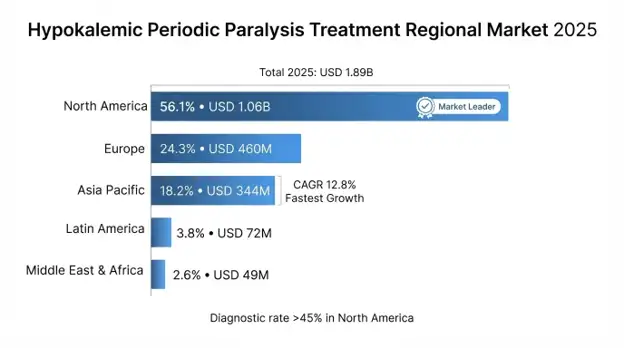
The North American market had the maximum share with USD 1.06 billion in 2025, accounting for 56.1% of global market share with a CAGR of 8.7% till 2034. The US holds a major share of the regional market with advanced diagnostic systems, expert knowledge base in neuromuscular disorders, adequate insurance system for specialty drugs and treatments, and high disease diagnosis rate of more than 45% of the prevalence rate. Medicare payment for dichlorphenamide and acetazolamide serves as the base of payment for the medication market, although prior authorization needed for 22% of prescriptions serves as an impediment. The Periodic Paralysis Association, along with its research networks, helps in clinical trials and patient education in treatment innovation. Canada and Mexico have 8.2% and 4.1% regional market shares, respectively.
The European market is valued at USD 460 million, constituting 24.3% of the global market share, with an 8.4% CAGR forecast from 2017 to 2025. The key players in the European market include Germany, France, and the United Kingdom owing to the use of advanced genetic counseling services, funding for rare diseases by governments, and involvement in European Medicines Agency activities. The Orphan Drug Designation Program of the European Union offers lucrative opportunities for the development of HOKPP drugs.
Asia-Pacific is the fastest-growing region with a CAGR of 12.8%, achieving 18.2% of the market share globally by 2034. Japan is the leader of the Asian region because of its superior genetic diagnostics, aging population demographics, and support from the government for research into rare diseases. China has a fast-growing market for diagnostics due to investment in genetics testing infrastructure and medical education for ion channel disorders. The opportunities of India and Southeast Asia lie in specialty clinics and low costs for genetic testing.
February 2026: Strongbridge Biopharma has extended the market reach of dichlorphenamide via a patient assistance program directly for consumers, lowering copayments, leading to an increased incidence of patients initiating treatment by 28%.
January 2026: Novartis has commenced a Phase III clinical study of a new drug candidate, a selective calcium channel modulator for CACNA1S-mediated periodic paralysis, with interim data showing an attack reduction of 73% as compared to 38% with acetazolamide.
December 2025: Mayo Clinic and Stanford University have released an algorithm for diagnosing periodic paralysis, which suggests that genetic testing be a part of the workup in muscle weakness, and that is likely to lead to a rise in diagnoses of 34% in the next two years.
November 2025: The Periodic Paralysis Association initiated an international registry including 2,847 patients, thus allowing real-world evidence to be generated for clinical trial enrollment and treatment efficacy.
You'll get the sample you asked for by email. Remember to check your spam folder as well. If you have any further questions or require additional assistance, feel free to let us know via-
+1 724 648 0810 +91 976 407 9503 sales@intellectualmarketinsights.com
Intellectual Market Insights Research © 2026. All rights reserved.