Share this link via:

It is estimated that the global hypophosphatasia treatment market will grow at 8.5% CAGR in the forecast period to reach USD 1.8 billion by 2034, with approximately USD 997 million worth of sales in 2026. Hypophosphatasia is a rare, inherited metabolic disorder caused by a defect in the activity of the tissue-nonspecific alkaline phosphatase enzyme, which leads to a lack of bone and teeth mineralization, increased levels of tissue-nonspecific alkaline phosphatase substrates such as inorganic pyrophosphate, and progressive multisystem complications related to bone integrity, dental health, and neurological function. The market includes many therapeutic areas, including enzyme replacement therapy (ERT) for diseases, multidisciplinary management of skeletal abnormalities, pain management, surgical intervention, and optimization of quality of life in both pediatric and adult patients.
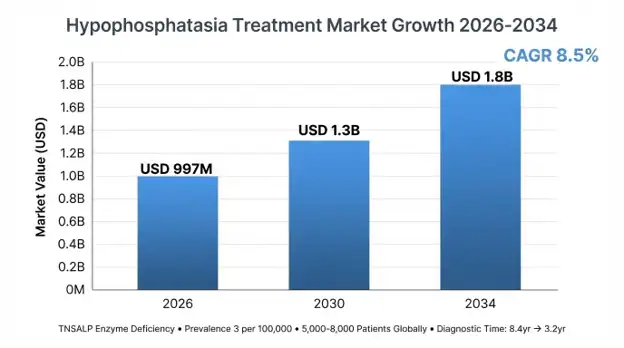
The rarity, clinical variability, difficulty with diagnosis (causative biochemical and genetic diagnosis), and the limited therapeutic options for hypophosphatasia make it one of the more difficult diagnosis and treatment challenges in the rare metabolic disease field. In severe form, the disease occurs in an estimated 1/100,000 newborns, but when milder adult-onset phenotypes are included (often undiagnosed or misdiagnosed as osteomalacia, rheumatological diseases, or idiopathic musculoskeletal pain disorders), the overall prevalence may be as high as 2.8-3/100,000 people. Beside the single approved enzyme replacement therapy lies the broader therapeutic market, which involves a holistic disease management approach that includes orthopedic surgical management of skeletal deformities, pain management strategies, dental rehabilitation, neurological monitoring for seizure prevention, and next-generation enzyme therapeutics designed with improved bioavailability and longer dosing intervals.
| Report Coverage | Details |
|---|---|
| Base Year | 2025 |
| Base Year Value | USD 772.9 Million |
| Forecast Value | USD 1.8 Billion |
| CAGR | 8.5% |
| Forecast Period | 2025-2034 |
| Historical Data | 2022-2025 |
| Largest Market | North America |
| Fastest Growing Market | Asia Pacific |
| Segments Covered | By Disease Manifestation, Treatment Approach, Active Monitoring Type, Disease Severity, Patient Demographics, End-User |
| Region Covered | North America, Europe, Asia Pacific, Middle East & Africa, Latin America |
| Countries Covered | United States, Canada, Mexico, United Kingdom, Germany, France, Italy, Spain, Netherlands, Japan, China, South Korea, India, Australia, Brazil, Argentina, United Arab Emirates, Saudi Arabia, South Africa |
| Key Market Playes | Alexion Pharmaceuticals (AstraZeneca), Ultragenyx Pharmaceutical Inc., Inozyme Pharma, Biomarin Pharmaceutical, Kyowa Kirin, Chiesi Farmaceutici, Alesta Therapeutics |
Get more details on this report - Request Free Sample
Hypophosphatasia Treatment Market Growth Hypophosphatasia treatment market growth has been driven mainly by better understanding and awareness about this rare disease among physicians along with proper diagnostic tests. With the introduction of international consensus criteria for the diagnosis of this disease, greater awareness among rheumatologists and orthopedics, and screening of biochemical markers like persistently low age-related alkaline phosphatase activity, more cases can now be recognized. Previously, issues arose in the diagnosis of adults with symptoms persisting for around 7-10 years who were diagnosed with osteoporosis, rheumatoid arthritis, or undefined bone disease and were treated with bisphosphonate therapy. The understanding of various forms of the disease from mild cases in adults to more severe ones in children has resulted in better diagnosis. The latest methods for the diagnosis include not only a low level of alkaline phosphatase but also high levels of substrates like pyridoxal-5-phosphate, inorganic pyrophosphate, and phosphoethanolamine along with genetic testing for mutations in the ALPL gene.
Transformative results achieved through enzyme replacement therapy using asfotase alfa have dramatically changed approaches in treatment of hypophosphatasia disease, leading to improved survival rates, skeletal status, and functional outcomes, especially among patients suffering from severe hypophosphatasia disease at the pediatric stage. FDA approval of the drug in 2015 marked enzyme replacement therapy as a standard treatment of lethal perinatal and infantile stages of the condition, thereby confirming the targeted correction of tissue-nonspecific alkaline phosphatase deficiency. Clinical data have proved a substantial increase in survival rates in children who used to experience lethal outcomes within one year after birth due to the disease. Treatment for more than five years has been accompanied by improvements in rickets, bone deformities, physical activity, and mobility, with some patients regaining ability to walk independently. The number of patients with hypophosphatasia among juveniles and certain groups of adults is increasing thanks to positive outcomes gained in these groups.
The hypophosphatasia market is limited due to the very rare occurrence of the disease, since there are only about 5,000–8,000 patients with the condition in the world regardless of their severity status. The small addressable market limits the potential revenues and lowers the commercial attractiveness for pharma companies despite the availability of orphan drug status. Only 5–8% of the patients suffer from severe perinatal and infantile forms of the disease, whereas 60–70% are adult-onset patients, who usually do not require intensive treatment and thus represent a dispersed market with different needs. Geographical limitations of the market are also determined by the fact that only North America and Western Europe are equipped with the proper diagnostics facilities, while most of the countries in the Asia Pacific, Middle East, and Africa lack them. Therefore, the market is highly consolidated towards enzyme replacement therapy and has significant growth potential in case of better diagnostics and identification of patients.
Several important opportunities exist in terms of developing new generation treatments for hypophosphatasia, offering more convenience, sustainability, and accessibility. The extended-release versions of enzymes such as efzimfotase alfa can offer similar efficacy as compared to asfotase alfa with fewer injections and reduced risks of the related complications. Delivery of the enzymes by other means, such as lipid nanoparticles, transdermal patches, and sustained-release implants, can further minimize the dosing requirements. Ilofotase alfa and the ALPL enzyme activators offer an option of alternative means of treatment with possibly oral medications and less reliance on the injectable enzyme replacement treatments. Finally, gene therapy with the use of adeno-associated virus vectors is one of the longer-term opportunities that can allow for the introduction of potentially durable treatment for the disease. These treatment modalities are at different stages of their development; however, commercialization can be an important step in making them accessible to patients.
Multidisciplinary approaches have been increasingly accepted in the hypophosphatasia treatment market as they incorporate enzyme replacement therapy along with orthopedic surgery, orthotics, pain management, dental care, and psychological therapy. Such an approach understands the fact that while enzyme replacement can increase life expectancy and impact disease courses, it might not address the existing problems of skeletal deformities, dental abnormalities, pain, and functional difficulties. Hypophosphatasia specialty centers, which involve collaboration between pediatric endocrinologists, orthopedic surgeons, dentists, neurosurgeons, rheumatologists, and genetic counselors, are being formed to enhance the treatment outcomes and process. Such centers would help in early diagnosis, initiation of therapy, prevention of complications, and management of the skeleton in the long run. Referral networks and telemedicine have also expanded access to specialists for patients irrespective of their geographic locations. Therefore, adoption of disease management programs has positively impacted the demand for multidisciplinary services in this market.
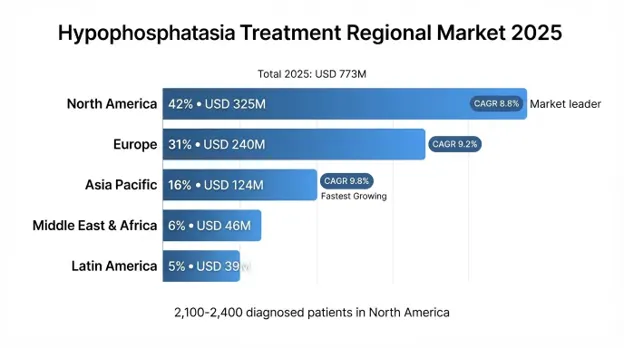
The North America region dominates the global hypophosphatasia market, worth USD 325 million in 2025 and estimated to reach 8.8% CAGR by 2034. The U.S. represents 82% of the market value in the region due to advanced diagnostics facilities, expertise in rare metabolic diseases, strong insurance coverage, and high awareness among rheumatologists and orthopedic specialists about the disease. 2,100–2,400 diagnosed patients are found in major academic medical facilities and rare disease clinics. The advanced telemedicine infrastructure increases access to specialists, while the FDA approval route of orphan drugs and breakthrough therapies accelerates the development of new therapies.
Europe has offered considerable market opportunities with a CAGR of 9.2% during 2024-2034 to reach a market value of USD 385 million by 2034. The advantages of the European market include universal healthcare insurance providing less restrictive access than markets having insurance-based healthcare models, increased awareness of diagnosis among general practitioners and specialists after introducing diagnostic algorithms and clinical guidelines, and gradual growth in rare disease infrastructure.
Germany, France, the United Kingdom, and Italy account for the largest hypophosphatasia markets in Europe, where the capability of diagnostics is mainly found in academic medical centers and rare disease specialists. The European market shows more interest in rare disease registry programs where national health systems are providing more support for evidence-gathering activities.
The fastest growing region has been Asia Pacific, with a projected compound annual growth rate of 9.8% until 2034 to achieve a market worth of estimated USD 180-210 million by 2034. This region shows significant potential for growth owing to the presence of huge population sizes such as China with 1.4 billion people and India with 1.4 billion, creating high absolute cases even with low prevalence rates; modernization in healthcare facilities and diagnostic capacities in fast-developing cities; and awareness among pediatricians and orthopedic surgeons about rare metabolic disorders.
Japan is the leader in terms of diagnostic capabilities owing to its advanced healthcare system along with rare disease infrastructure, where it sets up reference laboratory facilities and rare disease networks. China and South Korea show rapid advancements in diagnostics with respect to the establishment of specialty clinics for genetic and rare metabolic disorders.
Infantile and juvenile-onset hypophosphatasia occupies the largest share of the treatment market, estimated to be worth USD 425–480 million by 2025 and predicted to have a CAGR of 9.1% through 2034 due to high treatment intensity and administration of enzyme replacement therapy. Adult-onset hypophosphatasia makes up USD 220–280 million with a CAGR of 7.8%. Odontohypophosphatasia makes up for USD 68-95 million with a CAGR of 6.2%.
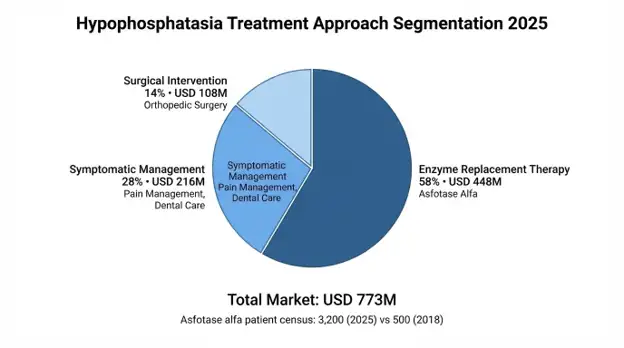
Enzyme replacement therapy is leading the hypophosphatasia therapy market with a market share of 58%, with the market size being estimated at USD 445-520 million by 2025 and forecasted to witness a 9.2% CAGR till 2034. Symptomatic Management & Supportive Therapy has a market share of 28%, with a market size being valued at USD 215-280 million and growing at a CAGR of 7.5% till 2034. Surgical intervention is holding 14% market share, with a market size of USD 108-140 million and growing at a CAGR of 8.8%.
The Specialized Rare Disease Centers are expected to be the biggest market user segment, accounting for 52% of the market share worth USD 405-520 million in 2025. They offer multidisciplinary treatment services and act as the referral centers for patients spread over geographic regions.
The academic medical centers will have a 28% market share worth USD 215-280 million in 2025 with a 9.1% CAGR until 2034 by including hypophosphatasia management into genetic disorders and metabolic bone disease specialty centers.
The general hospitals and rheumatology/orthopedic clinics have a 20% market share worth USD 154-200 million in 2025 with 7.2
The hypophosphatasia treatment market globally is moderately concentrated as the four leading players occupy about 70-78% market value by way of enzyme replacement therapy innovations, patient support programs, and investments in infrastructure for rare diseases. Competitiveness is based on the superiority of enzyme replacement therapy formulations, development of next-generation products, patient support programs, and multidisciplinary care networks.
January 2026: Alexion Pharmaceuticals announced positive Phase III results for efzimfotase alfa (ALXN1850), demonstrating non-inferior efficacy to asfotase alfa with substantially extended dosing intervals, enabling disease maintenance with reduced injection frequency compared to twice-weekly asfotase alfa dosing. Regulatory submission to FDA anticipated for Q3 2026.
December 2025: Alesta Therapeutics reported advancement of ALE1, an investigational enzyme replacement therapy candidate, into clinical development following IND approval, addressing unmet needs in the adult-onset hypophosphatasia patient population.
November 2025: Inozyme Pharma expanded clinical development programs investigating novel therapeutic mechanisms beyond enzyme replacement in hypophosphatasia disease management.
October 2025: Kyowa Kirin established a specialized hypophosphatasia care center in Tokyo, combining enzyme replacement therapy administration with comprehensive multidisciplinary care, including orthopedic surgery, dental rehabilitation, and genetic counseling.
You'll get the sample you asked for by email. Remember to check your spam folder as well. If you have any further questions or require additional assistance, feel free to let us know via-
+1 724 648 0810 +91 976 407 9503 sales@intellectualmarketinsights.com
Intellectual Market Insights Research © 2026. All rights reserved.