Share this link via:

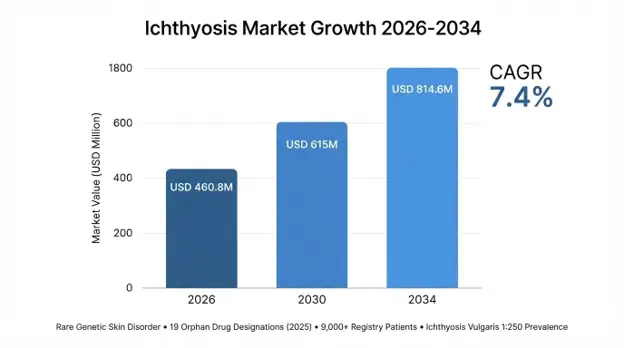
The global ichthyosis market size was valued at USD 430.5 million in 2025 and is projected to reach USD 460.8 million in 2026, expanding to USD 814.6 million by 2034, growing at a CAGR of 7.4% during the forecast period (2026-2034).
Ichthyosis is a term for a variety of inherited and sometimes acquired keratinization disorders defined by generalized, persistent scaling of the skin due to abnormalities in the processes of epidermal differentiation, desquamation, or lipid metabolism in the stratum corneum. Named for the fish-like scaly appearance of the skin. The clinical spectrum is wide, from the most common form, ichthyosis vulgaris, affecting about 1 in 250 people, a type associated with loss-of-function mutations in the filaggrin gene, to the rare, more severe forms, epidermolytic ichthyosis, congenital ichthyosiform erythroderma, Netherton syndrome, and harlequin ichthyosis—which are linked to mutations in the genes responsible for the formation of the cornified envelope, the activity of transglutaminase, the structure of keratins, the regulation of proteases, or lipid transport. Steroid sulfatase deficiency is associated with X-linked ichthyosis (XLI), which is found in an estimated 1 in 2,000-6,000 males and is commonly accompanied by extra-cutaneous problems such as corneal opacities. In addition to visible scaling, in moderate to severe cases, the barrier function is impaired, leading to excessive trans epidermal water loss, temperature dysregulation, frequent skin infections, painful fissuring, and significant psychological impact, especially in children and their parents/caregivers.
Until now, treatments used for ichthyosis have been symptomatic and supportive, involving regular application of emollients, humectants, and keratolytic agents (such as urea, lactic acid, and salicylic acid) to soften and peel away excess skin and systemic retinoids (acitretin and isotretinoin) applied in moderate and severe cases. These methods work in the reduction of hyperkeratosis but are poorly tolerated, may have teratogenic properties in systemic retinoids, and are not cures for the underlying genetic or biochemical defect. Increasing knowledge of the molecular mechanisms underlying the individual forms of the condition, over the last decade, has turned to mechanism-based approaches, such as topical gene therapy for transglutaminase-1 deficiency, enzyme-replacement therapy for steroid sulfatase deficiency, and repurposing of biologic drugs developed for atopic dermatitis and psoriasis for use in inflammation-driven types of ichthyoses, including Netherton syndrome.
A very small fraction of moderate to severe congenital cases (one in 200,000 to one in 500,000 births) drives the need for high-cost specialty therapy, while a much larger population of milder cases of ichthyosis vulgaris and X-linked cases ensures a steady demand for prescription or over-the-counter maintenance therapy. Combined with expanded genetic testing infrastructure and active patient advocacy efforts, such as the Foundation for Ichthyosis & Related Skin Types, the market for above-average growth over an extended time horizon, compared to other dermatology drug categories, is well poised for continuous improvement in diagnostic rates, natural history studies, and drug development investments through 2034.
| Report Coverage | Details |
|---|---|
| Base Year | 2025 |
| Base Year Value | USD 430.5 Million |
| Forecast Value | USD 814.6 Million |
| CAGR | 7.4% |
| Forecast Period | 2025-2034 |
| Historical Data | 2022-2025 |
| Largest Market | North America |
| Fastest Growing Market | Asia Pacific |
| Segments Covered | By Disease Type, Treatment Type, Route of Administration, Distribution Channel, End-User |
| Region Covered | North America, Europe, Asia Pacific, Middle East & Africa, Latin America |
| Countries Covered | US, Canada, Mexico, UK, Germany, France, Italy, Spain, China, Japan, India, Australia, South Korea, Brazil, UAE, Saudi Arabia, South Africa |
| Key Market Playes | Krystal Biotech, Timber Pharmaceuticals, LEO Pharma, Galderma, Almirall, Novartis AG, Quoin Pharmaceuticals |
Get more details on this report - Request Free Sample
Regulatory frameworks in the United States and in Europe have increasingly identified severe forms of ichthyoses as rare diseases, which require specific development programs and provide market exclusivity periods beyond the normal patent protection period, as well as lower fees and accelerated approval processes through their orphan drug designation. These developments, along with increased disease burden evidence from registries, have made this therapeutic area more attractive to pharma companies.
Next-generation sequencing panels targeting ichthyosis-related genes have made diagnostic routes easier as they allow for accurate molecular diagnosis, which is now becoming necessary for participation in clinical trials related to genotypes and future treatments. In other words, these diagnostic techniques are increasing the patient population.
Small, Fragmented Patient Populations Constraining Trial Design and Commercial Scale
The incidence rates for serious congenital types like lamellar ichthyosis and epidermolytic ichthyosis range from one in 200,000 to one in 500,000 births. It therefore becomes challenging to conduct randomized clinical trials that have sufficient statistical power in a commercially feasible manner due to the rarity of these subtypes. Key studies for such types usually take up to three to five years of recruitment in thirty or so sites in fifteen or more countries to recruit just 50-150 subjects.
Absence of Standardized Endpoints and Limited Reimbursement Pathways
Unlike psoriasis and atopic dermatitis, ichthyosis does not have any well-validated scoring systems for assessing severity regarding scaling, erythema, and functional impairment, making it challenging to establish efficacy for new treatment options. There is also a lack of experience from health technology assessment agencies in Europe and payers in the U.S. on how to appraise ichthyosis-specific products, which leads to uncertainty regarding pricing and patient access for high-value innovative products.
The accessibility of the skin makes ichthyosis an appealing candidate for localized correction of genetic defects that do not involve the difficulties associated with systemic administration of vectors used for treating internal organs. For instance, programs like Krystal Biotech's topical herpes simplex virus vector aimed at correction of transglutaminase-1 deficiency in lamellar ichthyosis have proven their concept of restoring protein function by administering the treatment to the affected areas. In addition, mRNA and lipid nanoparticle vectors are currently being investigated for restoration of filaggrin in ichthyosis vulgaris and ABCA12 in harlequin ichthyosis. Investments in dermatology programs utilizing gene and mRNA therapy were more than USD 400 million during the 2021-2025 period.
Netherton syndrome and some cases of congenital ichthyosiform erythroderma manifest an extensive degree of type 2 or Th17 inflammation in addition to the underlying barrier abnormality, which presents a rationale for the potential role of biologicals approved for the treatment of atopic dermatitis and psoriasis. Dupilumab administration for Netherton syndrome patients has been described in published case series and shown beneficial effects in terms of scaling and pruritus, and the label expansion is a cost-effective approach towards market entry.
The field has evolved from a phenotype-driven approach to one that is genotype-oriented, with unique therapy regimens being developed for transglutaminase-1 deficiency, ABCA12 deficiency, filaggrin mutation, and SPINK5 mutation as different disease entities. The strategy is like precision medicine approaches taken in oncology and will result in the creation of several niche markets with premium pricing.
The conventional petrolatum/urea emollient preparations are slowly giving way to advanced preparations that contain ceramides, lipids with optimal compositions, and keratolytic agents with controlled release for reconstructing the stratum corneum structure in an acceptable cosmetic manner. The high cost of prescription products has made them more appealing to dermatologists for moderate to severe conditions.
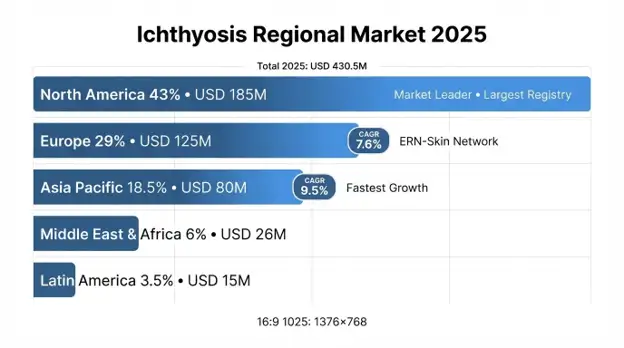
North America's well-established rare-disease infrastructure, extensive orphan drug incentive policies, and the Foundation for Ichthyosis & Related Skin Types (FIRST), with one of the world's largest patient registries and actively involved in clinical trial design, are driving North America to hold the largest market share at USD 185 million in 2025 and a projected CAGR of 7.1% until 2034. The United States generates most of the revenues in the region, and there are only a few academic dermatology and medical genetics centers that can diagnose and treat complex subtypes.
The European market has been valued at USD 125 million in 2025 and is expected to expand at a rate of 7.6% CAGR during the forecast period. The European Reference Network for rare skin disorders (ERN-Skin) facilitates the coordination of specialist expertise, harmonized diagnostic procedures, and cooperation in the organization of cross-border clinical trials in the MS member states, especially for those disorders with a very low incidence in one country so that they cannot be maintained by a single country's specialist infrastructure. The region's value is dominated by the three western European nations: Germany, France, and the United Kingdom.
Asia Pacific is expected to show the highest CAGR of 9.5% during the period, reaching USD 80 million by 2025. Large population scale in China and India, rapid growth in genetic testing capabilities, and increase in training of dermatology specialists are factors pushing growth, while the historically low number of diagnostics and limited access to advanced therapies are constraints that will be a significant latent opportunity as healthcare infrastructure grows.
Disease Type Insights: Ichthyosis vulgaris has the largest market share in terms of patients, making up around 40% of market value in 2025, owing to its high prevalence rate, despite having relatively low average expenditure per patient because of its management through emollient therapy. The autosomal recessive congenital ichthyosis, which includes lamellar ichthyosis and congenital ichthyosiform erythroderma, makes up about 22% of market value but will register the fastest growth, as there are many pipeline products aimed at treating these forms of ichthyosis.
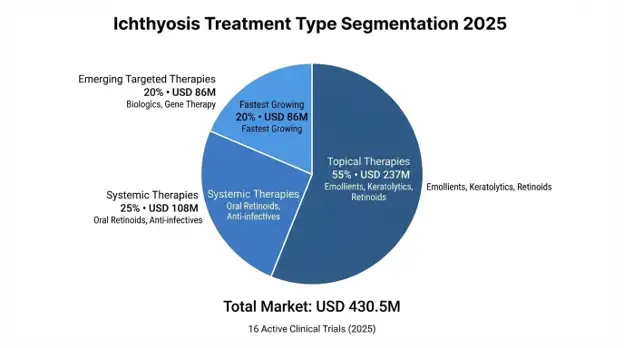
Treatment Type Insights: Topical agents, consisting of emollients, keratolytics, and topical retinoids, continue to be the leading group of drugs with nearly 55% of the market since they form the basis for the current standard of care in all sub-types. Newer targeted therapies, including biologic drugs and gene therapy, hold a minor position of only 20%, although their growth is expected to be the most rapid until 2034.
End-User Insights: Hospitals and dermatology clinics account for the largest market share at around 50%, which can be attributed to the nature of multidisciplinary treatment of ichthyosis, which requires collaboration among dermatologists, ophthalmologists, and geneticists. Home health care, despite accounting for only about 20% of the market share presently, is the fastest-growing segment due to advances in telemedicine and prescriptions of emollients.
The global ichthyosis market is highly fragmented because no one company offers a complete suite of treatment solutions across the different categories of disease or even within treatment modality type. The existing dermatology companies such as LEO Pharma, Galderma, and Almirall occupy a dominant position in the symptomatic topical treatment category, while the specialized biotechnology companies such as Krystal Biotech, Timber Pharmaceuticals, Quoin Pharmaceuticals, and Azitra offer genotype-based treatments via clinical development. Competition is based on the strength of clinical data of the specific genetic category, pipeline depth, rare disease network access, and efficient orphan drug process.
March 2026: Krystal Biotech reported positive Phase II data for its topical gene therapy targeting transglutaminase-1-deficient lamellar ichthyosis, demonstrating restored enzyme expression and reduced scaling severity in treated skin areas.
January 2026: Timber Pharmaceuticals, operating under Ascendis Pharma, announced plans for regulatory submission of its topical isotretinoin candidate following positive pivotal trial results in congenital ichthyosiform erythroderma and lamellar ichthyosis.
November 2025: Quoin Pharmaceuticals advanced its serine protease inhibitor replacement candidate into Phase III evaluation for Netherton syndrome, targeting restoration of LEKTI protease inhibitory function in affected skin.
September 2025: LEO Pharma expanded its prescription emollient portfolio with a ceramide-dominant barrier-repair formulation specifically indicated for moderate to severe ichthyosis, receiving regulatory clearance in the United States and several European markets.
You'll get the sample you asked for by email. Remember to check your spam folder as well. If you have any further questions or require additional assistance, feel free to let us know via-
+1 724 648 0810 +91 976 407 9503 sales@intellectualmarketinsights.com
Intellectual Market Insights Research © 2026. All rights reserved.