Share this link via:

The global immunodeficiencies market size was valued at USD 15.2 billion in 2025 and is projected to reach USD 16.5 billion in 2026, expanding to USD 31.8 billion by 2034, growing at a CAGR of 8.5% during the forecast period (2026-2034).
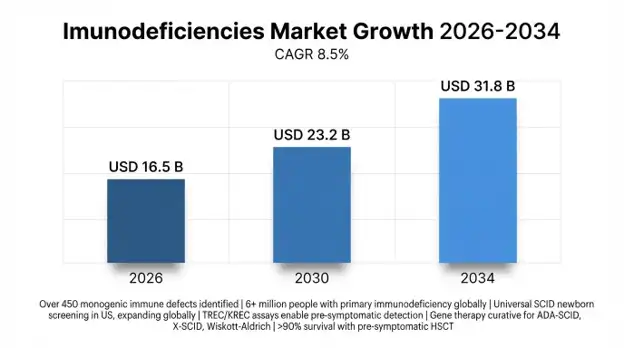
Immunodeficiencies are a heterogeneous and large group of diseases in which various parts of the immune system are unable to function to the same degree as they should, resulting in recurrent, severe, and sometimes unusual infections and an increased risk of autoimmune disorders and, in some cases, cancer. These disorders are grouped into two main categories: primary immunodeficiencies, defined by intrinsic and mostly inherited immune defects, affecting the development of or the function of immune cells, and secondary immunodeficiencies, which are acquired disorders caused by malnutrition, viral infection, malignancy, immunosuppressive drugs, organ transplantation, or the natural immunosenescence that occurs with age.
Over 450 different monogenic defects of the immune system are now known, including defects in antibody production (such as common variable immunodeficiency and X-linked agammaglobulinemia), defects in both cellular and humoral immunity (such as severe combined immunodeficiency), defects in phagocytic pathways (such as chronic granulomatous disease) and defects in the complement pathway. Overall, the burden of disease is significant, as more than six million people are thought to have some form of primary immunodeficiency globally, with only a small proportion of the disease burden being formally diagnosed, and this is historically underrepresented as a consequence of limited clinician awareness of the condition and limited access to specialist immunological and genetic testing outside of major academic centers.
The treatment of immunodeficiencies has progressed significantly from simple antimicrobial supportive therapy to complex immune-restorative treatment. Intravenous or subcutaneous immunoglobulin replacement therapy is the mainstay of treatment in most antibody deficiencies and also an expanding group of secondary hypogammaglobulinemia from the use of B-cell-depleting cancer treatments and chronic immunosuppressive drugs. Gene therapy has demonstrated clinical proof of concept in adenosine deaminase (ADA)-deficient severe combined immunodeficiency (SCID) and is steadily progressing toward other conditions with combined immune defects, such as X-linked severe combined immunodeficiency (SCID), Wiskott-Aldrich syndrome, and chronic granulomatous disease, for which it increasingly becomes a viable option to replace lifelong management of disease with durable, potentially curative genetic correction. While gene therapy has demonstrated clinical proof of concept in adenosine deaminase (ADA)-deficient severe combined immunodeficiency (SCID), it is making steady progress toward other conditions with combined immune defects, including X-linked severe combined immunodeficiency (SCID), Wiskott-Aldrich syndrome, and chronic granulomatous disease, for which it increasingly becomes a viable alternative to lifelong disease management.
The commercial opportunity is not limited to the sale of therapeutic products but also includes a complete diagnostic and care system that includes newborn screening programmers, next-generation sequencing laboratories, specialized home/ambulatory infusion centers, and long-term patient monitoring systems. Long-term demand will be maintained across the forecast period due to the consistent growth of severe combined immunodeficiency screening and, increasingly, secondary immunodeficiencies seen in patients receiving therapy in the oncology, transplantation, and autoimmune settings.
| Report Coverage | Details |
|---|---|
| Base Year | 2025 |
| Base Year Value | USD 15.2 billion |
| Forecast Value | USD 31.8 Billion |
| CAGR | 8.5% |
| Forecast Period | 2025-2034 |
| Historical Data | 2022-2025 |
| Largest Market | North America |
| Fastest Growing Market | Asia Pacific |
| Segments Covered | By Disease Type, Treatment Type, Route of Administration, End-User |
| Region Covered | North America, Europe, Asia Pacific, Middle East & Africa, Latin America |
| Countries Covered | US, Canada, Mexico, UK, Germany, France, Italy, Spain, Netherlands, China, Japan, India, Australia, South Korea, Brazil, Argentina, UAE, Saudi Arabia, South Africa |
| Key Market Playes | Takeda Pharmaceutical, CSL Behring, Grifols, Octapharma, Kedrion Biopharma, Pfizer, Orchard Therapeutics |
Get more details on this report - Request Free Sample
The single biggest catalyst behind market growth has been the fast growth in global newborn screening programs for severe combined immunodeficiency with the T cell receptor excision circle assay, along with the kappa-deleting recombination excision circle test for certain antibody deficiencies. Following almost universal coverage of the entire United States, there have been gradual expansions of these kinds of programs in Europe, Canada, Australia, and even selected countries in Asia to identify pre-symptomatic patients for curative treatment before any infections develop. Next-generation sequencing advancements have also helped to identify genetic disorders and better treatment selection.
The increasing number of cases of hypogammaglobulinemia caused by the use of B-cell-depleting monoclonal antibodies, Bruton’s tyrosine kinase inhibitors, and other biologic therapies in the management of hematologic malignancies and autoimmunity has led to an increase in the number of individuals that require immunoglobulin replacement therapy due to their condition. Other risk factors for the development of hypogammaglobulinemia include intensive chemotherapeutic approaches, corticosteroid therapy, and transplantation.
Immunoglobulin replacement continues to be one of the costliest chronic pharmacologic therapies, with an average price range of USD 30,000–USD 90,000 annually per individual, whereas currently available gene therapies for certain primary immunodeficiencies are priced at several hundreds of thousands of dollars per treatment course. The production of these products is based solely on human plasma pooling, which involves a complicated process of fractionation, viral inactivation, and release procedure taking several months to complete, making supply limited and susceptible to disruption.
The clinical success that has been achieved in gene therapy of adenosine deaminase deficiency associated with severe combined immunodeficiency disease has propelled the development of a portfolio directed towards X-linked severe combined immunodeficiency disease, Wiskott-Aldrich syndrome, chronic granulomatous disease, and leukocyte adhesion deficiency, which provides a more permanent solution to lifelong treatments that lack donors. Additionally, early-stage development of recombinant immunoglobulin preparations produced using cell culture technology instead of plasma has become an extremely strategic venture to reduce dependence on donor plasma.
The landscape for therapy administration is increasingly favoring administration not in a hospital setting but at home through a subcutaneous route with the development of subcutaneous medications that have facilitated subcutaneous delivery due to recombinant hyaluronidase that permits administration of high volumes with less frequency. This approach results in increased stability in pharmacokinetics and reduced systemic side effects as well as decreased treatment burden.
North America: North America is the leading region in the world in the immunodeficiencies market, owing to universal screening of babies for severe combined immunodeficiency at birth, full insurance support for immunoglobulins and treatment modalities, highly developed plasma collection facilities, and extensive academic immunology institutions. The US comprises a vast majority of the value in this market due to the reimbursement systems and incentives for orphan drugs to facilitate advancements in gene and cell therapy.
Asia Pacific: Asia Pacific is the fastest-growing regional market owing to enhanced knowledge among physicians, better diagnostic capabilities, increased health care spending, and more domestic plasma fractionation capabilities. While Japan and South Korea already have relatively developed immunology subspecialties, China and India present significant opportunities for future growth due to large numbers of previously undiagnosed patients and reimbursement coverage in the country.
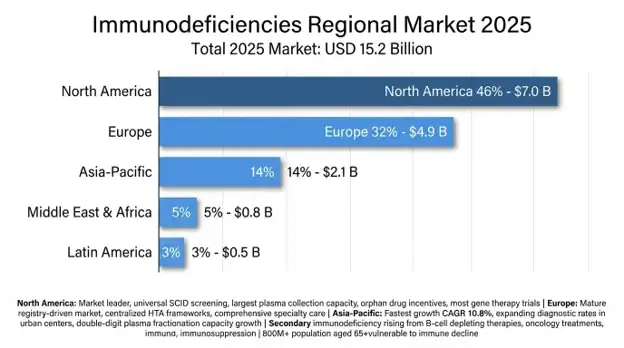
Europe maintains a mature, registry-driven market supported by centralized health technology assessment frameworks, while the Middle East, Africa, and Latin America remain smaller but developing markets characterized by heterogeneous access and expanding participation in international patient registries.
Disease Type Insights: The market value is dominated by primary immunodeficiency due to the requirement of lifelong dependency on immunoglobulin replacement therapy and curative transplantations along with gene therapies in cases such as common variable immunodeficiency, severe combined immunodeficiency, and chronic granulomatous disease. Second, immunodeficiency is also a significant market that is growing due to the increasing number of cases suffering from immune deficiency caused by diseases such as oncology, transplantation, HIV infections, etc.
Treatment Type Insights: The market segment Immunoglobulin Replacement Therapy is the largest therapeutic category, and that is due to it being the existing gold standard for the treatment of various antibody deficiencies. Hematopoietic stem cell transplantation is still used as a primary cure for severe combined immunodeficiency, while gene therapy stands out as the fastest-growing segment due to its efficacy and promising pipeline.
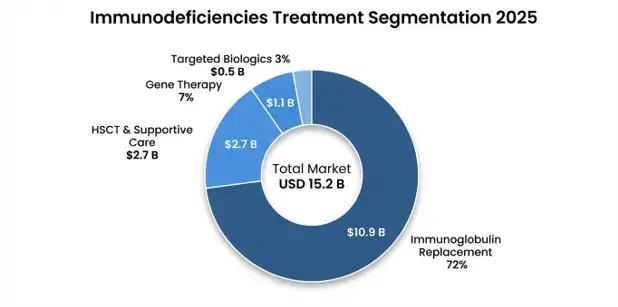
Route of Administration Insights: The intravenous route continues to be commonly employed in cases that need high dosages and when self-medication is not possible, whereas subcutaneous administration continues to gain popularity very quickly owing to convenience at home and pharmacokinetics. The oral route continues to be limited to prophylaxis of antimicrobials.
End-User Insights: The hospitals and specialty clinics account for the biggest end-user category, which includes diagnosis, transplantations, and case management, while home healthcare is the fastest-growing end-user category owing to increasing use of subcutaneous immunoglobulin. The other important end-user categories include the Ambulatory Infusion Centers and the Academic & Research Institutes.
The global immunodeficiency market continues to exhibit moderate to high levels of market concentration where only a few big plasma fractionation companies dominate the market share in terms of immunoglobulin production capabilities through donor relationships, regulation experience, and established connections with immunology experts. Differentiation in the market revolves around product quality, reliability of supply, and convenience of subcutaneous formulations. The gene and cell therapy business is highly fragmented, where biotechnology companies compete based on efficacy and longevity.
You'll get the sample you asked for by email. Remember to check your spam folder as well. If you have any further questions or require additional assistance, feel free to let us know via-
+1 724 648 0810 +91 976 407 9503 sales@intellectualmarketinsights.com
Intellectual Market Insights Research © 2026. All rights reserved.