Share this link via:

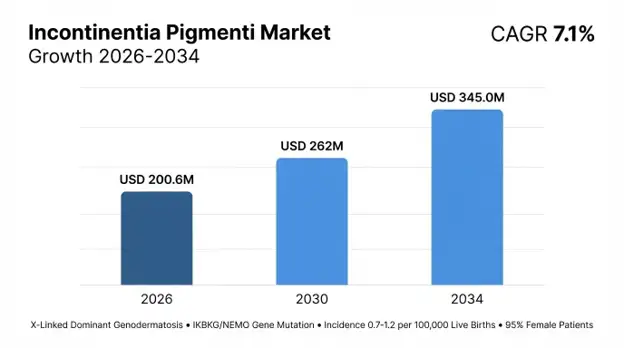
The global incontinentia pigmenti market was valued at USD 187.3 million in 2025 and is expected to reach USD 200.6 million in 2026, expanding further to USD 345.0 million by 2034, registering a CAGR of 7.1% during the forecast period (2026-2034).
Incontinentia pigmenti (IP), known as Bloch-Sulzberger syndrome, is an uncommon form of X-linked dominant genodermatosis characterized by loss-of-function mutations in the IKBKG gene encoding for NEMO (NF-kB essential modulator), a component of the IκB kinase complex responsible for regulating activation of the NF-kB pathway of inflammatory signaling. The dysfunction of the NEMO protein renders keratinocytes and other cell types susceptible to TNF-a-mediated apoptosis and results in the typical inflammatory skin lesions and associated multisystem tissue damage seen in IP. As the disease-causing gene is located on the X chromosome, the disease is invariably fatal for the male embryos in utero, and over 95% of affected individuals are females; the rare surviving males have either an extra X chromosome (47, XXY) or mosaic mutations of the IKBKG gene.
The estimated incidence of IP is around 0.7 to 1.2 in 100,000 live births, equating to a global prevalence of 45,000 to 65,000 people, with potential for an under-recognition among adolescents and adults because of a tendency for their characteristic dermatologic features to fade, meaning actual prevalence is more likely to be much higher than current registries. The disease presents itself clinically in four consecutive stages based on cutaneous presentation: vesiculobullous stage, which occurs soon after birth; verrucous stage, characterized by wart-like lesions appearing over the next weeks to months; hyperpigmented stage with whorls and streaks of brownish-grey pigmentation occurring throughout childhood; and finally, hypopigmented and atrophic stage, which may become visible in adolescents and remains visible in many patients well into their adult lives.
Apart from the skin, incontinentia pigmenti is essentially a multisystem disorder of the neuro-ophthalmic systems, needing continuous management over the lifespan. Neurological issues like seizures, motor delay, microcephaly, and even ischemic stroke-like events in some cases, involving the central nervous system, have been recorded in about 30-40% of patients and usually appear during the first weeks after birth, when aggressive neurological monitoring will considerably affect future development in both cognitive and motor aspects. Ocular abnormalities, seen in around 20-35% of the patients, involve peripheral non-perfusion of the retina, pathological neovascularization, and tractional detachment of the retina, like retinopathy of prematurity; thus, regular eye examinations will be crucial for maintaining vision. The dental abnormalities, which affect about 80% of patients, include delayed eruption, hypodontia, and conical teeth, while some patients have nail dystrophy, alopecia, and limb abnormalities.
Commercially, the market for incontinentia pigmenti does not currently have any approved disease-modifying or curing pharmaceutical treatments; instead, it includes a diverse range of diagnostic services (genetic and clinical), off-label symptomatic treatments (anti-epileptic drugs, anti-inflammatory and anti-microbial topical treatments, and ophthalmological anti-VEGF and laser therapies), and a coordinated team of specialists across multiple fields (dermatologists, neurologists, ophthalmologists, geneticists, and dentists). The market is slowly evolving from a fragmented and service-oriented approach to a more organized therapy segment with initial interest generated by NF-κB pathway modulation and gene correction technologies addressing the IKBKG gene abnormality.
| Report Coverage | Details |
|---|---|
| Base Year | 2025 |
| Base Year Value | USD 187.3 Million |
| Forecast Value | USD 345.0 Million |
| CAGR | 7.1% |
| Forecast Period | 2025-2034 |
| Historical Data | 2022-2025 |
| Largest Market | North America |
| Fastest Growing Market | Asia Pacific |
| Segments Covered | By Treatment Type, Disease Manifestation, Route of Administration, Diagnostic Approach, End-User |
| Region Covered | North America, Europe, Asia Pacific, Middle East & Africa, Latin America |
| Countries Covered | US, Canada, Mexico, UK, Germany, France, Italy, Spain, China, Japan, India, Australia, South Korea, Brazil, UAE, Saudi Arabia, South Africa |
| Key Market Playes | Novartis AG, Pfizer Inc., Sanofi, UCB S.A., Regeneron Pharmaceuticals, Ultragenyx Pharmaceutical, Chiesi Farmaceutici |
Get more details on this report - Request Free Sample
Broader use of next-generation sequencing panels and exome sequencing in the practice of pediatric neurology and dermatology has revolutionized the accuracy of diagnosis in incontinentia pigmenti through early detection of the IKBKG mutation and subsequent treatment with a multidisciplinary approach. The decreasing costs of sequencing have made genetic testing affordable within more healthcare facilities, and therefore, a wider pool of patients who are able to receive specialist care as well as a larger group that can be used in future research has been identified. Reproductive counseling will become increasingly common due to increased family testing of mothers and siblings of affected babies.
Historically, patients tended to be treated mainly by dermatologists who concentrated on the cutaneous manifestations, with neurological and ocular complications being realized only after permanent damage to their nervous system or eyesight. Today, systematic clinical documentation and consensus statements suggest that there should be regular neurological and ophthalmic investigations of all diagnosed patients, which include electroencephalography and imaging along with retinal investigations within the first few years of life. From the reactionary to proactive investigation approach, there has been an increase in demand for diagnostic and procedural procedures at the time when treatment can be done effectively.
The first major limitation to expanding markets lies in the tiny number of patients spread across vast geographical areas. Most countries identify no more than a few cases each year. This limits the feasibility of large-scale clinical trials and economic modeling of the potential high-cost treatment. Incomplete registers in many regions make the issue even more difficult to address.
Despite several scientific studies focused on the disease, there is still no disease-specific, FDA-approved medication to treat IP. The current treatments include general drugs such as anticonvulsants, corticosteroids, antibiotics, and ophthalmic preparations, which lack considerable pricing capability. The sales of products in the therapeutic group are expected to be restrained without any specialized drug approval and corresponding reimbursement.
IP is caused by a single-gene mutation, and there exists a characterized defect in the IKBKG/NEMO protein, making it a strong contender for gene replacement or modulation treatment using vectors like AAVs or lentiviruses targeted at skin, retinal, or neuronal cells or NF-κB pathway modulators such as small molecules that can reduce the inflammatory cascade responsible for the early-onset neurological and ophthalmological symptoms of IP. Since a significant number of IP cases suffer from devastating consequences of the disease, insurers may be willing to shell out a premium cost for a one-time treatment.
Retinal diseases associated with IP have similarities in their underlying mechanisms with retinopathy of prematurity. The potential is now increasing to develop screening strategies for neonatal retinopathy, along with the use of anti-VEGF therapy and laser photocoagulation, which have been proven to work in related disorders.
The trend in the field is now moving towards evidence-based treatment practices using longitudinal cohort studies and collaborative research networks, which create standardized phenotyping procedures and outcome assessment measures to make the interventional trials possible and to provide control data from the past for single-arm rare disease trials.
Many high-income countries are consolidating expertise in regional centers coordinating dermatology, neurology, ophthalmology, and genetics under one roof, improving diagnosis rates, standardizing care, and creating pivotal nodes for future clinical trial recruitment.
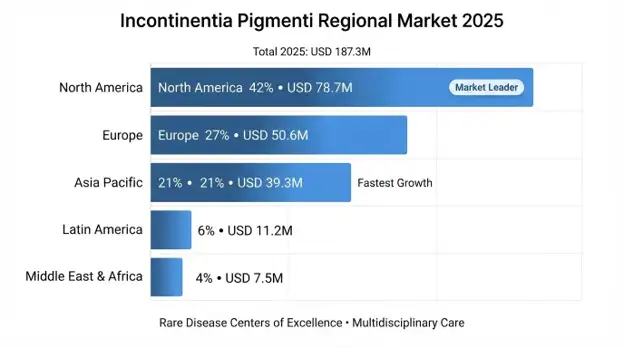
The North American region dominates the most significant market share, estimated to be worth about USD 78.7 million in 2025, owing to rare disease expertise among academic institutions and the presence of orphan drug regulations as well as insurance coverage to support treatment from various specialists. The US dominates the regional value, driven by pediatric rare disease research initiatives and patient advocacy structures.
The European market is the second largest market, accounting for an approximate size of $50.6 million in 2025. It will benefit from country-based plans for rare diseases, referral networks of rare skin and neurological diseases, and healthcare systems that emphasize early diagnosis and follow-up. Specialized centers can be found in Germany, France, Italy, and the United Kingdom.
Asia Pacific is considered the fastest-growing region, which is worth approximately USD 39.3 million in 2025 and is expected to witness a compound annual growth rate that surpasses the average growth rate on a global level from 2025 to 2034, mainly due to the availability of molecular diagnostics in Japan, China, South Korea, and Australia; an increase in awareness about rare diseases among pediatric specialists; and growing insurance coverage for complex pediatric diseases.
Middle East & Africa and Latin America account for an estimated USD 18.7 million in 2025, owing to the presence of limited diagnostic facilities and specialists; however, gradual development in neonatal intensive care units, pediatric neurology, and ophthalmology would help achieve steady growth.
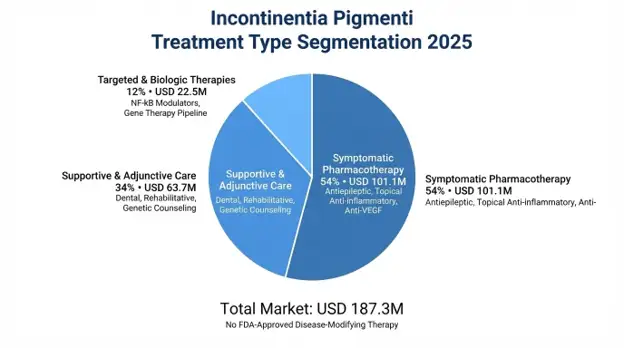
Treatment Type Insights: Symptomatic pharmacotherapy and supportive & adjunctive care together dominate the market, collectively accounting for roughly 88% of 2025 revenue, given the current absence of disease-specific therapy. Targeted & biologic therapies, though representing a small base of approximately USD 22.5 million in 2025, constitute the fastest-growing segment as early-stage NF-κB modulators and gene-therapy candidates progress through preclinical and exploratory clinical evaluation.
Disease Manifestation Insights: Neurological management represents the highest value share at about 34% (USD 63.7 million in 2025), considering the expenses on seizures, neuroimaging, and developmental monitoring, whereas ophthalmic management comes next at about 27% (USD 50.6 million), considering the expenses on retinal screening and lasers/anti-VEGF treatments. Cutaneous management holds third place at 24% (USD 44.9 million), despite nearly universal skin involvement, because of relatively low cost per episode, and dental & skeletal management is the smallest value share at 15% (USD 28.1 million).
End-User Insights: The Hospitals & Clinics segment takes up the position of leader among end-user segments, accounting for around a 50% share (USD 93.7 million in 2025) and includes pediatric academic hospitals and departments of neurology and ophthalmology dealing with acute and specialized care. The Specialty Dermatology & Rare Disease Centers occupy second place with a 30% share (USD 56.2 million), while Pediatric & Neonatal ICUs take up a 14% share (USD 26.2 million).
The IP market is still fragmented due to the lack of an approved drug and due to the use of repurposed drugs in dermatology, neurology, and ophthalmology for treating this disease. Competitive activity in this market is observed amongst rare-diseases-focused biopharmaceutical companies working on modulation of the NF-κB pathway, genetic diagnostics firms developing gene panels for neurocutaneous diseases, and traditional pharmaceutical companies providing anticonvulsants, topical anti-inflammatories, and anti-VEGF drugs used in ophthalmology off-label for the treatment of patients suffering from IP.
March 2026: A rare-disease-focused research consortium announced the initiation of a multi-center natural history study to characterize long-term neurological and ophthalmic outcomes in incontinentia pigmenti, intended to support future interventional trial design.
January 2026: Regulatory authorities in the United States and European Union granted orphan drug designation to an early-stage NF-κB pathway modulator program with potential relevance to IKBKG-associated inflammatory pathology.
November 2025: Pediatric ophthalmology groups in Europe and North America published updated consensus guidelines recommending systematic neonatal retinal screening and early laser photocoagulation protocols for infants diagnosed with incontinentia pigmenti.
September 2025: Genetic diagnostics providers expanded commercial availability of comprehensive neurocutaneous disorder gene panels incorporating IKBKG mutation analysis, improving diagnostic turnaround time in specialized pediatric centers.
You'll get the sample you asked for by email. Remember to check your spam folder as well. If you have any further questions or require additional assistance, feel free to let us know via-
+1 724 648 0810 +91 976 407 9503 sales@intellectualmarketinsights.com
Intellectual Market Insights Research © 2026. All rights reserved.