Share this link via:

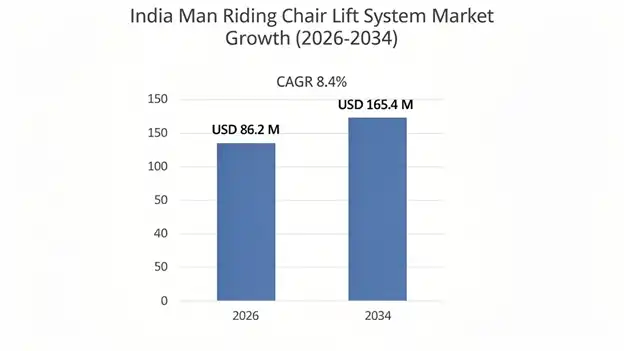
The India man riding chair lift system market was valued at USD 78.5 million in 2025 and is projected to reach USD 86.2 million in 2026, expanding to USD 165.4 million by 2034, growing at a CAGR of 8.4% during the forecast period (2026-2034).
Man riding chair lift systems offer complex systems of mechanized means of transport that allow for safe and effective conveyance of people through tough terrains, steep gradients, and inaccessible terrain where regular modes of transport cannot be used because of being impractical, dangerous, and/or costly. Within the framework of India, these systems serve two primary application categories of users: workers' transport in industries such as mines, and transportation of passengers for leisure and tourism purposes.
In India’s vast mining industry, the man riding chair lifts serve the basic needs of underground coal mines, open cast mining activities, and metalliferous mining operations wherein miners must cover long distances along inclines to access productive areas within the mines. DGMS rules require certain safety procedures for transporting miners in mining locations, thus increasing the demand for specialized man riding systems with redundant brakes, overspeed controllers, emergency stops, and monitoring equipment. Such equipment can cut down the travel time for miners from 45-90 minutes, usually spent walking, to 8-15 minutes by using mechanical assistance, thereby boosting the OMS.
Modern mining uses robust fixed-grip and removable-grip setups, that are basically engineered to keep running for long stretches in brutal underground conditions. They come with anti-corrosion parts, dust sealed electrical systems, and maintenance routines that match the legal inspection obligations or whatever is required by statute. In this context, Coal India Limited (CIL) units, such as Singareni Collieries Company Limited (SCCL), along with big private operators including Adani Mining, Vedanta and Hindalco are gradually rolling out these arrangements too. This is tied to mine mechanization plans, and to safety enhancement drives, especially in deep underground zones, where moving people manually become awkward and physically demanding, plus it tends to swallow time.
The tourism segment involves installing chair lifts in the hill stations, places of pilgrimage, ski resorts, and adventure tourism locations in India’s mountainous terrain. The sector is witnessing great traction owing to initiatives of the Government of India under the Parvatmala National Ropeway Development Program, which recognizes aerial conveyance as viable alternate means of transportation in mountainous areas where construction of roads can be environmentally harmful or financially unsustainable.
The scheme includes 58 projects in different states with cumulative investment running into over INR 2,500 crore. Important places of pilgrimage such as Vaishno Devi in J&K, Kedarnath and Badrinath in Uttarakhand, and other Himalayan temple complexes have a constant flow of visitors round the year and need personnel transport systems capable of handling the elderly pilgrims as well as those with physical disabilities. The Vaishno Devi ropeway system carries over two and a half million pilgrims annually.
Modern man riding chair lift systems in India is equipped with automation through programmable logic controller, load measurement facilities, sensors to measure weather conditions, and even remote diagnostics in accordance with international standards of safety along with local regulatory standards of India. The lift systems have various safety features such as mechanical and hydraulic brakes for emergencies, anti-rollback systems, speed limiters, and communication system for constant communication between operators and passengers.
The regulatory regime in question is based on guidelines issued by DGMS for mining purposes, as well as guidelines from the state tourism departments along with Bureau of Indian Standards. Such a regime ensures not only safety but also standardization of the industry, especially since insurance companies and legal liabilities require electronic monitoring and regular maintenance documentation.
| Report Coverage | Details |
|---|---|
| Base Year | 2025 |
| Base Year Value | USD 78.5 Million |
| Forecast Value | USD 165.4 Million |
| CAGR | 8.4% |
| Forecast Period | 2025-2034 |
| Historical Data | 2022-2025 |
| Largest Market | Eastern India |
| Fastest Growing Market | Northern India |
| Segments Covered | By System Type, Application, Capacity, Drive System, End-User |
| Countries Covered | Eastern India, Western India, Northern India, Southern India, Central India |
| Key Market Playes | LEITNER-Poma India, Doppelmayr India, Becker Mining Systems, Damodar Ropeways, Conveyor & Ropeway Services |
Get more details on this report - Request Free Sample
The key structural growth factor is the growing depth and mechanization of Indian mining operations in the coal and metal mining industries, whereby deeper levels of mining and greater distances of haulage have made it economically feasible to use mechanized transport for personnel movement. Coal India Limited, which produces an estimated 85% of all coal mined in India, has started mechanizing its 21 subsidiaries, considering the development of man riding as one of the necessary measures for improving efficiency and ensuring safety at underground longwall and continuous miner operations.
Man riding technology, which implies the mechanization of mining practices, demands workers to access ever-deeper working faces and locations, thus making pedestrian transport of personnel uneconomical and unfeasible for operations. Indian underground coal mines located in Jharkhand, Odisha, and Chhattisgarh reach depths more than 300-400 meters, implying haulage distances of 2-4 kilometers from the pit bottom to the mining face. Man riding chair lifts have been shown to increase efficiency of movement by 70-80% while also preventing worker fatigue on working faces.
Key Performance Metrics:
The Parvatmala National Ropeway Development Program by the Government of India is a pioneering policy intervention that raises aerial transport to an essential infrastructure segment, thus generating significant structured demand for chairlifts in hilly terrain. This program works on a model combining annuities and Public Private Partnerships (PPP) where risks of private investments are mitigated with guaranteed income to governments, thereby bringing international and domestic technology firms to develop manufacturing and service segments in India.
Projects in Phase I include 58 projects in 12 states covering a total distance of 250 kilometers with total investment estimated to be about INR 2,500 crore. The program focuses on projects where the use-case includes both transportation and tourism, thus generating sustainable revenues through the entire year, making them more viable than purely tourism-based ropeways. Projects in Uttarakhand, Himachal Pradesh, and Jammu & Kashmir are progressing towards detailed project reports and environmental clearances, with commercial services slated to commence by 2027-2028.
Program Impact Indicators:
India’s domestic tourism industry exhibits strong recovery post-pandemic with 1.73 billion domestic tourist arrivals recorded in 2024, marking a 14.2% increase from the previous year. The hill and mountain destinations account for around 18% of India’s domestic tourism, thus providing significant demand for accessibility facilities allowing the aged, handicapped, and those seeking comfort to visit the locations without the requirement for rigorous trekking.
Pilgrimage is one of the major segments exhibiting strong demand, especially considering that the demand remains resilient in relation to any adverse economic climate as pilgrims would not mind visiting temples irrespective of their financial status. The demand is supported by full occupancy in major pilgrimage destinations including a record high number of visitors to Vaishno Devi totaling 9.5 million tourists in 2024, alongside Char Dham Yatra in Uttarakhand with 5.61 million tourists.
Tourism Growth Indicators:
The major restriction impeding rapid growth of the market is the huge capital outlay involved in installing the lift chair system, including acquisition of equipment, civil construction work, terminals building work, electricity wiring and approval procedures amounting to around INR 15-80 crores depending upon the length of the system, number of persons that the system can carry at one time and the topography of the area. In case of mining operations, there are extra charges related to underground installation, ventilation system and special safety features which could raise the project cost by up to 30-40% relative to ground installation.
Project gestation periods could run from 24-48 months from the point of sanction until completion, which is due to the lengthy process entailed in securing approvals from various regulatory bodies, including state mining departments, forest departments, environmental boards, electrical inspectorates etc.
There is a growing opportunity of using chair lifts in urban public transport in the case of hilly cities where there are limitations in road transport due to the geographic features of the place and the environment. The cities like Shimla, Mussoorie, Darjeeling, Gangtok, and Shillong can become good candidates for the implementation of urban aerial transport systems, which would facilitate daily commutation transport between the hillsides and business centers on economic grounds throughout the year.
In addition, there can be opportunities to integrate such urban aerial systems with other modes of transport through smart cards and other facilities. The success of the Gangtok Ropeway in Sikkim is evidence of the commercial viability of urban aerial transport in India.
Chair lift installations increasingly incorporate Internet of Things (IoT) sensors and predictive maintenance technology capable of tracking important elements such as the tension of the haul rope, motor operation, brake system operation, and environmental conditions in real time. The information gathered from these sensors is then fed into a control center that will be able to detect any problems that may occur and avoid failures in the process.
Insurance firms and government agencies are requiring electronic surveillance technology as part of their criteria for coverage and operations, making this control and diagnostic technology mandatory.
The Eastern region enjoys the highest regional market share, estimated at 42% of the total market valuation in 2025, mainly due to the presence of major mining enterprises such as coal and metal mining enterprises in Jharkhand, Odisha, Chhattisgarh, and West Bengal. The region is home to some of the major subsidiaries of Coal India Limited, namely Southeastern Coalfields Limited (SECL), Mahanadi Coalfields Limited (MCL), and Eastern Coalfields Limited (ECL), whose total contribution to India’s total coal production is more than 60%, forming the main institutional consumer base for the mining man riding systems.
Some of the major private sector mining enterprises like Tata Steel, JSW Steel, Vedanta, and Hindalco have major mining assets in the region. This, coupled with the presence of adequate mining machinery and support facilities required for the installation of chair lift systems, ensures a stable demand for personnel transporters.
Northern India is the fastest-growing market in terms of CAGR of 11.2% up until 2034 due to tourism infrastructure development concentrated around the states of Himachal Pradesh, Uttarakhand, and Jammu & Kashmir. It can be explained by continuous tourism activities in summer for hill tourism, skiing in winter, and pilgrimages all year round, creating a constant flow of income for companies operating chair lifts.
The leader in regional development is Himachal Pradesh, with more than 35 chair lift projects already implemented and 12 new projects being developed. The government of Himachal Pradesh created the Ropeway and Rapid Transport System Development Corporation to facilitate further development of the industry in the state.
Fixed Grip Chair Lifts have captured the largest market share accounting for 58%, with revenues of USD 45.5 million by 2025, thereby constituting the dominant technology adopted in the mining sector and for low-budget tourism purposes. This technology provides reduced capital expenditure, simple mechanical construction, and operational experience of Indian lift operators. It is ideal for places that receive less than 2,000-3,000 passengers per day as well as mining activities that require efficient transportation of people.
The market size for Detachable Chair Lift Systems stands at USD 27.5 million by 2025 with 35% market share and will grow at 10.8% CAGR till 2034. This technology finds applications in busy pilgrimage destinations, high-end ski resorts, and city transit systems owing to its superior performance characteristics.
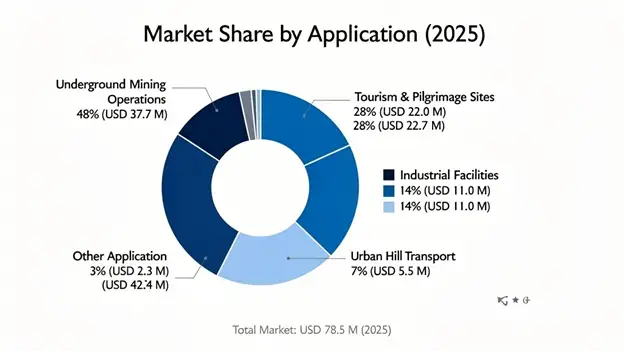
The Underground Mining Operations is the largest segment, accounting for 38% market share. It provides stable demand due to the need to consider efficiency in operation and ensure safety as opposed to economic gains from tourism activities. The application also provides countercyclical stability in revenue streams whenever the tourism industry faces difficulties.
The Tourism & Pilgrimage Sites, on the other hand, account for 34% market share with 12.1% CAGR between 2024 and 2034. The Tourism & Pilgrimage Sites are currently the fastest growing segment in the ski lift market. They include applications related to hill stations viewpoint access and pilgrimages.
Coal Mining Companies form the largest user category accounting for 31% of market share due to the importance of Coal India Limited subsidiaries and other major coal mining companies in satisfying industrial demands. Government Departments & Tourism Boards contribute 28% of market share as it includes various state governments, shrine boards, and government organizations that procure chair lifts.
The Indian market for chair lifts in the man riding chair lift system is moderately concentrated, with international technology leaders being at the top for high-end projects due to their engineering prowess, safety ratings from around the world, and service facilities, while domestic engineering organizations compete efficiently with regards to mining and tourist purposes.
LEITNER-Poma India, and Doppelmayr India together hold a significant 45-50% of market share for high-end projects. On the other hand, Indian organizations such as Damodar Ropeways and Infra Ltd., Conveyor & Ropeway Services Pvt. Ltd., along with regional heavy engineering companies have been able to create a strong competitive edge in the form of good government relations and quick project implementation due to cost efficiency.
March 2026: Tenders were issued by Coal India Limited for man riding chair lift systems for 12 underground mines in Jharkhand and Odisha with total project cost of INR 145 crore, being the largest procurement of personnel transport systems in the company’s history by far.
February 2026: The Ministry of Road Transport & Highways approved detailed project reports for 7 Parvatmala Phase I projects in Uttarakhand and Himachal Pradesh with total sanctioned cost of INR 485 crore, being the first batch of central government aerial mobility projects to achieve financial closure.
January 2026: LEITNER-Poma India has commissioned a new 8-seated detachable chair lift system for the Auli ski resort in Uttarakhand, enhancing its passenger lifting capacity from 1,200 per hour to 2,800 passengers per hour while reducing its average waiting time from 25 minutes to just 6 minutes during peak season.
December 2025: Damodar Ropeways & Infra Ltd. won a large order for designing, supplying, and installing the personnel transport systems at three SECL underground mines in Chhattisgarh, having a total order value of INR 67 crore and being the company’s largest mining sector order till date.
November 2025: The Himachal Pradesh Ropeway Corporation issued expressions of interest for 4 new chair lifts with an estimated cost of INR 280 crore under the tourism infrastructure development scheme of the state government.
List of Key Players in India Man Riding Chair Lift System Market
India Man Riding Chair Lift System Market Segments
By System Type:
By Application:
By Capacity:
By Drive System:
By End-User:
By Region:
You'll get the sample you asked for by email. Remember to check your spam folder as well. If you have any further questions or require additional assistance, feel free to let us know via-
+1 724 648 0810 +91 976 407 9503 sales@intellectualmarketinsights.com
19 May 2026
Intellectual Market Insights Research © 2026. All rights reserved.